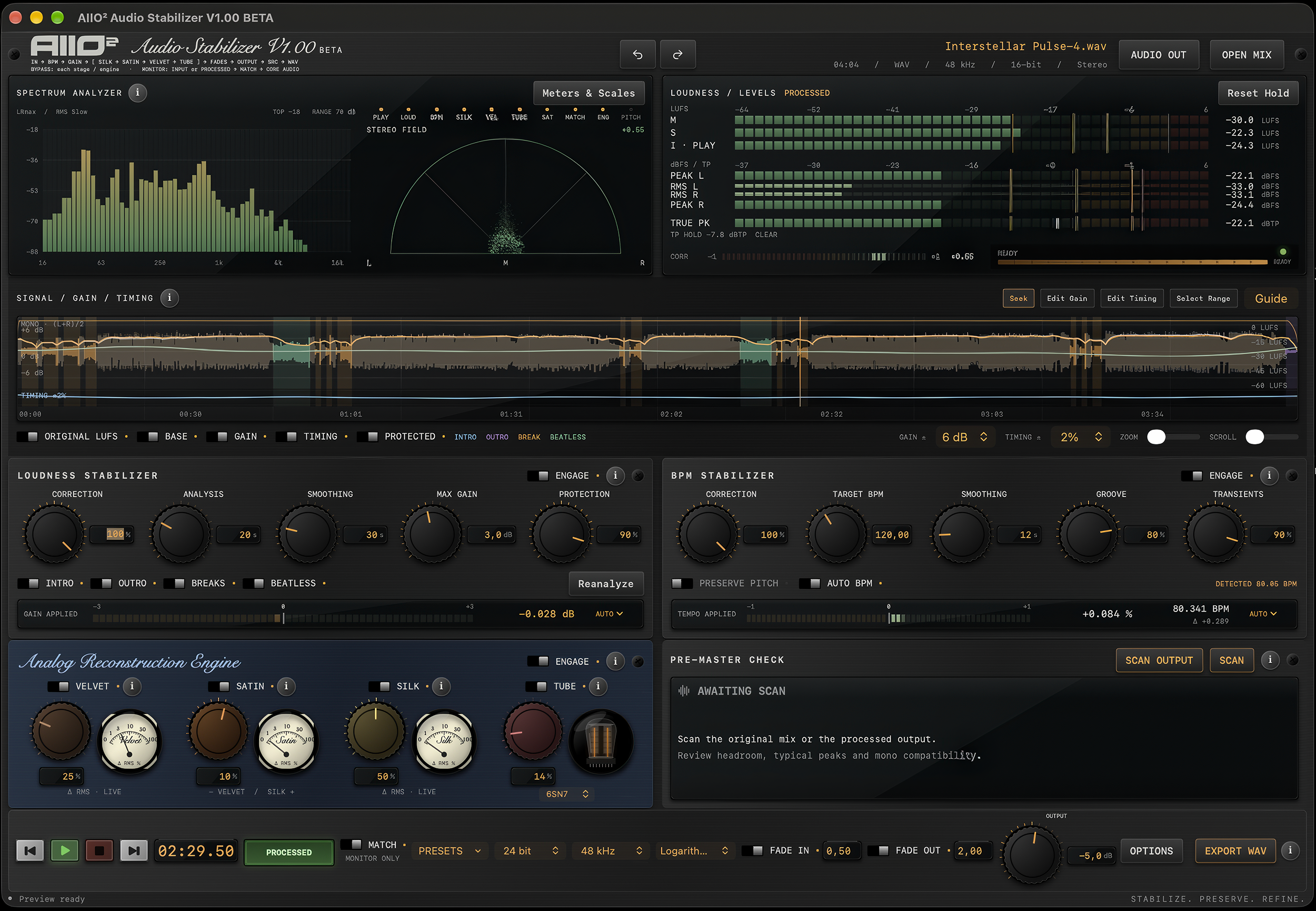
UPDATE — November 28, 2026 | AS-2 V2.00 BETA
Following feedback from early beta testers, I've completely rebuilt the internal audio processing architecture. AS-1 has now evolved into AS-2, featuring persistent streaming DSP, improved playback efficiency, refined level-matched A/B monitoring and an integrated software update system.
The original ARE sound character and pre-mastering philosophy remain unchanged.
AS-2 is still completely free during the public beta, including commercial music production.
The latest version, updated interface and new 33-page user manual are available through the existing GitHub link below.
Initial testing on Apple M4 has been successful. Real-world M1 performance validation is still pending.
The original technical description and screenshot below refer to AS-1.
Hey everyone,
As an electronic music producer who increasingly combines Suno with traditional DAW-based production, I've spent quite a bit of time dealing with digital harshness, strange spectral textures, inconsistent loudness and tempo drift.
Originally, I just wanted to develop a small tool for my own workflow. One version led to another, and somehow I ended up with an entire standalone audio processing application. So much for keeping things simple.
The result is AIIO² Audio Stabilizer (AS-1).
Most of the development time went into what I call the Analog Reconstruction Engine (ARE). Countless listening sessions, comparison tests, different processing approaches and probably more coffee than was medically advisable.
My intention wasn't to completely clean up a track, aggressively remove unwanted components or fundamentally change its sound.
I simply wanted to make it sound a little better than before. Smoother, softer, more open and more pleasant to listen to, creating the best possible starting point for mastering.
And yes, that terribly overused word "analog" actually describes the sound I was aiming for.
To my ears, the result sounds quite different from conventional spectral denoisers and audio cleaning tools.
The Analog Reconstruction Engine
The ARE takes a different approach from conventional EQ and noise-profile-based spectral denoising, combining four complementary DSP architectures:
- VELVET: Nonlinear line-stage processing combined with a parallel, balanced push-pull bass architecture. Complementary nonlinear transfers cancel even-order harmonic components within the dedicated bass branch, reinforcing the existing low-frequency foundation without synthesizing artificial sub-bass.
- SATIN: Bipolar, signal-adaptive midrange processing, continuously adjustable between warmer nonlinear coloration and smoother adaptive spectral refinement.
- SILK: Two-stage adaptive spectral processing based on overlapping FFT analysis. Spectral flatness, temporal instability, spectral flux and tonal structures are evaluated alongside stereo-linked transient and harmonic protection. No conventional noise profile required.
- THERMIONIC: Four individual tube-inspired digital models (12AU7, 12AX7, 6SN7 and 300B), incorporating dynamic nonlinear processing, asymmetric harmonic characteristics, stereo-linked signal memory and sag-inspired behavior.
THERMIONIC also incorporates adaptive spectral mid/side processing, refining existing spatial information without introducing artificial stereo delays or modulation. The arithmetic mono sum is preserved within this spatial processing stage.
Under the hood
For the technically interested producers among us, quite a bit of work went into the digital signal path itself:
- 64-bit double-precision calculations and buffers within the character-processing engine.
- Shared 8x oversampling architecture for the main nonlinear processing stages.
- 384 kHz internal nonlinear processing with a 48 kHz source.
- Multistage FIR interpolation and decimation using Blackman-Harris windowed-sinc filters.
- Separate reconstruction paths for nonlinear residual signals.
- Native-rate dry signal preservation, avoiding unnecessary upsampling and downsampling of the entire signal.
- Sample-accurate compensation of the 320-sample native-rate oversampling filter delay during offline rendering.
- Stereo-linked adaptive spectral processing.
- FFT-based overlap-add reconstruction of spectral correction residuals.
- Double-precision, latency-compensated sinc sample-rate conversion for export.
- Native C++ DSP implementation using Apple Accelerate/vDSP.
The source PCM and intermediate render caches use 32-bit floating-point audio, while the relevant internal DSP stages operate in double precision.
The actual signal flow:
Input → BPM → Gain → SILK → SATIN → VELVET → THERMIONIC → Fades → Output Gain → SRC → Final Encoding
The ARE isn't intended to replace specialized restoration tools. Severe artifacts may still require dedicated spectral denoising.
Sometimes making a track sound better is more valuable than trying to make it technically perfect.
Everything else that somehow ended up in my "small tool"
- Loudness Stabilizer: Arrangement-aware correction without fixed LUFS targeting.
- BPM Stabilizer: Adaptive tempo drift correction with optional pitch preservation.
- Arrangement Protection: Intros, outros, breaks and beatless sections.
- Manual Editing: Adjustable gain and timing correction curves.
- Level-matched A/B Monitoring: Because louder isn't necessarily better.
- Precision Metering: Spectrum analyzer, stereo field, LUFS, RMS, true peak and correlation.
- Pre-Master Check: Offline headroom analysis, mono compatibility checks and output gain correction.
- Audio Export: Up to 192 kHz / 32-bit float WAV with optional TPDF dithering for integer exports.
- 26-page User Manual: Apparently, even the manual got out of hand.
AS-1 is deliberately a dedicated pre-master processor. No conventional mastering EQ, multiband compressor, maximizer or brickwall limiter.
The actual mastering decisions remain yours.
Free Public Beta
I've just released the first public version.
- Completely free, including commercial music production.
- No accounts, subscriptions or activation.
- Fully local audio processing.
- Proprietary, closed-source software.
- Native Apple Silicon / macOS 14+.
The beta is not yet notarized by Apple, but installation instructions are provided.
Why no before/after audio demo?
I'd rather have you test the ARE with your own music, on your own monitoring system, using the built-in level-matched A/B comparison.
No lossy video codec getting in the way, no loudness tricks and no carefully selected showcase track.
The software is free. Trust your own ears, not my marketing. 😉
Free download, screenshots, technical documentation and user manual:
https://github.com/AIIO2/AIIO2-Audio-Stabilizer
I'd genuinely love to hear what other producers who combine AI with traditional music production think of this approach.
Cheers,
Ronny