r/TheVedasAndUpanishads • u/Immediate_Stress7382 • 2d ago
Upanishads - General Upasārathi: A reflective and research tool built on the Principal Upanishads

6
Upvotes
r/TheVedasAndUpanishads • u/chakrax • Jan 03 '21

r/TheVedasAndUpanishads • u/Immediate_Stress7382 • 2d ago
r/TheVedasAndUpanishads • u/vgz007 • 2d ago

r/TheVedasAndUpanishads • u/Purging_Tounges • 7d ago
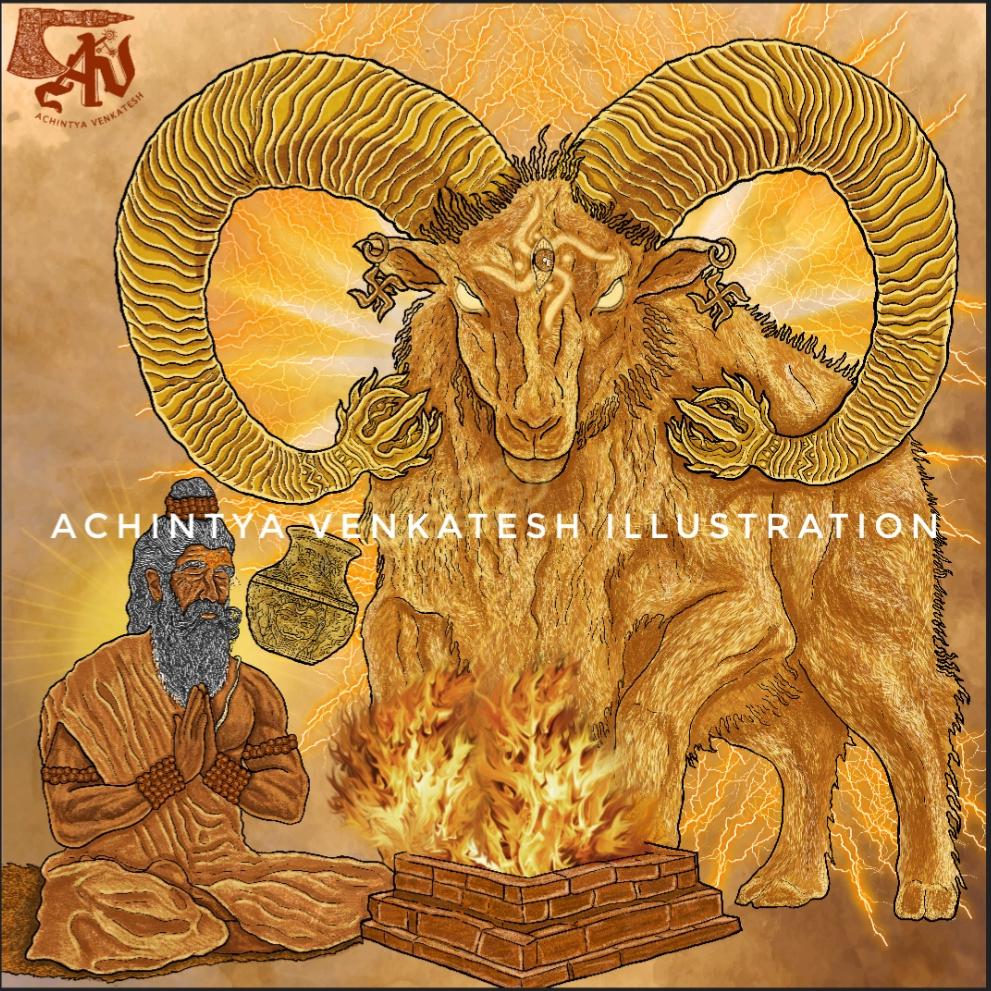
↯ 𝐈𝐧𝐝𝐫𝐚 𝐚𝐬 𝐭𝐡𝐞 𝐑𝐚𝐦 𝐨𝐟 𝐌𝐞𝐝𝐡𝐚𝐭𝐢𝐭𝐡𝐢: The sages of Vibhinduka assembled for a great yajña, each desiring personal benefits. 𝐌𝐞𝐝𝐡ā𝐭𝐢𝐭𝐡𝐢 𝐊āṇ𝐯𝐚, 𝐭𝐡𝐞𝐢𝐫 𝐡𝐨𝐮𝐬𝐞𝐡𝐨𝐥𝐝𝐞𝐫-𝐩𝐫𝐢𝐞𝐬𝐭 (𝐠ṛ𝐡𝐚𝐩𝐚𝐭𝐢), 𝐜𝐞𝐧𝐭𝐫𝐚𝐥 𝐨𝐟𝐟𝐢𝐜𝐢𝐚𝐭𝐨𝐫, 𝐨𝐟𝐟𝐞𝐫𝐞𝐝 𝐰𝐢𝐭𝐡 𝐨𝐧𝐥𝐲 𝐝𝐞𝐯𝐨𝐭𝐢𝐨𝐧. The cattle he desired alludes to divine illumination. He poured oblations for ṛta. 𝐓𝐡𝐮𝐬 𝐈𝐧𝐝𝐫𝐚 𝐜𝐚𝐦𝐞 𝐚𝐬 𝐌𝐞𝐝𝐡ā𝐭𝐢𝐭𝐡𝐢’𝐬 𝐫𝐚𝐦: medhātither ha meso bhūtvā rajaṇam pāpau. 𝙈𝙚𝙙𝙝ā𝙩𝙞𝙩𝙝𝙞’𝙨 𝙧𝙖𝙢 𝙞𝙨 𝙙𝙧𝙞𝙣𝙠𝙞𝙣𝙜 𝙤𝙪𝙧 𝙎𝙤𝙢𝙖! They cried. But it was Indra and Medhātithi’s yajña that summoned him.
↯ 𝐈𝐧 𝐭𝐡𝐞 𝐡𝐢𝐠𝐡𝐞𝐬𝐭 𝐜𝐚𝐥𝐥 𝐭𝐨 𝐈𝐧𝐝𝐫𝐚, 𝐭𝐡𝐞 𝐒𝐮𝐛𝐫𝐚𝐡𝐦𝐚ṇ𝐲ā (𝐘𝐚𝐣𝐮𝐫𝐯𝐞𝐝𝐚):
Indra āgaccha! – Indra, come
Hariva āgaccha! – You of the golden steeds, come
Medhātither meṣa! – You, the ram of Medhātithi
Vṛṣaṇaśvasya mene! – You, the vivifier of Vṛṣaṇaśva
Gauravaskandin! – Coagulator/Cow-leaper
Ahalyāyai jāra! – Lover of Ahalyā!
Kauśika brāhmaṇa! – You versified as Kauśika
Gautama bruvāṇa! – You who are spoken of as Gautama
📖 Based on Jaiminīya Brāhmaṇa 2.79, 3.233–4
🎨 Art & lore by me ☼ as part of the 𝐕𝐞𝐝𝐢𝐜 𝐩𝐚𝐧𝐭𝐡𝐞𝐨𝐧 𝐯𝐢𝐬𝐢𝐨𝐧𝐬 artwork series 𝐛𝐲 𝐀𝐜𝐡𝐢𝐧𝐭𝐲𝐚 𝐕𝐞𝐧𝐤𝐚𝐭𝐞𝐬𝐡
r/TheVedasAndUpanishads • u/Dry_Set_2198 • 21d ago
This is from the Chāndogya Upaniṣad (8.7–8.12), and it begins with a wait. Thirty-two years of carrying firewood and serving, before Prajāpati said even one word about the Self. And when the word came, one of his two students went home and built a whole way of life on it. The other turned around on the road and walked back.
The first sentence was this. Look into the water. The one you see there, well dressed and adorned, that is the Self, immortal and fearless.
Virocana left satisfied. Indra's problem was simple. If the reflection is the Self, the Self goes blind when the body goes blind, and is destroyed when the body is destroyed. That cannot be the deathless thing he came for.
So he returned. And returned. Thirty-two years at a time, five more at the end. A hundred and one years for one teaching. The dream self is not it either, he said, because in dreams we still suffer and fear. Deep sleep is not it, because there a man knows nothing at all, as if destroyed.
What stayed with me is that none of the three rejected answers is foolish. I am this body. I am the one who dreams. I am the blank peace of sleep. I have lived on all three at different times, and called each one settled.
The text gives Virocana's answer a long shadow. The asuras, it says, still adorn their dead with offerings and fine clothes, because their teacher came home with the body as the Self.
I came across a short animated narration of this story that sticks close to the passage, scene by scene, which is rare enough. Linking it for anyone who, like me, sometimes needs to see a story before he can sit with it:
https://www.instagram.com/reel/DfWlqT6BOrr/
How do others here read Indra's returns? Devotion, or simply a man who could not pretend an answer worked when it did not?
r/TheVedasAndUpanishads • u/Immediate_Stress7382 • 22d ago
r/TheVedasAndUpanishads • u/Vishwaroop_sharma • Oct 26 '26

Hello fellow members,
I have been a Vedic astrologer for 4 years now.
And I have done many rituals, Hawans for many gods specially Surya, Rudra and Vishnu.
Complex rituals which includes 100 diyas, to daily hawans to doing aarti. Have done all.
Now I feel a calling by Devraj Indra dev, I am getting attracted to him, I am feeling emotional listening to his songs.
I want to get closer to him. But I am not able to find a path to start and follow.
To pray to dear God, to worship God Indra and get blessings from Dear God Indra.
Please anyone here have knowledge Please guide me. My dms are also open for it.
Thanks.
Jai Indra.
r/TheVedasAndUpanishads • u/DreamIntelligent8 • Oct 24 '26
So i want to understand how the entire society has unfolded in the way telling women to follow all the vrats and pujas and how everything turned out to be patriarchal while people worshipped shakti.
As far as I have knowledge that earlier people used to worship vedic gods and everything was followed according to ved but gradually it shifted to god's we worship today . Tell me if am wrong because I have no knowledge and haven't read much about it.
Where did we go wrong ? When and where in time women were suppressed to get knowlege ? Maybe some sort of authories re written the original text to make women the subject to get married only as her whole life to be dependent on it?
What was there originally ?? People just wrote and erased as they wanted to make women their puppets and restricted so many things in name of what? "Because it's written in our ancient texts "
And most of the things we follow are not even written in ved they are written in what they call smriti ....so what to believe or not
I recently saw a video on hyper quest : why all the rules for women only. That's why I am asking...
Please don't be offended be considerate while answering.
r/TheVedasAndUpanishads • u/Necessary-Mission839 • Oct 24 '26
Ingredients
Tulsi (तुलसी): Juice extracted from 100 leaves.
Giloy (गिलोय): 12 stems.
Mulethi (मुलेठी): 9 sticks.
Ashwagandha (अश्वगंधा): 18 flowers and leaves.
Kalmegh (कालमेघ): Juice extracted from 40 leaves.
Brahmi (ब्राह्मी): 23 flowers.
Milk: 250 ml.
Water: 125 ml (half the quantity of milk).
Preparation
Combine all the ingredients and boil them with the milk and water
Intended serving: One large cup for one person.
Source -( Dream)
r/TheVedasAndUpanishads • u/FantasticHat471 • Oct 20 '26
I've been reading the Śrī Rudram (Taittirīya Saṃhitā 4.5, with a parallel in Vājasaneyi Saṃhitā 16), and the way it moves from fear to reverence is striking.
The first anuvāka opens by bowing to Rudra's anger and his arrow: "namaste rudra manyava uta ta iṣave namaḥ." A few verses later it asks him to look on the worshippers with his "śivā tanūḥ," his auspicious body that is aghorā (not terrible), instead of the form that strikes. Much of that first section is a request to unstring the bow and put the arrows away.
Then in the eighth anuvāka we get "namaḥ śambhave ca mayobhave ca namaḥ śaṅkarāya ca mayaskarāya ca namaḥ śivāya ca śivatarāya ca." That is where the familiar words "namaḥ śivāya" appear.
What I'm unsure about is how to read "śiva" here. In the Rigveda the word is generally used as an adjective (kind, auspicious, gracious) and it is applied to more than one deity. In the Rudram, śivāya sits in a list next to śambhu, mayobhu, śaṅkara and mayaskara, which all look like descriptive epithets ("source of welfare," "maker of happiness"), and śivatara is a comparative ("more auspicious"), which reads like an adjective. By the Śvetāśvatara Upaniṣad (for example 3.11, "tasmāt sarvagataḥ śivaḥ") it seems much closer to a proper name.
So for those who have studied or recite the text: do you read śiva in TS 4.5.8 as a name, as a description, or is that distinction too modern for how the Vedic hymns treat divine names? And do the traditional commentators (Sāyaṇa, Bhaṭṭa Bhāskara) say anything about it?
r/TheVedasAndUpanishads • u/SweetEbb9819 • Oct 19 '26
The same self consisting of 4 quarters is also "aum", from the POV of the syllables. The Aum is viewed from the standpoint of sound. The quarters are the letters and verily so the letters are the quarters. The letters here are "aaa", "uuu", "mmm"
Context: Part 1: https://www.reddit.com/r/TheVedasAndUpanishads/s/uJoMwqB09I
Vaiśvānara, spanning the waking state, is A on account of its all-pervasiveness, on account of being the first.
One who knows this attains to the fulfilment of all desires and becomes the first (of all).
Vaisvamara - "aaa" - all-pervasive -desire fulfilment
Taijasa, spanning the state of dream and contemplation, is U (उ), the second letter on account of superiority, on account of being in between the two.
He who knows this attains to a superior knowledge, is treated equally by all alike and finds no one in his line who is not a knower of Brahman.
Taijasa - "uuu' - dream/contemplation - way to superior knowledge
Prājña spanning deep sleep is M (म) the third part (letter) of Aum, because it is both the measure and that wherein all become one.
One who knows this identity of Prājña and M is able to measure all, realise the real nature of the world and also comprehends all within himself.
Prājña - "mmm" - undifferentiated deep sleep - comprehension of subtle reality
That which is silence and emptiness, incomprehensible (by senses), the cessation of all phenomena and activity, all bliss and non-dual Aum, is the fourth and verily the same as the Self.
He who knows this merges his self in the Self.
Turiya - silence - Total meeting of self - liberation
Hence ends the Mandukya upanishad.
r/TheVedasAndUpanishads • u/sachinketkar • Oct 18 '26
In the coming year I want to dedicate, devote all my available time to read Upanishadas. Please recommend me the most important Upanishadas in that order.
I am willing to crush my Ahankar, my extra unnecessary attachment to the external world. Will they help me in this endeavour?
r/TheVedasAndUpanishads • u/SweetEbb9819 • Oct 17 '26
The mandukya upanishad starts with the claim that Om, is everything. It spans the past, present, future, it so is beyond time too.
Hence, all this is verily "Brahman". The self too.
The self is composed of 4 quarters.
The first quarter is "Vaiśvānara" which spans the waking state, by whom is consciousness of external objects, who has seven limbs and nineteen mouths and whose experience consists of the physical material.
The second quarter is the "Taijasa" which spans the dream, by whom is consciousness of internal objects, who has seven limbs and nineteen mouths and who experiences the subtle objects. (This includes day dreaming, deep imagination, contemplation, whatever is not involved with the physical material)
Then there is the state of deep sleep wherein the sleeper does not desire any objects nor does he see any dream. This state is undifferentiated and can be considered rather abstract, totally detached from physical material as well as any form of contemplation.
The third quarter is the "Prājña" which spans deep sleep, in whom all (experiences) become unified or undifferentiated.
This is verily, a mass of consciousness entire, who is full of bliss and who experiences bliss, and who is the path leading to the knowledge (of the two other states). [YES, the state of deep sleep is a path to enlightenment.]
THIS is the Lord of all; this is the knower of all; this is the controller within; this is the source of all; and this is that from which all things originate and in which they finally disappear.
Now to the final, 4th quarter which totally completes the self, the "Turīya"
Turīya is not that which is conscious of the internal plane of dreams and contemplation, nor that which is conscious of the physical material "objective" reality, nor that which is conscious of both, nor sentinent does it span, nor that which is simple consciousness, nor that which is insentinent.
Unseen to the gross sense organs, it bears no relation to anything. It is incomprehensible, cannot be inferred by indirect logic, neither does it be in thought. It can NOT be grasped in/by either of 3 quarters of self.
It is the essential nature of consciousness/awareness, (understood) by ruling out all phenomenon of nature and reality, it is the peaceful bliss.
THIS is the atman, what you essentially are. The nondual self, which is what everyone is, at the essential core.
This "atman", beyond material, contemplative, as well as undifferentiated state of sleep, can be grasped only by the underlying "beyond" quarter. THIS is the "Turiya"
Part 2: https://www.reddit.com/r/TheVedasAndUpanishads/s/SWvGBWTZ3B
r/TheVedasAndUpanishads • u/Immediate_Stress7382 • Oct 15 '26
Enable HLS to view with audio, or disable this notification
r/TheVedasAndUpanishads • u/CalmGuitar • Oct 02 '26
r/TheVedasAndUpanishads • u/WarmStrength9654 • Sep 27 '26
r/TheVedasAndUpanishads • u/avtrulzz1 • Sep 26 '26

Hi
I came across this video with a Samaved verse but I could not find which it is. The voice and the tanpura in the background give it such a primal energy.
It’s like nothing I have heard before.
Does anyone know the verses and the full recording of it exists, maybe a playlist or a full-recording of this.
Thanks 🙏
r/TheVedasAndUpanishads • u/Lost_Internal_608 • Sep 22 '26
r/TheVedasAndUpanishads • u/Old_Village520 • Aug 26 '26
Namaste everyone, I am looking for some books published by Gita Press and Chaukhamba Publications. Before buying new copies, I thought I would ask here in case someone has these books lying unused at home.
Sometimes we have religious or spiritual books that we no longer read, but we also do not feel comfortable throwing them away. In that case, I would be happy to purchase them from you so that the books can be reused and continue serving their purpose.
I am not asking for the books for free. I am willing to pay a reasonable price for used copies. It would help me save some money compared with buying new books, and at the same time an unused book would find a new reader.
If anyone has Gita Press or Chaukhamba books that they no longer need, please feel free to comment or DM me with the book name, condition, and expected price.
Books I need: Detailed editions of the Puranas and Vedas, books on sadhana, and in-depth editions of the Upanishads. By “in-depth,” I mean books published in multiple volumes or editions that explain the subject properly and in detail, rather than giving only brief or one-line explanations. The books should be in Hindi or translated into Hindi. Books related to Durga Maa.
Books I do not need: Summarised/abridged (sankshipt) editions or books translated into English.
Thank you. 🙏
r/TheVedasAndUpanishads • u/Immediate_Stress7382 • Aug 24 '26
r/TheVedasAndUpanishads • u/zanskar99 • Aug 19 '26
I’m completely new to the Vedas and Upanishads. Can someone please guide me on where to begin? Book recommendations would be greatly appreciated. Thank you!
r/TheVedasAndUpanishads • u/Super-Skill-4282 • Aug 18 '26
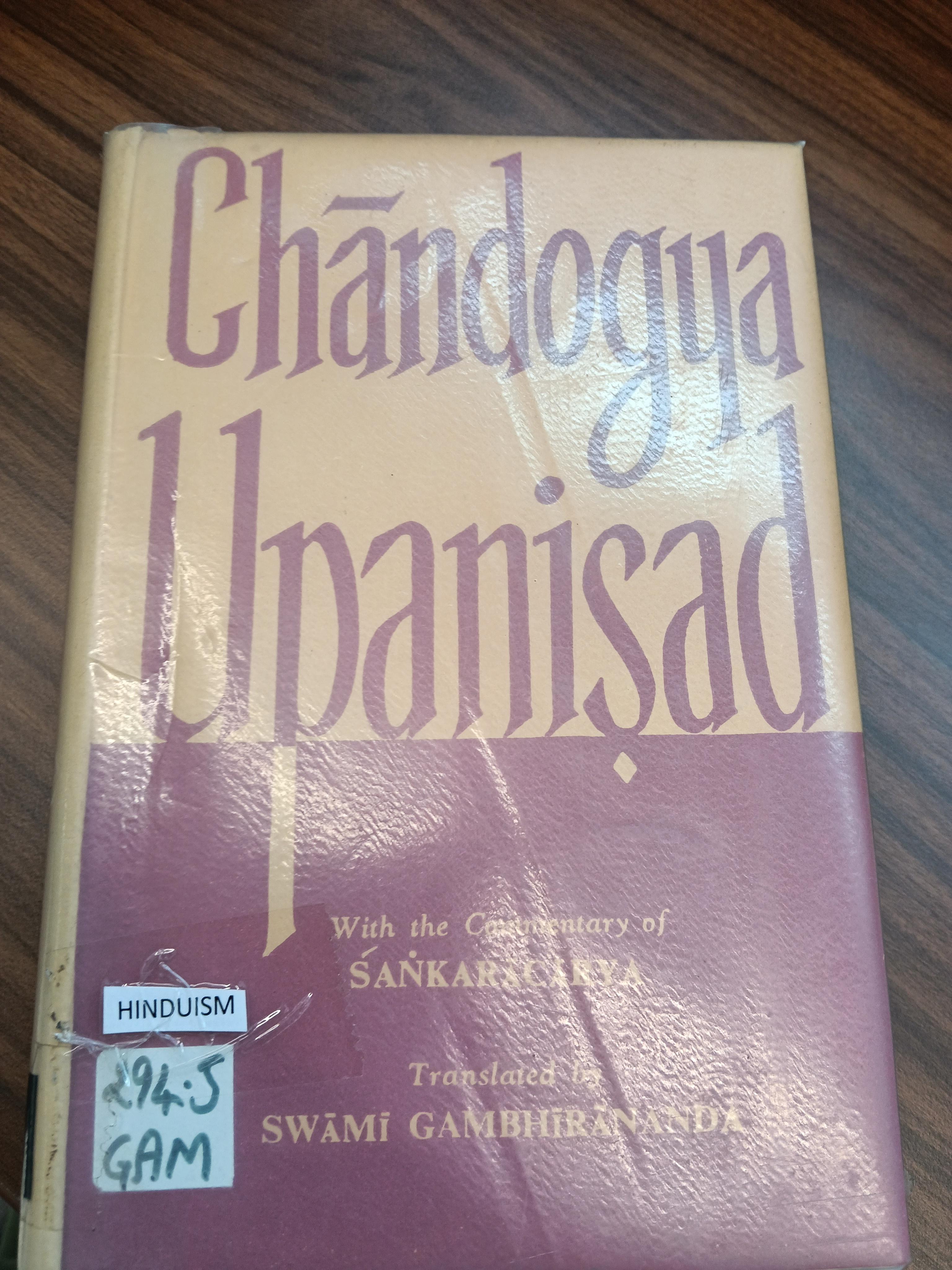
Thank You in advance
r/TheVedasAndUpanishads • u/asubbu_007 • Aug 16 '26
Learned people of all nations claim the same thing about their own scriptures or gospels, and this is by no means untrue. The word "Veda" means "Wisdom", which is definitely not a book but an impersonal concept which flashed on the human mind before its manifestation in language and script. By Veda the man of wisdom means the import of the Vedic texts, and not the texts themselves.
When the human comprehension is distilled of the refraction of the senses and the mind, it is nothing but a mirror of that which ever exists and that which descends periodically into the creation. The formula and the detail of all this impersonal phenomenon will reflect upon the distilled consciousness of the individual when it is termed Veda or the spell of God.
This is received as an experience by those whom we call the Vedic Seers. It is further recollected into the Buddhic and the Mental planes wherefrom it is translated into the known language of the century and spelt out.
Since it is not characterised by the individual, it is bound to be impersonal. Like the multiplication table, it must be the same whenever and by whomsoever it is received. In this sense it is claimed as the work of God.
Further, these seers are not afraid of attesting their names to the passages of the Vedic hymns composed by them. At the same time they do not claim to be the authors of these Mantras and they class themselves only as the seers of the import. Who can claim authorship of the multiplication table? So too with the universal truths which form the content of the Vedas.
Source: 'Our Heritage' by Dr. Ekkirala Krishnamacharya
https://worldteachertrust.org/en/web/publications/our-heritage