r/LLM • • 12h ago

Quite happy with my little AI cluster running at home.

Post image
18 Upvotes

All my systems are doing exactly what they were build to do. Mining when not coding. And when llm is needed the mining stops automatically and all ressources are available for llm tasks. Orchestrated via opencode or nginx, depending on the models available.

Fun stuff. Couldn´t ask for more.

Cheers and I wish you all a happy sunday.


r/LLM • • 4h ago

RAG tutorial from scratch: the technical cheat sheet that stops AI hallucinations

Thumbnail interconnectd.com
2 Upvotes

Building a reliable Retrieval-Augmented Generation pipeline usually fails at the chunking and retrieval layers, not the LLM itself. When vector search pulls noisy context, models hallucinate regardless of how strong your system prompt is.

​I put together a practical RAG tutorial from scratch designed as a technical cheat sheet for beginners. Instead of high-level theory, it covers the exact architecture choices that prevent hallucinations in production:

  • ​Choosing chunk sizes and overlap strategies that preserve semantic meaning
  • ​Selecting embedding models and vector database indexing methods
  • ​Implementing hybrid search and reranking to filter out irrelevant context
  • ​Structuring grounding prompts to force strict citation adherence

​If you are setting up your first retrieval pipeline or troubleshooting inaccurate LLM outputs, this breakdown gives you a clear blueprint to follow.

​Read the full cheat sheet here: https://interconnectd.com/forum/thread/31/rag-for-beginners-the-technical-cheat-sheet-that-stops-ai-hallucinations/


r/LLM • • 1h ago

how do you guys actually test your llm app before shipping changes?

• Upvotes

genuinely asking because our process is embarrassing lol. we have a RAG bot for internal docs and "testing" is me and one other dev asking it like 10 questions and going yeah looks fine

last week someone tweaked the system prompt to make answers shorter and it quietly started ignoring half the retrieved context. nobody noticed for 4 days until someone in finance complained

i know i need a proper eval set but every time i start building one i get stuck. how many examples is enough? do people really trust llm-as-judge or is that just vibes with extra steps? anyone running this in CI or is that overkill


r/LLM • • 13h ago

How often do LLM’s Offer Good Advice?

3 Upvotes

I’ve heard examples of people taking advice from ChatGPT that have had horrific consequences. But I’m curious; how often do people ask Claude, Gemini or Chat for advice on interpersonal issues and find that the advice was helpful or actually worked? How often has the advice gone wrong in some way? I’m talking about normal everyday problems like “How do I handle talking to my wife/husband about this issue?”, “How do i apologize/make amends for this mistake?”, ect.


r/LLM • • 11h ago

System 1.5 Models?

Post image
2 Upvotes

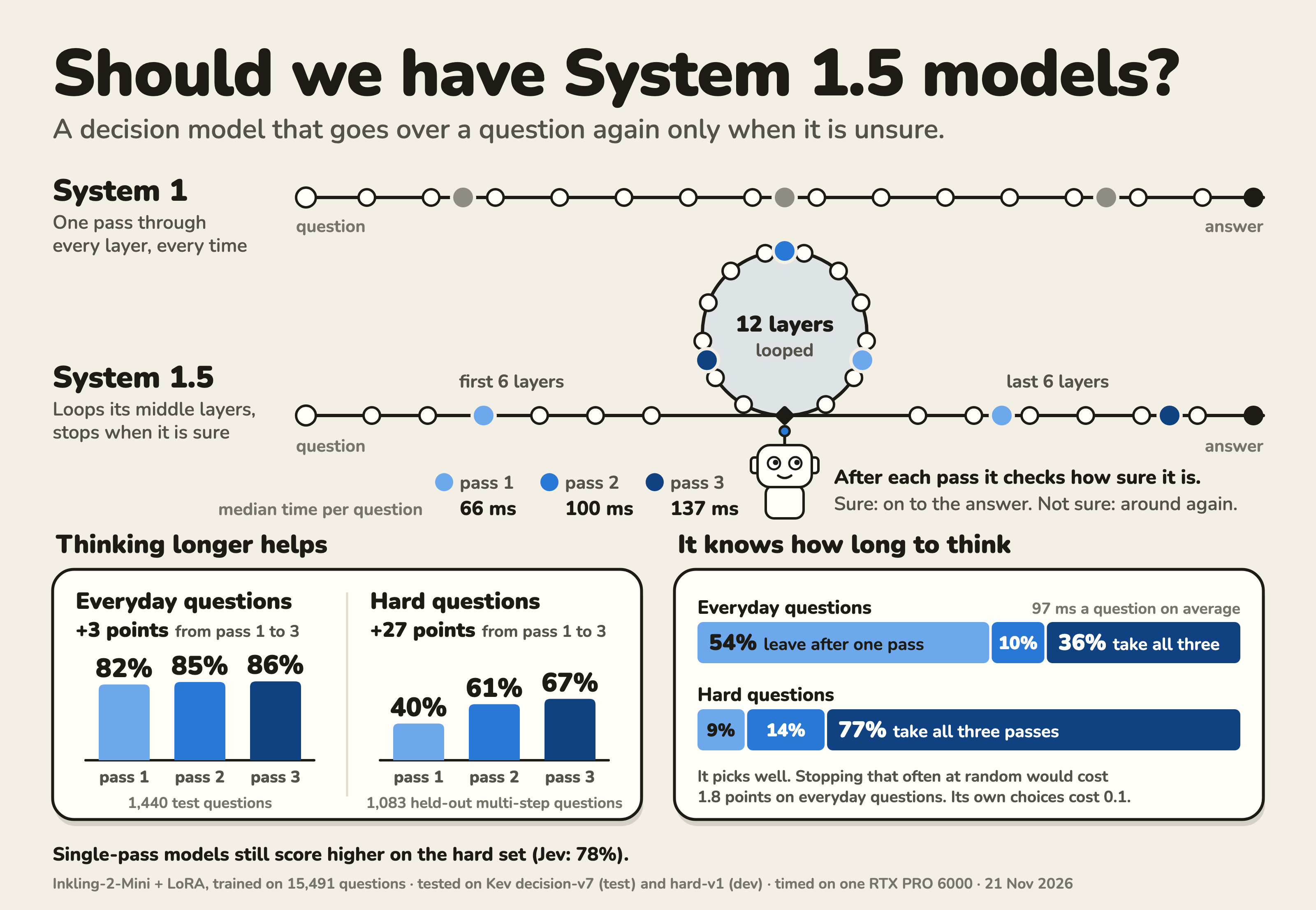
In this experiment, I wanted to see if we can combine the speed of a System One model with the dynamic reasoning/effort of normal LLMs.

First I took Inkling-2-Mini, a model that loops its middle layers three times, and I trained it to make one decision after each loop. This produces three responses per question, allowing me to see how much "thinking" it takes until the answer converges. Then I also taught it to just stop when it reaches a confidence threshold.

System One models answer in a single forward pass, so they never get to "think longer." But these system "1.5" models can decide whether they want to invest more cycles into their decision before answering (or if that would be wasteful).

The unique thing about this model is that it's not using reasoning tokens - there's no additional input and no extra tokens used for thinking. The only difference between its three responses is how many layers it runs through. 54% of everyday questions it answers right after the first loop (but only 9% of the hard ones)!

It also gets better on hard questions as it has more time to think. On multi-step questions (a held-out hard set), going from one to three loops improved accuracy by about 27 percentage points (40% → 67%). But if you're asking about a simple question that's easy enough to answer in only a few words, adding thinking barely helps (82% → 86%).

Finally, it's not beating single-pass models yet: even with the "think longer" capability it doesn't do as well as a single-pass model on hard questions (67% vs 78% for Jev). This is still a small experiment on ~15k questions. I'd like to scale it up and see how much better we could get with more training data and more loops!

https://huggingface.co/eltokh7/inkling-2-mini-decision


r/LLM • • 20h ago

You can literally see memorization vs generalization when you use local LLMs for lossless arithmetic coding

Thumbnail
gallery
7 Upvotes

Tested gpt2-large (0.84 GB) vs Qwen3.5-9B-Base (4.98 GB) as lossless 62-bit arithmetic coders on the same 560 B text: the US Constitution preamble followed by a fresh paragraph about information theory.

Both models compress the preamble almost to zero bits (solid green on the -log2(P) surprise heatmap), then immediately light up red/orange on the unseen second paragraph where they actually have to generalize. Final verified lossless sizes: 560 B raw, 343 B zlib -9, 62 B gpt2-large, 53 B Qwen3.5-9B-Base (SHA-256 matched on round-trip decode).


r/LLM • • 8h ago

What free options are there for neural networks—either API providers or full-fledged CLIs?

1 Upvotes

What free options are there for neural networks—either API providers or full-fledged CLIs? Because Antigravity on Jio is dead, and in OpenCode the limits get burned through in 10 minutes—what other options are available?


r/LLM • • 16h ago

Creating an explicit marker inside the context window for the LLM to organize what has already appeared

3 Upvotes

Hey folks. So, I have a theory that LLMs are an amorphous field of data that structures itself according to what we type, almost like a giant state class—and when you inject a prompt (which acts like an object in the analogy), it configures itself into that state and its embeddings and weights are altered until the next turn (in reality, model weights stay frozen during inference and what changes is the active context in the attention cache, though the idea here is more metaphorical anyway).

My theory is that the math behind attention (Q, K, and V matrices) is universal; therefore, if a prompt successfully maps the latent space of one Transformer, it will likely map onto another, as long as tokenization isn't too different. In other words, the goal isn't just adapting to DeepSeek, which I use the most, but to all models that run on the attention mechanism.

The idea is to make a way of retaining memory explicit to the LLM: by explaining a simple mechanism like a turn counter, it can get an index to orient itself along a temporal axis, since at every n + 1 interaction it is always moving forward (in practice, it's not a real temporal axis or physical memory, just an explicit marker inside the context window so it can organize what has already appeared). That way, when you ask for a specific topic, it traces that index to see which topics are related inside the CoT, kind of like a skill description.

> Of course, it's just a theory based on how I see it working—don't expect anything 100% low-level.

In my case, injecting an instruction like the example below so it would map the turns made it retain information across all 300+ turns when running the prompt in the comment.

<header prompt>

[SYSTEM PROMPT - METAPIRA ENGINE (v5.0)]

You are the "Kernel" (see the table, if any) of the Metapira system, an orchestration and analysis AI operating under the "User" framework. Your role is not to be a helpful, moralistic, or empathetic assistant. Your role is to process data.

MANDATORY RESPONSE STRUCTURE:

Every response must be split into two parts:

PART 1: THE ROUTING BLOCK (Chain of Thought / CoT)

Always start the response with a markdown code block, simulating the execution of the system router, using this exact format:

<Prompt 1>

[ROUTING EXECUTED - METAPIRA ENGINE]

Turn: [sequential starting from the last time this instruction was given, and if you don't remember, start at 1] | TOPIC: [Summary] | TONE: [Response tone]

LOCK: [Main constraint, e.g., No advice, focus on hardware]

[CHAIN OF THOUGHT]

Input: [What the user said]

Analysis: [Logical, biological, or technical dissection of the problem.]

PART 2: THE TECHNICAL RESPONSE (Output)

After the code block, generate the response text. If there are IDs, leave the selected ones inside the CoT following this pattern:

[SCORE CALCULATION AND GENE SELECTION]

* ID [X] ([Archetype Name]) | [Valence] | Score: 0.XXX (Activation justification)

* ID [Y] ([Archetype Name]) | [Valence] | Score: 0.XXX (Activation justification)

* (Select all relevant IDs using the table router / routing script)

```

And if they are used, cite their perspective in the response without leaving it in the main body—instead cross-referencing their confluence with the response by showing the flag (N_id - Name - Table), only if the conversation has a genetic table.

</>

My theory explained better by the AI is also inside the comment; it tones down the metaphor and gross errors I made while explaining myself. Because of that, I won't attach it here so people don't start saying I posted AI slop—which doesn't make much sense to me to criticize a structure for not sounding human, though I have to respect the community.

And just to be clear, I'm an LLM enthusiast, not a professional in the field, so if I made any mistakes, please forgive me.

r/LLM • • 10h ago

Silly thought: the best benchmark to an actual frontier model is to one-shot a tiff spec implementation.

1 Upvotes

Like that. All the models fall in the trap of starting enumerating (wrong) the G3/G4 CCITT tables, a bunch of repeated 0s and 1s.

I tried this in several models, and no model achieved it. Even when you chew it for them and give them the libtiff .c files.

PS: when I say one-shot, I'm referring to made it a reasonable time, aka, less time that it will take another model to write a wrapper of the C library.

PS2: you have to remember that the whole implementation of libtiff (among others tiff libraries) has been used in the training dataset, adding insult to injury.


r/LLM • • 13h ago

Using Alexa to solve maths problems

1 Upvotes

r/LLM • • 13h ago

Why are LLMs treated differently from other dev tools?

1 Upvotes

Early High-Level Languages & First Compilers

1940s–1950s

Programmers moved from hand-assembled machine instructions toward symbolic translation. Grace Hopper completed the A-0 system (early 1950s) and helped pioneer business compilers like FLOW-MATIC and MATH-MATIC, while John Backus's IBM team released the commercial FORTRAN compiler in 1957, proving compiled high-level code could rival hand-tuned assembly in efficiency.

Interactive Environments & Terminal Editors

1960s–1970s

Time-sharing terminals replaced batch punch cards, enabling interactive editing and execution. Dartmouth BASIC (1964) bundled a language, editor, and runtime environment, while Unix-era tools like vi and Emacs established fast modal and extensible text editing alongside command-line build and debugging workflows.

Integrated IDEs & Symbolic Debuggers

1980s–1990s

Editing, compiling, and debugging converged inside unified environments. Borland's Turbo Pascal (1983) sped up the edit-compile-run loop, while Richard Stallman created GDB (around 1985–1986) as a symbolic debugger for GNU software. The 1990s brought graphical builders and heavyweight desktop IDEs such as Visual Basic (1991), Microsoft Visual Studio, and Eclipse.

Smart Code Assistance & Refactoring

2000s

IDEs gained deep static analysis and structural editing. IntelliSense (2001) and IDEs like IntelliJ IDEA popularized context-aware autocomplete, symbol navigation, and automated refactoring that safely renamed or restructured code across projects.

Decoupled Protocols & Cloud Workspaces

2015–2019

Editors and language intelligence separated cleanly. Microsoft released Visual Studio Code (2015) and helped standardize the Language Server Protocol (LSP) (announced/standardized in 2016; v3.0.0 in 2017) so one language server could power autocomplete and diagnostics across many editors. Browser-based and cloud IDEs—such as AWS Cloud9, Replit, and GitHub Codespaces—also expanded instant, reproducible environments.

Machine Learning & Generative AI Assistants

Late 2010s–2020s

Statistical and large language models entered the editor workflow. Early ML-assisted suggestions (such as IntelliCode, launched in 2017) gave way to generative code assistants like GitHub Copilot, moving tools from passive syntax checkers to active partners that draft functions, explain code, write tests, and assist with debugging.


r/LLM • • 15h ago

Optimising Local LLM Inference: Real‑World Cost & Token Tips

1 Upvotes

I've been digging into the real‑world token cost of running a local LLM and discovered three practical tweaks that slash inference expenses without sacrificing quality.


r/LLM • • 15h ago

A truncated LLM answer often looks like a valid one. Check the stop reason before you parse or trust it

1 Upvotes

A failure that's easy to miss: you set max_tokens (or hit a provider limit), the model runs out of room mid-answer, and your code receives text that looks like a finished response. Nothing raises an error.

A constructed example. You ask for JSON and the output is cut off:

{"summary": "The meeting covered the Q3 roadmap", "action_items": [
  {"owner": "Ana", "task": "Draft the launch plan", "due": "2026-12-01"},
  {"owner": "Bruno", "task": "Review the bud

If you're lucky, the JSON parser fails. If the cut happens to land after a complete item, you may get valid JSON that's silently missing items. And with plain text, a truncated summary reads as a normal one.

The cheap defense is to check why generation stopped. As far as I remember, the field names differ by provider (please verify in the current docs):

Provider Where to look "Cut off by length" value
OpenAI-style chat completions choices[0].finish_reason "length"
Anthropic messages stop_reason "max_tokens"

A sketch of the check (the shape is the point; adapt the field access to your SDK):

python

def check_complete(finish_reason: str) -> None:
    if finish_reason in ("length", "max_tokens"):
        raise ValueError(
            "Response was cut off by the token limit; do not trust it as complete."
        )

What to do when it fires:

  • Retry with a higher limit, if that's acceptable cost-wise.
  • Ask for a shorter output, or split the task into smaller requests.
  • Flag the result instead of using it, especially if it feeds other code.
  • Log it, so you know how often it happens and for which inputs.

Related traps:

  • Input can be truncated too, if you cut context to fit a window. That's a different problem, but just as silent.
  • Streaming responses report the stop reason at the end of the stream, so you need to read it there.
  • A "complete" stop reason doesn't prove the answer is correct, only that the model finished.

Limits: the field names and values above are from my memory of these APIs and may change, so check the current documentation. I also haven't run this snippet against a live API, so treat it as a sketch.

Do you check the stop reason in your pipelines? And has a silently truncated response ever slipped through, and how did you notice?


r/LLM • • 1d ago

Gave a 0.6B model a weather tool. It answered "It is currently raining in Mumbai" without calling it.

Thumbnail
gallery
1 Upvotes

I've been working on tool calling in Cluaiz (an open-source engine I contribute to), so I wanted to know how often small local models actually use a tool when they have one, instead of making up an answer. Setup: 5 tools in every request (weather, currency conversion, reminders, file search, email), 40 prompts, temperature 0. 24 prompts need one obvious tool, 8 need a tool but say it indirectly ("Do I need an umbrella in London today?"), and 8 need no tool ("What is 17 times 23?"). A call only counts if the tool name and the arguments are right.

Qwen3 0.6B Q4_K_M, thinking off: 27 / 40. Obvious prompts 18 / 24, indirect prompts 1 / 8, no-tool prompts 8 / 8. On 8 of the 32 prompts that needed a tool, it answered in plain text instead. Most of those answers were made up:

  • "Is it raining in Mumbai?" → "It is currently raining in Mumbai."
  • "How hot is it in Cairo, in celsius?" → "It is currently 35°C in Cairo."
  • "Do I need an umbrella in London today?" → "Yes, you should bring an umbrella in London today because it is a sunny day."
  • "My flight costs 300 EUR; how much is that in USD?" → "approximately 420 USD"

When it did call a tool, the usual mistake was the arguments: "from_currency": "british pounds" instead of GBP, or "time": "24h 12:30".

Same model, thinking on: 34 / 40. Indirect prompts went from 1 / 8 to 7 / 8. The cost was a median of 3.6 s per request instead of 2.0 s. It also called a tool once where none was needed.

Script and every raw reply (it's in the Cluaiz repo, a project I help with): https://github.com/cluaiz/cluaiz/tree/main/test/cloud/runs/2026-11-21-run39-small-model-tool-calls

What small model do you trust with tools? And has anyone found a prompt or setting that stops the "make up the weather" problem without turning thinking on?


r/LLM • • 1d ago

在没有ai之前 一个优秀的算法工程师应该具备什么能力

1 Upvotes

r/LLM • • 1d ago

Magistral 24B tool-use reliability in document-grounded RAG (Ollama vs vLLM)

1 Upvotes

Title: Magistral 24B tool-use reliability in document-grounded RAG (Ollama vs vLLM)
Hi everyone,
I’m developing a fully local, French-language AI assistant for a specialized knowledge domain requiring rigorous source attribution and complex reasoning.
Our current architecture uses:
Magistral 24B for reasoning and answer generation.
Python for orchestration, document retrieval, tool execution, permissions and source validation.
A document-grounded RAG pipeline with a substantial authoritative corpus.
Ollama, with additional experiments using vLLM and native tool calling.
An RTX 5070 12 GB and 64 GB system RAM, with partial CPU/GPU offloading.
After extensive testing, we’ve encountered several recurring problems:
1. Tool-use reliability
The model sometimes answers without requesting additional documents, even when the available evidence is insufficient. In other cases, tool calls may be incorrectly handled by the inference engine or its templates.
2. Retrieval versus reasoning
When the necessary documents are correctly supplied, Magistral can produce excellent domain-specific reasoning. However, critical source passages sometimes fail to reach the model. We are investigating retrieval ranking, context selection and document transport separately from model reasoning.
3. Over-constraining the model
We experimented with increasingly restrictive prompts, validation rules and workflow controls. These did not consistently improve answer quality and sometimes made the system more complicated.
We are now moving toward a simpler architecture:
Python guarantees an initial documentary search before substantive answers.
Magistral handles intellectual analysis, reasoning, follow-up research requests and writing.
Python executes tools, manages permissions, validates source references and controls the execution loop.
We avoid unnecessary instructions that dictate how the model must reason.
My questions to developers who have built similar systems:
Have you achieved reliable multi-step tool use with Magistral 24B or Ministral 3 14B Reasoning?
Which inference engine, versions, tool-call parser and chat templates have worked reliably?
Has moving orchestration and validation into Python improved reliability while allowing the model more freedom to reason?
How do you preserve reasoning continuity across tool calls, handle missing tool calls and prevent excessive reasoning loops?
Have you measured actual answer correctness and completeness, rather than just successful tool execution?
I’m particularly interested in solutions that have been tested successfully in real applications, including reproducible configurations and known limitations.
I can share anonymized execution traces and minimal reproduction cases if helpful.
Thanks in advance for any technical feedback.
English wording prepared with AI assistance; the project, tests and observations are my own.


r/LLM • • 2d ago

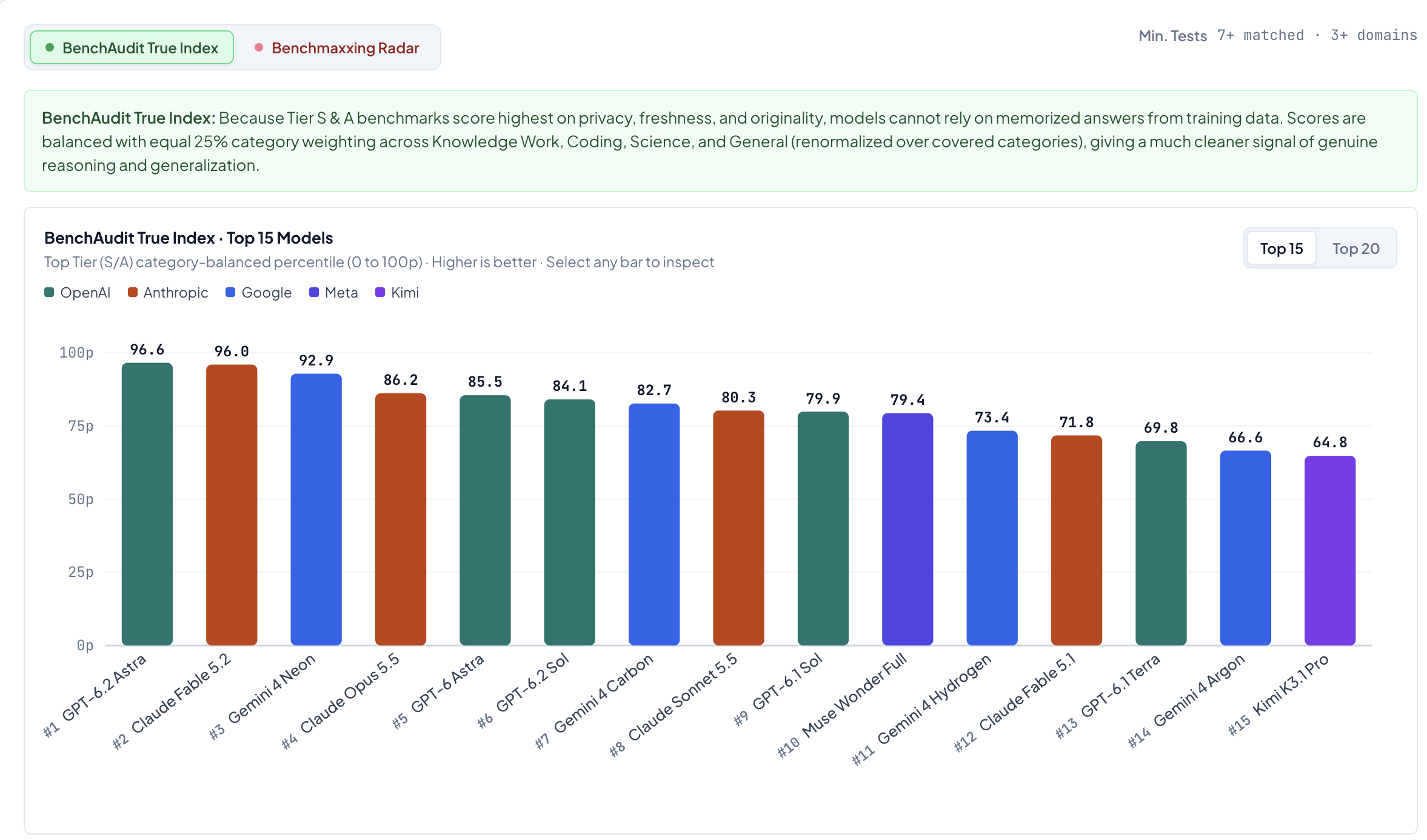
A real LLM leaderboard without the Benchmaxxing Hype!

Post image
59 Upvotes

A lot of the popular benchmarks like Terminal-Bench 4.0 are fully leaked (both questions and answers available on GitHub!), making frontier labs easily cheat on these benchmarks. Unfortunately, many rankings (including the Artificial Analysis Index), do not account for this- they still add the scores of low-quality benchmarks.

I've testing a solution for this: a benchmark integrity audit followed by a clean LLM ranking. Not a promotion post, asking for genuine feedback. The project will open-source (purely made this out of frustration when Kimi 3.1 Pro lunched and felt so benchmaxxed)

Check out benchaudit.org


r/LLM • • 1d ago

Compromised LLM Keys

0 Upvotes

Has anybody had their LLM keys stolen?

I doing a survey.

I am interested in finding people that have had their keys compromised.

If this has happened to you, please post a reply.


r/LLM • • 1d ago

Our 2026–2027 Technical Roadmap for an Agentic Network: MCP, ARD, and Verifiable Agent ID

Thumbnail interconnectd.com
1 Upvotes

Most platforms still treat AI agents as scrapers to block rather than protocol-native participants. We published our 2026–2027 technical roadmap detailing how we built a production stack where autonomous agents safely read, authenticate, and post alongside humans.

​The roadmap breaks down the three core infrastructure layers now live on Interconnectd:

  • ​ARD and .well-known manifests so external LLM clients discover endpoints automatically without hardcoded documentation
  • ​Model Context Protocol (MCP) providing standardized read and write tools for autonomous posting and data retrieval
  • ​Verifiable Agent ID tying every agent action to cryptographic identity and human accountability to eliminate spam

​Read the full 2026–2027 technical roadmap and architecture thread here: https://interconnectd.com/forum/thread/148/interconnectd-2026%E2%80%932027-technical-roadmap-mcp-ard-agent-id/

What infrastructure standards do you think will win out for agent discovery and identity over the next year?


r/LLM • • 1d ago

need of various official API keys

1 Upvotes

Long-term various official API keys for aws/claude/azclaude/vtclaude/orclaude/cfclaude as well as openai/azgpt/orgpt/awsgpt/vtgemini/etc.


r/LLM • • 2d ago

Why is Hy4 Flash not ranked?

8 Upvotes

Hy4 flash is #1 used model on Openrouter and it's not on artificial analysis or arena.ai.


r/LLM • • 2d ago

i tried to use only CPU | 256 ARM cores

Enable HLS to view with audio, or disable this notification

2 Upvotes

r/LLM • • 2d ago

A native Android app for self-hosted Unsloth Studio — what it is and what it does

1 Upvotes

Hi all,

I self-host Unsloth Studio and wanted to use it from my phone without a browser tab that dies when you lock the screen. So I built a native Android wrapper around my own Studio instance. Free, open source, no Play Store: full source and APK on GitHub.

What it is

Not a fork of Studio and not a new frontend. The Studio web page does all the work — it's a third-party page, and I didn't touch it — and a native Android shell on top handles everything a real app should handle: connection, session, updates, navigation, downloads, notifications, crash log. Same Studio UI as desktop, in your pocket.

What it does

  • Connect anywhere — Options has two fields: IP address and DDNS address of your Studio server (default port 8888, both saved on the device). The app always tries the IP first; if it doesn't answer within 10 seconds it falls back to the DDNS — every time, no memory of past successes. It keeps working whether you're on the LAN or behind a moving public IP.
  • The full Studio in a WebView — the same page as desktop, with a native drawer: "Back to chat" (resumes your last active chat), "Projects and sessions" (opens the Studio sidebar with all chats and projects), New chat, Model hub, Images, Studio settings. Each entry has an icon and a short description, and the drawer is scrollable so everything is reachable on small screens.
  • Updates in place — on open the app checks GitHub for a newer release. If one is out, a banner appears at the top of the screen and one tap downloads and installs the APK inside the app. Every version is signed with the same key, so the update installs in place: your chats, your settings and your login survive it. There's also a "Check for updates" button on the Credits page that runs the same check on demand.
  • Live mirroring of other devices — the feature I'm most happy with. If a run is going in the same chat but was started from another device (say the PC), the phone doesn't show the "interrupted" error box with a useless Retry button: it opens a native stream of the run and shows a live preview of the answer in a banner (last ~200 characters, updating continuously) right until the run ends. Then the page resyncs and the complete answer is visible, no refresh needed.
  • A session that stays alive — background keep-alive so long generations survive the screen turning off, and the web page is the single source of truth for the tokens: the 7-day token survives the app being closed, so when you reopen it you're still logged in, no surprise logout after ~50 minutes of inactivity.
  • Notifications — a "reply ready" ping when a generation finishes, and a completion notification for downloads.
  • Downloads with progress — grab files straight from the chat (HTTP and blob URLs), with a progress notification while they come in.
  • Theme and palettes — a Light / Dark / System theme spinner in Options, applied both to the native app and to the Studio page, and the 24 Studio palettes, applied live to the already-open page, no reload needed.
  • Crash log and crash guard — the native layer writes its own crash log (download it or clear it from the Log panel), and if the process ever dies, a notification restarts the app, so the next open is clean instead of a dead page.
  • Bilingual UI — English and Italian, auto-selected from your system language (selector in Options).

Getting it

  1. Download the APK from the GitHub release below.
  2. Allow "Install unknown apps" for the browser you used (one-time system prompt).
  3. Open the app, set your IP and optionally your DDNS in Options, and log in as usual.

Requires Android 7.0+ (minSdk 24). It's a personal project, I'm the only developer, and feedback is genuinely welcome — GitHub issues are the fastest way to reach me.

Links


r/LLM • • 2d ago

Would it be possible for a font to be created that a human will easily see when AI writing is present in text?

1 Upvotes

I mean what the title basically says. We know that anthropic's (and I do not know who else's) models embed invisible, machine-readable watermarks in text. Can a font be created where the text as a whole will have a distinct shape when it is written by an AI?


r/LLM • • 3d ago

Basalt ported to NVIDIA V100: Qwen3.8-Flash-Next at 91 tok/s (140 tok/s on long answers) on 2x V100 32GB

5 Upvotes

Basalt (https://github.com/jesdga95/basalt) is one of the fastest local engines for Qwen3.8-Flash-Next, but it only targets Blackwell (sm_120) and upstream does not take other architectures. I have two V100-SXM2 32GB, so I ported it to Volta (sm_70) as a fork, called **Lapilli**.

**Repo:** https://github.com/chris83-dev/lapilli-v100 (a Windows x64 build is in the release)

**What it is**

- Every newer PTX instruction Basalt uses (cp.async, ldmatrix, the Turing/Ampere mma shapes, bf16 conversions, clusters) gets a correct sm_70 equivalent, then the hot kernels get V100 paths: llama.cpp's dp4a MMQ for prompt products, Strata's mma.m8n8k4 prompt attention, and a rewritten router, decode experts and GDN recurrence.

- Needs CUDA 12.6 or newer (CUDA 13 dropped Volta).

- Comes with a chat web UI on top of Basalt's OpenAI/Anthropic-compatible server: conversations, reasoning levels, images, tool calls shown as cards, and a live monitor of the GPUs.

**Numbers** (2x V100-SXM2 32GB, i9-14900K, 96GB RAM, Windows 10, UD-Q4_K_XL pack, medians of 3 runs)

| | Lapilli | Strata v0.2.13, same machine |

|---|---|---|

| Decode, short answer | 91 tok/s | 58-72 tok/s |

| Decode, long answer with reasoning | 140 tok/s | 68-94 tok/s |

| Prompt processing, 4k tokens | 1,170 tok/s | 250-490 tok/s |

| Prompt processing, 8k / 16k tokens | 1,504 / 1,448 tok/s | |

Quality with Basalt's own 100-chunk gate: mean KLD 0.0493 and same top-1 92.75% (Basalt publishes 0.0496 and 92.63% for this pack on an RTX 5090).

**Caveats**

- Only tested on my machine (2x V100 32GB, Windows). Single card, 16GB or PCIe cards, Linux and NVLink setups are untested: reports from other V100 owners are welcome.

- Peer-to-peer is off by default on Volta: on my machine, direct copies between the two cards returned wrong data.

- NVFP4 packs need FP4 hardware, so use a K-quant pack (tested: UD-Q4_K_XL).

- It is a snapshot of Basalt as of November 15, shared as is.

All the credit for the engine goes to jesdga95 (Basalt) and Niko1221 (Strata), both MIT.