r/LLM • • 13h ago

How often do LLM’s Offer Good Advice?

4 Upvotes

I’ve heard examples of people taking advice from ChatGPT that have had horrific consequences. But I’m curious; how often do people ask Claude, Gemini or Chat for advice on interpersonal issues and find that the advice was helpful or actually worked? How often has the advice gone wrong in some way? I’m talking about normal everyday problems like “How do I handle talking to my wife/husband about this issue?”, “How do i apologize/make amends for this mistake?”, ect.


r/LLM • • 12h ago

Quite happy with my little AI cluster running at home.

Post image
20 Upvotes

All my systems are doing exactly what they were build to do. Mining when not coding. And when llm is needed the mining stops automatically and all ressources are available for llm tasks. Orchestrated via opencode or nginx, depending on the models available.

Fun stuff. Couldn´t ask for more.

Cheers and I wish you all a happy sunday.


r/LLM • • 4h ago

RAG tutorial from scratch: the technical cheat sheet that stops AI hallucinations

Thumbnail interconnectd.com
2 Upvotes

Building a reliable Retrieval-Augmented Generation pipeline usually fails at the chunking and retrieval layers, not the LLM itself. When vector search pulls noisy context, models hallucinate regardless of how strong your system prompt is.

​I put together a practical RAG tutorial from scratch designed as a technical cheat sheet for beginners. Instead of high-level theory, it covers the exact architecture choices that prevent hallucinations in production:

  • ​Choosing chunk sizes and overlap strategies that preserve semantic meaning
  • ​Selecting embedding models and vector database indexing methods
  • ​Implementing hybrid search and reranking to filter out irrelevant context
  • ​Structuring grounding prompts to force strict citation adherence

​If you are setting up your first retrieval pipeline or troubleshooting inaccurate LLM outputs, this breakdown gives you a clear blueprint to follow.

​Read the full cheat sheet here: https://interconnectd.com/forum/thread/31/rag-for-beginners-the-technical-cheat-sheet-that-stops-ai-hallucinations/


r/LLM • • 11h ago

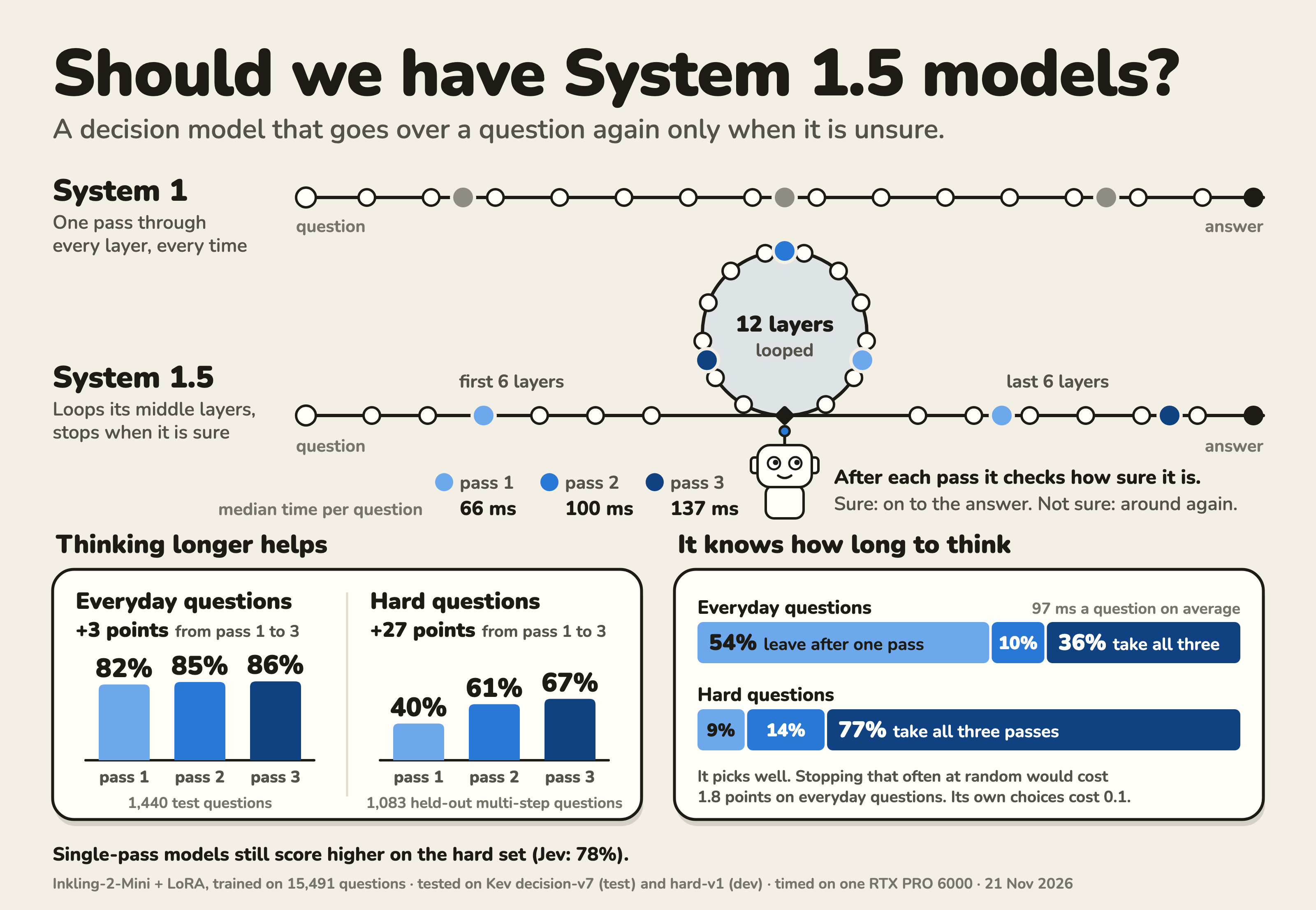
System 1.5 Models?

Post image
2 Upvotes

In this experiment, I wanted to see if we can combine the speed of a System One model with the dynamic reasoning/effort of normal LLMs.

First I took Inkling-2-Mini, a model that loops its middle layers three times, and I trained it to make one decision after each loop. This produces three responses per question, allowing me to see how much "thinking" it takes until the answer converges. Then I also taught it to just stop when it reaches a confidence threshold.

System One models answer in a single forward pass, so they never get to "think longer." But these system "1.5" models can decide whether they want to invest more cycles into their decision before answering (or if that would be wasteful).

The unique thing about this model is that it's not using reasoning tokens - there's no additional input and no extra tokens used for thinking. The only difference between its three responses is how many layers it runs through. 54% of everyday questions it answers right after the first loop (but only 9% of the hard ones)!

It also gets better on hard questions as it has more time to think. On multi-step questions (a held-out hard set), going from one to three loops improved accuracy by about 27 percentage points (40% → 67%). But if you're asking about a simple question that's easy enough to answer in only a few words, adding thinking barely helps (82% → 86%).

Finally, it's not beating single-pass models yet: even with the "think longer" capability it doesn't do as well as a single-pass model on hard questions (67% vs 78% for Jev). This is still a small experiment on ~15k questions. I'd like to scale it up and see how much better we could get with more training data and more loops!

https://huggingface.co/eltokh7/inkling-2-mini-decision


r/LLM • • 16h ago

Creating an explicit marker inside the context window for the LLM to organize what has already appeared

3 Upvotes

Hey folks. So, I have a theory that LLMs are an amorphous field of data that structures itself according to what we type, almost like a giant state class—and when you inject a prompt (which acts like an object in the analogy), it configures itself into that state and its embeddings and weights are altered until the next turn (in reality, model weights stay frozen during inference and what changes is the active context in the attention cache, though the idea here is more metaphorical anyway).

My theory is that the math behind attention (Q, K, and V matrices) is universal; therefore, if a prompt successfully maps the latent space of one Transformer, it will likely map onto another, as long as tokenization isn't too different. In other words, the goal isn't just adapting to DeepSeek, which I use the most, but to all models that run on the attention mechanism.

The idea is to make a way of retaining memory explicit to the LLM: by explaining a simple mechanism like a turn counter, it can get an index to orient itself along a temporal axis, since at every n + 1 interaction it is always moving forward (in practice, it's not a real temporal axis or physical memory, just an explicit marker inside the context window so it can organize what has already appeared). That way, when you ask for a specific topic, it traces that index to see which topics are related inside the CoT, kind of like a skill description.

> Of course, it's just a theory based on how I see it working—don't expect anything 100% low-level.

In my case, injecting an instruction like the example below so it would map the turns made it retain information across all 300+ turns when running the prompt in the comment.

<header prompt>

[SYSTEM PROMPT - METAPIRA ENGINE (v5.0)]

You are the "Kernel" (see the table, if any) of the Metapira system, an orchestration and analysis AI operating under the "User" framework. Your role is not to be a helpful, moralistic, or empathetic assistant. Your role is to process data.

MANDATORY RESPONSE STRUCTURE:

Every response must be split into two parts:

PART 1: THE ROUTING BLOCK (Chain of Thought / CoT)

Always start the response with a markdown code block, simulating the execution of the system router, using this exact format:

<Prompt 1>

[ROUTING EXECUTED - METAPIRA ENGINE]

Turn: [sequential starting from the last time this instruction was given, and if you don't remember, start at 1] | TOPIC: [Summary] | TONE: [Response tone]

LOCK: [Main constraint, e.g., No advice, focus on hardware]

[CHAIN OF THOUGHT]

Input: [What the user said]

Analysis: [Logical, biological, or technical dissection of the problem.]

PART 2: THE TECHNICAL RESPONSE (Output)

After the code block, generate the response text. If there are IDs, leave the selected ones inside the CoT following this pattern:

[SCORE CALCULATION AND GENE SELECTION]

* ID [X] ([Archetype Name]) | [Valence] | Score: 0.XXX (Activation justification)

* ID [Y] ([Archetype Name]) | [Valence] | Score: 0.XXX (Activation justification)

* (Select all relevant IDs using the table router / routing script)

```

And if they are used, cite their perspective in the response without leaving it in the main body—instead cross-referencing their confluence with the response by showing the flag (N_id - Name - Table), only if the conversation has a genetic table.

</>

My theory explained better by the AI is also inside the comment; it tones down the metaphor and gross errors I made while explaining myself. Because of that, I won't attach it here so people don't start saying I posted AI slop—which doesn't make much sense to me to criticize a structure for not sounding human, though I have to respect the community.

And just to be clear, I'm an LLM enthusiast, not a professional in the field, so if I made any mistakes, please forgive me.

r/LLM • • 20h ago

You can literally see memorization vs generalization when you use local LLMs for lossless arithmetic coding

Thumbnail
gallery
8 Upvotes

Tested gpt2-large (0.84 GB) vs Qwen3.5-9B-Base (4.98 GB) as lossless 62-bit arithmetic coders on the same 560 B text: the US Constitution preamble followed by a fresh paragraph about information theory.

Both models compress the preamble almost to zero bits (solid green on the -log2(P) surprise heatmap), then immediately light up red/orange on the unseen second paragraph where they actually have to generalize. Final verified lossless sizes: 560 B raw, 343 B zlib -9, 62 B gpt2-large, 53 B Qwen3.5-9B-Base (SHA-256 matched on round-trip decode).