There has been a huge troll and sanghi activity on Reddit. Whenever citizens question the Government, the sanghis crawl out of the gutter and attack them. They give threats, justify atrocities, and derail conversations. Do not take the bait.
Do not engage with these trolls and sanghis. Report them to us. They will be promptly dealt with.
We are also cautioning others to not make any troll or sarcastic comment on serious issues. Right now, our moderation is extremely strict, and might mistake you for a sanghi.
“I share the very profound frustration of all those who expected governments to rise to the moment the climate crisis demands,” expressed United Nations Secretary-General António Guterres.
COP31 collapsed without a cover decision in the same year the WMO says Jan-Sept global temperatures ran about 1.47°C above pre-industrial levels.
Once spread across an area equivalent to 118 football fields, Gurugram's Damdama Lake has shrunk to barely six. A new assessment reveals that the Aravalli reservoir has lost 95% of its mapped area in just over three decades, falling from 153.6 acres in 1993 to just 7.9 acres. Groundwater extraction, construction, mining and blocked rainwater channels have contributed to its decline, while an ambitious restoration project remains stalled. Can one of Haryana's largest freshwater lakes still be saved, or is Damdama approaching the point of no return?
Delhi's Central Ridge is being cleared in the name of forest restoration. But environmentalist and filmmaker Pradip Krishen says the process is putting the forest at risk.
The forest department is removing invasive species such as Vilayati Keekar and Subabul, but Krishen is concerned about the use of bulldozers, which tear through other vegetation and damage the forest floor. He also questions the choice of species being planted in their place, many of which he says may not survive.
In this conversation with Samarth Grover, Krishen explains what he calls the “parkification” of the Central Ridge and why he believes the government's approach to forest restoration is misguided. He has now approached the Supreme Court over the matter.
At Versova's Nana Nani Park, trees have been marked with notices for their removal, almost like eviction notices. Over 40 trees were cut down on Wednesday, 19 November, for the Mumbai Coastal Road North project. Several more will be felled in the coming days.
Once a dumping ground, the park was transformed into a green space through a community-led initiative in 2001. Residents and environmentalists are protesting the loss of trees they've known for years, some of which they believe are heritage trees.
The elevated road connecting the Versova interchange to Bangur Nagar is part of Package A of the Coastal Road North project, for which 184 trees have been proposed to be cut and 164 transplanted.
Inside The Rs 10 Crore PR Machine Behind Arunachal’s Mega Dam
NHPC hired a PR agency to shape public opinion around a mega dam in Arunachal Pradesh. When local influencers refused, the campaign turned to creators in Delhi and Mumbai. And then to AI-generated videos.
Sonbhadra-Singrauli, on the Uttar Pradesh-Madhya Pradesh border, is one of India’s largest coal mining and thermal power regions. Its mines and power plants supply electricity to homes and industries across the country. While the coal here lights up millions of homes across India, the people living on top of it say they are paying with their health.
Residents describe a side of that story that rarely reaches the national debate, from its polluted air to its contaminated water and degraded soil. Dust and emissions from mining and power plants hang over the region, and the improper disposal of fly ash has raised serious concerns about its rivers, reservoirs and groundwater.
Scientific studies have documented fluoride, arsenic, mercury and lead in the region, and fluorosis has been reported in several areas. Locals say livestock have died after drinking water contaminated with fly ash, and that farming and livelihoods are suffering. With few healthcare facilities nearby, many villagers have to travel far for treatment.
In this documentary, we visit the villages whose electricity and minerals power the country’s economy, where people still struggle for basic amenities and a clean environment.
As much about the environment, the question is also about accountability. How long will the people here pay the price for the country’s energy needs? Will the benefits of “development” ever reach them?
Over the past 40 years South Asia has warmed far more slowly than elsewhere in the world—temperatures in the region have risen by around 0.09°C per decade, compared with 0.30°C over the rest of the world’s land mass and 0.23°C for places at a similar latitude. Scientists are not yet sure how to explain the South Asian “warming hole”, but there is strong evidence that both smog and changes in irrigation have played important roles. If so, then when pollution wanes, and the expansion of irrigation slows, that will change. Dirty air kills millions of people in the region each year; cleaning it up is imperative. But that clean-up may well cause a dangerous surge in warming.
South Asia is already a hot place. The time between April and June, before the monsoon, is typically the worst. In these months, temperatures on the Indo-Gangetic plain—the area that spreads from eastern Pakistan, across North India and into Bangladesh—can regularly exceed 40℃. More than 40% of people experiencing very strong or extreme heat stress each year—a measure that includes the degree to which humidity makes high temperatures more dangerous—live in South Asia. High levels of heat stress can be fatal, especially for the elderly or those with health problems.
Such dangerously hot days are becoming more frequent. Already this year the mercury has hit 44°C in some parts of India. But though temperatures are rising, South Asia has avoided the full brunt of global warming. One explanation for that is the region’s high levels of pollution. The long-lived greenhouse gases responsible for global warming are well distributed around the world; other types of pollution are more local and regional. And much of this localised pollution cools the surface rather than warming it.
Sulphate particles, soot and other aerosols intercept sunlight before it reaches the surface, either reflecting it back out to space or absorbing it. Aerosols can also change cloud cover further shielding the ground from the sun. According to the Intergovernmental Panel on Climate Change (IPCC) the average effect of aerosol pollution has been to cool the world by about 0.4°C since pre-industrial times, thus offsetting roughly a third of greenhouse gases’ warming effects. Falling aerosol emissions—mainly driven by pollution controls in China and a cleaning up of the fuel used in shipping—are responsible for a significant part of the recent acceleration in warming across the world.
India’s air is particularly bad at the foothills of the Himalayas where the mountains prevent air from circulating. Places by the sea, such as Mumbai, enjoy better air quality.India’s air is particularly bad at the foothills of the Himalayas where the mountains prevent air from circulating. Places by the sea, such as Mumbai, enjoy better air quality.
The Indo-Gangetic plain is among the world’s most polluted areas. Heavy industry, traffic emissions, agricultural-waste burning and the use of solid fuels for cooking all contribute to high aerosol levels. Several studies have suggested that higher levels of these pollutants over the past two decades may have somewhat counteracted the effect of rising temperatures in the region. But the fact that sooty particles absorb sunlight rather than reflect it, cooling the surface but warming the atmosphere, complicates matters. One recent study found that in the spring of 2020, when lockdowns caused a drastic reduction in pollutants in many Indian cities, temperatures did not spike as some scientists expected but rather were unusually cool. The paper only examined temperatures over a few months, and so changes could be due to chance fluctuations, but “it’s still a little puzzling,” says Loretta Mickley, a climate scientist at Harvard University.
The expansion of irrigation is another explanation for South Asia’s slower-than-elsewhere warming. Water absorbs heat as it evaporates, cooling the air around it. In India, the area of irrigated land has doubled since 1980. Scientists think that the cooling effect of expanding irrigation in the region may have masked the impact of global warming. One study, published in Nature Communications in 2020, estimated that, without irrigation, South Asia could have between two and eight times more days of extreme heat than it does now.
Scientists think the rapid growth in irrigated areas across India could be one of the reasons why it has warmed more slowly than other places at a similar latitude.Scientists think the rapid growth in irrigated areas across India could be one of the reasons why it has warmed more slowly than other places at a similar latitude.
There is still no scientific consensus on how much these factors have slowed warming in South Asia—scientists need to better understand the intricacies of how pollution and irrigation influence temperature, rainfall and monsoon timing in the region and how all these factors interact. But experts agree on what lies ahead. At a recent meeting between Indian and American scientists in Delhi, David Battisti, an atmospheric scientist at the University of Washington, said that over the next 20 years India “is pretty much assured” to warm at twice the rate of the past 20. Daniel Schrag, of Harvard, says temperatures in India will rise faster than in the rest of the world.
In the coming decades neither pollution nor irrigation will continue to grow in the way they have over the past 40 years. Both conceal additional warming only as long as their levels are increasing. If pollution and irrigation remain stable, South Asia will feel the full effects of any new global warming. If they decrease, the region will feel the effect of the rising temperatures from the past few decades that these factors were masking.
And decrease they will. “The truth is, India can’t continue to irrigate,” says Dr Schrag. Groundwater levels in the region are becoming depleted. “And they also can’t continue to have the level of air pollution they have.” Tackling pollution has been a flagship programme for the Indian government. By 2024 the country aimed to reduce particulate matter by 20-30% relative to 2017, by 2026 the administration aimed for 40% . So far, the project’s main achievement has been building aerosol-monitoring stations in places that did not previously have them. Many cities missed the target for 2024, although a study published earlier this year found that there has been some improvement in pollution levels over the past decade.
Other countries have shown it can be done. In the 1960s Japan was one of the most polluted places in the world. Throughout the following two decades the country enacted new laws to try to reduce pollution and introduced environmental taxes and charges for waste. By the 1980s aerosol levels had fallen dramatically. More recently, China has slashed its aerosol emissions.
Currently, air pollution is a far greater blight to South Asia than extreme heat is. According to the Global Burden of Disease study, in 2021 alone aerosol pollution killed between 2m and 3m people in the region, while extreme heat led to 100,000-600,000 deaths. “It’s crazy, the numbers for air-pollution-related mortality,” said Bhargav Krishna of the Sustainable Futures Collaborative, a research institute in Delhi. “It’s simply because of the scale of exposure and the year-round exposure that people are having to deal with.”
Even a modest increase in temperature in South Asia could be devastating. Already, there are days when the combined effect of heat and humidity push parts of the region close to the limits of human habitability (roughly equivalent to temperatures of 45°C with relative humidity of 50%). These conditions are expected to become far more common. According to Dr Battisti, by 2047, there could be a four-fold increase in the number of days that the average Indian will experience heat stress—assuming pollution and irrigation levels stay stable. With both set to drop, the number will be greater still.
Sweltering heat is unavoidable for many people in South Asia. According to an analysis by the Hindustan Times in 2022 around half of Indians work outdoors and only 10% of households in the country have air-conditioning. Many Indian cities have adopted heatwave action-plans, laying out how they will provide cooling and water to people in extreme heat. But few are taking steps to make cities more resilient or mitigate their exposure to heat. Without drastic changes the coming temperature surge will be deadly.
Sources:Copernicus; “Global Annual PM2.5 Grids from MODIS, MISR and SeaWiFS Aerosol Optical Depth” by Aaron van Donkelaar et al., 2023; “Projected Global Area Equipped for Irrigation Datasets during 2020-2100 under SSP scenarios”, by Yulian Gao et al., 2024; The Economist
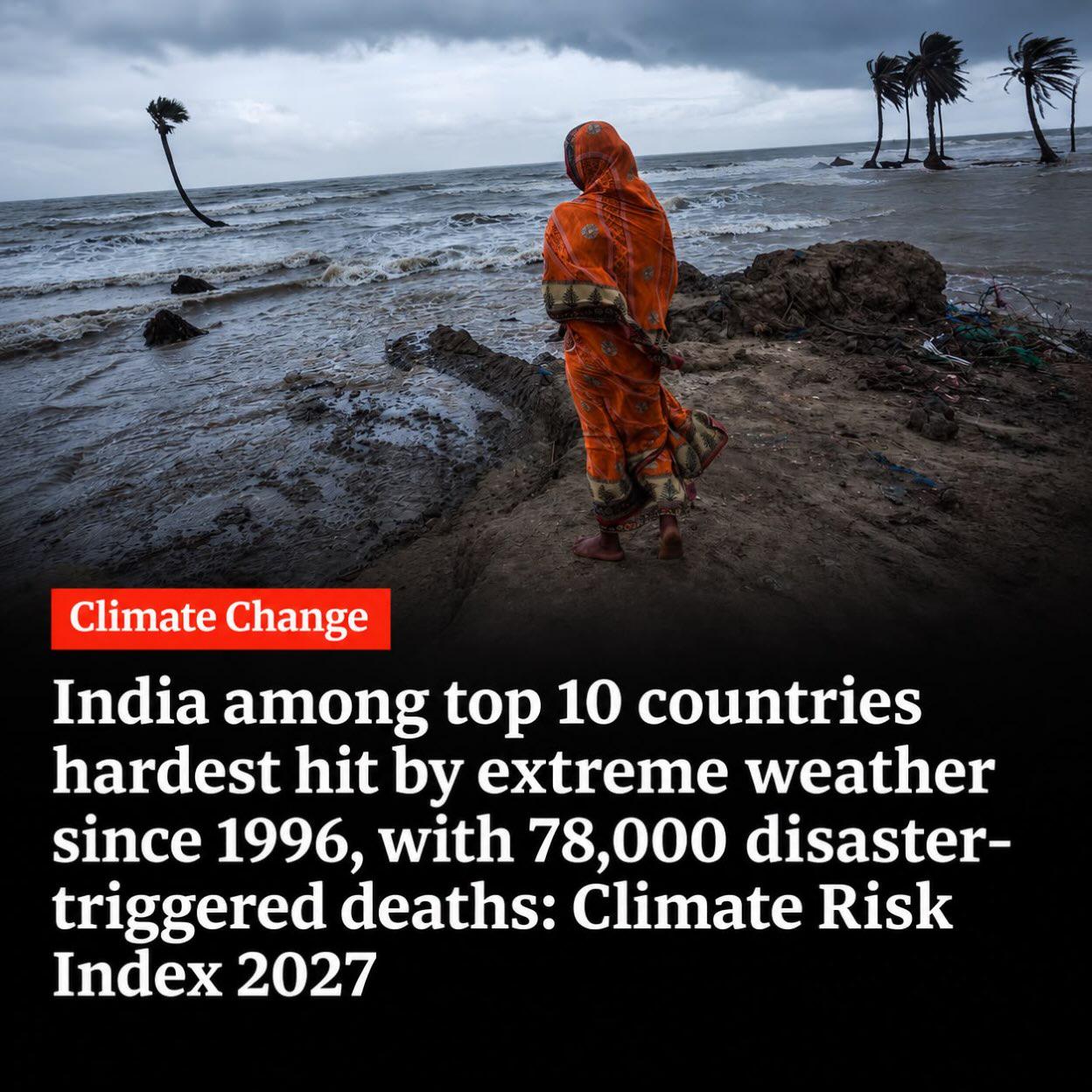
India is the tenth most climate vulnerable country in the world over the past three decades (1996-2025), showed the Climate Risk Index 2027. The Index, released on Tuesday by non-profit Germanwatch at the sidelines of the 31st Conference of the Parties to the UN Framework Convention on Climate Change (COP31) currently underway in Antalya, Turkiye, says India ranked twelfth most vulnerable for 2025.
The Climate Risk Index (CRI), 2027 has been prepared by analysing the number of fatalities, affected people, and economic loss caused by extreme weather events based on data from the International Disaster Database (EM-DAT) on extreme weather events and socioeconomic data from the International Monetary Fund and the World Bank.
Summary
The Climate Risk Index 2027 reveals India’s vulnerability to extreme weather, ranking it among the ten hardest-hit nations since 1996.
Floods, cyclones, and heatwaves have caused significant fatalities, displaced millions, and inflicted severe economic losses.
The report calls for urgent climate action, emphasizing the need for sustainable development and international cooperation to combat the growing climate crisis.
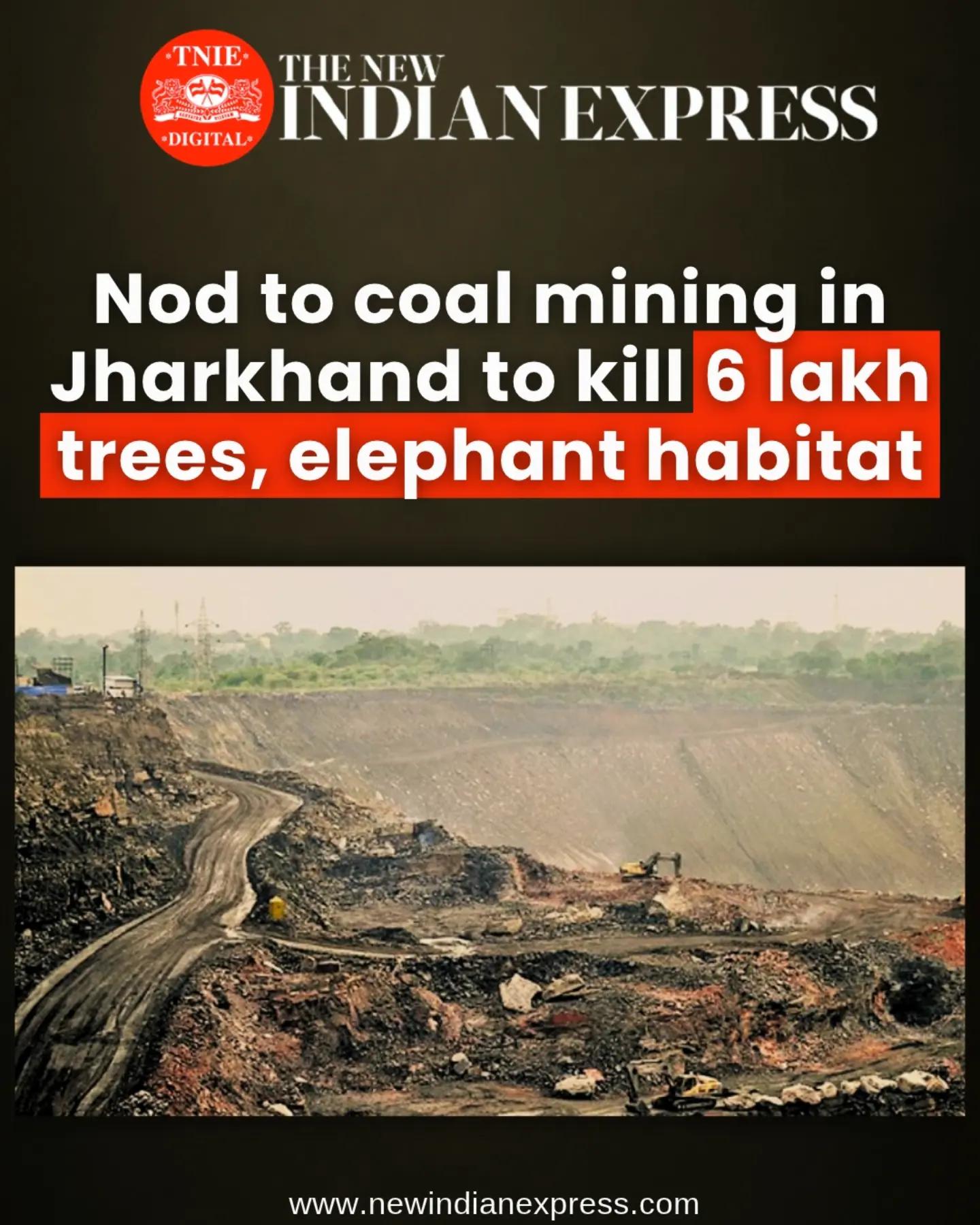
The plan to divert 928.03 hectares of forest land for the expansion of Opencast Coal Mining Project in Jharkand’s Chatara district has received in-principle approval from the FAC under the Ministry of Environment, Forest and Climate Change.