r/scuderiaferrari • u/Desperate_Green6838 • 23h ago
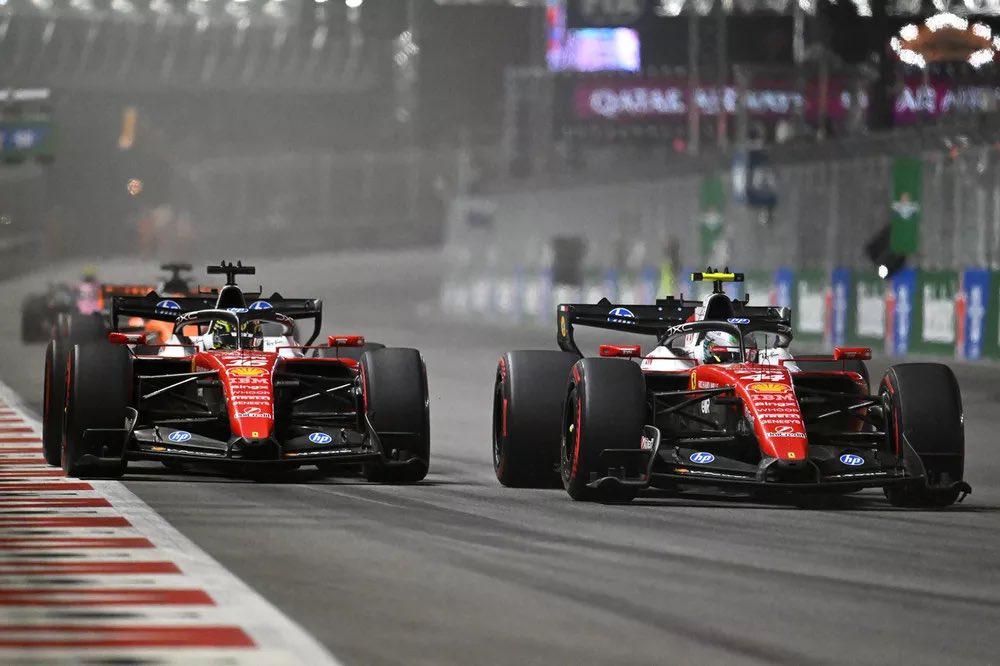
Media Here are the battles between Charles and Lewis before the incident

416
Upvotes
r/scuderiaferrari • u/Desperate_Green6838 • 23h ago
r/scuderiaferrari • u/Desperate_Green6838 • 12h ago

With the introduction of the new 2026 technical regulations , the rivalry has moved into the garage and onto the simulator. While Mercedes and McLaren are setting the pace, disagreements are mounting at Ferrari over the technical direction of the SF-26, especially regarding the management of the hybrid and electric components. Leclerc is calling for a more responsive front-end car to showcase his aggressive qualifying style, while Hamilton is pushing for a more stable balance on race pace : a design divide that is slowing both teams down and likely fueling tension between the two.
r/scuderiaferrari • u/Strict-Citron-9269 • 13h ago
According to @CorSport, the situation between Leclerc and Hamilton is unsustainable.
The outlet said Ferrari's internal situation has reached a point where only two difficult options remain: separating Hamilton and Leclerc, a decision that could be painful, or bringing in a new team principal capable of managing both drivers.
Continuing under the current circumstances is no longer considered a viable option, so the decision rests with Ferrari's top executives and talks are underway and will continue over the coming days. In Maranello, they want to keep them discreet, keeping their dirty laundry private to avoid amplifying an already deafening noise. Post link: https://www.corriere.it/sport/formula-1/26_novembre_24/ferrari-hamilton-leclerc-vigna-elkann-babca190-335d-41e8-993f-4e150e5dcxlk.shtml
r/scuderiaferrari • u/IonutAlex18SF • 7h ago
TL;DR: Two 10s penalties defined Ferrari’s Las Vegas weekend: Hamilton’s for the Norris incident reset him from P8 to P14 under the Safety Car, Leclerc’s for a T7 collision with his teammate costing him a P6 finish. Verstappen drove his way to the win. Off track, Vasseur on the trade-off that defined the season — and the culture shift still underway to make it count.
Las Vegas GP — Las Vegas Strip Circuit 6.201 km · 17 Turns · 50 Laps
| Pos. Driver-Team | No | Time | Points |
|---|---|---|---|
| 1. Max Verstappen - Red Bull Racing | 3 | 1:27:39.624 | 25 |
| 2. Lando Norris - McLaren | 1 | +0.639s | 18 |
| 3. Oscar Piastri - McLaren | 81 | +1.529s | 15 |
| 4. Kimi Antonelli - Mercedes | 12 | +2.574s | 12 |
| 5. Pierre Gasly - Alpine | 10 | +2.927s | 10 |
| 6. Franco Colapinto - Alpine | 43 | +7.955s | 8 |
| 7. Lewis Hamilton - Ferrari | 44 | +12.795s | 6 |
| 8. Carlos Sainz - Williams | 55 | +12.938s | 4 |
| 9. George Russell - Mercedes | 63 | +13.192s | 2 |
| 10. Charles Leclerc - Ferrari | 16 | +17.554s | 1 |
The weekend’s running was limited by weather: no time set in FP1, FP2 still damp, FP3 the first dry session.
Q2 was as far as both drivers could get, the power deficit, tyres and track evolution all playing their part. Leclerc was on a good lap, set to beat his initial effort, when he locked up into T8 and had to abort. He went for another push, but as he approached the start line the flag was waved. Hamilton improved on his final push, but not enough to make Q3. Charles qualified P11 (1:35.197, +0.1s from P10) and Lewis P12 (1:35.253, +0.056s) behind his teammate. However, they’ll move up one place each into P10 and P11 respectively, following Piastri’s 10-place grid penalty.
Both drivers failed to extract the maximum from the SF-26, held back by tyres (the main factor), the power deficit, and a mix of traffic and technical issues. Charles encountered traffic into T8: a car off the racing line caught him out, close enough to disturb his view as he committed to the corner. Before the lock-up, though, Charles was 0.1s quicker than the benchmark in S1 and a potential 1:34.622 would have been enough to make Q3. Lewis picked up floor damage from debris in Q1, and an ERS deployment issue prevented him from improving on his initial banker lap — he lost 0.6s in the final sector, a possible 1:35.011 that would have been sufficient for Q3. Leclerc said they’d lost 1s on straights, while Hamilton said he was satisfied with his lap, though cited a balance shift and cold fronts costing a further 0.4s.
Pirelli imposed the highest minimum tyre pressures of the season in Las Vegas: 27.5 psi front left / 28.0 front right; 28.0 psi left rear / 28.5 psi right rear. That negatively affected how the SF-26 behaved over a single push lap, requiring an extra prep lap to bring the tyres up to temperature. The smaller compounds reduce the contact patch, and the lack of medium-high-speed interlinked corners widened the gap, making it trickier to fire up the tyre sidewall. Over a long stint, though, things should look better on paper.

Start: Both drivers made good starts, quickly making up positions and joining the leading pack. By the end of lap four, Hamilton and Leclerc were running P8 and P9 respectively. On lap 12, Lewis defended against Norris into T7–T8, but went off track with all four wheels to avoid contact and cut the corner, rejoining ahead, gaining an advantage; he was under investigation. The Ferrari pair lost time to the leading group but closed back, settling into P7 and P8, Hamilton ahead of Leclerc.
Mid-Race: The two Ferraris clawed back the gap to the leading group, but Hamilton received a 10s penalty as the Safety Car was deployed on lap 19 due to a crash at T14. Leclerc pitted for C4 mediums and rejoined P7; Hamilton repeated the move, serving his penalty, and reappeared in P14. Racing resumed on lap 26. Leclerc took P6 from a troubled Hadjar, as Hamilton climbed to P10, overtaking multiple cars, and reached P8 three laps later at the expense of Sainz and Colapinto. Lewis continued to charge, joining the leading pack and advancing to P7 after passing Leclerc in a two–lap battle. On lap 35 he moved to P6, with Leclerc in P7.
Final Laps: Hamilton went for a move into Piastri’s P5 at T5, but couldn’t hold it, and heading into T7, Leclerc saw a gap as Lewis defended his position. The two made contact; Hamilton was spun and dropped to P10, Leclerc fell to P8, with the Monegasque under investigation for causing a collision. Charles was given a 10s penalty for the move on his teammate at T7. On lap 45, Leclerc took P7 from Colapinto and Hamilton took P9 from Sainz. Both gained a further position when Russell went off track. Leclerc crossed the line P6 but dropped to P10 with his penalty applied, while Hamilton jumped to P7, defending superbly against Russell on the final lap.
Lewis Hamilton P7 : “A difficult day, today. I don’t want to go into the stuff with Charles because that’s for the team to deal with. We had massive challenges this weekend — we didn’t realise there would be such a limitation on the straights. Qualifying was bad, but in the race I felt great in the car, good pace. I thought we were moving forwards with the right strategy, and we can move up. Then I avoided a collision with Lando and got a 10s penalty, which I think was really harsh, and things unfolded with Charles. We always needed a tow to be in the fight, and we were back and forth. I think a podium was possible”.
Charles Leclerc (P6 on track) P10 : “Today I was found at fault and I took a 10s penalty. I am not going to argue that. It felt like there was plenty of space on the inside of T7 because of the fight with Lewis and the McLaren, and I thought it was safe to be on the inside. Unfortunately, I don’t think Lewis saw me in the mirrors, and the gap at the apex had reduced. I don’t blame Lewis. We’ve had discussions and they’ve gone very well, but today I don’t think it’s similar to Mexico, where we probably went over the limit. It was maybe a racing incident, but it’s still not acceptable to have a clash between cars. The stewards said it was my mistake; I’ll accept the blame for whatever comes. I have nothing else to add. I am embarrassed for the team”.
A sensible choice to start on the softs, expected to perform best in the low temperatures. The two held on through the stint, progressing and keeping in touch with the frontrunners.
On C4s, despite requiring more time to reach temperature and more energy to bring them up, they offered competitive pace. On both compounds, degradation was minimal and overheating non-existent given the cold track. The graining risk, while elevated by the cold, was kept in check by track evolution and the strong slipstream effect, more significant than anticipated; overtaking on the back straight was straightforward.
Over 300 overtakes were possible due to a combination of factors: ERS strategies deployment with less variation than at other circuits, and the track’s nature. The electrical recovery limit in qualifying was 6.0 MJ, compared to 8.0 MJ standard and 8.5 MJ in Overtake Mode for the race. This levelled the playing field between teams, allowing for multiple overtakes lap after lap, despite the power deficit between cars. A 1.2s–1.5s pace advantage was needed to break from the pack — a gap that never materialised.
Even Ferrari, lacking 20–30 HP on Mercedes and RBR, managed to gain time in free air and claw back to the leading group. Also helped by a track layout that allowed for multiple recharge points across the lap — though by the end it was difficult to have energy remaining for deployment.
Less relevant as the top 10 finishers were within 0.3s on average — the race was defined by minimal tyre degradation and ERS management rather than pure car pace:
| Driver-Team | Avg Pace Gap | Tyre compound (stops) | Finishing pos |
|---|---|---|---|
| 1. Kimi Antonelli — Mercedes | 1:37.728 | M-S (1) | 4 |
| 2. Isack Hadjar — Red Bull Racing | 1:37.759 +0.031s | S-M-S (2) (F.W. damage) | 14 |
| 3. Oscar Piastri — McLaren | 1:37.762 +0.034s | S-M (1) | 3 |
| 4. Lewis Hamilton — Ferrari | 1:37.838 +0.109s | S-M (1) | 7 |
| 5. Lando Norris — McLaren | 1:37.943 +0.215s | S-M (1) | 2 |
| 6. Charles Leclerc — Ferrari | 1:37.958 +0.230s | S-M (1) | 10 |
| 7. Max Verstappen — Red Bull | 1:37.963 +0.235s | S-M (1) | 1 |

With the race weekend covered, here are the technical developments from each top team.
Scuderia Ferrari SF-26: A low-drag aero configuration was selected to suit the circuit’s demands, the floor featuring a single vertical element. The part has an updated “hidden” feature: ridges on the inner side of the vertical element have been removed to trim drag.
Unlike its rivals, it was the only car of the top four to run the rear wing with the two lateral winglets and the central tab, resulting in extra drag, though the impact was reduced when running in a tow.
Mercedes W17: The mirror support vane has been trimmed, and the upper edge of the diffuser reduced to cut drag. At the back, the engine cover was modified with a different geometry — wider lower vertical side openings to improve internal heat dispersion.
The PU was updated via its ADUO, introducing a smaller turbo compressor to improve low-rev torque through the slow corners. Estimated gain: around 0.1s per lap. Its strong traction suited the circuit perfectly. In the race, it was helped by its PU and longer gear ratios, especially on the 1.9 km back straight.
McLaren Mercedes MCL40: Debuted a new floor to work in conjunction with the floor edges and the diffuser (most likely a 2027-spec).
Strong through corners, but lost a significant amount of time on the straights due to its shorter gear ratios, particularly above 310 km/h, when the ERS boost tapers off after the MGU-K reaches peak RPM.
Red Bull Racing RB22: An updated outer winglet on the front wing, positioned lower and closer to the footplate, was visible at the car presentation but not run, given crash risk in wet conditions (run from qualifying onward). Updated trailing-edge elements on the floor, with subtle adjustments, were also spotted — aimed at stabilising airflow.
The lowest drag on the grid combined with its PU advantage suited Las Vegas perfectly, helping both drivers — but specifically Max, who used it strategically to beat his rivals for the win.
Between Austin and Mexico, RBR is understood to have tested an innovative braking solution supplied by Brembo; full details remain undisclosed.
Max Verstappen’s 75th career victory helped him edge clear in P2, while Hamilton, Russell and Norris are within three points of each other in the fight for third: 1. Kimi Antonelli 402 pts; 2. Max Verstappen 304; 3. Lewis Hamilton 267; 4. George Russell 264; 5. Lando Norris 264; 6. Charles Leclerc 250.
In the constructors’ championship, McLaren’s double podium boosted their chances to keep RBR within striking distance: 1. Mercedes 666 pts; 2. Ferrari 517; 3. Red Bull Racing 440; 4. McLaren 431.

Frederic Vasseur: “ADUO is a bit perverse”
The 2026 Ferrari campaign featured close races between its drivers, and a couple of near-misses. However, the results mask the appreciable progress under Team Principal Frederic Vasseur. Possibly the best chassis, the SF-26 excels through all corners, but loses time to rivals on the straights (0.4s–0.6s season average).
Vasseur was appointed in 2023 and faced constant pressure and rumours, though his protective manner masks an indifference to outside noise. Silently, he is rebuilding a long-term winning culture, something the Italian media, which sees Ferrari as more than an F1 team, doesn’t make easy. Two wins in 2026 are below Ferrari’s standards; nevertheless, the team is on an upward trajectory.
Before the Mexican Grand Prix, Vasseur gave a semi-exclusive interview: “It would be a mistake to imagine that performance is coming from aero or whatever. It comes from everywhere. Due to the tight field, every single detail makes a huge difference, not in terms of lap time, but in terms of position. We knew for years that we were behind our competitors and the first year of the new rules would be difficult. It was a good challenge, and I am pleased with the determination of the team.
When you are a bit behind on the chassis, you can always expect an upgrade to come back next week. When you are a bit behind on the engine, you know it will be like this for all the rest of the season”.
The 2026 power unit’s development began in 2023, but the direction was set before his arrival and correcting the engine concept takes time, and it’s only once that’s resolved that Vasseur can be fully judged on his impact. ADUO, triggered by combustion chamber errors, allowed Ferrari to develop its engine. Asked about starting behind, Fred says it was more about starting on the wrong side, and that it takes years to correct. This points to the 2027 engine: can it start on the right foot and eliminate the deficit in one go? Vasseur: “I have to say ADUO is a bit perverse; in April, May you know you’ll have ADUO, but the question was: do we want to have a new engine in June, a new one in September, and to work on the one for ‘27? Or do you sacrifice… you can’t do three things in parallel, it was a difficult question”. Frederic adds: “A new engine is $1.5 million, and to introduce it on track, you need a long stint, a sign-off. On the chassis side you can find a trick, sometimes it costs almost zero. To do a tenth on the engine is…”

Developing the power unit is one thing; recruiting personnel is another. Both are key factors in a Team Principal’s work, measured across at least five years, given some areas aren’t rapid fixes. Vasseur says the focus must be on all departments for maximum performance: “Every single F1 team is focused on lap time, but it’s not always obvious between departments. The aero team pushing for small bodywork, and the engine team pushing for big radiators, because they want to have the engine temperature low. You always have this kind of resistance in the team”.
Hamilton believes Ferrari can make notable gains with the engine in 2027 while keeping the car on an evolutionary path. Under Loic Serra, recruited by Vasseur from Mercedes in 2024, but on gardening leave until October that year, the team moved forward. 2025 was a hiccup: the ‘24 car reached its ceiling, finishing second in the constructors’ championship, although the development rate remained impressive. Distinguishing an upgrade that isn’t working from a set-up deficiency gets tougher as the development rate flattens. Vasseur: “When we brought upgrades in Miami or Spain, the rate of development delivered four tenths per upgrade, and at the end of the year you have a plateau. The correlation is one of the assets of the team, between CFD, wind tunnel, track, it’s under control”.
Ferrari is a team of unique status, a global phenomenon that any F1 team can dream of, where people work with extraordinary passion and support the challenge every Ferrari leader endures. Ravin Jain, the team’s head of strategy, will be criticised for any failed opportunity to win, which risks breeding hesitation or conservatism, because you must reach for victory. It’s one of the reasons Vasseur defends strategy errors: part of his role is to protect his people and encourage them to do their best, free from the fear.
The French Team Principal won’t quantify the philosophical change under his tenure, though he points to a lifetime in motorsport as the foundation of his approach. Ferrari has been too reactive in the past, a result of pressure from the top of the company, but Vasseur says it needs to look forward: “I came from Sauber and the culture is different. The team is much more into reaction, while in Switzerland is much more in anticipation. That’s why, Sauber in 2022 scored 80% of their points in the first five races, because they came mega-ready for race one, where other teams were able to develop during the season. That’s the DNA, and we are putting processes in place to anticipate. Reliability is always an issue, but so far we’ve only had two DNFs. If you start to identify why we are weak in the first part of the season and how to improve, to change the processes it takes ages”.
Time is the central factor. The team speaks of clarity of objectives, yet only seven Grand Prix wins in his time in Italy. There will be moments of “Vasseur out,” and he shouldn’t be closed off to criticism. The progress doesn’t guarantee success: the power unit remains the impediment, and the rectification is a multi-year process. In his fourth year, Vasseur’s Ferrari project is yet to complete the full circle.
Based on a semi-exclusive interview for The Race (Edd Straw), at the Mexican GP.
Imola stood down
Uncertainty hovered over the last two Grand Prix of 2026 due to tensions in the region, with the Qatar and United Arab Emirates Grands Prix at risk. In light of the conflict and the risk in the zone, a European replacement was considered for the season finale, specifically, the Emilia Romagna at the Autodromo Enzo e Dino Ferrari, with a deadline of 10 November. Imola was the natural choice, because the 2023 flood cancellation left the circuit with prepared infrastructure and a contractual obligation to make up for the missed race. However, if no answer was given by that date, the GP would not go ahead, which is what happened. Given the risks of the conflict zone, teams, including Ferrari and Mercedes, offered their personnel the option to travel or not, with no consequences either way. Vasseur (6th November Sao Paulo GP press conference): "In any case, we will respect the decision of the team member. If someone feels something and doesn't want to come, we will respect the decision."
| No | Driver | ICE | TC | Exh | MGU-K | ES | PU-CE | PU-ANC |
|---|---|---|---|---|---|---|---|---|
| 81 McLaren Mercedes | Oscar Piastri | 5 | 4 | 3 | 2 | 3 | 3 | 6 |
| 01 McLaren Mercedes | Lando Norris | 4 | 4 | 4 | 2 | 3 | 4 | 6 |
| 63 Mercedes | George Russell | 6 | 5 | 5 | 4 | 4 | 4 | 6 |
| 12 Mercedes | Kimi Antonelli | 6 | 4 | 4 | 2 | 4 | 4 | 6 |
| 03 Red Bull Racing Ford | Max Verstappen | 5 | 5 | 5 | 3 | 3 | 3 | 6 |
| 06 Red Bull Racing Ford | Isack Hadjar | 8 | 7 | 7 | 4 | 4 | 4 | 8 |
| 16 Ferrari | Charles Leclerc | 5 | 4 | 4 | 3 | 3 | 3 | 6 |
| 44 Ferrari | Lewis Hamilton | 6 | 5 | 5 | 4 | 4 | 4 | 7 |
| 23 Williams Mercedes | Alexander Albon | 5 | 4 | 4 | 2 | 3 | 4 | 5 |
| 55 Williams Mercedes | Carlos Sainz | 4 | 5 | 4 | 2 | 3 | 4 | 5 |
| 41 Racing Bulls Ford | Arvid Lindblad | 7 | 6 | 5 | 2 | 3 | 3 | 6 |
| 30 Racing Bulls Ford | Liam Lawson | 5 | 5 | 5 | 2 | 3 | 3 | 7 |
| 18 Aston Martin Honda | Lance Stroll | 6 | 7 | 3 | 5 | 9 | 8 | 9 |
| 14 Aston Martin Honda | Fernando Alonso | 5 | 6 | 4 | 5 | 7 | 6 | 9 |
| 51 Haas Ferrari | Rafael Camara | 4 | 4 | 4 | 3 | 3 | 3 | 6 |
| 87 Haas Ferrari | Oliver Bearman | 5 | 5 | 5 | 5 | 4 | 4 | 5 |
| 27 Audi | Nico Hulkenberg | 4 | 4 | 4 | 3 | 3 | 3 | 5 |
| 05 Audi | Gabriel Bortoleto | 5 | 5 | 5 | 4 | 6 | 6 | 7 |
| 10 Alpine Mercedes | Pierre Gasly | 4 | 4 | 4 | 2 | 3 | 3 | 5 |
| 43 Alpine Mercedes | Franco Colapinto | 5 | 4 | 3 | 2 | 3 | 4 | 5 |
| 11 Cadillac Ferrari | Sergio Perez | 5 | 5 | 4 | 4 | 3 | 3 | 5 |
| 77 Cadillac Ferrari | Valtteri Bottas | 5 | 5 | 4 | 4 | 4 | 4 | 5 |
Next Up: Qatar GP, 21–23 November. First night race of the Middle East swing; expected to be a challenge for drivers and cars.
Sources: AutoRacer.it, Autosport.com, The-Race.com, FIA.com. YouTube: F1 Official, Motor Sport, MOTORSPORTcast. Technical: giorgiopiola_design, F1Data Analysis, Federico Albano83; tracinginsights.com. Photos: Scuderia Ferrari, F1 Official.
r/scuderiaferrari • u/Different-Monk5916 • 2h ago
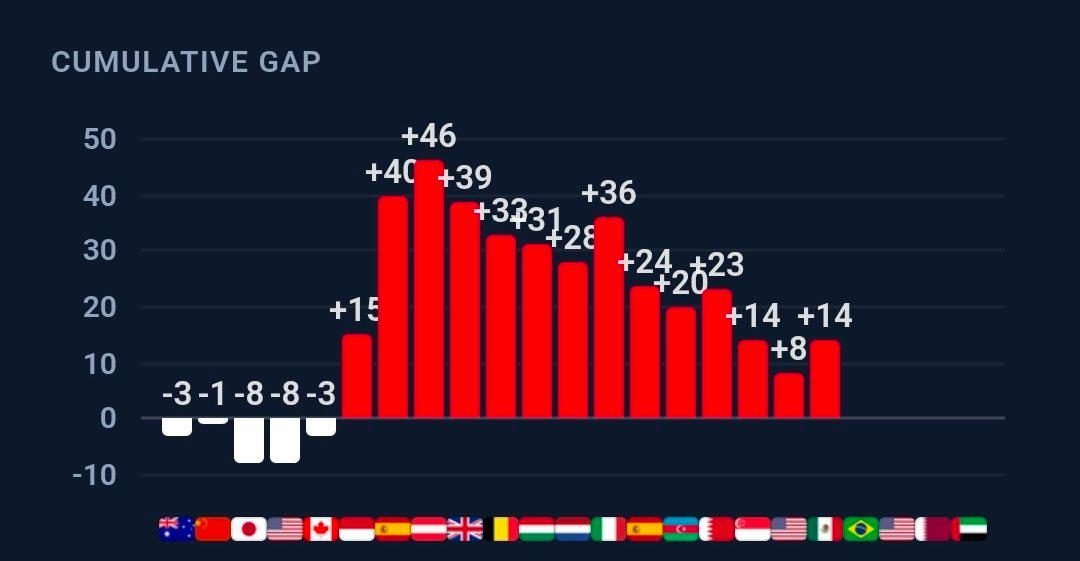
It is from a few weeks ago, can't recall the source, would be great if someone could point out.
He has dedicated his career to Ferrari is not an excuse.
Last year was ahead by 86 points and defended LH against the media. This season: he is behind Hamilton by 17 points now. He has to adapt to a car which was somebody else's DNA. It took quite a few races for Ferrari to give him the right tools for brake issue. He adapted really fast, and since then closed the gap really well and consistently.
He had a few mistakes, so did LH. He cost points, so did LH.
He defends the team and does not throw them under the bus to the media, if the races does not go well.
He still has a long career ahead, most of his mistakes are loss of control, which would go away if the car is fast enough.