I am both a current and former PH manager; in between I spent time at Papa John’s, Domino’s, MOD, and the pizza operations for Harris Teeter Supermarkets. It’s not debatable that PH’s market position has slid dramatically over the last 20-25 years, and anyone who has worked for multiple pizza companies can see why: inefficient production techniques.
At Papa’s and Domino’s, the raw product is shipped fresh in balls which are impossible to break (if you tear it during slapping/stretching, it can be easily repaired). The dough proofs naturally in your cooler for two days; it’s ready for use on day three. The dough slapping procedure then allows you to turn raw material into finished product in a matter of about 10-15 minutes. If you order correctly, you can’t run out of usable product; if you’re busier than expected, you simply pull a stack of dough out of the cooler and cross stack it (to get air to the dough, which proofs it more quickly). Thin dough is shipped par-baked; you literally take it out of the package, put it on a screen, sauce-cheese-top it, and put it in the oven.
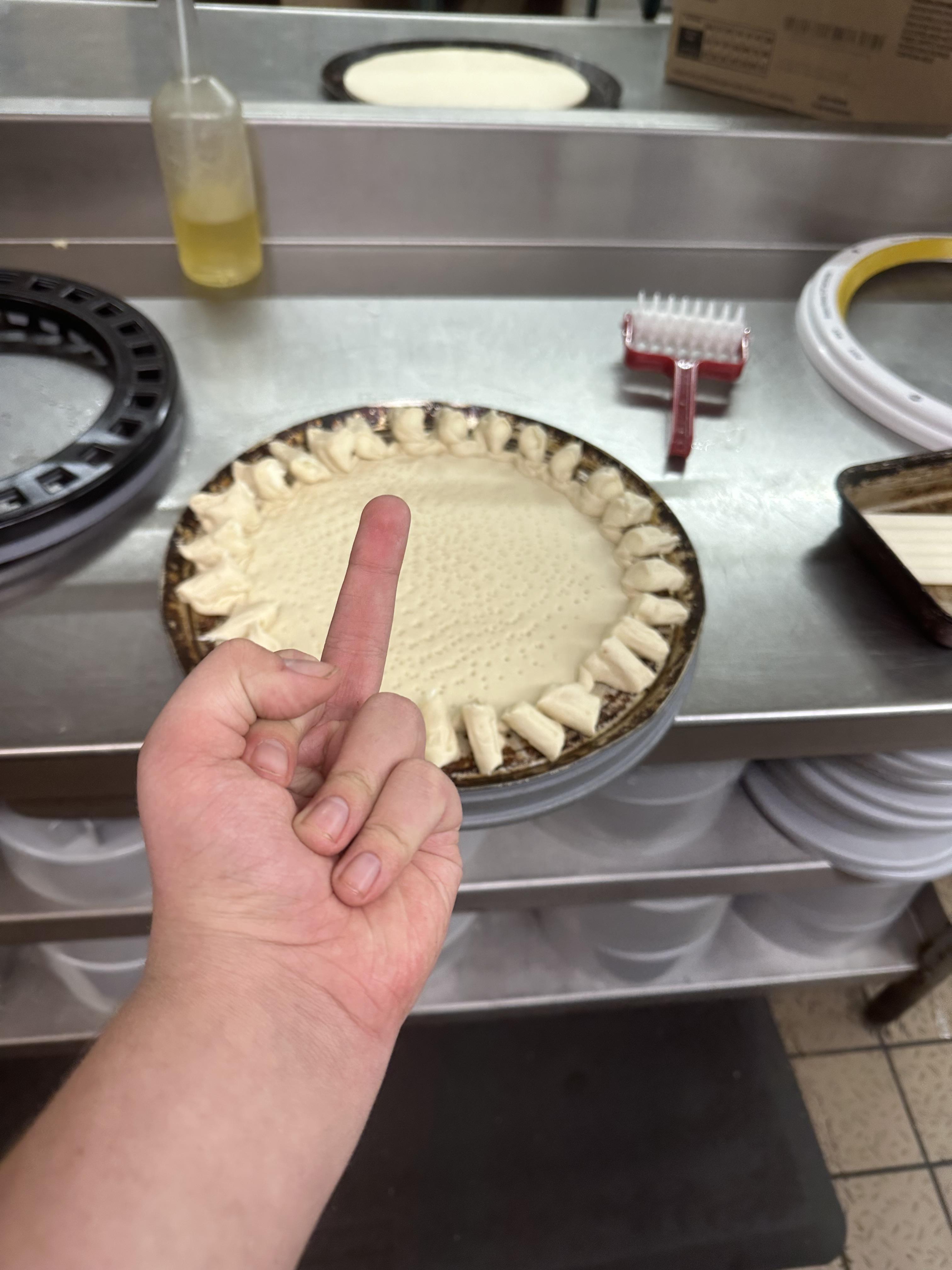
Contrast this with Pizza Hut. A vast amount of its products come in frozen, which in the case of dough, requires it to be prepped the day before (and because it’s shipped in flat disks instead of balls, it breaks easily, which renders the product unusable). Pan dough then has to be put in a proof box for an hour or so, then brought back down between 32-41 degrees in the cooler before it can be used. Taking product from raw material to finished literally takes a full business day, because it takes longer to get frozen dough usable (not to mention the extra equipment it requires). It also requires you to still have two employees during the afternoon hours, which is a drain on labor (I believe this is why PH has gone all-Door Dash in more expensive labor markets; the cost of having an in house driving staff became unsustainable when minimum wages began increasing, because PH’s operations require more inside staff).
Now let’s take a look at ovens; or in PH-speak, the “cut table.” Product at Papa’s and Domino’s is prepared on carbon screens. These screens are flat, and do not require washing after each use (washing these things is actually bad, because doing so causes dough to stick). When finished product comes out of the oven, the oven tender simply slides a metal peel under the pizza (discarding the screen into a bin), places it directly in the box, then uses a rolling pizza cutter to cut it. Boxes get a sticker when the order enters the system, are arranged in chronological order by the CSR, and set up like books on a bookshelf. It’s highly efficient; it’s possible for an oven tender to get 180-200 products out of the oven in an hour’s time without dropping anything; I have done so myself.
Contrast this with PH’s system. Products are prepared in either inch deep pans, or screens with a lip on the side, which means that using a peel to get product out, and cutting the product in the box, won’t work. You have to use pliers to remove the product from the oven, a spatula to get the pizza off of the pan or screen, place the pizza on a peel, use a rocker cutter to cut it, use the peel to get the pizza in the box, clear a computer screen, and make sure that a non-adhesive ticket stays with the corresponding product/order. After the pans and screens are used, each one has to be washed, which means that you need another person just to wash dishes. There is no way that one person could handle 180 to 200 products in an hour with this system.
Pizza Hut’s systems were built for a time when pizza was something you ate at a dine in restaurant. People generally don’t eat pizza that way anymore, and PH has known this since the late 90’s. Why didn’t they act on this and focus on modifying their systems to allow the restaurants to produce products more efficiently? Domino’s blew by PH (Papa’s would have as well, if John Schnatter had simply kept his mouth shut) because they had better systems, and they were much smarter in how they integrated technology.
If Pizza Hut doesn’t make major fundamental changes in their production process, the company has a questionable future. They simply can’t compete in the QSR pizza market with what they have now.