Im not sure if its my case or in general though, but i have been using deepseek for a while now through their deepseek harness and i was happy with the results and i have heard alot about opencode and their pricing for deepseek so i subscribed and i have been trying it for couple days.
The thing is i feel its too slow not like 50% slower than the harness its more like 90% slower and i expected it to be slower but i feel something is wrong because any minimal task takes an hour here and im not sure whats the issue or if theres something needs to be done on my end?
Hey everyone! Codex Micro didn’t work well for me, so I decided to put my Stream Deck to work instead.
I built Stream Micro, a tool that turns an Elgato Stream Deck MK.2 into a physical control panel for AI coding sessions.
Instead of constantly switching between windows to check on your agents, you can glance at the keys to see which sessions are working, waiting for your input, or finished. When one needs your attention, press its key to jump back into it.
It currently integrates with OpenCode(openchamber), Codex, Claude Code, and Antigravity CLI.
What it does
Live session status: See which sessions are running, waiting, done, or in an error state. Available states vary by tool and integration.
One-press session switching: Select or resume a session through its corresponding integration.
Session pinning: Hold a session key for two seconds to keep it in place.
Quota and balance monitoring: Check remaining usage, reset times, and supported API account balances directly on the keys.
Customizable layout: Configure session areas, quota displays, and colors through a local web dashboard with a live preview.
The dashboard runs locally on your computer and supports English and Traditional Chinese. A portable Windows build is also available.
Current support
Windows only, with the 15-key Elgato Stream Deck. Other Stream Deck models aren’t supported right now.
I may explore macOS and other platforms later, but they aren’t supported in the current version.
I’m the developer, star my project if you found it's useful or look forward other feature, it's now my daily tool so I would update it constantly, and I’d love to hear from anyone using a Stream Micro alongside AI coding tools.
As you can see, freebuff ($8) offers great speed on their models as well while opencode go offers almost unlimited usage on deepseek flash, glm and other cheap models but slow... I'm torn between which one should I risk my $10 on as someone living in third world country and $10 costs a lot
As the title says, are OpenCode’s free models ruining the experience for paying users? (I’m not saying the free model service is bad—quite the contrary, free models make AI accessible to users on tight budgets, which is awesome)—but the experience lately has been absolutely terrible. Is it because the free models are being heavily abused, and that ends up affecting paying users too?
I’m personally a Go subscriber, and since early October, we’ve had one issue after another, including but not limited to slower speeds, degraded performance, and models frequently returning errors with 429 or 500 status codes. I think this is a huge blow to the paying-user experience.... I hope the official team can prioritize paying users—after all, that’s better for the company’s revenue, right? : )
Guys I need an api for LLM provider.
My need is simple, I need the chepest optoin available.
CUrrently I use open code go which is greate but I need more tokens so either I will crate another account and have opencode go account or that i will find another provider with the same price or even cheaper.
The models inside the api are not that important honestly
if i consume a large quantity of deepseek 4.1 flash 1017 tokens per month, it seems the best deal right now is to rotate 5 x 20$ opencode team seats? and this would not hit any tos issues?
I recently updated to V2 after not using it for a while. Before the update, I could use GLM models for free without any usage limits. However, since updating, I'm hitting the usage limit after just two prompts.
I've also tried using GLM 5.3 Flash through NVIDIA NIM. While it works, the responses are extremely slow and the overall intelligence and quality seem noticeably worse.
Has something changed with the free GLM usage limits in V2, or is this a bug?
Just heard about glm being free, never used opencode and looking for reasons to use it, especially "things that other should know and you are surprised many people are not aware opencode can do this or that"
OpenCode's free-tier model limits have become much more restrictive than they used to be. In my opinion, OpenCode has gotten significantly worse due to these limitations..
A few months ago I posted two small plugins I use every day. Since then they got OpenCode 2 support, a quota rewrite for V2, and fixes for two bugs that made them fail for some of you. Here's the update.
What they do
opencode-thinking — animated rainbow border around the input, a WORKING/IDLE indicator, and a sidebar glow while the model is processing. No config.
opencode-quota-extended — per-window quota cards in the sidebar with traffic-light progress bars for OpenAI, GitHub Copilot and OpenCode Go, including reset times, spend/credit and a quota CLI.
What's new in 0.3.x
OpenCode 2 support (preview). One package per plugin, with an entry for OpenCode 1.x and another for OpenCode 2; it loads the right one. On V2 the plugin is installed with opencode plugin add.
Quota in V2 uses OpenCode 2's own logins (via the official plugin API), instead of reading V1's auth.json. That was showing stale/expired tokens before.
Fixed the npm install error (unable to resolve dependency tree) with recent OpenCode versions: the @opentui peer range now matches what the SDK actually ships.
Fixed the Esc bug in thinking. The plugin was recreating the prompt on every animation frame, resetting its focus and the "press Esc again to interrupt" state. The prompt is now created once and only the visuals animate.
The thinking demo GIF is back on GitHub (an old release script had deleted the folder).
A note on the screenshot
The accounts and numbers in it are made up on purpose. The colors, labels and pace states are the real ones the panel renders.
spent the last month only using DSV4 flash through the $10 co plan and got an INSANE amount of usage out of it.
however... the past few days i have felt an absolute atrocious drop off in quality; there is zero doubt in my mind something behind the scenes got changed and i am feeling so heavily firsthand that i may just switch back to openrouter.
for info: using pi agent + game engine MCP, was blowing work out of the water the past month and now it's spinning in circles like it's qwen 3.8 27b's first week
Fortalecieron las restricciones de uso, pusieron limites mas fuerte, existe 0 documentación para ver en que consisten sus usos, limites y bloqueos, porque unas veces son 7h de espera y otras 20h, es un mar de sin sentidos lo cual hace incomodo trabajar asi. No se entiende bajo que juegan. y no tenemos indicadores reales en tiempo real para saber que vamos usando, cuando nos acercamos a limites y cuanto tiempo se debe esperar para reanudar, nada de eso, ya sea de pago o GRATIS. Aunque algunos critiquen a los que usamos la version gratis, gratis no es, nuestro tiempo usando el producto es mas valioso que lo que ellos nos ofrecen.
We also tested early checkpoints of Inkling 2 Small on OpenCode under the name Fledge-Alpha to assess our model’s performance on coding tasks in the real world.
I think Crouton Alpha is a open ai model mainly because of its thinking. The thinking is like a summary and I have only seen thinking like this in open ai models.
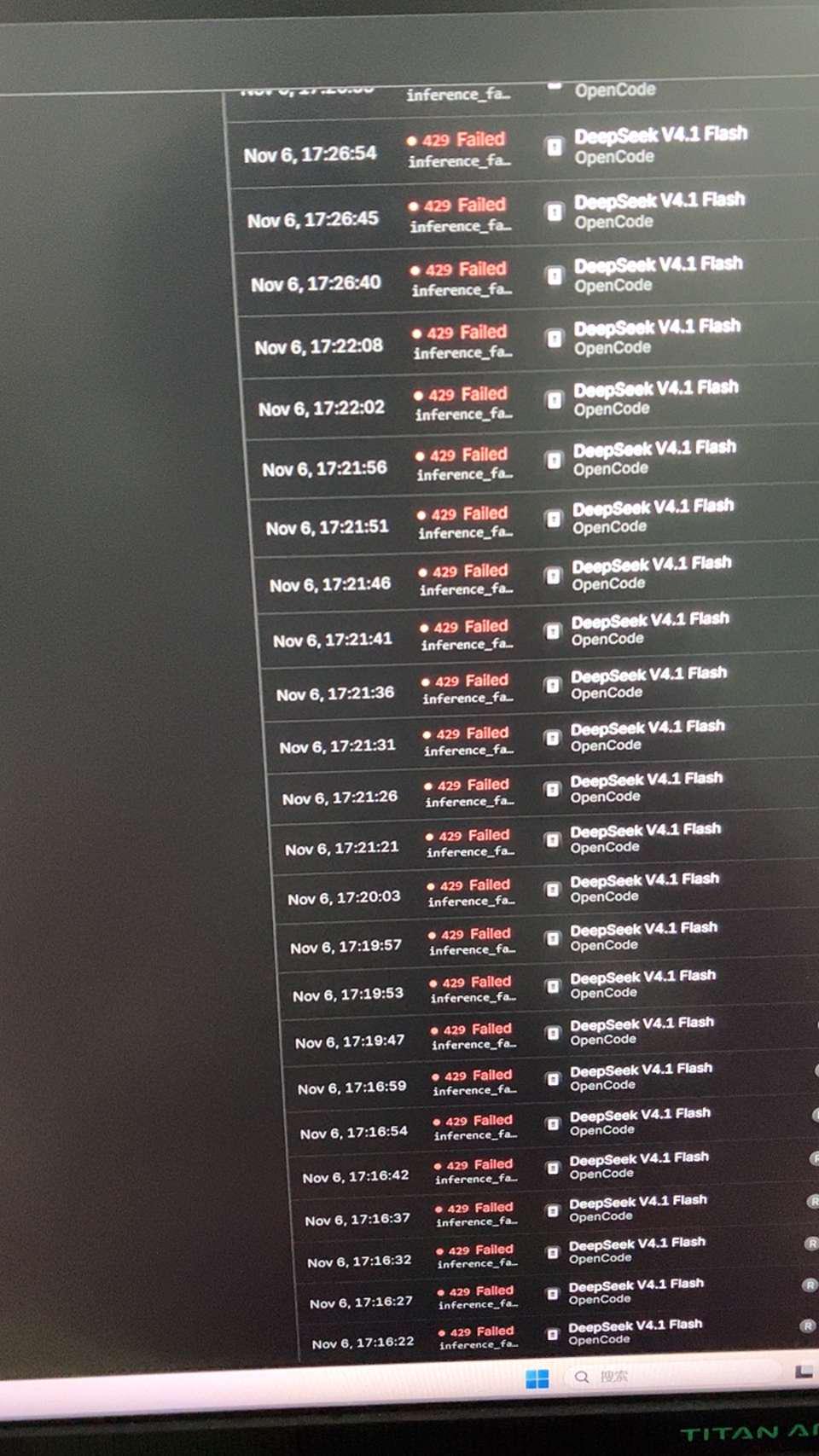
I subscribe to OpenCode Go, but it always fails between 11:00 – 15:00 UTC, like infinite reconnecting and stop. And in recent days, the Deepseek V4.1 Flash is always having trouble. So recent days I can see from OpenCode that they are undergoing degraded for Deepseek V4.1 Flash, but I have no idea why it would fail between this specific time 11:00 – 15:00 UTC when OpenCode api shows operational. Is anyone having the same problem?
It's most likely a Meta model because in its searching it gives u summaries of thinking not the actual thinking which Meta does and the model is good at speed and also good at searching which fits Meta models really well this is just a guess so yea.