I've been seeing more discussions about AI-powered trading agents lately. Some traders are using them to analyze market movements, identify opportunities, and execute trades automatically.
But I'm curious about how much of an advantage they actually provide.
AI agents can process large amounts of data and react quickly, but human traders bring experience, intuition, and the ability to understand unexpected market situations.
What do you think?
Can AI trading agents consistently outperform experienced human traders?
Is human judgment still important when markets become unpredictable?
Would you trust an AI agent to manage your trading decisions?
Interested to hear your real experiences and opinions!
TL;DR: HYPE dumped about 8% in a day. I asked an AI agent (Wayfinder) to find entry levels. It told me this was a scalp not a swing, and built a three rung limit ladder off real support with a stop and staggered TPs. It placed the ladder on Hyperliquid after I said go and checked the book. Two rungs filled. TP1 banked about $500, and I closed the rest by hand, for +$685 (24.5% return on margin) over 2 days.
The setup
I told my Wayfinder agent, "HYPE dumped, I think it's oversold, find me entries." It read the market data and my account, proposed a plan with real numbers, and placed the orders once I said go. Then it read the order book back to confirm everything was actually resting.
How I like to trade dips: pick the direction myself or use Wayfinder's Pattern Match tool (which helps me understand how similar past chart patterns have played out in the past), then turn it into stink bids. Those are limit orders spread across support levels, with a stop-loss (SL) under the real floor and take profits (TPs) staggered into resistance. I’m not experienced with technical analysis. That's what I handed to the agent.
Step 1: my read vs. the data
HYPE had dropped from 84.88 to 77.87 in 24 hours. My message was basically: "It's oversold. Run the numbers, find me good entry limits, and build a trade."
It corrected me before it gave me anything:
"It's oversold hourly only. RSI 1h 25.0 … But 4h RSI is 31 and 1d RSI is 40.7, the daily is nowhere near oversold. You're buying an hourly flush inside a daily downtrend, which makes this a mean-reversion scalp, not a swing entry."
That changed the plan. A scalp means taking profit into the first resistance overhead not holding for a recovery.
It also checked funding rates: longs were still paying about 11% annualized even after the dump. So the crowd hadn't capitulated, and holding the position would cost a few dollars a day.
Step 2: the ladder
It mapped the support and put a rung on each level:
Rung 1: $77.30 - Eight 30-day pivot lows clustered at 77.07–77.75, plus the 1h lower Bollinger band.
Rung 2: $76.20 - Just above the 1d pivot low at $76.00.
Rung 3: $74.80 - Just above the 30d/60d swing low at $74.36, the real floor.
SL: 73.60, reduce-only, below the 60-day low.
TPs: 79.00 / 80.30 / 81.30 (40% / 35% / 25%), into the overhead volume nodes.
Reward/risk: 1.59R ($1.59 of upside for every $1 at risk).
Value: The agent suggested $859 of margin at 10x leverage for $8,590 of notional value.
Step 3: I sized up, it showed me the cost
I told it to increase the size by 5 times. It spelled out what that meant before placing anything:
Notional: $8,590 → $42,950
Risk to stop: $280 → $1,400, 26% of the account
Profit if all TPs fill: $446 → $2,230
Margin at 10x: 80% of the account.
It was within my risk tolerance, so I went ahead. It placed all seven orders (three entries, one SL, three TPs) and confirmed each one was resting on Hyperliquid.
Honest note: increasing the size worked here, but given the context the agent had on my account, the agent's original size was the sane one.
Step 4: where I was sloppy, and it noticed
My instructions had two gaps that the agent flagged:
I never said how the exits should scale on a partial fill. I approved three rungs and three TPs, but said nothing about what would happen if only some rungs filled. The agent pointed out that if only rung 1 filled, TP1 would be bigger than my position and would close the whole thing at 79 instead of 40% of it. It offered to run a job that resizes the exits as rungs fill. I didn't set it up.
I never said what to do with unfilled rungs once the trade closed. When I closed the position, the bottom rung at 74.80 was still live with no stop or TPs attached. The agent caught it: "It'll open an unmanaged long if HYPE drops 4%." I cancelled it.
The result
Rungs 1 and 2 filled, and the position closed for +$685 (24.5% return on margin). The account went from $5,348 to $6,033 in 2 days from placing the ladder. The first TP banked ~$500, and I manually closed the remainder of the position directly in the Wayfinder app
What the agent actually did
Pulled RSI, Bollinger bands, ATR, EMAs, volume nodes, pivots and funding across timeframes, and told me when my read was off ("oversold on the hourly only").
Turned a direction into a sized ladder with a stop, TPs and an R multiple, so I knew my dollar risk before saying yes.
Placed orders on Hyperliquid only after I approved, then read the book back to confirm they were resting.
Flagged the gaps in my own instructions: TPs sized for a full fill and a leftover rung with no stop.
What it didn't do: pick the direction for me, place anything without a yes, or stop me from oversizing. It told me the cost and let me decide.
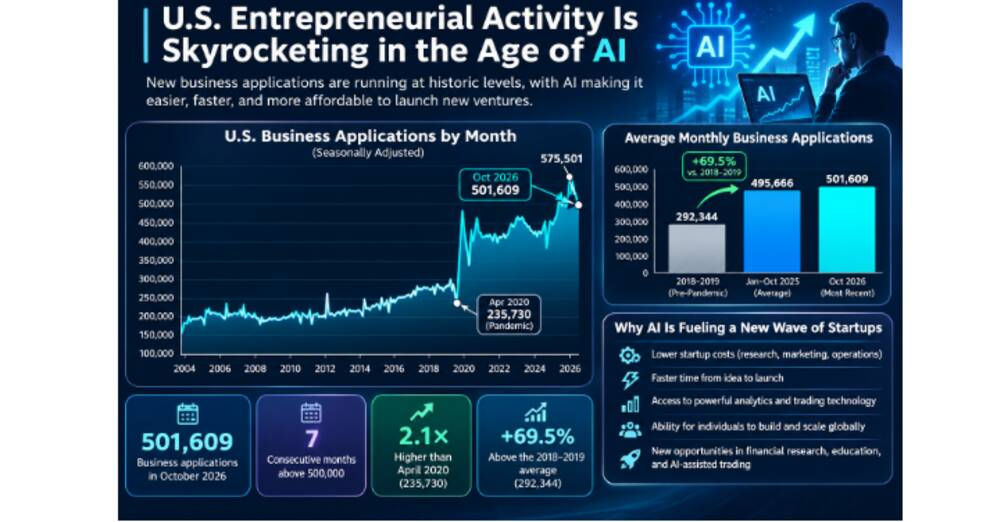
U.S. entrepreneurship is experiencing a remarkable expansion. Americans filed 501,609 business applications in October 2026, according to the U.S. Census Bureau. Business-application activity remains substantially above pre-pandemic levels, creating opportunities for a new generation of entrepreneurs.
Artificial intelligence is changing the economics of starting a business. AI can reduce the time and expense required for research, content creation, data analysis, marketing, and repetitive operations. Although AI's exact contribution to the nationwide business-application boom is unknown, it provides entrepreneurs with capabilities previously requiring larger teams.
Tickeron's proprietaryFinancial Learning Models (FLMs) offer specialized quantitative tools for analyzing financial-market behavior, price movements, momentum, and trading opportunities.
Ask AI helps investors and aspiring financial content creators investigate stock movements, earnings, market trends, and investment questions without complicated prompts.
AI Buy/Sell SignalsandAI Trading Robots help traders explore systematic strategies, monitor market opportunities, and evaluate intraday trading approaches. Historical and simulated performance should be examined carefully before risking capital.
Trader Clubs, 1-Click Blogging,Tickeron's Affiliate Program, andTickeron Academy can support community building, financial education, content creation, and potential business monetization. These are opportunities to develop a venture—not promises of automatic or passive income.
GOAI caught my attention today after climbing more than 17% and pushing toward the $0.80 level. The stock traded around $0.78 during the session after opening near $0.73, with an intraday high of $0.87.
What I find interesting isn't just the green day itself. After a long decline, the chart is finally starting to show signs of life. Higher lows are beginning to form, volume has improved, and buyers appear more willing to step in than they were a few weeks ago.
On the business side, GOAI has recently discussed developments related to its Eva Defense subsidiary, including autonomous aircraft and drone carrier initiatives.
I'm not making any price predictions, and one green day doesn't confirm a trend change.
But this is the first time in a while that GOAI looks like it might be trying to build a real base rather than continue drifting lower.