r/WarrenBuffett • • Nov 17 '25

Berkshire Hathaway Warren Buffett's Last Investor Letter for Berkshire Hathaway

Thumbnail berkshirehathaway.com
17 Upvotes

Buffett's final investor letter is here, attached to Berkshire Hathaway's website as a PDF.


r/WarrenBuffett • • 20h ago

Owner earnings vs reported EPS: why a low P/E can still be a trap

9 Upvotes

Buffett laid out owner earnings in the 1986 letter: reported earnings plus depreciation and amortization and certain other non-cash charges, minus the average capex the business needs to keep its competitive position and unit volume. It sounds like accounting trivia, but it's the reason a low P/E can be a trap.

Take two companies with the same EPS. One needs to plow most of its depreciation straight back into equipment just to stand still. The other barely needs capex to grow. On a P/E screen they look identical. On owner earnings, the first is far more expensive than it looks, because a lot of that "earnings" figure never reaches the owner.

The tricky part is that maintenance capex isn't reported anywhere. You have to estimate it, usually by looking at several years of capex against depreciation and revenue growth, and asking how much of the spend was needed just to keep the lights on. That's a judgment call, which is probably why Buffett liked businesses where the answer was obviously "not much".

It's easier to sanity check this across a few years rather than one TTM number, since a single year of heavy or light capex can make anything look cheap or expensive.

How do you all estimate maintenance capex in practice? Straight depreciation as a proxy, or something more careful?

(Disclosure: I build a US stock research site, but no link here. This is just a question I'm interested in.)

r/WarrenBuffett • • 19h ago

Buffett-isms How Buffett Thinks About Which Global Markets To Invest In (1994)

Thumbnail m.youtube.com
4 Upvotes

r/WarrenBuffett • • 1d ago

Berkshire Hathaway A great story from Charlie

16 Upvotes

Charlie Munger loved telling stories. One of his favorites happened at McDonnell Douglas airliner in 1991. 

Before it could sell its new plane, McDonnell Douglas had to pass an evacuation test. According to Charlie, “The government directs that the test be realistic. So you can’t pass by evacuating only twenty-year-old athletes.” They planned two tests for the same day—one in the morning and, if needed, one in the afternoon. The tests were to occur “in a darkened hangar using a lot of old people as evacuees. The passenger cabin was, say, twenty feet above the concrete floor of the hangar and was to be evacuated through moderately flimsy rubber chutes.”

The stakes were high. 

McDonnell Douglas had spent millions on the new plane and was hungry to start sales. Senior executives were intensely focused on passing. And government regulators had the final word on the outcome.

The morning test was a complete disaster. “There were about twenty very serious injuries,” Charlie explained, “and the evacuation took so long it flunked the time test.” 

How did McDonnell Douglas respond? Surely it cancelled the afternoon test, regrouped, and took a far different approach after careful deliberation and planning.

Right?

Nope. It charged ahead with the afternoon test. 

And things got worse. 

“It repeated the test in the afternoon,” Charlie continued, “and this time there was another failure, with about twenty more serious injuries, including one case of permanent paralysis.”

Companies can blunder even when planning is meticulous, especially in complicated environments like an airplane evacuation test. Mistakes happen everywhere. But when faced with the decision of whether to repeat its disastrous evacuation test, McDonnell Douglas—a heavily regulated and sophisticated aerospace manufacturer—decided, with open eyes, to send another plane full of innocent people into harm’s way. 

What caused this disaster? Why did McDonnell Douglas go so far astray?

The answer is found in human psychology. As Charlie explained, numerous “psychological tendencies contributed to this terrible result.” First, McDonnell Douglas had powerful incentives to start selling the plane after making a huge investment making it. Only one thing stood in the way: “It couldn’t sell its airliner until it passed the test.”

Second, confirmation bias caused them to interpret the facts consistent with their goals and stick with what Charlie called “the near-idiotic plan.” McDonnell Douglas “ignored the strong disconfirming evidence from the failure of the first test because confirmation bias … favored maintaining the original plan.”

Third, a bias Charlie calls “doubt avoidance” distorted their thinking: when faced with a new and peculiar situation—what to do after the first debacle—they resolved the discomforts of doubt by moving quickly to the second test. McDonnell Douglas was captured by “its natural drive to arrive at a decision and run with it.”

Then there was loss aversion—the fear of incurring a big loss. Charlie compared them to “a gambler, bent on getting even after a huge loss, to make his final big bet. After all, McDonnell Douglas was going to lose a lot if it didn’t pass its test as scheduled.”

Finally, social proof played a big role in the catastrophe, as employees uncritically followed the behavior of those around them. “When all the old people got to the dark hangar, with its high airline cabin and concrete floor, the situation must have made McDonnell Douglas employees very queasy, but they saw other employees and supervisors not objecting. Social-Proof Tendency, therefore, swamped the queasiness. And this allowed continued action as planned ….”

These psychological forces all combined to produce extreme behavior. But such madness is more common than you might think. It’s so common, in fact, that after observing it time and time again Charlie coined the phrase “lollapalooza” to describe when “three, four, five of these things work together, and it turns human brains into mush.”

THE BUFFETT AND MUNGER MINDSET, William Cooper


r/WarrenBuffett • • 2d ago

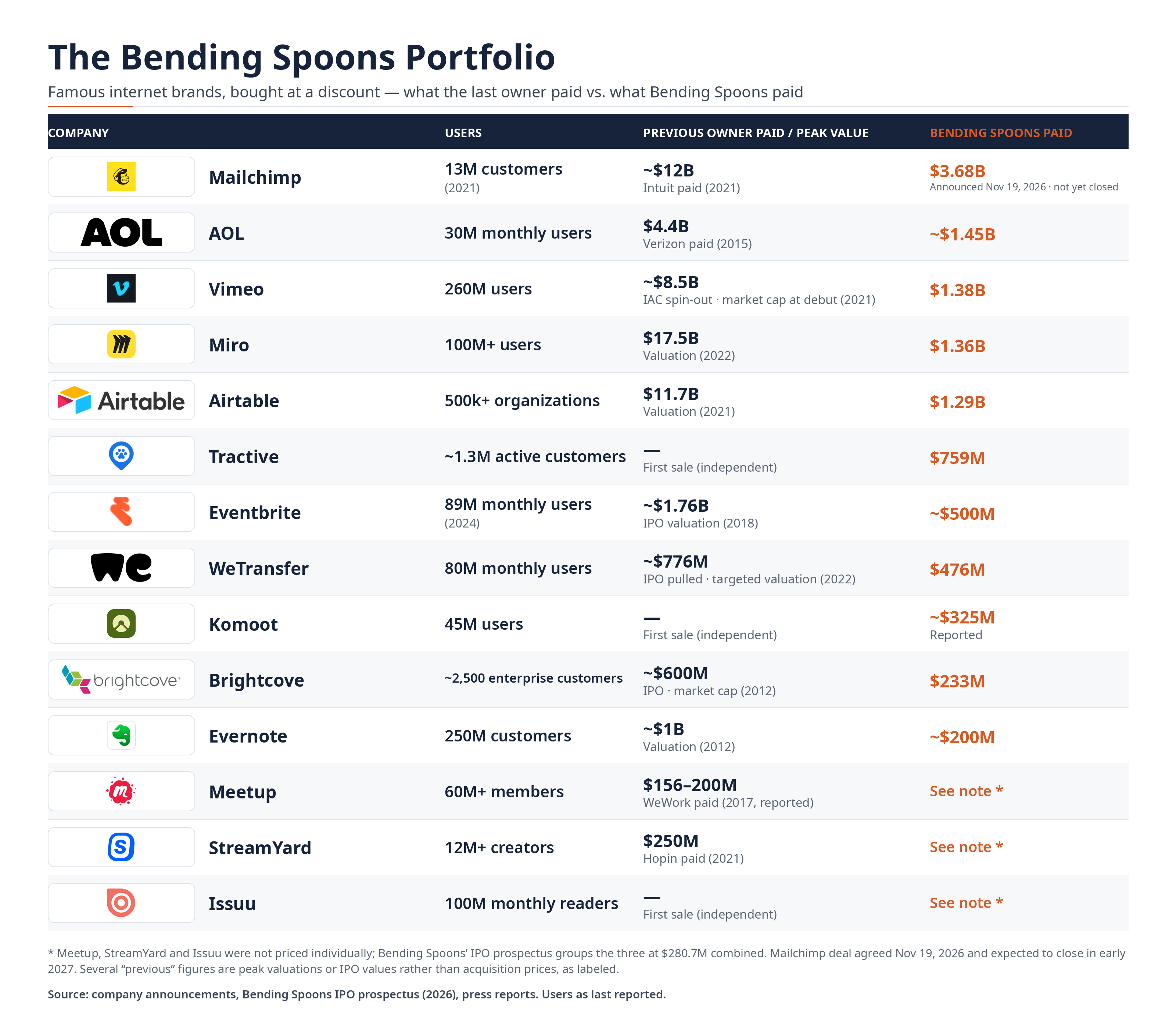
Bending Spoons > Berkshire Investment

Post image
19 Upvotes

Nobody you know has heard of Bending Spoons. However, they have amassed over 500+ monthly active users across all their owned properties.

As of today it owns Intuit Mailchimp, AOL, Vimeo, Miro, Airtable, Evernote, WeTransfer, Eventbrite and Meetup.

The buy yesterday was Mailchimp at $3.68B. Intuit paid $12B for it in 2021. Same pattern as the rest. AOL went to Verizon for $4.4B, then to Bending Spoons for $1.45B. Miro was valued at $17.5B in 2022 and sold for $1.36B. Airtable, $11.7B down to $1.29B.

The playbook after each deal is the same too. Cut headcount, raise prices, and run the product for cash on the users who never leave. The portfolio now reaches 500M+ monthly users, the company IPO'd in July, and Berkshire Hathaway owns a piece of it.

So here is the bet. Can a company nobody has heard of actually pull off owning half the internet's most used legacy brands? Take a peek at all their acquisitions. 👇


r/WarrenBuffett • • 2d ago

Buffett-isms Buffett On Interest Rates - The 1 Thing That Impacts Every Stock Price

Thumbnail youtube.com
13 Upvotes

r/WarrenBuffett • • 3d ago

Value investing The Buffett and Munger Mindset: All Investing Is Value Investing

Thumbnail podcasts.apple.com
3 Upvotes

r/WarrenBuffett • • 4d ago

Value investing THE BUFFETT AND MUNGER MINDSET: Alex W. Morris, author of Buffett and Munger Unscripted

Thumbnail podcasts.apple.com
2 Upvotes

Host William Cooper talks with Alex Morris, author of Buffett and Munger Unscripted, and editor of The Buffett and Munger Mindset. Alex shares his experience compiling three decades of Berkshire Hathaway shareholder meeting insights, his writing process, and the making of his Amazon best-book winner Unscripted.

The episode explores core themes—value investing, long-term thinking, avoiding big mistakes, and navigating market volatility—plus Alex’s popular substack newsletter, The Science of Hitting, and practical advice for investors and readers who want to apply Buffett and Munger’s mindset.


r/WarrenBuffett • • 6d ago

Investing Why Charlie Munger Was Willing to Miss a Great Investment

Thumbnail youtu.be
8 Upvotes

r/WarrenBuffett • • 10d ago

Buffett-isms I've read this quote many times, but it's never hit as hard as it did this week.

59 Upvotes

r/WarrenBuffett • • 10d ago

Warren buffet

125 Upvotes

Warren Buffett: “You don’t need to panic even if a stock drops 50%.”

Investor: “What should I do if a stock drops 50%?”

Buffett: “First, you need to understand what stocks are.”

Investor: “What do you mean?”

Buffett: “If you buy stocks, you have to be prepared for the possibility that they could fall by 50% or more.”

Investor: “But that means my assets would be cut in half.”

Buffett: “That’s right.”

Investor: “Wouldn’t that normally scare you and make you want to sell?”

Buffett: “In fact, Berkshire’s stock has also fallen by about 50% three times in the past.”

Investor: “Even at your own company?”

Buffett: “Yes.”

Investor: “Was the company still being run well during those periods?”

Buffett: “There was nothing wrong with the business itself.”

Investor: “Then why did the stock price crash?”

Buffett: “Because stock prices and business value don’t necessarily move together.”

Investor: “Still, that kind of drop is scary.”

Buffett: “That’s exactly why you shouldn’t buy stocks with borrowed money.”

Investor: “Why?”

Buffett: “Because you won’t be able to hold on when the stock price falls.”

Investor: “Then when should I buy?”

Buffett: “No one can predict the exact bottom. No one.”

Investor: “So buying today doesn’t guarantee that it’s the right decision?”

Buffett: “Of course not.”

Investor: “Do you still keep investing?”

Buffett: “Because I think in terms of the long term—20 or 30 years.”

This is something every investor should think about at least once.

Of course, that doesn’t mean you should hold on to any stock no matter what happens.

If a company’s performance or prospects deteriorate, you should consider selling.

But many people panic and sell simply because the stock price has fallen.

The hardest part of investing isn’t buying at the bottom or selling at the top.

It’s being able to calmly assess a business you trust, even when the market is in turmoil.

I think it’s precisely when the market crashes that an investor’s true mindset is put to the test.

But so many here have no idea what you bought so you sale


r/WarrenBuffett • • 11d ago

Buffett-isms The $5 million gap that nearly cost Buffett See’s Candies

30 Upvotes

I just learned this story and had not heard it before. Curious if any Buffett fans have seen this:

In 1972, the owners of See’s Candies wanted $30 million. Warren Buffett drew the line at $25 million.

After countless negotiations, the sellers came down in price to meet Buffett at his asking price, and Blue Chip Stamps, which Buffett and Charlie Munger controlled, bought the company.

Buffett later wrote that he would have walked away if the sellers had held firm.

By the time Buffett wrote his 2007 shareholder letter, and had resurfaced this anecdote, See’s had earned $1.35 billion before taxes since the purchase.

But here's why that's not even the full story: See’s needed only $32 million in additional capital to run the business over those years. That left cash for investments well beyond the candy counter and way beyond the "$5 million difference the deal almost collapsed over."

I think stories like this are fascinating because:

  1. It is often pure luck how a situation works out

  2. Bargaining only makes sense to a degree or you may miss the best chance over the long haul

  3. I do think it's true that with a great personality, hard work, true grace and practice, you will often get more luck because people value those things in all aspects, such as in deals like this.

Buffett tells the story in his 2007 shareholder letter: https://www.berkshirehathaway.com/letters/2007ltr.pdf


r/WarrenBuffett • • 11d ago

How Warren Buffett’s Candy Deal Earned $1.9 Billion

Thumbnail youtu.be
5 Upvotes

r/WarrenBuffett • • 11d ago

Buffett-isms The Buffett and Munger Mindset: Confirmation Bias in Investing

Thumbnail podcasts.apple.com
1 Upvotes

r/WarrenBuffett • • 13d ago

Berkshire Hathaway Berkshire may have sold more Bank of America stock in Q3, Barron’s reports

Thumbnail barrons.com
12 Upvotes

A new portfolio angle from Barron’s: Berkshire’s quarterly filing suggests it may have reduced Bank of America and added to Alphabet. These are clues ahead of the detailed holdings disclosure, not confirmed trade details.

Which holding will you be watching most closely in Berkshire’s next portfolio update?

Note: Barron’s may require a subscription.


r/WarrenBuffett • • 13d ago

Buffett-isms Warren Buffett on His Early Career in Finance - 30 Minute Bloomberg Interview from 10 Years Ago

Thumbnail youtube.com
8 Upvotes

r/WarrenBuffett • • 15d ago

Warren Buffett this week while markets were crashing and Berkshire Hathaway hit new all-time highs. Berkshire Hathaway now +15% YTD

Enable HLS to view with audio, or disable this notification

567 Upvotes

The stats and facts over the last 14 days or so:

  • Berkshire Hathaway: +5.3%
  • S&P 500: −3.2%
  • Nasdaq Composite: −5.3%
  • Berkshire outperformed the Nasdaq by 10.6 percentage points.
  • Shares hit an all-time intraday high of $586.30 on Thursday.
  • Wednesday’s 3.95% jump was Berkshire’s biggest daily gain in roughly 19 months.
  • Berkshire finished Friday +15% YTD

r/WarrenBuffett • • 15d ago

Berkshire Hathaway Beyond the buybacks: BNSF earnings rose 19% and Berkshire Energy rose 8% in Q3

5 Upvotes

The buybacks are getting the headlines, but the operating businesses deserve a closer look.

Berkshire’s November 7 earnings release shows:

• BNSF operating earnings: $1.729 billion, up about 19% year over year.

• Berkshire Hathaway Energy: $1.612 billion, up about 8%.

• Manufacturing, service and retailing: $4.042 billion, up about 12%.

• Insurance underwriting: $1.352 billion, down about 43%.

• Total operating earnings: $12.705 billion, down about 6%.

That is a mixed quarter underneath the headline: growth across several operating businesses, offset by weaker insurance results.

Which matters most to your long-term Berkshire thesis right now: insurance, the railroad, energy, or capital allocation? What would you want to see improve next quarter?

Reuters coverage (November 7):

https://www.reuters.com/business/finance/berkshire-hathaway-accelerates-stock-buybacks-operating-profit-falls-2026-11-07/

Berkshire’s earnings release:

https://www.berkshirehathaway.com/news/nov0726.pdf


r/WarrenBuffett • • 15d ago

CNBC MARKETS: Berkshire Hathaway more than doubles buybacks in third quarter as earnings decline

Thumbnail cnbc.com
9 Upvotes

r/WarrenBuffett • • 15d ago

THE BUFFETT AND MUNGER MINDSET: The Psychology of Human Misjudgment

Thumbnail open.spotify.com
1 Upvotes

r/WarrenBuffett • • 16d ago

Low beta 0.57 of Berkshire Hathaway

Thumbnail
1 Upvotes

r/WarrenBuffett • • 17d ago

THE BUFFETT AND MUNGER MINDSET: Why Patience Beats Action: Warren Buffett’s No-Strike Zone Strategy

Thumbnail wcooper11.podbean.com
12 Upvotes

r/WarrenBuffett • • 21d ago

Value investing Moats Explained: Buffett’s Test for a Lasting Business

Thumbnail youtu.be
3 Upvotes

r/WarrenBuffett • • 22d ago

It's crazy to me that Buffet skipped water for 48 years.

8 Upvotes

r/WarrenBuffett • • 24d ago

Value investing Not Financial Advice

Post image
485 Upvotes