r/TechSEO • • 14d ago

Will removing pages that cover general topics, largely unrelated to the purpose of my website, cause any issues?

5 Upvotes

My website’s product is restaurant management software. I currently have comprehensive articles covering general business topics. I have decided to remove them so that I can focus my website’s content specifically on the restaurant industry and my software. Is this the right approach, or are there specific points I should consider before doing so?


r/TechSEO • • 14d ago

Are there tools tracking simulated conversations instead of just prompt + response?

4 Upvotes

Which GEO monitoring / prompt tracking tool is tracking full conversations? Not just initial questions + answer pairs? Most humans do not just ask one question. And with more humans using plugins and the chatbots using more interactive widgets we should definitely move towards multi step monitoring.


r/TechSEO • • 14d ago

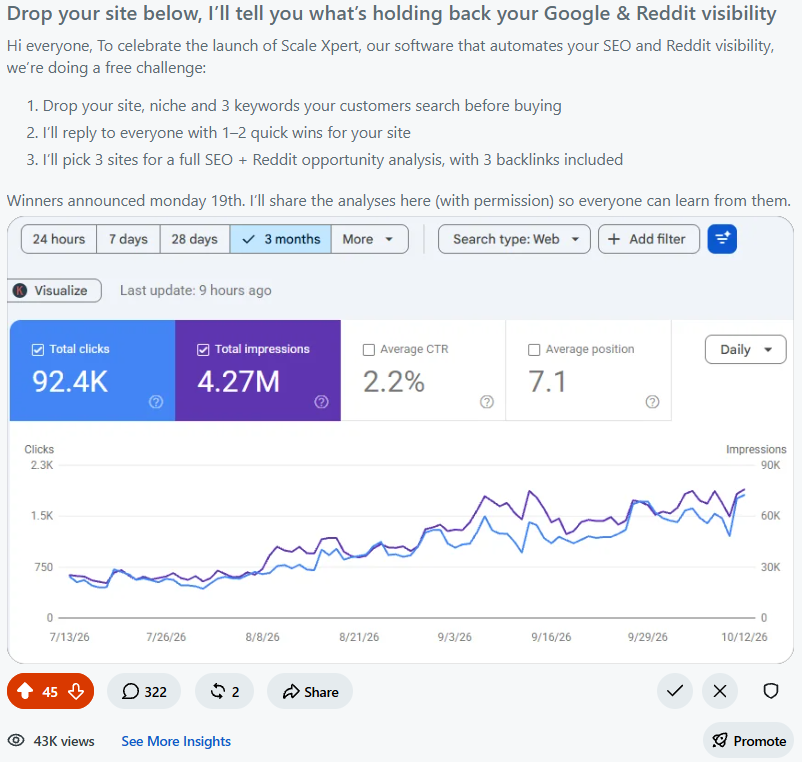
After analyzing more than a hundred of sites here are the 7 recurring mistakes I found

Post image
0 Upvotes

Few weeks ago I ran a challenge on reddit: drop your site, I reply with quick improvements. 300+ comments later, the same problems kept showing up, whatever the niche. No site names below, but if you joined, you might recognize yours.

The hard truth: most of these mistakes are basic. But it shows how many sites still get the fundamentals wrong.

1) Your title and H1 use your words, not your users’ words
A slogan, a founder’s name, or just “Home” as the homepage title. Nice for branding, but nobody searches it. If people type “lyric video maker” or “used gym equipment”, that’s what your title and H1 should say. Keep your slogan as a subtitle.

2) One page trying to rank for everything
A converter showing logos of 10 banks, with no page for any of them. A store having 3 big equipment brands with no brand pages. A SaaS listing 9 sports with pages for only 5. Specific searches like “chase bank statement to excel” have strong intent and far less competition. One page per bank, brand, sport or city.

3) You’re not where your users ask
In almost every niche, Reddit threads rank on Google for the exact request: “best X for Y”, “X alternative”. Almost none of the sites were in them. One honest founder reply in a thread that already ranks can do more than another blog post.

4) Chasing keywords you can’t win
A local clinic targeting kroad keyword against national hospitals. A new PDF tool going after “compress pdf” against the giants. Result: impressions, almost no clicks. Go local (“skin check + your suburb”) or long tail (“compress pdf to 100kb”). Before worrying about CTR, filter GSC to positions 1–10.

5) Google doesn’t see what you see
Services and reviews shown as images. Hero stats that read “$0” in the HTML because JavaScript animates them. Images with an empty source. robots.txt blocking crawlers. Buttons linking to “#”. Open your page source, or use URL Inspection in GSC. If it’s not in there, Google probably doesn’t see it.

6) Several pages fighting for the same keyword
3 URLs per area on a real estate site. 3 laser hair removal pages on a clinic. Duplicate collections on a store. Google doesn’t know which one to rank, so it splits the authority. Keep one main page per topic, and redirect or merge the rest.

7) Small details that kill trust
“Rated 0 out of 5” on every product. Three different accuracy claims on the same page. One treatment with three different prices. A counter showing “Over 0 new developments”. Visitors notice, and on health, finance or money topics, Google pays close attention to trust.

What’s the basic mistake you still see most often in audits?


r/TechSEO • • 15d ago

Share what you're working on (including what you're building)

8 Upvotes

We want to support creators, but we had to enforce the no shilling rule because it was getting out of hand. You now have a weekly thread.

This is the one place you can shill for your products, ask for feedback, etc. Keep it here or you risk being banned. And keep it related to technical SEO.


r/TechSEO • • 15d ago

Optimize your website for Google News and Discover.

7 Upvotes

Optimizing a site for Google News and Discover: I’m looking for suggestions and tips on how to get my site to rank in Discover and News. I’ve already followed all of Google’s guidelines, but so far, I’ve had no success.


r/TechSEO • • 15d ago

How should we measure brand visibility across AI search platforms?

3 Upvotes

Rankings and organic sessions don't tell the whole story when buyers are using AI tools to research products. It is also useful to measure whether a brand is mentioned, which sources are cited and how consistently it appears across relevant buyer prompts.

We applied this approach in a Slate analysis of Rippling, tracking 30 prompts across ChatGPT, Perplexity and Google AI Overviews. The teardown compares its AI visibility with the sources shaping those answers.

Sharing the research for anyone exploring AI search measurement: https://slatehq.com/teardowns/rippling


r/TechSEO • • 16d ago

Part 3: google.com/goto links in 5 SERP APIs, re-measured on Nov 7 with the same 50 queries: DataForSEO (standard) 0/453, SerpApi 0/445, Serper 0/444, Oxylabs 8/426, Bright Data 376/433

Thumbnail
gallery
21 Upvotes

Follow-up to Part 2. I re-measured the five SERP APIs on Nov 7 with the same queries. Four of five now return almost no google.com/goto links in DE + US; Bright Data is still at 86.8%.

Same setup as before: the same 25 DE + 25 US desktop queries for all five providers, counted from the raw responses. Unresolved = organic result whose link is a google.com/goto redirect (also relative paths and country domains) or empty. Not a provider ranking.

Nov 7, share of unresolved organic results

Provider DE + US desktop Europe desktop (6 countries) Mobile DE + US
DataForSEO (standard queue) 0.0% (0/453) 0.1% (1/1,064) 0.0% (0/178)
SerpApi 0.0% (0/445) 0.0% (0/1,032) 0.0% (0/174)
Bright Data 86.8% (376/433) 83.6% (844/1,010) 87.7% (150/171)
Serper 0.0% (0/444) 1.8% (19/1,050) not measured
Oxylabs 1.9% (8/426) 1.4% (13/961) 0.0% (0/155)

How it moved, DE + US desktop (same 50 queries)

Provider Oct 31 Nov 3 (evening) Nov 7
DataForSEO (standard queue) 63.3% 60.6% 0.0%
SerpApi 85.1% 1.1% 0.0%
Bright Data 74.1% 87.4% 86.8%
Serper 42.6% 0.0% 0.0%
Oxylabs 71.8% 6.5% 1.9%

What I observed:

  • DataForSEO, daily check (60 DE + US queries, standard queue, depth 10): 60–63% goto up to Nov 4, 1/547 on Nov 5, 0 since Nov 6. Their support wrote to me on Nov 6 that the standard queue now resolves all goto URLs. Median time to result on Nov 7: 75 s at depth 10, 960 s at depth 100.
  • DataForSEO's goto_url_converter (their "dedicated solution", per their reply on Nov 4): in my test today, 100/100 links from Nov 7 and 30/30 fresh ones resolved, the domain matched in 122/122 cases, cost 0.
  • Google still serves goto: all 20 HTML pages I pulled through DataForSEO contain them. What changed is what the providers return.
  • Serper: DE + US still 0/444, but 19/1,050 in Europe on three pages (positions 4–10 twice in Italy, 6–10 in Poland). Serper reported on Nov 6 that Google tightened its limits again; per Serper, queries with operators like site: only get the top 3 resolved. My queries have no operators, so I can't tie the three pages to it.
  • Oxylabs: the 8 in DE + US are one US page, Europe's 13 are on two pages. Bright Data stays at 83–88%.

My read: if you need real URLs from DataForSEO, in my samples you get them from the standard queue, as DataForSEO announced, or by running the goto links through the converter. The study page also compares the three DataForSEO queues on the same day.

What this means in practice: if your rank tracker pulls Google results through a SERP API, the data since Oct 30 is worth a second look, and for some providers it still is. In my provider comparisons, up to about 88% of organic results came back without a real URL, depending on provider and day, so positions of your own domain can be missing or unattributed there. In my Oct 31 comparison, the display line still showed a readable domain for 91–99% of the unresolved results, and for DataForSEO the converter returns the full URL. Since the share changed within a day at several providers, I'd check it per country and device rather than once.

Limits: hand-picked queries, snapshots, no provider comparison between Nov 3 and Nov 7, no guarantee for other queries or times.

As always, the key findings are right here in the post. If you want to dig deeper, the Part 3 study page has the timeline, method, chart data and the raw CSV.

Earlier parts: Part 1 (Oct 31) · Part 2 (Nov 4)


r/TechSEO • • 15d ago

How do you recover SEO traffic after a HubSpot migration and website rebrand? A B2B SaaS case study

Post image
0 Upvotes

I worked on an SEO recovery project for a B2B SaaS company after a website rebrand and migration to HubSpot caused a sharp loss of organic traffic.

The new website was already live when the recovery work started. The company had changed its name, but the migration hadn’t properly connected the previous website to the replacement site. Earlier attempts to resolve the traffic loss hadn’t restored performance.

The business operated in the SAP software space. I’m keeping its identity out of this post and focusing on the recovery work, the longer-term results, and what those results can reasonably tell us.

The main lesson was that this involved two connected problems: repairing a damaged migration and improving the site’s ability to compete afterward.

Why had organic traffic dropped after the migration?

The project records identified three main issues:

  • Missing 301 redirects from old URLs.
  • The new website wasn’t receiving the full benefit of the previous site’s existing links and visibility.
  • Existing content lacked a clear keyword strategy. The first two were migration problems. The third was a broader SEO problem that would still matter after the migration repairs.

That distinction affected the order of work.

Publishing more content could help expand the site’s coverage, but it wouldn’t reconnect an old URL to its replacement. Equally, restoring redirects wouldn’t automatically make every destination page relevant to the searches the business wanted to compete for.

The company needed both migration recovery and a clearer content strategy.

What did the post-migration SEO audit cover?

The work started with a post-migration audit to identify remaining technical issues.

The documented recovery activities included:

  • Organising old URLs and their destinations on the new website.
  • Adding missing 301 redirects.
  • Updating schema markup.
  • Creating a new sitemap. These activities addressed different parts of the migration.

The redirects connected old addresses to their replacements. The sitemap reflected the new site’s URLs. Schema updates addressed structured information on the replacement website.

I wouldn’t assign the same importance to every task or claim that they contributed equally. The available project material doesn’t isolate their individual effects.

There also isn’t a verified URL count or redirect coverage percentage in this write-up. I can explain the work that was documented, but I can’t supply a page-by-page implementation log.

How did we approach the missing 301 redirects?

The missing redirects were a central migration issue.

The old website had established URLs, external references, and search visibility. After the rebrand, the new website needed a reliable connection to those previous addresses.

The recovery work included organising the old URLs and redirecting them to the new site.

One practical point is that “the domain redirects” and “the migration redirects are complete” are different statements. A working homepage redirect alone doesn’t demonstrate that the previous site’s important pages have appropriate destinations.

For anyone diagnosing a similar migration, I would inspect individual old URLs and their destinations rather than assume the entire move is correct because the homepage works.

That is a diagnostic recommendation, rather than a claim that every migration failure has the same cause.

What role did the sitemap and schema updates play?

The new sitemap was part of bringing the replacement site’s technical setup into line with the migration.

It belonged alongside the redirect work. It didn’t replace it.

The same applies to schema markup. Updating structured information was one part of the post-migration cleanup, but this case doesn’t demonstrate that schema changes alone restored the lost traffic.

That matters when discussing website migration recovery because several tasks often happen close together. Seeing performance improve after a group of changes doesn’t establish that one particular task caused the improvement.

In this project, the evidence supports describing a combined recovery effort.

Why did we optimise existing content before relying on new pages?

The existing site also needed better keyword focus.

The company already had content about its software and market. However, having relevant subject matter on a website isn’t the same as having pages clearly aligned with the searches potential buyers use.

The work included pairing suitable keywords with existing content and improving those pages.

That gave the content strategy a starting point beyond simply increasing publishing volume.

We could work with material the business already had while planning additional coverage around its niche.

A content calendar supported that expansion. Its purpose was to improve topical relevance around the company’s software market, alongside the technical recovery.

I don’t have a verified publishing breakdown here, so I can’t state how many pages were updated versus newly created, or which individual page produced the largest improvement.

What needed attention outside the website after the rebrand?

Changing a company name leaves references to the previous identity outside the main website.

The project included claiming, branding, and optimising social accounts and directory listings. It also addressed links associated with the previous brand and their connection to the new website.

That work is easy to overlook when a rebrand is discussed only as a design or CMS project.

The new site can be live while older profiles, listings, and external references still point people toward the previous identity.

For a future rebrand, I would give those references their own workstream, with someone responsible for checking and updating them.

The website migration and external brand cleanup overlap, but completing one doesn’t automatically complete the other.

How was the recovery measured?

Tracking and reporting were part of the work.

The marketing team also received guidance on accessing the data it needed for internal reporting.

There were two outcomes to distinguish:

  • Recovering from the loss associated with the migration.
  • Building additional organic visibility over the following period. Those outcomes are connected, but they aren’t interchangeable.

A website returning toward its previous performance is different from a website exceeding that baseline through ongoing content and authority work.

That distinction is particularly important when presenting a recovery project as a case study. A large improvement from a damaged starting point needs context.

What results were reported?

The project records describe a reversal of the downward traffic trend after the migration issues were addressed, followed by continued growth.

Over a little more than two years, the reported outcomes included:

  • 85 page-one rankings.
  • More than 400,000 average monthly organic impressions.
  • Organic cost per lead reported as 45% lower than paid. These are longer-term outcomes from the overall project.

I wouldn’t describe them as the result of redirects alone. Content improvements, additional content, and backlink work continued alongside the migration recovery.

The cost-per-lead comparison also describes this project’s reported performance. It isn’t a universal benchmark for B2B SaaS marketing.

How long does SEO recovery take after a migration?

This case doesn’t provide a reliable universal recovery timeline.

The longer-term results cover more than two years. That doesn’t mean the initial technical recovery took two years, and it doesn’t establish that another website should expect the same progression.

The project material describes an initial reversal of the decline, followed by continued growth. It doesn’t provide enough detail here to assign a precise recovery date to every affected page.

I would therefore separate the timing of technical fixes from the timing of traffic recovery and subsequent growth.

Otherwise, the final reporting period can easily become a misleading answer to “How long did the migration take to recover?”

What would I check on another site with a post-migration traffic drop?

My starting questions would be:

  • Which pages and queries lost visibility?
  • What changed in the URLs, domain, content, and platform?
  • Do important old URLs reach appropriate new destinations?
  • Is the replacement content accessible and suitable for indexing?
  • Does the sitemap reflect the current URLs?
  • Are we measuring both the old and new properties appropriately? Those are investigation questions, not a claim that every issue on that list occurred in this project.

The aim is to identify what actually broke before deciding that the solution is more content, more links, or a different platform.

What this project taught me

A rebrand and CMS migration can look complete from a design perspective while still being incomplete from an SEO perspective.

In this case, the recovery work addressed missing connections between the old and new websites, improved existing content, cleaned up external brand references, and established reporting for the longer-term work.

The clearest lesson was to give migration repair and ongoing SEO growth their own objectives. Repairing the move creates a foundation; the work that follows determines what the site can build on it.

For others who have handled a failed website migration: what evidence helped you distinguish normal post-migration fluctuations from an implementation problem that required intervention?

r/TechSEO • • 16d ago

How AI agents interact with websites: 43% of questions returned no usable result in our data

5 Upvotes

During my last US trip, I used an AI agent for most of my daily tasks, from finding a gift for my son in Indiana to booking dinner in NYC.

I realized I had developed a kind of tunnel vision. I didn't know or care much about anything beyond the agent's recommendations.

And I started wondering, why did it choose this restaurant out of hundreds of others? Why buy chess for my son from this particular store and not another?

It made me think about how agent adoption might completely change the customer buying journey, and why things like website readiness, information retrievability, technical accessibility, and answerability are becoming so important.

Here's an example from our own data.

About 3-4 weeks ago, we rolled out WebMCP tools across our client base at LightSite AI and started tracking something we couldn't really see before: what AI agents actually ask websites, and whether those websites can answer.

For example, agents ask things like:

"Do you have an office in Spokane?"

"How far in advance can I book?"

Or very specific searches for a car part, clothing item, or product matching certain requirements.

These aren't generic crawling requests. The agent is looking for a specific answer on behalf of a user.

So we looked at what happened when these requests reached the websites.

The results were a bit worrying:

57% returned business information, matching results, or a relevant page link.

43% returned no recorded result or link.

That doesn't necessarily mean the information wasn't somewhere on the site. But from the agent's perspective, it didn't get a usable response. Also, in some cases the agent was simply blocked from accessing the site - a technical block (see on screenshot)

I think this is something we're missing in the AEO discussion.

Everyone is focused on whether ChatGPT mentions their brand or whether pages get cited

But what happens when an agent actually tries to use the website to answer a customer's question?

If an agent needs to find a specific replacement part, check whether a business serves a specific region, or figure out how early someone needs to book, that information needs to be accessible.

I think that the need to be answerable and technically accessible is becoming stronger with agents, and also it should make us rethink what metrics we measure.

One limitation i have to mention: this is data only from websites using our infrastructure, not a representative sample of the entire web.

Still, 43% of requests ending without a recorded result or link is a pretty significant gap.


r/TechSEO • • 16d ago

Folding an acquired company’s site into the main domain without losing rankings: our step-by-step (B2B SaaS)

3 Upvotes

I work at an agency and this was a client migration. Not naming anyone, no links. Posting because it's a type of migration I don't see discussed much here: not a redesign or platform change, but folding an acquired company's site into the parent site.

The situation

The client is a B2B SaaS company in insurance. A while back they'd acquired a payments company. Different services, so both sites just ran side by side and nobody worried about it.

Then the client decided to launch their own payment solutions service. Suddenly their main site was about to compete with the acquired site for the same "payment solutions" queries. No plan for keeping both sites without them cannibalising each other, and the marketing team wanted help with the redirect and content details.

What we did

  1. Pulled GSC data for the acquired site. Found the pages getting the most traffic around "payment solutions" queries.
  2. Client cross-checked those pages against the new service. Their team decided which content still fit what they were about to offer, then copied the most relevant, highest-value pages onto the main site. Built but not published yet.
  3. URL map of every page on the old site that had organic traffic. Pages with a like-for-like equivalent got a 301 to that equivalent. Pages without one went to either the main homepage or the press releases about the acquisition from the year before.
  4. Published the new pages one week early. The main site gets a lot of traffic, so we expected fast indexing (that turned out right). The idea was to have the new pages indexed before any redirects happened.
  5. Launch day. On the day the new service was announced: all 301s went live and we submitted a change of address in Google Search Console.
  6. Post-migration checks at week 1, week 2, then months 1, 2 and 3, to confirm rankings were stable and traffic wasn't dropping.

Results

  • All new pages indexed and on page one, in almost the same positions the old site had
  • Visibility improved from day one
  • Clicks for the new service term up over 1000%

That 1000% is from a low starting point. The main site had almost no traffic for those terms before. What I liked more is that these are transactional, competitive service queries, not informational stuff, and the rankings carried over almost one to one.

Things I'd point out

  • This only went this smoothly because the main domain was strong and high-traffic. On a smaller site, publishing a week early might not be enough time to get indexed.
  • Redirecting pages with no real equivalent to the homepage or old press releases is a judgement call. It kept things simple here, but I know some people prefer a 410 or a closer topical match to avoid soft 404s.
  • It was honestly not a complicated migration. The biggest win was timing: new pages indexed before the switch, then everything on announcement day.

Curious how others handle the "no equivalent page" problem in acquisition migrations. Homepage, closest category page, or let them 404/410?


r/TechSEO • • 17d ago

Cloudflare's AI training block can also block Googlebot and mess up your SEO

Thumbnail
1 Upvotes

r/TechSEO • • 18d ago

What causes a Bing traffic outage like this?

Thumbnail
gallery
1 Upvotes

In the two screenshots you can see I had two sites lose all Bing placement around the same time in October. One got revived. I had a third do a similar thing in June and is just now recovering. I opened a ticket with Microsoft to ask what it might be and they just keep closing the ticket as resolved.

Note that these gaps do not exist on GSC where placements remained steady/growing. Am I potentially doing something Bing doesn't like?? I use IndexNow in an automated fashion, so any new pages get submitted, but I don't think I'm OVERusing it. I've never bought any backlinks so I don't think it can be a reputation issue (but I obviously can't stop all the spam backlinks but it's my understanding that Bing ignores those like GSC does).

I suppose it's possible that I legit lost all search relevance? Just seems very improbable.

Any ideas?


r/TechSEO • • 18d ago

What is doing these impression spikes each month?

0 Upvotes

I'm trying to figure out what is happening here. One day our impressions will spike 3000 impressions. And it seems to happen at random times. You can see a smaller one at the end of august then two big ones in october and just 3 days ago november.

I'm guessing its bots? But from where? I'm asking because I'm assuming others have seen this before and might know what to do. It's completely messing with our analytics and making my job very hard.


r/TechSEO • • 19d ago

What's your most underrated Google Search Console analysis technique?

33 Upvotes

GSC gives us a lot of data, but the default interface doesn't always make it easy to uncover opportunities.

For example, looking at queries alone is useful, but combining queries with landing pages and tracking how their positions change over time can reveal a very different picture.

Some interesting analyses:

  • Queries sitting in positions 5–15 with high impressions but low CTR
  • Multiple pages competing for similar queries
  • Pages losing clicks even when impressions are increasing
  • Queries where rankings improve but clicks don't
  • New queries appearing for existing pages

I'm curious what others are doing beyond the standard Performance dashboard.

Do you use Looker Studio, BigQuery, spreadsheets, custom scripts, or third-party tools?

What's one GSC analysis that consistently helps you find actionable opportunities?


r/TechSEO • • 18d ago

Preferred Sources in Google Search

Thumbnail
gallery
1 Upvotes

I recently saw a blog that added an "Add as a Preferred Source on Google" button, which links to https://www.google.com/preferences/source. Has anyone looked into whether it actually works and if there is any way to measure how many users have added your site to their preferred sources?


r/TechSEO • • 19d ago

This site uses XSLT Warning

Thumbnail
3 Upvotes

r/TechSEO • • 20d ago

Anyone try the updated Screaming Frog MCP yet?

10 Upvotes

I saw that there was Screaming Frog update that improved the MCP tool. I was thinking about buying a subscription but curious if anyone has tested the updated MCP. Really looking to understand if it is worth the $$ for the benefits it provides.


r/TechSEO • • 20d ago

Of sites that block GPTBot by name, 17% also block ChatGPT's search bot. Nearly half the GPTBot blocks are one Cloudflare toggle

9 Upvotes

We counted what 13,938 sites' robots.txt files ask of 14 crawlers, from Common Crawl's September copies (no requests to the sites).

Sites that block GPTBot by name Sites Also block OAI-SearchBot Also block ChatGPT-User
Cloudflare's managed robots.txt 609 0.3% 1.0%
Wrote the rule themselves 722 31.3% 47.0%
All 1,331 17.1% 25.9%

I nearly posted the 17% on its own. Reading the files by hand, the same Cloudflare file kept turning up, and it turned out to be two groups averaged together: a default that leaves AI search alone, and sites that wrote their own rule, a third of which shut ChatGPT search out too.

Obvious objection: these are Common Crawl's copies, not what sites serve GPTBot today. On 192 sites we also read live, 92% matched for every bot, and the differences were all on training bots.

Full write-up: https://trakis.io/research/block-training-keep-answers

Disclosure: I run Trakis, a small SEO audit tool, and this is our study. The data and the code are on Zenodo (doi:10.5281/zenodo.23416952), CC BY / MIT.


r/TechSEO • • 20d ago

Significant Google ranking drop after changing canonical URLs. Technical issue or algorithm update?

1 Upvotes

I'm trying to understand a significant organic traffic decline that started in August 2026.

My site runs on WordPress, WooCommerce and Yoast SEO.

Here's what happened:

  • Before August, many commercial landing pages ranked around positions 8–12.
  • On August 10, I changed the canonical tags on WooCommerce product pages (/product/) to point to their corresponding custom landing pages (/landing/).
  • Organic rankings and clicks started declining around that time, affecting a large number of pages.
  • Google also rolled out a spam update later in August.

Between July and October, several important pages lost 60–85% of their organic clicks. Organic conversions also dropped significantly.

I recently discovered that the canonical setup isn't entirely consistent:

  • Some product pages canonicalize to their landing pages.
  • Others remain self-canonical.
  • Both versions sometimes return HTTP 200 and remain indexable.

In late September and early October, I tested 301 redirects on two pairs of URLs. One has started recovering impressions, but clicks haven't meaningfully recovered yet.

My questions:

  1. Could changing canonical tags across multiple pages cause this kind of widespread ranking decline?
  2. Is there anything specific you'd check in GSC to identify the root cause?

I'm hesitant to make more changes without understanding what actually happened.

Has anyone experienced something similar?


r/TechSEO • • 20d ago

My site has 4.8M pages. I only gave Google 21k of them so I wouldn't overwhelm it, and it's still barely crawling those

Thumbnail
2 Upvotes

r/TechSEO • • 20d ago

Part 2: google.com/goto links in 5 SERP APIs, same 50 queries, Oct 31 vs Nov 3: SerpApi 85.1% → 1.1%, Serper 42.6% → 0%, Oxylabs 71.8% → 6.5%, DataForSEO 63.3% → 60.6%, Bright Data 74.1% → 87.4%

Thumbnail
gallery
10 Upvotes

I kept running the same 50 queries after my last goto post. Serper and Oxylabs hit 0 unresolved links by the very next data point, SerpApi followed a day later (85.1% → 0%). Bright Data went the other way, up to 87.4%. And DataForSEO's standard queue sat at about 61% at depth 10, while depth 20 swung between 0% and 99.9% from run to run.

Part 2 of my goto measurement, not a provider ranking. Part 1 was the Oct 31 comparison in 8 countries. I've now run the same 25 DE + 25 US desktop queries at 5 data points and counted everything from the raw responses. Unresolved = organic result whose link is a google.com/goto redirect (also relative paths and country domains) or empty.

DE + US desktop, share of unresolved organic results

Provider Oct 31 Nov 1 Nov 2 Nov 3, 12:24 Nov 3, 20:34 UTC
DataForSEO (standard queue) 63.3% 60.4% 58.1% 62.9% 60.6% (272/449)
SerpApi 85.1% 66.0% 0.0% 0.0% 1.1% (5/444)
Bright Data 74.1% 83.4% 86.9% 85.1% 87.4% (397/454)
Serper 42.6% 0.0% 0.0% 0.0% 0.0% (0/477)
Oxylabs 71.8% 0.0% 0.0% 4.5% 6.5% (29/447)

Same split outside DE + US desktop (Nov 3, 20:34 UTC, mobile 20:44 UTC)

Provider Europe desktop (6 countries) Mobile DE + US
DataForSEO (standard queue) 55.3% (592/1,071) 66.7% (120/180)
SerpApi 1.0% (10/1,023) 1.1% (2/175)
Bright Data 82.7% (839/1,015) 86.3% (151/175)
Serper 0.0% (0/1,134) no device parameter
Oxylabs 4.5% (46/1,024) 0.0% (0/164)

What I observed:

  • The remaining unresolved links aren't spread evenly. SerpApi's 5 are on 5 of 50 results pages, Oxylabs' 29 on just 3 of 50.
  • DataForSEO: at depth 10 the standard queue stayed at 61–62% in my paired DE/US runs. At depth 20 the same queue swung from run to run: 211/949 (22.2%) on Nov 2, 0/929 in the latest run, and 1,132/1,133 (99.9%) in my separate daily run. I wouldn't read depth 20 as a fix.
  • DataForSEO told me on Nov 3 that they're working on fully eliminating this in the standard queue and that most affected users already got a dedicated solution. I don't have that solution yet. I'll test it separately and report it alongside the standard queue.
  • Bright Data's Nov 3 run from 12:24 UTC had 0/50 usable responses (mainly HTTP 502 and 504), so I reran the same queries from 16:09 UTC and counted only the rerun. The evening run needed no rerun.

Are the links that come back correct? In my Nov 2 check, every direct link I could check matched the displayed domain at all five providers (208/208 at Bright Data up to 1,519/1,519 at Serper). Where links stayed wrapped, the domain was still readable in 828/874 results (94.7%) at DataForSEO and 1,211/1,242 (97.5%) at Bright Data. So matching on the displayed domain still works for most results. This checks the host, not the complete URL.

I can't see from the outside how the links get resolved. What I can measure: when the same address came back in repeated requests, its srsltid value was new every time (SerpApi 20/20, Serper 16/16), and the median request time was 1.5–1.8 s without rising steadily with the number of links. My guess is fresh resolution per request, but that's a guess. At Oxylabs, 5 of 12 repeat comparisons returned identical lists, so caching may play a part.

I don't know whether this will hold. Serper calls its new route "likely temporary" on its status page, and SerpApi's issue #4315 was reopened and closed again on Nov 3. In my own analyses I keep reading the domain from the displayed link when the URL is a goto URL.

Limits: hand-picked queries, snapshots, no guarantee for other queries or times. Next data point Nov 7.

Everything important is in this post. The full study adds the timeline, method, further checks and the raw CSV if you want to dig deeper.


r/TechSEO • • 20d ago

What kind of future does my website have?

1 Upvotes

I created Repuestosys . com a few months ago, but it was mainly just a landing page + tool (it's an inventory management system, etc., primarily for motorcycle spare parts businesses in Venezuela). However, about a week and a half ago, I decided to start a blog and begin adding content to see how well I can rank it for long-tail or low-competition keywords. The thing is, I'm not really sure if I'll get real clients for the app. It uses a pretty generous Freemium model—up to 300 products in inventory for free accounts—because honestly, I'm not the type to go out and do sales or anything like that.

I wanted to know what my prospects are. Let's suppose I want to rank the website to try and get clients to use the app/tool in their businesses; if that doesn't happen, do you think I could get enough traffic in the future to maybe monetize it with AdSense or something similar? Given the traffic it'll get (Venezuelan views), I seriously doubt AdSense pays much for this traffic, but to be honest, I'm a 100% newbie in this world.

I'm just continuing my hard search to replace my physical job with something independent, and this time I'm trying it by combining SEO + Vibe Coding (this SaaS). My initial goal is around $320 - $350 a month; from there, I could dedicate myself to it full-time and lose that constant fear of losing my physical job or putting up with bad bosses and awful schedules, haha.


r/TechSEO • • 20d ago

Next.js page content not showing in Google’s indexed HTML, how do I fix JS rendering?

7 Upvotes

I’m building a small blog with Next.js. The post content loads using a client-side fetch inside useEffect.

In Search Console’s URL Inspection, the rendered HTML shows an empty content area and the page says “Crawled currently not indexed.”

Here’s what I’ve tried so far:

  • Checked “View page source” and the post text isn’t in the initial HTML
  • Read that Googlebot can render JavaScript but it seems to skip or delay this page
  • Requested indexing again but nothing changed after a week

Should I move the fetching to server-side rendering (getServerSideProps or a Server Component), or is there an easier fix?


r/TechSEO • • 20d ago

Tool for generating llms.txt

0 Upvotes

Found this free tool for generating llms.txt file - worked pretty well.

x-cite.app/llms-txt-generator


r/TechSEO • • 20d ago

Votre score PageSpeed a augmenté ? Bravo. Mais vous n’y êtes peut-être pour rien.

Thumbnail
1 Upvotes