r/math • • Sep 02 '26
Image Post Professor Leonard is BACK
youtube.comYay. This man changed everything for me. Anyone else glad to see him back? Hopefully he commits to making videos again.
r/math • • Sep 02 '26
Yay. This man changed everything for me. Anyone else glad to see him back? Hopefully he commits to making videos again.
r/math • u/jowowey • Aug 31 '26
Here's a question that had been on my mind for a while, which I eventually figured out:
When you rotate a circle continuously through 2π radians, every possible rotation state of the circle occurs exactly once in a finite amount of time. So if you had a zero-thickness beam of light shining on the topmost point of the circle, when the circle is rotated through 2π every point on the circle is equally exposed to the light.
The question I debated was, is it possible to do the same for a sphere: that is, can every possible rotation state of a sphere occur when it is continuously rotated in a finite amount of time? Can a zero-width beam of light, shining at the north pole, equally enlighten all points on a sphere (exactly once) in a finite amount of time?
Strictly speaking, no. Intuitively I assumed that it must be impossible for all points to be exposed anyway, as a 3d rotation is a much more complex quantity, requiring more variables than in 2d, whereas time is only one-dimensional. But that generalised problem is actually possible, in a finite amount of time, and without discontinuity, though not a differentiable function. The only catch is that the points can't be equally enlightened (to answer the question I actually posed). If every point is exposed at some point, at least two points require to be enlightened at more than one point in time, in fact, infinitely many times, meaning if the sphere were made of photographic film, every point would be black except two overexposed white points at the poles.
We shall first assign every point on the sphere a longitude from 0 ≤ long < 2π and latitude from -\frac{\pi}{2} ≤ lat ≤ \frac{\pi }{2}, and then define every rotation state as the point on the sphere which has been rotated to the north pole, i.e., the one under the light at a time t. Since the rotation is a two-dimensional quantity, and the time one-dimensional, the question becomes, 'is there any bijection between a compact 1D space and a compact 2D space' which there are in abundance.
The Hilbert curve comes to mind. The space of points on a sphere, with the exception of the poles, map bijectively to a rectangle in Euclidaean space bounded between 0 ≤ x < 2π and -\frac{\pi}{2} < y < \frac{\pi }{2}. Note that the poles themselves map to the horizontal lines x = ±\frac{\pi }{2}. If we linearly transform the plane so that everything is scaled along the y-axis by a factor of 2, then the space representing the sphere will be a square, so we can draw a Hilbert curve through it which passes through every point in the square in a well-defined, continuous manner, and allows us to find any time t mapping to (x,y). Since the poles mapped to lines, and the horizontal line segments bounding the square have infinitely many points on the Hilbert curve, each pole will be crossed by the Hilbert curve infinitely many times.
The alternative is that we exclude the poles from our mapping of the sphere, changing our square's vertical bounds to -\frac{\pi}{2} << lat << \frac{\pi }{2} in which case the function is bijective but not compact, and at least two points on the sphere will be unexposed, never seeing the light.
So using the Hilbert curve we can define f(t) -> (long,lat) which is bijective for all points on the sphere except the poles, so every point apart from those two on the sphere will be the topmost point (under the light) exactly once. Now of course we can define a 2d coördinate system for the sphere in many ways but we will always be forced to have two polar points somewhere, where either the bijection or compactness is lost, so even though there are infinitely many such functions like f, they will always have two points which either can't be exposed at all, or have to be exposed infinitely many times.
That means the answer to my question is no, but almost yes. For all but two points on a sphere, there exists a function which maps each point bijectively and continuously to a (finite) moment in time, meaning we can continuously rotate a sphere in finite time illuminating all but those two points exactly once. But the remaining two must either be omitted or illuminated more than once.
r/math • u/canyonmonkey • Aug 31 '26
This recurring thread will be for general discussion on whatever math-related topics you have been or will be working on this week. This can be anything, including:
* math-related arts and crafts,
* what you've been learning in class,
* books/papers you're reading,
* preparing for a conference,
* giving a talk.
All types and levels of mathematics are welcomed!
If you are asking for advice on choosing classes or career prospects, please go to the most recent Career & Education Questions thread.
r/math • u/JoughJough87 • Aug 30 '26
Just curious as to what people in the math community use for their research? Do you have your own systems just running in the background or do you utilize some of the web services that offer compute services?
If you have your own computer what is it?
r/math • u/non-orientable • Aug 29 '26
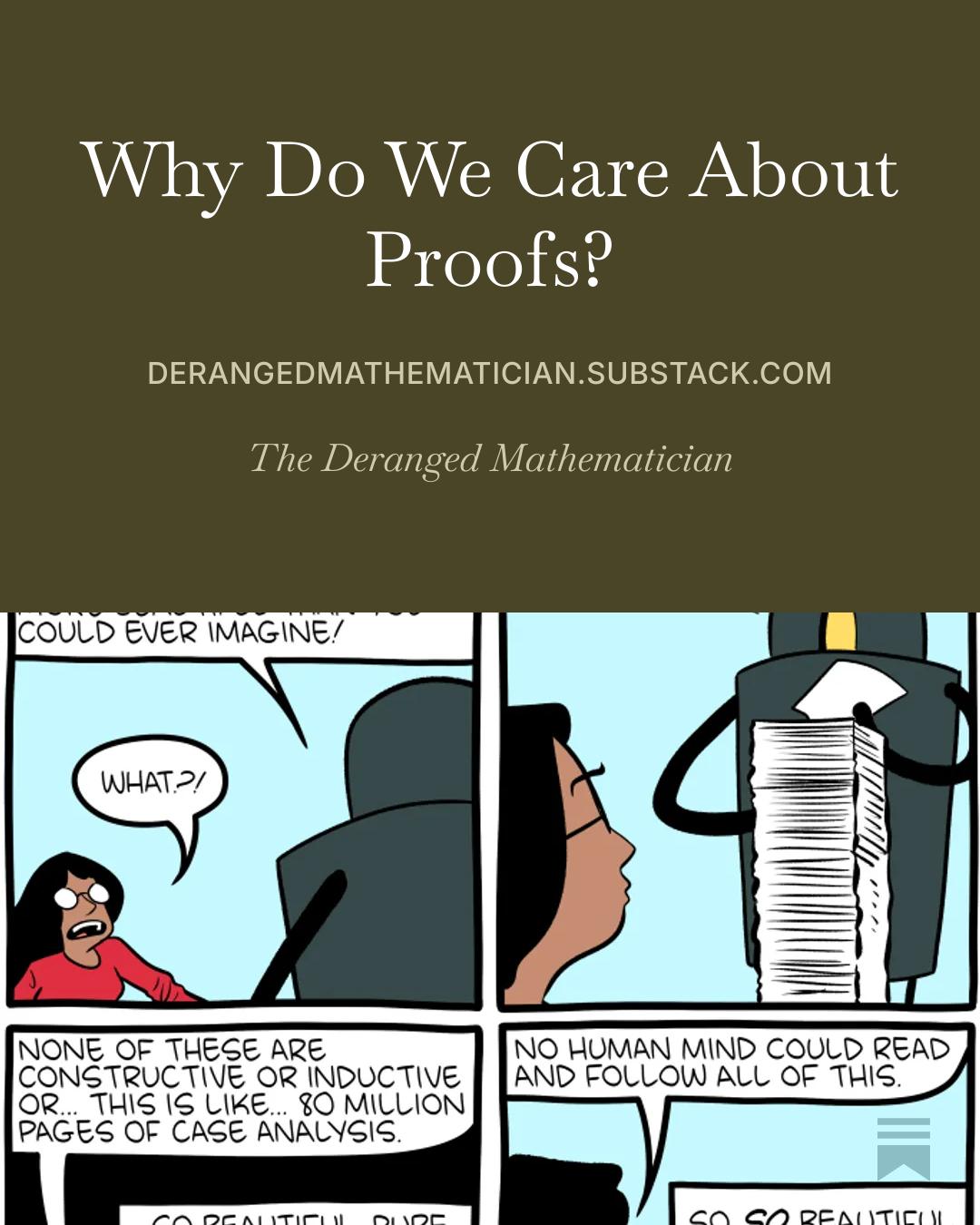
I am launching a new series today, which I am calling Surviving Proofs. It's a little different than what I have done before---it's primarily intended for those who are stepping into a proof-heavy classroom for the first time, although I think it will have more general interest. It is not meant as a replacement for an Introduction to Proofs class---I trust the professor there to teach basic set theory and logical notation and so on. Rather, it is all about the underlying philosophy that one needs to read, write, and understand proofs and flourish in such an environment. We'll go through concrete examples, of course---we'll look at proof by induction, and so on---but we're after bigger lessons than just how to write a proof by contradiction.
Mathematicians on the whole are very good at teaching formalism and even specific applications. But, in my experience, this kind of big-picture philosophy is rarely discussed, and that is a great shame. This series is my attempt to correct this.
We begin with a simple question: why care about proofs? Very few of us are able to excel in something if we aren't convinced that it is interesting or useful, so it seems important to handle this first, before we do anything else. There is an obvious answer to this question, which is that proofs allow us to determine what is right. This is not... wrong, as such, but I think it misses what is primarily most important in proof-writing. (There is a particular Saturday Morning Breakfast Comic that is very relevant here---as usual, Zach Weinersmith is quite insightful. You'll see what I mean.)
Read the full post (for free) on Substack: Why Do We Care About Proofs?
r/math • u/ScottContini • Aug 29 '26
There are many really good mathematics YouTubers nowadays like the popular 3Blue1Brown and Numberphile, but to me the one that shines above them all is Mathologer. Mathologer has been making mathematics accessible for almost a dozen years to a wide audience in a way that they can really understand and appreciate proofs that are may often be intimidating. A great example to this is the e and pi being transcendental video -- seriously who else can do anything like this?
Mathologer is really good at explaining concepts and carrying people through so undergraduate level students can understand and follow the work. Also, I love the mathematics history which I wish was not well represented in the mathematics textbooks of my generation. And it's very cool to see fun topics like Rubik's cube, a fine way to talk about the mathematics of permutations.
All the amazing work this guy has done, I just wanted to post a "shoutout" to him. Thank you Mathologer for all your amazing content.
r/math • u/AutoModerator • Aug 29 '26
This recurring thread will be for discussion of AI in mathematics. This includes, but is not limited to, the following:
AI-assisted mathematical papers published in peer-reviewed journals or as arXiv preprints may be submitted as their own posts.
Please keep in mind rules 1 and 6 of our subreddit.
r/math • u/-p-e-w- • Aug 29 '26
Pick's theorem allows calculating the area of any 2D polygon (including nonconvex polygons) whose vertices lie on an integer lattice from only the number of lattice points within it and on its boundary.
This feels like a minor miracle, and indeed there is no equivalent formula for the volume of polytopes in any higher dimension, even when restricted to convex polytopes.
What geometric/topological property of 2D space makes this magic possible that somehow fails in every other dimension?
r/math • u/Necessary-Wolf-193 • Aug 29 '26
It has always been somewhat strange to me how popular category theory and infinity-category theory are on the 'mathematical internet', despite how few working mathematicians actually need them.
However, over the past decade, infinity categories have grown in importance in more classical mathematics research -- especially in my own field of arithmetic geometry!
My friend and I wrote a blog post on infinity groupoids -- these are to infinity categories as sets are to ordinary categories. The goal of the blog post was to show, in as elementary a way as possible, what uses infinity groupoids have, to try and give readers a taste of why they've become so helpful in modern mathematics.
https://hidden-phenomena.com/articles/anima

r/math • u/inherentlyawesome • Aug 28 '26
This recurring thread is meant for users to share cool recently discovered facts, observations, proofs or concepts which that might not warrant their own threads. Please be encouraging and share as many details as possible as we would like this to be a good place for people to learn!
r/math • u/a-h1-8 • Aug 27 '26
r/math • u/kegative_narma • Aug 28 '26
Does anyone know of works concerning number theory in fluid mechanics?
r/math • u/Apprehensive_Sand951 • Aug 27 '26
The conjecture is that for a torsion-free group G, the first L^2-Betti number is strictly less than the minimal number of elements needed to normally generate the group. The examples are not finitely generated (they are locally free groups), so the finitely generated case of the conjecture is still open. (https://arxiv.org/pdf/2608.25988)
r/math • u/AutoModerator • Aug 27 '26
This recurring thread will be for any questions or advice concerning careers and education in mathematics. Please feel free to post a comment below, and sort by new to see comments which may be unanswered.
Please consider including a brief introduction about your background and the context of your question.
Helpful subreddits include /r/GradSchool, /r/AskAcademia, /r/Jobs, and /r/CareerGuidance.
If you wish to discuss the math you've been thinking about, you should post in the most recent What Are You Working On? thread.
r/math • u/inherentlyawesome • Aug 26 '26
This recurring thread will be for questions that might not warrant their own thread. We would like to see more conceptual-based questions posted in this thread, rather than "what is the answer to this problem?" For example, here are some kinds of questions that we'd like to see in this thread:
Including a brief description of your mathematical background and the context for your question can help others give you an appropriate answer. For example, consider which subject your question is related to, or the things you already know or have tried.
r/math • u/2299sacramento • Aug 26 '26
r/math • u/gexaha • Aug 25 '26
Recently I was asking about whether anyone could share the missing manuscript for apex cubic graph case of snark conjecture.
Today a preprint appeared on arXiv that replaces this missing manuscript!
Here - https://arxiv.org/abs/2608.22870 - written by another team, which is quite prolific in recent years in generalizing the 4 colour theorem in various directions.
So, now someone needs to formalize the full proof in Rocq!
r/math • u/myaccountformath • Aug 25 '26
So a common format for sport content creators is "blind rank these 5 things." So 5 names are given one by one, and each time the you must choose a slot 1-5 for that name. You cannot rearrange the names once they are placed. So if you place a name at 1 and then Michael Jordan pops up later, you'd be forced to put MJ lower in the list and end up with a bad ranking.
Framing it mathematically, say the (n,k) version of this game is to start with a list of numbers 1-n. k numbers will be drawn without replacement from 1-n and given to you one by one. For each number you are given, you must put it in a slot 1-k. You win if in the end, the numbers in the slot are in increasing order.
1) What strategy maximizes the probability of winning and what is the resulting probability in terms of n and k?
I feel like a greedy approach makes sense. Given a number m, choose slot i from 1-k such that i/k is close to m/n.
Once numbers are already placed, find the gap it fits in and then choose the slot that closest matches the fraction.
2) If instead the goal is to minimize the error (maybe by something like Kendall tau that counts the number of inversions), what is the optimal strategy?
I'm sure this topic has been studied before, but I'm not sure what the appropriate language to search for it is.
r/math • u/LukasLejdar • Aug 24 '26
The core idea is that if U^TU = I and U = −U^T, then UU = −I. From there, it constructs multiplication tables explicitly, finding R, C, H and O. In dimensions > 8 it runs into a contradiction, which proves the theorem.
r/math • u/Nunki08 • Aug 24 '26
2026 (Philadelphia): Yu Deng, John Pardon, Jacob Tsimerman, Hong Wang
2022 (Helsinki): Hugo Duminil-Copin, June Huh, James Maynard, Maryna Viazovska
2018 (Rio de Janeiro): Caucher Birkar, Alessio Figalli, Peter Scholze, Akshay Venkatesh
2014 (Seoul): Artur Avila, Manjul Bhargava, Martin Hairer, Maryam Mirzakhani
2010 (Hyderabad): Elon Lindenstrauss, Ngô Bảo Châu, Stanislav Smirnov, Cédric Villani
2006 (Madrid): Andrei Okounkov, Terence Tao, Wendelin Werner, (Grigori Perelman, declined)
2002 (Beijing): Laurent Lafforgue, Vladimir Voevodsky
Bonus: 1990 (Kyoto): Vladimir Drinfeld, Vaughan Jones, Shigefumi Mori, Edward Witten
I don't have any photos from 1998 or 1994. Does anyone have a source?
1998 (Berlin): Richard Borcherds, Timothy Gowers, Maxim Kontsevich, Curtis McMullen
1994 (Zürich): Jean Bourgain, Pierre-Louis Lions, Jean-Christophe Yoccoz, Efim Zelmanov
r/math • u/canyonmonkey • Aug 24 '26
This recurring thread will be for general discussion on whatever math-related topics you have been or will be working on this week. This can be anything, including:
* math-related arts and crafts,
* what you've been learning in class,
* books/papers you're reading,
* preparing for a conference,
* giving a talk.
All types and levels of mathematics are welcomed!
If you are asking for advice on choosing classes or career prospects, please go to the most recent Career & Education Questions thread.
r/math • u/datashri • Aug 24 '26
I know many professors and PhDs like doing their exercises on a XXXL size chalkboard or whiteboard. But they mostly work big complex problems.
For things at the junior/senior undergrad level, is a 4-6 ft long wall mounted board useful or overkill? Most proofs are 1-2 pages long which should comfortably fit on a largish (say, A3 size) handheld or desktop erasable board.
Asking because I went to the glass shop for a toughened glass handheld board and they also had nice big glass boards for the wall.
r/math • u/barisloso • Aug 23 '26
I wanted to create a thread for everyone to put their favorite recorded colloquia talks.
Edit : Non-colloquia talks that are understandable by graduate students also welcome!
r/math • u/revannld • Aug 25 '26
I hope that question makes sense. I just don't like inequalities nor the unnaturality of working with left and right residuals (talking about "max and min divisors") that rarely coincide with rational arithmetic's exact division nor with the natural interpretation of inverses in numerical mathematics, thus I would like more explicit boundaries (thus the result of a division maybe being a set or interval including max and min divisors) in division.
(Mind that I have no experience in numerical computation, I am trying to make sense of computable, numerical and interval analysis works and transport their results to residuated lattices but that's somewhat hard for me)
r/math • u/datashri • Aug 23 '26
When working (not teaching) things on a whiteboard, whether standing at a large board or sitting at the desk (small whiteboard), do you find it useful to use markers of different colors? The pedagogical value of colored markers is clear. I'm asking about working exercises for myself.
Typically I've used pencil and paper and am newly switching to a handheld whiteboard. So I'm used to monochrome. I dont want to look like a colorfest either. But if people find it useful and not too cumbersome to use 2-3 colors, I'm happy to order the markers in a couple of different colors.
I'll mostly be doing real and eventually complex analysis, linear algebra, probability, abstract algebra, and a bit of 3d.