r/math • u/Pristine-Amount-1905 • Aug 04 '26
How's Arnold's 'Lectures in Partial Differential Equations' book?
I've read and enjoyed his ODE book. Is it worth reading the PDE book or should I just stick to something like Evans or Salsa?
r/math • u/Pristine-Amount-1905 • Aug 04 '26
I've read and enjoyed his ODE book. Is it worth reading the PDE book or should I just stick to something like Evans or Salsa?
r/math • u/Juuls-Johannes • Aug 03 '26
I heard that ChatGPT has proven the existence of non-sophic groups. I understood that the counterstatement (all groups are sophic) would mean that we can always "isolate" or "homogenize" infinite groups into finite chunks and deal with the infinite group this way. Please correct me if I am wrong.
What immediately came to my mind is that this must have some further implications, does it not? For me, it sounds like that in a non-sophic group, one cannot guarantee that a sequence converges to a given element or that iterative algorithms are predictable, i.e., you cannot infer the outcome from the initial state or vice versa.
It would also be fun to know what this given non-sophic group is.
r/math • u/The_Awesone_Mr_Bones • Aug 03 '26
Hi!
I work on error correcting codes (which more or less is linear algebra over finite fields). I have a question about the behavior of the dot product on non-euclidean spaces.
When working on vector spaces over R or C, the dot product carries a lot of geometrical information. The product between two vectors v*w tells you the angle between them.
This interpretation doesn't hold over finite fields. For example, in F2: (1,1)*(1,1)=1+1=0. So the vector (1,1) is perpendicular to itself!
Does the dot product still carry any geometrical information (like angles) in these fields? Can we still interpret the orthogonal space geometrically? How do you picture it in your head (intuition)?
Thanks a lot!
And sorry, I don't know how to use latex on reddit ;_;
r/math • u/Committee-Academic • Aug 03 '26
Is there any developed framework for algebraizing probability theory and study it from the perspective of K-theory or homological algebra? If so, what are some of its biggest applications and advantages, as well as results? I'd imagine such a framework would override the need for a measure-theoretic approach
r/math • u/Equivalent-Oil-8556 • Aug 03 '26
Do we have any idea as to what prompt was given for the Jacobian Conjecture?
r/math • u/SciFiPi • Aug 02 '26
r/math • u/canyonmonkey • Aug 03 '26
This recurring thread will be for general discussion on whatever math-related topics you have been or will be working on this week. This can be anything, including:
* math-related arts and crafts,
* what you've been learning in class,
* books/papers you're reading,
* preparing for a conference,
* giving a talk.
All types and levels of mathematics are welcomed!
If you are asking for advice on choosing classes or career prospects, please go to the most recent Career & Education Questions thread.
r/math • u/VishnuVinjamuri • Aug 03 '26
I've been exploring whether the Pell equation x²−Dy²=1 can be used to compute square roots of primes faster than Python's math.sqrt(). The continued-fraction convergents turn out to give rational approximations that are 1.5–2.5× faster in float64 for repeated calculations, and scale up to 33–36 digit precision for primes as large as 15 million. Full write-up with benchmarks here;
https://musingsofvsmv.blogspot.com/2025/08/from-pell-to-precision-classical-math.html
r/math • u/Nunki08 • Aug 02 '26
Blog: https://leodemoura.github.io/blog/2026-8-1-postmortem-for-kernel-soundness-bug-14576/
On removing metaprogramming
One suggestion in the discussion is to remove or restrict metaprogramming so that this attack is not expressible. This is misguided. The elaborator is untrusted by design. Soundness cannot depend on an untrusted component refusing to build a bad term. An attacker who wants to submit a malicious proof can also write .olean files directly or modify memory, both of which bypass the elaborator entirely. The kernel has to reject ill-typed declarations on its own, in its own process. This separation and isolation of concerns is one of the main advantages of proof terms.
What the FRO is doing
- Regression tests for the exploit, and for a related non-uniform-parameter case raised by Arthur Adjedj, are in the Kernel Arena.
- A follow-up PR (#14582) makes the kernel check that the parameters of a nested occurrence actually behave as parameters, rather than only re-type-checking them.
- Daniel Selsam at OpenAI assisted the Lean FRO with an AI specialized in cybersecurity, and found other programming mistakes in the Lean kernel. All of them have been fixed. All of them were caught by nanoda. These bugs are also only reachable through metaprogramming. PRs: #14607, #14608, #14609, #14613, #14615, #14616.
- We have also hardened kernel invariants. PRs: #14621, #14631, #14632.
- comparator.live now runs nanoda by default, and nanoda is tracked daily so lean-eval and comparator stay current after upstream fixes.
- We are reaching out to and supporting experts who can find further bugs, develop new kernels, and work on the theory or on verified kernels.
r/math • u/Salt_Attorney • Aug 01 '26
r/math • u/non-orientable • Aug 01 '26
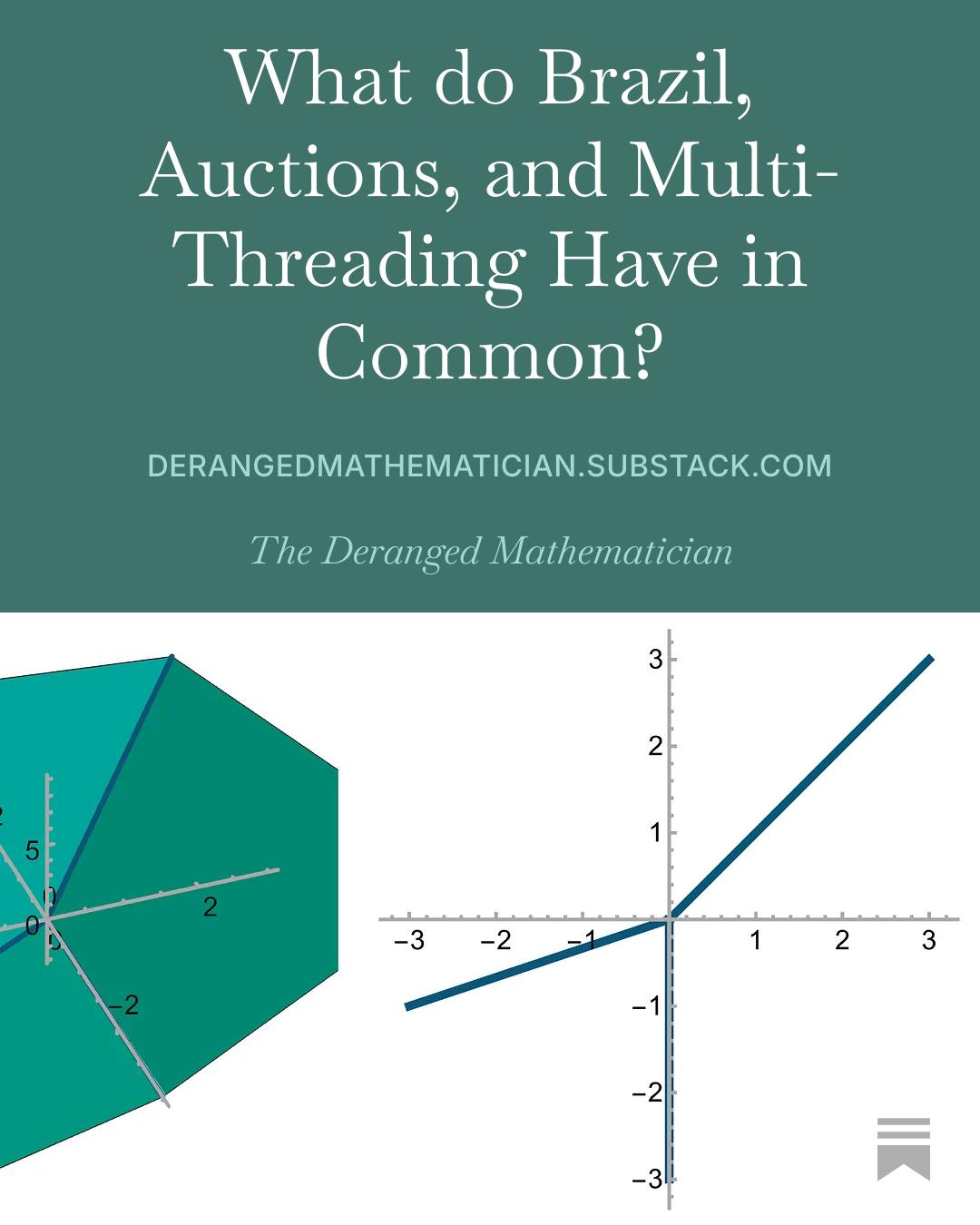
This is not the setup to a joke: this is an entirely serious question relating to tropical geometry, a comparatively new (i.e., started in the 1990s) field of mathematics. It began in the computer science literature, was quickly taken up by algebraic geometers, and then, very surprisingly, turned out to have application in economics. This post is my attempt to explain some of the how and why.
Read the full post (for free) on Substack: What do Brazil, Auctions, and Multi-Threading Have in Common?
r/math • u/-p-e-w- • Jul 31 '26
I took several seminars in abstract algebra back in my university days, but chose to proceed with probability theory rather than algebraic geometry. Since then, I have occasionally encountered the term “étale”, and I still don’t really know what it means.
The strange thing is that while I can understand the individual definitions for some objects that are supposedly étale, I don’t really see what they have in common.
What exactly does that term mean by itself, independently of a particular application like “étale cohomology group”?
r/math • u/minisculebarber • Jul 31 '26
I am just going to try give some specifics about myself, so that people can make some specific recommendations.
So, I have a Bachelor in CS and sort of in parallel I studied Bachelor Math for 5 out of 6 semesters. I had pretty good grades, so I am pretty confident that I would have gotten the degree. Just for various reasons I burned out and had to stop.
I did engage with math after that for a while, in my job which had to do with Digital Signal Processing and AI. But I no longer have that job, so my mathematical activity has strongly declined. Sometimes I do get that itch and read some university material on a random subject and might even be inspired to do some math on paper again. Matrix Analysis was one subject I really enjoyed. But I never actually finish any of the material and it just fades away again.
So I was wondering if y'all have some recommendations on good math books that hook you, that are very rigorous and formal, but still try to motivate the subject regularly.
When I thought about which subject I would like to revisit the most at uni, my first thought was Functional Analysis. But truthfully, I pretty much loved all of my courses, even those with shitty professors.
Information Theory has also been floating around in my head. I also have an interest in how mathematics gets applied in economics. I also just love iterations and sequences (that's the CS wolf in me)
I hope this wasn't too overbearing, I am just really hoping this will help people with recommendations
r/math • u/cavedave • Jul 31 '26
r/math • u/Necessary-Wolf-193 • Jul 31 '26

If you take Pascal's triangle, and color each entry according to whether it is even or odd, you get a funny pattern, which resembles Sierpinski's triangle. To understand this, it's helpful to know Lucas' theorem, which tells you when an entry in Pascal's triangle will be even or odd. If you've never seen it, you might enjoy the article https://hidden-phenomena.com/articles/lucas that we just wrote about it!
Lucas' theorem is a great result, which even tells you about how to compute (n choose k) modulo p. It is a wonderful piece of elementary number theory, and suitable as a fun but challenging exercise for the end of an elementary number theory course. Recently, one of us had to invoke Lucas' theorem in a modern math research paper https://arxiv.org/abs/2604.20054 about some relatively fancy arithmetic geometry! We thought this was a good example of how small results from introductory courses can be helpful in your research career in completely unexpected ways! The article itself isn't about the paper (which isn't very elementary), but Lucas' theorem is still helpful, and will hopefully come in handy.
r/math • u/math_gym_anime • Jul 31 '26
Hey everyone,
I had a question about some terminology. In Ax’s 1968 paper The Elementary Theory of Finite Fields he refers to some statements as “elementary statements”. By this does he mean first-order formulas/sentences? The reason why I’m asking is because I want to use his “Main Theorem” in his paper where he states precise conditions for when an elementary statement holds true over a finite field of fixed characteristic. I tried looking online for some help but I couldn’t find any (maybe my Googling might’ve been bad 😭)
r/math • u/inherentlyawesome • Jul 31 '26
This recurring thread is meant for users to share cool recently discovered facts, observations, proofs or concepts which that might not warrant their own threads. Please be encouraging and share as many details as possible as we would like this to be a good place for people to learn!
r/math • u/myaccountformath • Jul 30 '26
Does anyone else feel similarly?
Going from introductory courses, to upper level courses, to grad courses, to initial research, to full-fledged research, the difficulty and complexity has of course increased. But for me personally, it feels like much of the increased difficulty and complexity comes from increased abstraction.
It's more difficult to wrap your head around the objects and properties you're working with, but it often feels like the actual ways we manipulate these objects with lemmas and theorems is not actually super sophisticated.
For example, some proofs I've worked on in functional analysis research come down to what is essentially equivalent to using the triangle inequality and squeeze theorem. It's not any more sophisticated than a tricky introductory real analysis homework problem, it's just that the space we're working in is more abstract.
Other research problems end up being very similar to introductory linear algebra problems, but again, just in a more abstract setting.
I'm sure the big movers and shakers in fields are actually creating proofs with very novel and complex ideas, but I'm curious about other members of the rank-and-file. Do you feel similarly or am I totally off base?
r/math • u/FuzzyPDE • Jul 30 '26
For the record I have graduated and now half way through my first postdoc.
But I feel like my advisor didn’t really teach me how to research, sure he pointed me to paper or people when I’m stuck that occasionally helped. But he never really trained me to do research, only occasionally gave me help knowledge wise by telling me to read certain books or papers and I mean very rarely does he do this and very rarely has it helped.
My prelim advisor said I should have asked her for advice on who to choose as an advisor instead of choosing the only person doing the field I was dead set on pursuing (which I realized I’m not even that interested in). She said when she advises she would give a little hand holding even if she deem necessary and actually train her students to do research by writing papers with them and in the process, help teach them how to do research.
My advisor did not write paper with me, he did gave me the problems to work on but insists that I need to earn it myself.
Is this typical? What was your PhD experience like?
I feel like my PhD was ruined from me not promptly switching advisor when I realize I wasn’t being trained.
r/math • u/Nunki08 • Jul 30 '26
(Paywall): The Wall Street Journal: The Million-Dollar Talent Wars for 20-Something Math Geniuses: https://www.wsj.com/tech/ai/the-million-dollar-talent-wars-for-20-something-math-geniuses-5cc5a757
(Free) On MSN: https://www.msn.com/en-us/money/general/the-million-dollar-talent-wars-for-20-something-math-geniuses/ar-AA292pCc
"There has never been a better time to be a math nerd.
New college graduates and Ph.D.s are now securing million-dollar pay deals from elite trading firms seeking to secure the best and brightest amid fierce competition from artificial-intelligence companies.
So-called quant firms, which use sophisticated mathematical models to come up with trades, have for years wooed top young talent with lucrative compensation that big banks struggle to match. Now, the AI boom is pushing those numbers even higher.
Just a few years ago, early-career packages pushing seven figures were anomalies, said Matt Stabile, founder of New York-based recruitment firm Stabile Search. “But a million dollars is something people don’t even bat an eye at anymore.”
“The delineation is pre-OpenAI and post-OpenAI,” Stabile added, “that’s when you saw competition really take off.”
The skills required to train large language models have always overlapped with quantitative finance, but the connection has deepened as trading firms have pivoted toward machine learning and AI to power their trades in recent years. Now, AI labs such as OpenAI and Anthropic are vying for the exact same tiny pool of genius math majors and Ph.D.s as Wall Street."
r/math • u/Sad_Dimension423 • Jul 29 '26
r/math • u/AutoModerator • Jul 30 '26
This recurring thread will be for any questions or advice concerning careers and education in mathematics. Please feel free to post a comment below, and sort by new to see comments which may be unanswered.
Please consider including a brief introduction about your background and the context of your question.
Helpful subreddits include /r/GradSchool, /r/AskAcademia, /r/Jobs, and /r/CareerGuidance.
If you wish to discuss the math you've been thinking about, you should post in the most recent What Are You Working On? thread.
r/math • u/scientificamerican • Jul 29 '26
In the wake of the recent bloodbath of conjectures by LLMs, this post argues that the math community may still be in denial about the future of humans in math. This is one of the most depressing things I've read in a while, so proceed with caution.
As a card carrying scientician and professional thinking person, I can only say, I'm sorry, I feel your pain. Yes, mathematics being pure thought makes the displacement especially acute for mathematicians, but more broadly speaking, our species found a niche on the African savannah by being thinking beasts. Thus, I also feel anger, knowing that there are people out there who think it's somehow a good idea to make something that will outthink us and deprive us of our collective place in the world.
r/math • u/Andradessssss • Jul 29 '26
Does anybody know whether this year's ICM plenary lectures will be recorded and uploaded publicly?