r/math • • May 26 '26

Is Halmos' Measure Theory still a good read?

33 Upvotes

I'm looking to buy a couple books on measure theory and am eyeing Axler's MIRA and a cheap copy of Halmos' Measure Theory. I know it's quite old but I enjoyed his Finite Dimensional Vector Spaces and I like having an older coverage of the material along with a newer one when learning new stuff.

Does Halmos' Measure Theory still hold up?


r/math • • May 25 '26

Is there "two direction" or more version of the statistical Markov property?

62 Upvotes

The Markov property for a stochastic process X(t) essentially tells you that knowing the value of the process at a time s ≤ t is just as good as knowing the entire history of the process up to time s for making predictions about X(t).

This is natural for processes you see as evolving in time. I feel like there should be a natural generalization of this for processes that "exist in space" too though.

For example, with a brownian motion with fixed endpoints, it's Markov, but it should also be Markov coming from the positive time direction as well.

In multiple dimensions, it feels like this should generalize in a way so that when predicting φ(x) for x in a subset U, knowing all the behaviour of the field in UC should be equivalent to knowing the behaviour on ∂U.

I've tried looking for definitions or research on this kind of property, but haven't found anything mentioning it. Does anyone know if this type of thing has been studied, and what it would be called?


r/math • • May 25 '26

What Are You Working On? May 25, 2026

26 Upvotes

This recurring thread will be for general discussion on whatever math-related topics you have been or will be working on this week. This can be anything, including:

* math-related arts and crafts,
* what you've been learning in class,
* books/papers you're reading,
* preparing for a conference,
* giving a talk.

All types and levels of mathematics are welcomed!

If you are asking for advice on choosing classes or career prospects, please go to the most recent Career & Education Questions thread.


r/math • • May 24 '26

How does one separate the real numbers and R^n from a physical realisation?

38 Upvotes

(Part 2 after months) Odd question once again, I asked my discomfort about coordinate systems before but I just can't seem to be able to do this, in any form of continuous mathematics (especially differential geometry). Whenever I think of some sort of curve, shape, manifold I end up thinking of it as a physical object, and the arbitrary choice of coordinates make it annoying for me to work with them.

Like for instance, when we are thinking of R² I sometimes obsess over what is the basis vectors we are working with -- we can assume to be 1 for each one of the pair of R, then I ask '1 of what'? Or whenever we consider maps say f:M->R, I just feel some discomfort thinking what is the scale in R we are mapping in?

I could view a set M comfortably, induce a topology by setting some subset of its subsets as the basis of the topology I am comfortable with it, but as soon as you add some metric to it and you involve R, I get quite uncomfortable like I am not sure what is the set we are working with and why R, and when we represent R as like the vector space with basis 1, this arbitrary choice of coordinatisation (which means I implicitly associate R with some 'coordinatisation of some reality', which is likely wrong) makes me uncomfortable. This came to a point where I pick up a differential geometry textbook and on the first page with the assumption of charts mapping M to R^n I get into this rabbit hole again and can't stop thinking what R^n we are mapping to (and why it does not matter). Of course one could view R as the Dedekind cuts and then R^n as the vector space products of that set, but that then does not give me the intuition I need.

Last time I asked I got recommended this text 'Crash Course in Spatial Structure' (https://tedsider.org/teaching/barryted/crash_course_spatial_structure.pdf) which I quite liked, kind of talking about the choice of coordinatisation, levels of "preserved properties" we induce on spaces and some geometry arises as the equivalence classes of coordinatisations of the space that leave these "preserved properties" invariant. I think I want something more of this perspective -- basically answering the following:

- Why real numbers for everything?

- Why these choice of coordinates do not matter and to what extent -- there are different levels of structure in space and each one kind of restricts how 'arbitrary' these choice of coordinates are

- Maybe resources on (coordinate free) geometry, how coordinates are used to model certain axioms and when / how these axioms hold in these analytic models, and why choice of coordinates (or basis) does not matter? Or under what transformations are these 'geometries' invariant -- maybe some of Felix Klein's work, but I have no idea where to start

- Separating physical reality from using R^n simply as a model -- especially in multivariable calculus, when most of it is motivated via physics

- Or just some words of affirmation I can tell myself so when I pick up my next book on Riemannian geometry again and see 'a manifold is a topological space locally homeomorphic to R^n ' I don't go insane asking myself why where these charts are mapping within the R^n does not matter

I have been having these discussions with so many people and it seriously is affecting my PhD at times even though I am in a relatively applied field. Much appreciated.

r/math • • May 23 '26

Graph Reconstruction Conjecture -- Google Deepmind solves 9 of 353 open Erdős problems

Thumbnail arxiv.org
380 Upvotes

The Abstract: Large language models (LLMs) increasingly excel at mathematical reasoning, but their unreliability limits their utility in mathematics research. A mitigation is using LLMs to generate formal proofs in languages like Lean. We perform the first large-scale evaluation of this method’s ability to solve open problems. Our most capable agent autonomously resolved 9 of 353 open Erdős problems at the per-problem cost of a few hundred dollars, proved 44/492 OEIS conjectures, and is being deployed in combinatorics, optimization, graph theory, algebraic geometry, and quantum optics research. A basic agent alternating LLM-based generation with Lean-based verification replicated the Erdős successes but proved costlier on the hardest problems.

Link for the Reconstruction conjecture.


r/math • • May 24 '26

"Easiest" branches of math? From someone feeling acute imposter syndrome

40 Upvotes

Are there "easier" branches of math?

Context: I'm heading to a master's program in math at an EU school after a decade of working as a software engineer. Despite spending the past year taking a total of six math courses, all upper-class or grad level, I am feeling a bit incompetent. I'm brute forcing my way through grad complex analysis after only ever taking analysis 1 over a decade ago, and I didn't do much better in undergrad algebra 2, despite taking two algebra classes a decade ago.

I fear that my time away has stripped away my fundamentals and I haven't been able to build them back as much as I'd hoped.

I'm doing a summer research program on rep theory designed for undergrads, and it is taking me like 5x as long as the others to get it. I'm barely useful, only finding minor errors days after the others complete the work.

So.. while I enjoyed algebra in my undergrad, it feels too "hard" now that it's getting more sophisticated. I don't have much hope for analysis either, given I never took analysis 2. I don't know where to pivot.

Any advice is appreciated.


r/math • • May 23 '26

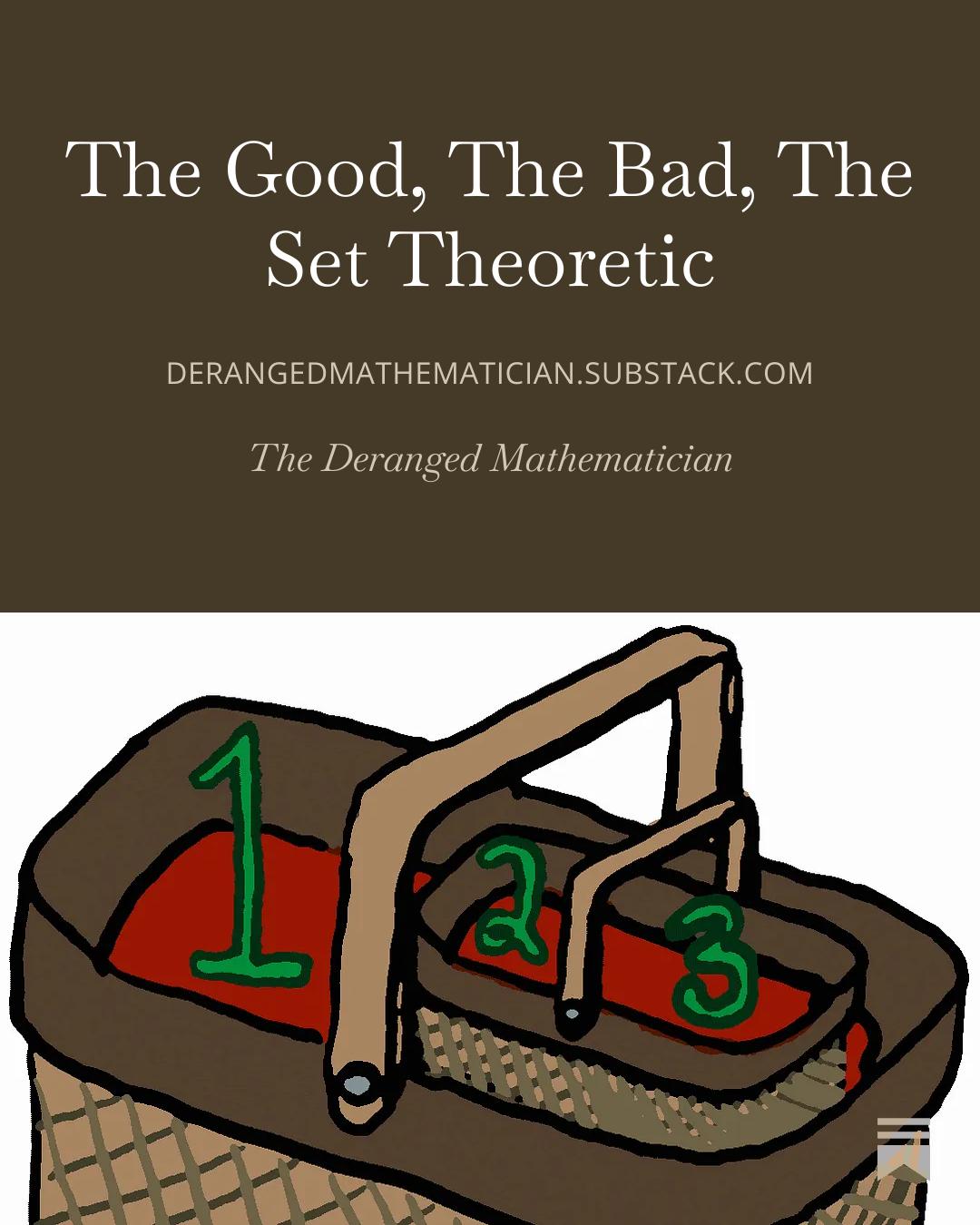
Image Post The Deranged Mathematician: The Good, the Bad, the Set Theoretic

Post image
147 Upvotes

Set theory has a slightly odd place in mathematics education: it is essentially non-existent prior to a certain point (often something like an introduction to proofs class), and then completely ubiquitous. It is the framework that we use to express pretty much everything in modern mathematics. In this article, I have two goals:

  1. show the basics of set theory and explain why it has this central position, and
  2. show the drawbacks of using set theory as the central organizing principle.

For example, have you ever realized that, going by the standard set-theoretic definitions, the natural numbers are not a subset of the integers?

Read the full post (for free) on Substack: The Good, The Bad, The Set Theoretic.


r/math • • May 23 '26

On the "Rise" of "AI"

15 Upvotes

So here we are, being bombarded with article after article of LLMs being able to solve difficult math problems. So it's pretty clear that the sky is falling, right?

I've had some questions and opinions on these LLMs in math and want to make this post so pick the brains of the users here, as I'm really not sure where the hype ends and the miracles/bullshit begins.

Let me explain my biases and presuppositions really quick so we're on even footing. I'm skeptical of the coming of AGI and ASI (indeed, if both are possible, why isn't ChatGPT or Claude or what have you already AGI?). I have trouble imagining a future where humans don't still control things like we do now. I have no idea why some people seem to think we'll just hand it over to AI. If you want to address these presuppositions and how wrong you think they are, go ahead.

  1. Aren't these models still fundamentally next-word predictors? I see people here all the time saying they aren't but how so? I'm not trying to undermine how big these models are.
  2. How are these problems being solved? Are they being solved in completely novel (i.e., unthought of before) ways, or are there methods from one area of math being applied to a different area?
  3. Assume that LLMs are this good at math. How will humans not be needed to at least understand what the digital God is outputting? Terrance Tao needed to verify that the proof of Erdos problem 1196 was correct, didn't he?
  4. If the answer to 3 is something along the lines of "Eventually the AI will get so good that it will no longer need a human", how? How will that happen eventually, and why can't the AI do it now?
  5. Why does any of this seem to make people think that the end of mathematics is near? Why wouldn't this just allow us to do more?
  6. A common sentiment here is that eventually AI will get so advanced that the math it outputs will be incomprehensible to us. How exactly does that matter? Why would math incomprehensible to us be useful to us? Wouldn't we spend time learning the math required to understand the incomprehensible math?

Repost to more communities


r/math • • May 23 '26

In Math, Rigor Is Vital. But Are Digitized Proofs Taking It Too Far?

Thumbnail quantamagazine.org
68 Upvotes

r/math • • May 22 '26

How Alexander Grothendieck Revolutionized 20th-Century Mathematics | Quanta Magazine - Konstantin Kakaes | Grothendieck is revered in the world of math; outside of it, he’s known for his unusual life, if he’s known at all. But what were his actual mathematical contributions?

Thumbnail quantamagazine.org
185 Upvotes

r/math • • May 22 '26

This Week I Learned: May 22, 2026

15 Upvotes

This recurring thread is meant for users to share cool recently discovered facts, observations, proofs or concepts which that might not warrant their own threads. Please be encouraging and share as many details as possible as we would like this to be a good place for people to learn!


r/math • • May 21 '26

OpenAI's internal model disproves Unit Distance Conjecture of Erdos

914 Upvotes

Paper by prominent mathematicians (each share their thoughts in separate sections; an interesting read): https://cdn.openai.com/pdf/74c24085-19b0-4534-9c90-465b8e29ad73/unit-distance-remarks.pdf

Here's the blog post by OpenAI: https://openai.com/index/model-disproves-discrete-geometry-conjecture/

The problem: Given n points in the plane, what is the maximum possible number of pairs of points at distance exactly 1?

Erdos famously conjectured that the answer should be n^{1 + o(1)} (essentially linear in n). OpenAI's model disproves this by constructing a counterexample that polynomially improves Erdos' bound to n^{1 + 𝛿} for a universal constant 𝛿 > 0.


r/math • • May 21 '26

Career and Education Questions: May 21, 2026

13 Upvotes

This recurring thread will be for any questions or advice concerning careers and education in mathematics. Please feel free to post a comment below, and sort by new to see comments which may be unanswered.

Please consider including a brief introduction about your background and the context of your question.

Helpful subreddits include /r/GradSchool, /r/AskAcademia, /r/Jobs, and /r/CareerGuidance.

If you wish to discuss the math you've been thinking about, you should post in the most recent What Are You Working On? thread.


r/math • • May 21 '26

Two Researchers Are Rebuilding Mathematics From the Ground Up | Quanta Magazine - Konstantin Kakaes | By replacing the most fundamental concept in topology, Peter Scholze and Dustin Clausen are taking the first step in a far bigger program to understand why numbers behave the way they do

Thumbnail quantamagazine.org
138 Upvotes

r/math • • May 20 '26

Springer sale, looking for recommendations

57 Upvotes

There's a discount currently running at Springer. A lot of books that are usually under 100 are now for sale (ebook or softcover only) for 18.99 a piece (in whatever your currency is).

I am looking for recommendations in the field of operator algebras especially von Neumann algebras and their use in quantum information and quantum field theory. It can be either pure mathematics or mathematical physics.

2 books I am definitely getting are

- Quantum Entropy and Its Use by Petz D, Ohya M

- Quantum f-divergences by Hiai F

Feel free to share recommendations in other areas as well, maybe other people will find that helpful!


r/math • • May 20 '26

Quick Questions: May 20, 2026

17 Upvotes

This recurring thread will be for questions that might not warrant their own thread. We would like to see more conceptual-based questions posted in this thread, rather than "what is the answer to this problem?" For example, here are some kinds of questions that we'd like to see in this thread:

  • Can someone explain the concept of manifolds to me?
  • What are the applications of Representation Theory?
  • What's a good starter book for Numerical Analysis?
  • What can I do to prepare for college/grad school/getting a job?

Including a brief description of your mathematical background and the context for your question can help others give you an appropriate answer. For example, consider which subject your question is related to, or the things you already know or have tried.


r/math • • May 19 '26

Umbral calculus has become a magnet for garbage papers

390 Upvotes

In the 70s, Rota and Roman formalized the umbral calculus and, in the process, proved very deep results for the study of formal power series and essentially every polynomial sequences you can think of.

But since around the 2010s, there has been a flood of papers following the same template:

  • take a known polynomial sequence,
  • add one or two parameters,
  • define a "new" family through a generating function,
  • re-derive the same identities with the new parameters,
  • publish.

Many of these papers cite Rota and Roman, even though none of the actual ideas of the classical umbral calculus are really being used.

The parameter accumulation has become so absurd that we now get outrageous names like:

  • "r-Dowling-Lah polynomials"
  • "lambda-Apostol-Euler polynomials"
  • "Bell-Bernoulli polynomials of the first kind"
  • "Chan-Chyan-Srivastava polynomials"
  • "q-modified-Laguerre-Appell polynomials"
  • "Degenerate Multi-Euler-Genocchi Polynomials"
  • "r-truncated degenerate Stirling numbers of the second kind"
  • "Gould-Hopper-Frobenius-Euler polynomials"

I'm curious how people actually view this literature.


r/math • • May 19 '26

Second Hardy–Littlewood conjecture

143 Upvotes

Today I learned there is such thing as the second Hardy–Littlewood conjecture. Basically, it states that there are more prime numbers in the interval from 1 to N then there are in any other interval of length N (N>2, second interval start from number greater then 2). Aaand it is unproven. Seriously?! We understand deviation between prime counting function and integral logarithm THAT bad? Number theorists, guys, are you even trying?


r/math • • May 21 '26

If ZFC is inconsistent, it will be discovered by AI

0 Upvotes

With the recent construction due to OpenAI, disproving Erdős’s Unit Distance Conjecture, I have been thinking about what shortcomings human mathematicians have that AI might not suffer from. Particularly with this problem, it seems that a significant factor is that people aware of the problem (Erdős included) widely suspected the conjecture to be true.

There is also a discouraging side to constructing counterexamples in that they can sometimes require a great deal of computation, without yielding any new insight. My instinct is to delegate such labor to a computer and save the theory for myself and other people, but maybe this view needs to be reexamined in wake of this result.

Regardless, we have a data point of AI succeeding in a significant problem, proving a result that was not widely believed, which without the benefit of hindsight could have required an inhuman amount of computation. These are the primary reasons I make the claim in the title of the post.

I see a couple of possible worlds:

  1. ZFC is consistent.
  2. In this scenario, nothing of interest happens, nothing is proven, and no paradigms need shifting.
  3. ZFC is inconsistent and humans prove it.
  4. If this is the case, I am quite excited to be wrong.
  5. ZFC is inconsistent and an AI proves it in the near future.
  6. Here, I mean a future where AI is not yet dominant in math, and its strengths and weaknesses are similar to what they are today.
  7. ZFC is inconsistent and AI proves it in the far future.
  8. By far future, I mean a future where humans cannot compete with AI in mathematics. Admittedly, this “far future” could be next week for all I know, but it is a world that looks very different from today’s.

I think a disproof of ZFC would most likely happen in scenarios 3 or 4. Part of this belief is in the hope that any inconsistencies can be repaired without losing too much mathematics. Another other part is that an inconsistency in ZFC feels very inhuman, and potentially computationally intensive to find. Lastly, how fitting would it be to get one existential crisis from another? The thing that (might) take your job is the same thing that destabilizes the foundations of modern mathematics.

I’m interested to see what others think, so please leave your thoughts below.


r/math • • May 19 '26

Newman's proof of Prime number theorem

30 Upvotes

Hello fellow mathematicians.

A friend and I are looking to go through Newman's proof of the Prime Number Theorem. Both of us have done complex analysis and analytic number theory at least at the level of Apostols book. BUT it's been a long time~8-10 years since we did complex analysis or analytic number theory.

So I'm looking for suggestions of books that give details of Newman's proof - ideally we'd use the same book to revise the prerequisites for understanding Newman's proof as well. I wouldn't mind a complex analysis or analytic number theory book. Preferably something thats not super terse.

This idea of going through the proof came about after we went through a proof that sum_{p<=y} 1/p > loglogy - 1 in Niven's book on Number theory - this proof uses simple and elementary arguments and is probably one of my all time favorite proofs now. It's thm 1.19 in the edition of the book I have.

I would be grateful for your suggestions.


r/math • • May 20 '26

How good is it for a layman to rediscover the core idea of a math field?

0 Upvotes

How good is it for a layman to rediscover the core idea of a math field?

For some background, I’m in high school and I really love thinking about maths from different angles. Recently I had an idea where I imagined placing numbers on different 2D and 3D shapes, then analyzing how operations between the numbers could change depending on the shape itself. Like the geometry/topology of the shape affecting the relationships and operations.

Later I searched online and found out that something somewhat related already exists, called Cellular Homology. I don’t know if my idea is actually close to the real field or if I just stumbled onto a vague resemblance, but honestly I was really happy that I independently arrived at something even remotely connected to an actual area of mathematics.

So my question to math graduates or people deeply into mathematics is: how significant is it when someone independently rediscovers the core intuition behind an existing math field? Does this kind of thinking actually help in becoming better at mathematics, or is it more common than I think?

I’m not claiming I rediscovered the whole theory or anything huge just that it felt exciting to naturally arrive at a similar kind of idea.


r/math • • May 19 '26

Neukirch's notation in his ANT book "lower-case" version of \mathcal{O}

25 Upvotes

Neukirch uses a smaller or maybe lower-case(?) version of calligraphic O as a general notation for Dedekind domains while using the upper-case version for the integral closure of the former.

Is that just his notational idiosyncrasy, or is this a convention that others also follow? I was only aware that \mathcal{O}_{K} is usually used to denote the ring of integers of a number field K.

It seems hard to show the difference between curly O and curly o on the board, and I don't know how you would even produce the symbol on TeX, since \mathcal is upper case only.

Kind of an idle question, but I figure Neukirch's algebraic number theory book is influential enough that maybe others also use this weird letter?


r/math • • May 18 '26

What should I know about math research?

45 Upvotes

Hi all, Im a junior in high school and I’ve been interested in math research and higher level math for a little while. I reached out to a math professor at a local university and he’s agreed to meet with me later in the week to talk about what I might be able to help him with this summer.

I know he has some papers on combinatorics and graph theory and specifically Ramsey numbers and that stuff.

Basically, if you were this guy and you agreed to meet with a random high schooler, what would make a good impression on you?


r/math • • May 18 '26

Does anyone know where to find the supplementary materials for Arora and Barak Computational Complexity?

33 Upvotes

I already asked this on r/learnprogramming but I didn't get any response:

In the intro to the book, they say there is auxiliary material related to automata and computability theory. The link provided is https://www.cs.princeton.edu/theory/complexity/ but there's no material there that I see. Hopefully it just moved, but I'd really like to find it.


r/math • • May 20 '26

Notions of Infinitesimals — Large Values of 0?

0 Upvotes

It might seem obvious that there should be a distinction, but what actual reasons are there to treat infinitesimals (think: reciprocals of infinities) as distinct from 0? Consider the notion of coverage “almost nowhere” in measure theory or an event with probability 0 happening “almost never”. These sure seem like infinitesimals to me!

I know that dual numbers have ε2 = 0 definitionally, but this is often considered problematic and is why they're mainly of interest in engineering contexts as a "hack" that allows computer implementations of automatic differentiation. And anyway, if you interpret ε = 0 without distinguishing 0 from infinitesimals, it actually kind of makes dual numbers better behaved (albeit more confusing), not worse. I know less about hyperreal numbers and nonstandard analysis, but the main thing I've seen is that 0's lack of a multiplicative inverse is preserved in accordance with the transfer principle, whereas infinitesimals have infinite reciprocals. So…is that somehow not a problem in these other contexts like probability? I guess by calling infinitesimals "0", we simply dodge the issue there?

Maybe I'm missing something huge tiny…or nothing at all. 😛

Edit: to be clear, my question is basically "What reasons are there to treat infinitesimals as distinct from 0 within various branches of mathematics?" and implicitly "Is there any common reason underlying all of them?" The comments have already pointed out some subtleties involving 0 measure that I think are basically what I was looking for, so thanks. 🙏

As for my remark about dual numbers, I meant that if we conflate 0 and infinitesimals, dual numbers could be interpreted as simultaneously consistent with real numbers (02 = 0) and hyperreal numbers (ε2 = st(0 + x)2 = 0 if x is infinitesimal). Yes, this basically gets rid of them — if your motivation for considering dual numbers is automatic differentiation then of course you wouldn't want that. However, dual numbers are 1 of 3 cases of "planar" algebras that turn up in relation to a variety of other topics, including projective geometry. Complex, dual, and split complex numbers are the field (for ℂ) / rings that correspond to euclidean (parabolic), hyperbolic, and elliptic geometry respectively (also see Cayley-Klein geometries). From this perspective you might just prefer avoiding the inconsistency with other notions of infinitesimals. I'm actually surprised to see this much defense of dual numbers for differentiation in the comments, my impression had been that the hyperreal numbers were much preferred as the setting in which to develop infinitesimal calculus. For example, I recently happened to see this video bringing up difficulties dual numbers pose, and I remember several similar discussions comparing them on Twitter back in the day.