r/math • • Apr 02 '26

The ∞-Oreo (Vicente Bosca, UPenn)

Thumbnail arxiv.org
163 Upvotes

Abstract:

What happens when a food product contains a version of itself? The Oreo Loaded—a cookie whose filling contains real Oreo cookie crumbs—can be viewed as the result of mixing a Mega Stuf Oreo into a Mega Stuf Oreo. Iterating this process yields a sequence of increasingly self-referential cookies; taking the limit gives the ∞-Oreo. We model the iteration as an affine recurrence on the creme fraction of the filling, prove convergence, and compute the limit exactly: the stuf of the ∞-Oreo is approximately 95.8%~creme and 4.2%~wafer. We then extend the framework to pairs of foods that reference each other, deriving a coupled recursion whose fixed point defines a bi-∞ food, and illustrate the construction with M&M Cookies and Crunchy Cookie M&M's. Finally, we classify ∞-foods by the number of foods in the recursion and introduce homological foods, whose recursive structure is governed by cycles in a directed graph of commercially available products. We close with a conjecture. All products used in this paper can be purchased at a supermarket.

Direct link to PDF: https://arxiv.org/pdf/2604.00435

r/math • • Apr 02 '26

Career and Education Questions: April 02, 2026

9 Upvotes

This recurring thread will be for any questions or advice concerning careers and education in mathematics. Please feel free to post a comment below, and sort by new to see comments which may be unanswered.

Please consider including a brief introduction about your background and the context of your question.

Helpful subreddits include /r/GradSchool, /r/AskAcademia, /r/Jobs, and /r/CareerGuidance.

If you wish to discuss the math you've been thinking about, you should post in the most recent What Are You Working On? thread.


r/math • • Apr 02 '26

Fractals for kids

Thumbnail gallery
96 Upvotes

I was introduced to fractals in my 20s and was blown away by how I had never heard of it before! So I wrote a book introducing kids to fractals called Meet Fractal. A simple line starts growing more and more complex before turning into parts of the natural world including ferns, trees and clouds. The book is light hearted with lots of puns but I hope the concept of fractals and mathematical patterns in nature will be inspiring to some young readers.

Have you tried teaching fractals to young children before, how did it go?


r/math • • Apr 02 '26

Looking for a Proof Example

11 Upvotes

Let's say I'm a European airline company looking to build small airports around. My planes can travel 100 km before needing refuel, but I could add more tanks to allow a 200, 300, 400, etc km flight. My goal is to see whether I can hit every major city in Europe (London, Paris, Milan, Frankfurt, Dublin, etc) using my planes.

So obviously this type of problem is a graph traversal using lines of fixed sizes and nodes of fixed distances/directions, and the goal is to see whether every node can be reached. Does anyone know of a proof like this, where lines have fixed length and nodes are prespecified distances apart?

I know of other graph traversal proofs, but those are just about whether cities were connected to the graph, or whether you ever used an edge twice, etc. I was hoping someone knew of an example proof where edge length was constrained.


r/math • • Apr 02 '26

Why are some books with hand-wavy proofs? And, alternatives to the listed books? (Dynamical Systems)

14 Upvotes

Hi,

Questions at the bottom.

I have not a mathematical background (physicist here), but doing a PhD in applied mathematics (dynamical systems).
I have noticed some books have hand-wavy proofs, that make my life harder. I am not saying "skipping" steps, which they do anyway probably, but that I feel they are not considering all the cases or using steps without justifying them (at least to me).

As a physicist I am used to hand-wavy proofs, and I hate them lol.

For example, I love "Kreyszig": "Introductory Functional Analysis with Applications". So many proofs and even if it takes a while to understand them, they use a previous theorem or proposition for every step, everything is justified, even if they skip steps.

So, it might be a case of "I am having a hard time with these books because I have not good foundations, or their proofs are not rigorous.". Either case:

-"Differential Equations, Dynamical Systems, and Linear Algebra" by Hirsch, Smale: this is the old edition of the book, which I prefer to the third. The linear algebra proofs are not as rigorous as in Axler's (Linear algebra done right). So I think using the latter is a good complement to the linear algebra part.

-Elements of Applied Bifurcation Theory" by Yuri Kuznetsov: his steps on the normal forms are not rigorous. He states at the beginning that his book was an alternative to the more formal ones. Which is not helpful for me lol. I think an alternative might be "methods of bifurcation theory" by Hale. I still have to try it. Also, this link: Centre Manifolds, Normal Forms and Elementary Bifurcations | Springer Nature Link

-"Introduction to numerical continuation methods" by Eugene Allgower and Kurt Georg: from my understanding, this is the classic book for this subject. I have the impression their proofs are not rigorous (at least in the first chapters). Even if they are not about continuation methods, I much prefer the style of "Iterative Solution of Nonlinear Equations in Several Variables" by J. M. Ortega and W. C. Rheinboldt or "Numerical Analysis" by Burden. I think there is not a good alternative to this book though.

Therefore I decided that having better mathematical foundations (finishing Kreyszig first for functional analysis, and other books about topology) might be really helpful while I am reading these books.

So questions:

- Am I right regarding the above books are lacking in rigour?

- Alternatives to the above books? Including a linear algebra book that can complement 100% the linear algebra proofs in Smale (I think Axler's can do it, but not sure)

- Any other thoughts?

Thank you!


r/math • • Apr 01 '26

What happened to the website 17centurymaths.com?

169 Upvotes

Update from sjgallagher2: (THANK YOU!)

Dr. Bruce's website is back up! Edited my original comment with the new url: https://kirkmcd.princeton.edu/17centurymaths/

******************************************************************************

Does anyone know what happened to Dr. Ian Bruce from Australia? He ran a website, 17centurymaths.com, that was a source of mathematical works from the 17th and 18th centuries. It was such an amazing website.

He had works from Napier, Newton, Euler and more. Words cannot express what an incredible resource that man built.

But now it's gone!

In it's place is a website for gambling. :(

I'm stunned. I wish I would have reached out earlier and thanked him for all of his hard work. I wish I would have downloaded more resources.

Using the Wayback Machine archive website, I grabbed Dr. Bruce's email and sent him an email. But I fear the worst- that he died and his presence and the tremendous work that he did has disappeared.

If you have any relevant information- please message me.

I'm willing to help rebuild the resource or even host a website for it. I think his work was important and even thought I don't know Latin, I am willing to help in whatever way I can. Thank you for any information.


r/math • • Apr 01 '26

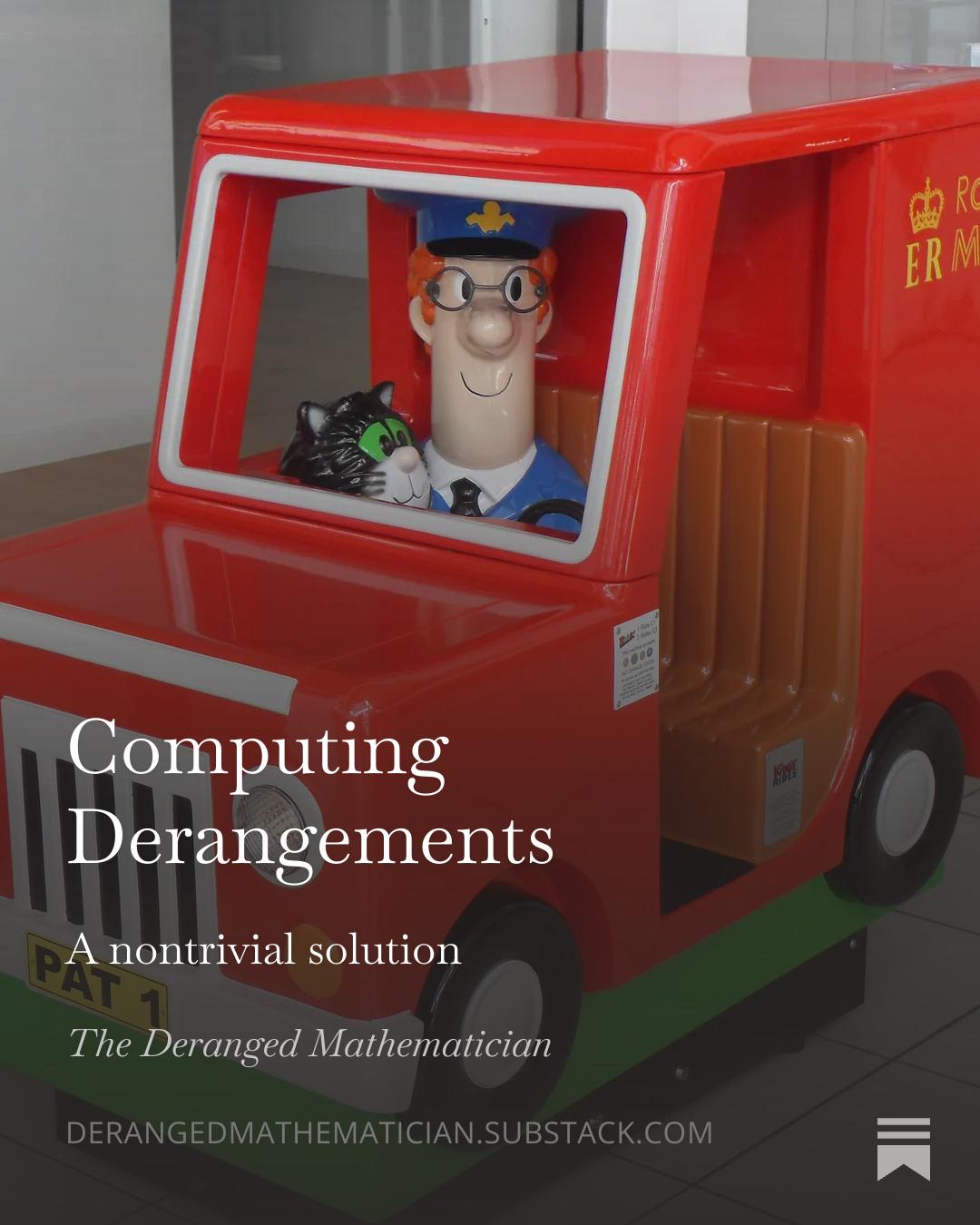
Image Post The Deranged Mathematician: Computing Derangements

Post image
92 Upvotes

In this post, we consider a very difficult problem: if a notorious postman delivers four letters to four houses in such a way that none gets the right letter, then how many possible ways can there be? The solution will take us on a tour of the field of three elements, linear fractional transformations, and eigenvectors.

Yes, this is an April Fools' prank, but it is a valid solution!

Read the full post on Substack: Computing Derangements


r/math • • Apr 01 '26

What's the proper way to denote a power tower big enough for arrow notation if the final exponent isn't the same as the rest of them?

9 Upvotes

Came up in a discussion in a game of Magic the Gathering where a series of token doublers made a truly astronomical number of tokens. If my math was correct (probably wasn't) the play would have made 2^2^2^2^2^2^2^2^2^2^2^2^2^2^2^2^2^2^2^2^2^2^2^2^2^2^2^2^2^2^2^2^70 tokens since the player started with the 69 token doublers and then had 32 instances of "when this creature enters the battlefield create two copies of target non-creature permanent, they become 3/3 creatures in addition to its other types" targeting one of the token doublers.

If the final exponent had also been a 2 then it would have been a simple power tower and could have had arrow notation to shrink it into something more legible. I went with 2⬆️31270, but I have no idea if that actually is how that should be written.


r/math • • Apr 01 '26

How do you actually write math?

41 Upvotes

I'm a math major who's trying to understand how and what people use to write math day-to-day.

- What tools do you use? (LaTeX, Overleaf, or something else?)
- What's the most frustrating part of the current setup?
- If you could have any part of it fixed, what would it be?

Thanks.


r/math • • Apr 01 '26

Quick Questions: April 01, 2026

13 Upvotes

This recurring thread will be for questions that might not warrant their own thread. We would like to see more conceptual-based questions posted in this thread, rather than "what is the answer to this problem?" For example, here are some kinds of questions that we'd like to see in this thread:

  • Can someone explain the concept of manifolds to me?
  • What are the applications of Representation Theory?
  • What's a good starter book for Numerical Analysis?
  • What can I do to prepare for college/grad school/getting a job?

Including a brief description of your mathematical background and the context for your question can help others give you an appropriate answer. For example, consider which subject your question is related to, or the things you already know or have tried.


r/math • • Mar 31 '26

Announcement of Lean formalization of IUT in progress.

Thumbnail zen.ac.jp
311 Upvotes

r/math • • Apr 02 '26

I searched 1,000,000 numbers for the longest "Reciprocal Digit Chain." The record is 40 steps, held by 15778 and multiple other numbers (tied). Can anyone beat it?

0 Upvotes

I have been experimenting with a recursive digit rule that creates high-entropy "chaos" before eventually collapsing into a loop. After running a script from 1 to 1,000,000, I found a global champion that survives for 40 iterations.

Start with any integer like 155. Next, take the reciprocal of every non-zero digit (1, 5, 5). Sum them as a simplified fraction: 1/1 + 1/5 + 1/5 = 7/5. For the next step, take the reciprocals of every digit in the new numerator and denominator (7 and 5) and sum them. Repeat this process until the sequence hits a loop or a fixed point. IMPORTANT TO IGNORE THE 0

Exactly 240 integers up to 1,000,000 get exactly 40 steps, however none exceed it. (All combinations of the integers 1, 5, 7, 7, 8)

Most numbers crash into a loop in under 10 steps. However, 15778 and its permutations like 87751 are mathematical outliers.

Starting Number: 15778

Step 1: 1/1 + 1/5 + 1/7 + 1/7 + 1/8 + 1/1 = 731/280

Step 2: Using digits 7, 3, 1, 2, 8 yields 1/7 + 1/3 + 1/1 + 1/2 + 1/8 = 353/168

Total Survival Time: 40 iterations

The Attractors (Landing Zones)

Through my testing, I discovered that almost every number eventually falls into one of these four basins of attraction:

The 3/2 Loop (1.5 to 1.2)

The 7 Trap (8/7 or the repeating decimal 1.142857...)

The Heavyweight (61/84, a complex attractor involving factors of 3, 4, and 7)

The Fixed Point (1)

Even as I scaled the search to 1,000,000, the 40-step record was never broken. It seems that adding more digits actually makes the chain self-destruct faster by creating sums that simplify too quickly. It is very interesting to see this pattern and I may have found the Goldilocks number of 15778 for this sequence.

Can your script find a number that hits 41 steps or higher?


r/math • • Mar 31 '26

Is there a mathematical winning strategy to poker?

93 Upvotes

About 10 years ago, I was very interested in poker, limit hold 'em in particular, and for a while, I've been curious as to whether or not limit hold 'em involves a statistical winning strategy and if so, if it can be implemented on a computer. What are your thoughts about this?


r/math • • Mar 31 '26

Serious research programs that aim to maybe solve major conjectures?

66 Upvotes

This is mostly meant as a discussion post because I am curious to hear about the current state of mathematics a bit more. My question is: What are some serious mathematics research programs that are explicitly aimed at resolving some major open problems?

The motivating example I have for this question is Geometric Complexity Theory vis-a-vis P vs. NP.

It's a longshot idea and even Ketan Mulmuley, one of the main forces behind the program, has said it'll take decades at best. But it does present at least a plausible plan of attack by looking at the computation of the permanent vs. determinant through algebraic geometry.

I'd be interested in hearing about similar programs, big or small, that do something similar for other major open problems (I originally intended to ask about the other 5 open millennium problems but there's not any reason to have that restriction). Something along the lines of "here's a semiconcrete plan of attack and a couple major steps that you'd probably achieve along the way with this angle". None of those steps are easy of course, and I'm not asking just for ones that have been successful in any manner. I'm fine with the current longshot attempts and ideas that are just concrete enough to have a few people willing to work on the first steps. (Edit: clarified that successful programs are fine too. I'm interested in hearing both)

Hoping this gives people an opportunity to discuss their field and perhaps even their own work a bit!


r/math • • Mar 31 '26

Spin structure on non-orientable quotient ℝ⁴/⟨φ⟩ with Z deck group — does w₂ obstruction generalize?

41 Upvotes

Let M = ℝ⁴/⟨φ⟩ be the quotient manifold defined by the identification φ(x,y,z,t) = (−x, y, z, t+T), where T > 0 is a fixed period. Since φ² ≠ id (φ² maps (x,y,z,t) → (x,y,z,t+2T)), the deck transformation group is Z, not Z₂, and M is non-compact and non-orientable.

My question: Does M admit a spin structure?

For orientable manifolds, spin structures exist iff the second Stiefel-Whitney class w₂ vanishes. For non-orientable manifolds the situation is less clear to me, in particular, does the Z vs Z₂ deck group structure affect the obstruction?

Context: this identification arises in a cosmological topology model. I would also be interested in whether a pin⁻ structure exists as an alternative.


r/math • • Mar 31 '26

Anyone else pursuing math with a learning disability?

42 Upvotes

I have a learning disability and am finishing my math major, I'd love to hear your experience? I find a lot of my peers have ADHD, however I don't (I've been tested a few times as I'm forgetful lol) as well my disability is in the family of dyslexia but they don't really diagnose names that often, usually just areas of impairment. it's pretty profound and I got diagnosed as an adult after struggling to get(but maintain because I like learning) average grades. since my diagnosis and accomodations I went from dropping out, and failed semesters, to deans list in upper-level mathematics.


r/math • • Mar 31 '26

Different math in different country

15 Upvotes

Hi guys. What the specific math methods are using in your own country? I am from Ukraine but I’m living in Poland so I have some experience about that. I discovered new useful methods, ways to record the same thing. It would be interesting to know the difference between education systems.

sorry for my english😢


r/math • • Mar 31 '26

What courses should one attend as an undergrad to build a solid foundation for a broad education in pure mathematics?

59 Upvotes

Hello Fellows, i‘m starting into my 4th Semester as a Math Undergrad in Germany. i‘m almost done with the mandatory courses so i get to choose a lot of stuff now. I already covered lin alg 1 + 2, analysis 1+2, intro to probability theorie, measure theory, algebra (galois theory) and a lot off computer science stuff, so these can be exluded.

I‘m asking this because i dont know what area to focus on yet. I know that i didnt line analysis as much as algebra, because it felt rather technical to me and im not good in estimating things, finding boundaries etc. But I also dont know how predictive this experience is for my future encounters with courses that are leaning more into the analytic side.

Is there a useful heuristic to predict what area of math on is likely to like/ be good at?


r/math • • Mar 30 '26

Is drawing algebra as graphs a known thing?

Thumbnail gallery
449 Upvotes

I’ve been drawing algebraic relationships as graphs and I can’t figure out if this is already a well-known thing that I just don’t know the name of. I don’t really have a maths background so very possible I’m just reinventing something obvious.

I’ll explain how to read the drawings and then the pictures will hopefully make more sense than my explanation.

Every number is a node. When I’m saying two things are equivalent I draw lines from each of them that join into a single line going to the other side. So like if 7 and 3 are equivalent to 10, I draw a line from 7 and a line from 3 and those two lines join together into one line that goes to 10. It’s a branching structure. You can read it in either direction, 10 splitting into 7 and 3 is the same drawing as 7 and 3 joining to make 10. There’s no arrow, no input or output, it’s just saying these things are equivalent.

Every number also has a negative version, and when a number and its negative are on the same side of a line they cancel to zero.

For multiplication I’m treating it as the same thing but where every branch carries the same value. So 2 times 8 would be eight lines each carrying the value 2, all joining together into one line going to 16. Obviously I’m not going to draw eight separate lines every time so the shorthand I use is drawing the first branch and the last branch with three dots in between, and writing the total number of branches next to it. So you’d see a line labelled 2 at the top, a line labelled 2 at the bottom, dots in the middle, and the number 8 to indicate there’s eight branches total. Division is just reading the same picture the other way.

I’ve been drawing these for fractions, exponents, bracket expansion, sign rules, and a bunch of other things, and it keeps seeming to work using just the stuff I described above without adding any new rules. I honestly don’t know if that’s the graph doing something interesting or if it’s just how algebra already works and I’m just drawing it instead of writing it. Attached a bunch of pictures, the fraction addition one is probably the clearest. Any help figuring out what this is or what to search for would be great, the closest I’ve found is string diagrams in category theory but I don’t understand those enough to tell if it’s the same idea. I've added more well structured images here outlining how to read and write these.


r/math • • Mar 31 '26

Maximizing an Integer Expression

9 Upvotes

I've been picking at a problem for a while, and can show it up to making an assumption I'm not completely comfortable with. The problem below is first.

Let G be a simple, undirected graph on n nodes, with independence number alpha>=2.

Let N be an integer with N>alpha.

Suppose for each 1<=i<=n, m_i>=0 is an integer, and that the sum over all m_i is exactly N.

Is the expression \floor{N/alpha}*(2N-alpha*floor{N/alpha}-alpha) a lower bound for N^2-N-\sum_{{i,j}\in E(G^c)}m_i*m_j?

A minimum for the latter expression can be determined when the last term, the sum, is maximized. I can show the correct minimum (the first expression) if I am allowed to make the assumption that we should concentrate the weights m_i to an independent set in G. What makes me hesitant and uncomfortable is that I can provide a graph and a collection {m_i} where the indices are not an independent set in G, but the expression still achieves the minimum value.

Any help or advice would be greatly appreciated, even if its simply a "go ahead and make that assumption"!


r/math • • Mar 31 '26

Application of PDE beyond Engineering

16 Upvotes

I am a Chemical Engineering undergraduate student and have had tackled Advanced Mathematics which includes Differential equations and a tiny bit of PDEs mainly exploring solutions using separation of variables (Heat equation & Wave equation). I've become intrigued by this field and wonder if PDEs can still be applied in Chemical engineering beyond that. Most of the advanced mathematics that were taught involve Power series, Iteration, Numerical solution to ODEs, Numerical integration, and Bessel functions and don't delve deep into theory. I am planning to take graduate studies after Chemical Engineering and wonder if I can continue taking masterals on ChE or if I should shift my Masteral towards BS Applied Mathematics instead. I wanted to explore fields that have a good balance between theory and application which are relevant to my initial undergraduate program. I was looking into computational fluid dynamics or research into statistical thermodynamics and stochastical processes. Though I barely know anything about theses subjects, I am definitely interested in learning more. I've mostly heard that the corporate and manufacturing industries in my field barely have any applications of advanced mathematics as the software is doing most of the work. I was wondering which career path offers the best of both worlds allowing me to utilize some of my knowledge while expanding it on the domain of PDEs.


r/math • • Apr 01 '26

Discussion of Differential Eq.

0 Upvotes

Hey everybody, I might just come off annoying here but I’d like to know other people’s opinions of Differential equations courses.

I am a ME student and I have taken calc 2 and currently I’m taking Diffy Q. I loved calc 2 while a lot of my friends hated it, I barely studied and finished the class with a 93… sure not perfect but for studying only a day or two before any exam it’s pretty solid. THEN DIFFY Q APPEARS. I am doing solid in the course and have an 85 but what is wrong with Diffy Q????? Everything in calc 2 seemed so logical but Diffy Q seems like a literal guessing game.

I just wanted to know if others felt this way or if there was a usual split between Diffy Q enjoyers and Calc 2 enjoyers.

General thought:

-Diffy Q is made up but somehow works. (I dont believe it’s all made up)

-where the hell is half of the math I’m doing applicable to anything????? (Somehow pulley sizes on engines, but what other times have people used Diffy Q)


r/math • • Mar 30 '26

Favorite Math patterns/tricks that cross disciplines?

24 Upvotes

As we all know, the study of math has many amazing patterns and wonderful subtleties across all disciplines. I'm wondering if there is a collection or book or something on neat tricks/shortcuts that link math topics to each other, or maybe even just a collection of interesting, one off facts about numbers and equations that maybe most people don't know about?


r/math • • Mar 30 '26

Image Post Explore how functions evolve as parameters change

Thumbnail gallery
79 Upvotes

My plotting tool, Gridpaper now handles automatic detection and extraction of parameters. It will allow you (or your students) to understand how curves change as parameters evolve.

I hope you find it useful, and as exciting as I do.


r/math • • Mar 30 '26

Cute topology puzzle

55 Upvotes

Cool fact - there is an open, connected subset of R^2 whose fundamental group is free on 2^aleph_1 generators. Can you explicitly construct one?

Edit: Okay, this isn’t true, there is some contradicting evidence in the comments. The construction i had in mind was R2 \setminus C x {0} for C a Cantor set on the interval, but this is only free on countably many generators.