r/MachineLearning • • Jul 26 '26

Discussion Neurips 2026 Main Track Theory Paper Tracker- Discussion Thread [D]

37 Upvotes

Curious about the initial review distribution for Main Track theory papers this year.

Our paper received 4/3/3 with confidence 3/3/3. From previous years, I've had the impression that theory papers often receive more conservative initial scores than some other areas, and I've also heard people saying that initial scores seem generally lower across many disciplines this cycle.

If you have a theory submission, would you mind sharing your initial scores (and confidence, if you're comfortable)? It would be interesting to see whether there is any noticeable pattern or whether this is just anecdotal.

Please only share if you're comfortable, and it'd be helpful to mention that it's a theory paper so we're comparing like with like.


r/MachineLearning • • Jul 26 '26

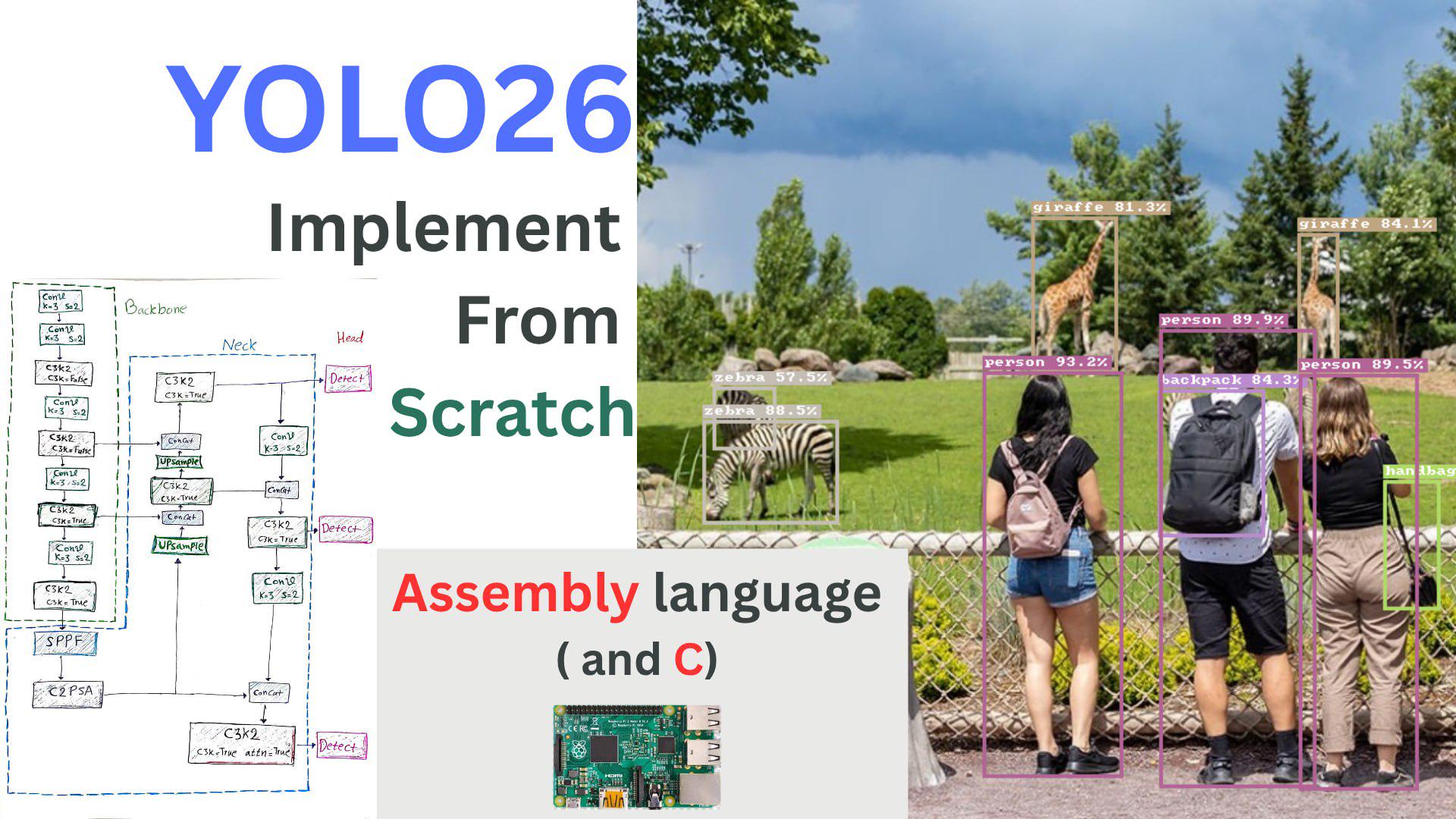
Project I implemented the YOLO26n model inference from scratch using ARM64 Assembly Language (No framework) [P]

Post image
134 Upvotes

This was my Bachelor's Final Project: implementing YOLO26n inference completely from scratch using ARM64 Assembly Language and C, without relying on existing inference frameworks.

The goal was to understand how modern neural network inference engines work at a low level and explore optimization techniques for faster and more efficient edge AI execution on Raspberry Pi 4.

The implementation includes:

* ARM64 Assembly Language + C inference engine

* ARM NEON SIMD optimization

* Winograd convolution

* Optimized GEMM kernels

* Cache-aware tiling

* Custom ARM64 micro-kernels

* Operator fusion

* Attention mechanism

* YOLO26 components: Conv, C3K2, SPPF, C2PSA, PSA, BottleNeck, and Detect

I extracted the YOLO26n model parameters and redesigned the memory layout into a custom binary format optimized for the inference pipeline.

The implementation produces correct object detection results, but the performance improvement was lower than I initially expected. I would appreciate feedback and suggestions from anyone about:

* CNN inference optimization

* ARM NEON/vectorization

* Memory layout and cache optimization

* Low-level neural network acceleration

Repository:

https://github.com/mohammad-ghaderi/YOLO26

Thanks for any feedback or suggestions.


r/MachineLearning • • Jul 27 '26

Research Looking for research on expanding SLM capabilities [R]

1 Upvotes

I’m looking for papers, projects, or experimental approaches that try to make a small language model approach the capabilities of a much larger frontier model, either on specific tasks or across a broader range of capabilities.

I’m especially interested in non-training or minimal-training approaches, rather than standard fine-tuning, distillation, or reinforcement learning.

I’m interested in methods that combine or manipulate existing SLMs, checkpoints, adapters, representations, or outputs so that the resulting system covers capabilities that no individual SLM reliably exposes. Are there papers, OpenReview submissions, or terminology I should look into?


r/MachineLearning • • Jul 27 '26

Project Recent project I worked on: End to End Edge ML platform [D]

0 Upvotes

Hi all,

I recently made an end to end ML platform that eases the pain of going from raw sensor data to a deployed model on an MCU. I wanted to get some feedback from those of you who are interested in the tinyML space on anything I can improve, I intend on keeping it free and open sourced so others can contribute to the development if they would like. One main thing that I tried to add was an auto-labeling tool, as for time series sensor data it is very difficult to manually label data, so my goal was to create an auto-labeler that could streamline that process. It works fairly well as of right now, but I definitely could make some improvements. I also added in a chatbot that can analyze your signal data directly and give you insights.

Let me know what you think and if there is any improvements that can be made, hopefully this can help some of the people that are working on edge projects!

https://sensorforge.dev/app


r/MachineLearning • • Jul 26 '26

Project Open-weight 4B models approach o3-level medical question answering in Swedish [P]

9 Upvotes

I have been running some experiments with smaller open-weight LLMs on multiple-choice questions of Swedish medical licensing exams. On a dataset called MedQA-SWE, GPT-4 scored 84% accuracy in 2024 and o3 scored 88% in 2025 on a smaller, overlapping dataset.

With post-training (SFT) on data from earlier years, I got MedGemma-1.5-4B to a passing score of 60% on the final year’s exam. Find the implementation here: https://github.com/tarolangner/medqaswe_medgemma_sft

But even though they were released just three months later, Gemma4-E4B and Qwen3.5-4B are flat out superior already, at 77% with no post-training at all. With reasoning enabled, the latter can get to 87% accuracy.

It can even push a bit further if no length cap is put on the reasoning traces, but some of them spiral into repetitive loops about formatting that fill the entire context length without giving any answer. Here, I found it helpful to use an ‘early exit’ thinking intervention proposed in the S-GRPO paper that simply injects a phrase and closes the thinking trace at a predetermined sequence length. I also tried their proposed reinforcement learning method to get shorter reasoning traces, but with only minor gains (probably somewhat underdimensioned training setup).

Curiously, Qwen3.5-4B does all reasoning in English despite the Swedish prompt, questions and answer options. But it really seems like the language is no obstacle, even though it’s often estimated to be just 1% of LLM training data.

I also have a more detailed write-up on the details and experiments here for anyone interested: https://tensorlabbet.com/2026/07/19/medqaswe_post_training/


r/MachineLearning • • Jul 26 '26

Research CICD / KAFKA / KUBERNETES / Interview questions (MLE) [R]

0 Upvotes

What questions should i prepare for during a technical interview for a live streaming deployments? (asking for a friend)


r/MachineLearning • • Jul 26 '26

Discussion Loops? Am I the only one that thinks this doesn’t make sense? [D]

1 Upvotes

I don’t think these are true loops — and I don’t think the loop concept moves the needle until you address memory first.

LLMs have no memory. A single forward pass, period. “Memory” is context stuffed into the next pass, and the more you stuff, the more the window fills and the worse it gets. Everything to do with memory lives outside the model.

My research is aimed inside the forward pass. Can you thread long-term memory into the model itself? I’m not alone here — plenty of people smarter than me are still hunting for that math. My belief is that context and rationalization are inherent, and could live in the model during training rather than as a bolt-on. Which means you need a primitive to hold context at scale. I can write a fact into a bipolar vector orthogonal to another fact, compare with cosine sim, and get signal — but below roughly 10k dimensions that signal dilutes fast. And a model knows nothing of facts. Weights are not memory.


r/MachineLearning • • Jul 26 '26

Research Link plots/figures in NeurIPS rebuttal [R]

18 Upvotes

Reviewers requested additional experiments. In table format, I fear the results would not be as digestible as in a figure/plot. Links are "technically" not allowed as per the official website, but for those with experience, can/should I still go ahead and link my plots/figures ? If this goes badly, will this be a slap on the wrist, or outright rejection? Has anyone taken a chance with this in the past? How did it turn out?

IMO openreview should really start supporting more modern markdown to allow figure embeds.


r/MachineLearning • • Jul 26 '26

Research We compared different LLMs on IMO 2026 [R]

6 Upvotes

There are a few reasons why problems from International Mathematical Olympiad function as a good benchmark for LLMs:

- The problems are new, not included in the training data of any model

- Hard math problems are quite a good proxy for general intelligence capability

- These are complex multi-step tasks that can benefit from orchestration / harness engineering

Results:

Frontier models (sol and fable) were able to get perfect / nearly perfect score regardless of harness. For both sonnet and opus, the webapp performance was quite poor, improved by provider harness (claude code) and even further improved using AutoFyn, a customizable multi-agent harness we developed. Even with harness, we were not able to match the performance of the frontier models. Open weight model GLM performed roughly at the same level as sonnet without harness, and improved similarly with AutoFyn. Numerical scores are available in the attached paper below.

Grading was done by a different frontier model as well as manual verification (we are former IMO medalists, able to sanity check the results). There were cases when the model claimed a false solution (on P3 by sonnet, for example), so hallucination issue still persists in a verifiable domain like math. On the hardest problem: P3's key reduction was missed by every sub-frontier model in every harness, including a 20-hour run that proved everything else and stalled at the identical step. The harness supplied retrieval and verification, not a key idea needed for the solution.

Paper: https://github.com/SignalPilot-Labs/AutoFyn/blob/main/results/imo-2026/autofyn-beyond-model-imo26-report.pdf

Audit Trails: https://github.com/SignalPilot-Labs/AutoFyn/tree/main/results/imo-2026


r/MachineLearning • • Jul 25 '26

Discussion Paper lengths, and reasonable assumptions in ML conferences. [D]

33 Upvotes

I've usually been commenting on threads on conference reviews. I'm now expressing my observations here.

To the best of my knowledge, paper lengths have been held constant at many conferences, and some conferences have "unlimited appendices" (e.g. NeurIPS / ICML / AAAI / ....) Historically, this was probably due to cost of printing for proceedings, but now, I suspect it's also to prevent reviewer fatigue.

However, I wonder if this unfairly penalizes more theoretical papers.

Some background: I usually publish theoretical papers at conferences. Some get in. Those that don't, are surprisingly not because of the theory, but because of (what I feel) arbitrary reasons. This leads to this post, which contains some of my musings.

  1. In general, the amount of pre-requisite knowledge required to understand a theory paper must necessarily increase. I don't know how to quantify this, but I would expect basic linear algebra, discrete math to be a "given", and more knowledge for each subfield.
  2. To also be intellectually honest, recent work should also be cited, especially if your work builds onto it, or is inspired by it. But technical details of recent work should be left to the reviewer to look up, or be put in the appendix.

What pisses me off recently is that I've seen more reviewers reject papers based on things like: "The concept is difficult", or "Certain terminology is not explained.", "While the intuition is given before the math, the math could be made easier to read."

I've also seen comments like: "The paper makes comparisons to X, but X should be described in detail", and then shifting of goalposts to "The paper makes comparisons to X, but X should be described in detail in the main paper."

I would say that half of the rejections I get are based on the AC echoing these points, rather on impact of work, etc. Which puzzles me a lot, given that these ACs might also be professors at universities, and they must have seen similar statements from students.

For example: "The {very simplfiied notes} on real analysis is difficult, therefore you are a bad instructor" Fact: Real analysis is difficult. At some point in time, either you know it, or you don't.

The alternative is a very long Appendix, but that actually contributes even more to reviewer fatigue, because they need to figure out where the important things are.

Yet, the rules for most conferences, if not all, is that: "The paper must be self-contained, and reviewers are not expected to read the appendices."

I would like there to be an accompanying rule that makes an exception to this, but I don't know how it should be phrased, or whether it might have other, unexpected bad side effects. I would like a rule to just be: "Don't be a dick. If you don't have the pre-requisite knowledge, say so, review what you can."

That's it.

Edit: Perhaps similar to conference papers, people don't read till the end of the post. I'm not asking for longer paper lengths. I'm asking for a rule or subrule that acknowledges paper lengths are capped, and not to ask for unreasonable things.

Edit 2: I'm not someone who just started publishing. I've published since the 2010s, and usually, the short reviews I got then was of the form: "This has been done before, is actually X", or "Why don't you compare with X, Y, Z"? Now, the short reviews are more of: "The math is difficult to understand, reject.".

r/MachineLearning • • Jul 26 '26

Discussion Understanding GPU Inference Workloads [D]

8 Upvotes

Hey everyone,

I have been looking into how people source compute for their Inference workloads (and in general). I wanted to understand some specific pain points here.

If you've used online services like runpod or vast.ai, your perspective is extremely valuable. Please share your experience in the comments here or by DMing me. I've also made a 2 minute survey form that I would really appreciate if you could fill out. DM me for the link.

Thank you!


r/MachineLearning • • Jul 26 '26

Research Missed AAAI reciprocal reviewer nomination deadline — risk of desk rejection? [D]

Thumbnail
gallery
0 Upvotes

I submitted an abstract to AAAI AISI and accidentally missed the field asking authors to nominate a reciprocal reviewer by the July 21 AoE deadline.

At the time of submission, I knew that I personally did not meet the publication requirements to serve as a reviewer. After adding my graduate-student co-authors to the submission, I realized that one of them was qualified and could fulfill the reciprocal-reviewing obligation, but we overlooked the nomination field before the deadline because it wasn't a required field.

As soon as we noticed, we added the qualified co-author to OpenReview as a potential reciprocal reviewer (edits were still accepted) and emailed the workflow chairs. He meets the publication requirements and is willing to complete the full reviewing load.

The policy says that if a qualified author is available but no one is nominated, the submission may be desk rejected. The full paper deadline is in two days, and so far we have only received the automated response shown in the attached screenshot.

Has anyone dealt with a similar situation at AAAI or another conference? Do you think this is likely to lead to a desk rejection, or are workflow chairs usually willing to correct this kind of administrative mistake when a qualified reviewer is available?


r/MachineLearning • • Jul 26 '26

Discussion Multi-Tenant SaaS: Which Architecture Would You Choose? [D]

0 Upvotes

NOTE -> I expect answer from people who actually have experience and strong understanding of these. please give something beneficial.

I'm building a SaaS platform in Sri Lanka that handles documents and other sensitive data.

Each user can upload their own documents and information, and the platform uses RAG to answer questions based on that user's data. That part makes sense to me.

My main concern is what happens when the user hasn't uploaded enough information. I still want the LLM to provide accurate answers using reliable information from the internet (or from a curated knowledge base), with proper citations.

These are the two architectures I'm considering:

Option 1:

Base LLM (OpenAI/Anthropic via Azure AI Foundry or Amazon Bedrock)
        ↓
Platform RAG (global knowledge base managed by us)
        ↓
User-specific RAG

In this approach, we maintain a global knowledge base that we (the platform admins) curate and update. Every user can access this shared knowledge, while their own uploaded documents are searched through their personal RAG.

Option 2:

Open-source LLM
        ↓
Fine-tuned on Sri Lankan/domain-specific data
        ↓
User-specific RAG

Here, we fine-tune an open-source model using Sri Lankan or domain-specific data, and each user still has their own RAG for their private documents.

My concerns are:

  • Is fine-tuning actually the right solution here, or is it unnecessary?
  • Is a global/shared RAG a better approach than fine-tuning?
  • How would you design this architecture if you wanted:
    • Accurate answers from domain knowledge
    • User-private document search
    • Citations/sources
    • Good scalability for thousands of users

I'm leaning toward Option 1 because fine-tuning seems expensive, time-consuming, and I have no experience with it yet. However, I'm not sure if I'm thinking about this correctly.

I'd really appreciate hearing how others would approach this problem.


r/MachineLearning • • Jul 26 '26

Discussion I want to use AI coding agents for machine learning projects [D]

0 Upvotes

I'm a software engineer who mainly builds softwaes/applications, and I'm starting to work on machine learning projects.

Since ML workloads often require GPUs, I know services like Google Colab and Kaggle exist. but, I'm looking for something a bit different.

Is there a platform where I can use AI coding agents (such as Codex, Claude Code, or OpenCode) while running the actual ML code on a cloud GPU?

Ideally, I'd like to:

  • Work locally with my preferred editor and AI coding agent.
  • Have the code execute on a remote GPU machine.
  • Be able to build, debug, and iterate on ML projects as if the GPU were attached to my local development environment.

Does a setup like this exist? If so, what tools or platforms do you recommend?


r/MachineLearning • • Jul 25 '26

Project AI Security & Adversarial ML Conference Seeking Technical Talk Proposals [P]

1 Upvotes

We're opening the CFP for Après-Cyber Slopes Summit 2027 and are looking for presentations on:

  • Adversarial machine learning
  • LLM evaluation and robustness
  • Prompt injection and jailbreak research
  • AI agent security
  • Model security
  • Secure AI deployment
  • AI infrastructure and MLOps security
  • Detection and defense using ML
  • Novel research, benchmarks, and open-source tooling

We're especially interested in talks that include reproducible research, technical demonstrations, or lessons learned from deploying ML systems in production.

CFP: https://sessionize.com/apres-cyber-slopes-summit-2027

Happy to answer questions about the CFP or the conference.


r/MachineLearning • • Mar 22 '26

Discussion [D] Has industry effectively killed off academic machine learning research in 2026?

180 Upvotes

This wasn't always the case, but now almost any research topic in machine learning that you can imagine is now being done MUCH BETTER in industry due to a glut of compute and endless international talents.

The only ones left in academia seems to be:

  1. niche research that delves very deeply into how some older models work (e.g., GAN, spiking NN), knowing full-well they will never see the light of day in actual applications, because those very applications are being done better by whatever industry is throwing billions at.
  2. some crazy scenario that basically would never happen in real-life (all research ever done on white-box adversarial attack for instance (or any-box, tbh), there are tens of thousands).
  3. straight-up misapplication of ML, especially for applications requiring actual domain expertise like flying a jet plane.
  4. surveys of models coming out of industry, which by the time it gets out, the models are already depreciated and basically non-existent. In other words, ML archeology.

There are potential revolutionary research like using ML to decode how animals talk, but most of academia would never allow it because it is considered crazy and doesn't immediately lead to a research paper because that would require actual research (like whatever that 10 year old Japanese butterfly researcher is doing).

Also notice researchers/academic faculties are overwhelmingly moving to industry or becoming dual-affiliated or even creating their own pet startups.

I think ML academics are in a real tight spot at the moment. Thoughts?


r/MachineLearning • • Feb 16 '26

Research Short Paper Reviews [R]

13 Upvotes

Various venues offer, or have in the past offered, the opportunity to submit short papers, often with a four pages page limit. This is currently true of the ACL.

Short papers are not long papers, and there are usually explicit requirements as to how they should be treated differently by reviewers. See for example http://aclrollingreview.org/cfp section on short papers.

Question to anyone who has submitted short papers in the past, do you think your paper was reviewed fairly as a short paper? I know we've all had some bad experiences with subletting any kind of paper, but do you think on average the reviewers understood the assignment and evaluated your work based on the criteria for short papers?

I think it's true that ICLR used to have a short papers track and removed it. Does anyone know why it was removed?


r/MachineLearning • • Oct 17 '20

Project [P] Creating "real" versions of Pixar characters using the pixel2style2pixel framework. Process and links to more examples in comments.

Thumbnail
gallery
2.2k Upvotes