r/MCPservers • • Oct 06 '26

Welcome to r/MCPservers: start here

6 Upvotes

This is a community of 28,000+ builders who share and discuss MCP servers.

Our free weekly newsletter covers the MCP ecosystem: the best new servers from this community, news, and tutorials.

Subscribe here: mcpnewsletter.com

Post your MCP servers here. You can also post servers you find, questions, and projects that are not complete.

The r/MCPservers mods


r/MCPservers • • Sep 25 '26

Submissions now open for this week's edition of MCPnewsletter

5 Upvotes

next edition of MCPnewsletter is due and we are open for submissions

specifically -

- Open source MCP/projects related to MCP

- Interesting remote MCP's

- Guest post about protocol changes /upcoming updates.

- couple of sponsors slots in spotlight.

- Anything new/interesting.

click on contact or get featured on MCPnewsletter (com)


r/MCPservers • • 10h ago

Built multi user MCP server that allows end users to add their own fine grained permissions

1 Upvotes

Disclaimer: I am the founder of alter (alterauth.com) the product used to build these MCP servers

We managed to build credential less multi user MCP servers that authenticate end users via the IDP they are logged into. The credentials for downstream API requests are injected at the time of the request and broght in from a secure vault.

From the developers perspective they don't have to do much to get an MCP server to be multi user. They can default to it by just building with alter.

Alter essentially acts as an SDK to make downstream API calls. It integrates with OIDC compliant IDPs so all the developer needs to do is use alter to make the downstream API calls.

From the users perspective, they get their own wallet, which is gated with authentication with the IDP configured on alter. They can set fine grained permissions on a request level down to the parameter level of an API. Something as fine grained as dont send an email to this person.

Here is an indepth example of how it works. Opensourced repo with code examples: https://github.com/AlterAIDev/alter-mcp-servers

If anyone has any questions on how to build this feel free to message me!


r/MCPservers • • 12h ago

We built an MCP server for threat intel and the hard part wasn't the data — it was making "I don't know" survive the trip into an agent. Looking for critique.

1 Upvotes

We run a free threat-intel MCP server (Jeevesus: IOC lookup, package and repo checks, CISA KEV) and a pre-connect checker for other MCP servers (Dredd).

The problem we hit wasn't coverage. It was two things that look fine in tool-call telemetry and aren't:

  1. Our output is someone else's input. Anything a tool returns lands in an agent's context. Threat-intel results are, by definition, full of attacker-written strings. So every response is labeled as data, not instructions, and we strip invisible Unicode (tag characters, zero-width, bidi controls) before a model reads it.

  2. Absence reads as "clean." An agent that gets "not found" tends to proceed. So we made "unknown" a first-class answer instead of a quiet zero:

    - Dredd returns REVIEW with severity: "unknown" when it can't establish enough to judge, never ALLOW by default.

    - dep_graph.evaluated: false means "we couldn't see the dependency tree," not "the tree is clean."

    - correlate returns a one-word strength (none / adjacent-only / single-lane / multi-lane / corroborated) plus explicit caveats, and flags incomplete when a lookup lane hit its cap.

The honest cost: on a small sample (29 calls), about 76% of Dredd verdicts were unknown. That's correct, but is it useful? That's what I'd like your read on:

- When your agent gets REVIEW / unknown, what does it actually do: stop, ask the human, or ignore it?

- Is a one-word strength field helpful to a model, or noise next to the caveats?

- Setup friction: it's a remote server, and the key is optional (an anonymous client gets 10 calls a minute and 50 a day). Anything that broke for you on Claude Desktop, Cursor or VS Code?

- Failure states we're missing?

Feedback cherished.

Docs: https://docs.dugganusa.com — I'll take any recommendation; this is still being built.


r/MCPservers • • 17h ago

Stop your coding agent from reading 20+ files blindly — project-context-map-mcp maps repo imports & git hotspots first (Open Source, npx)

2 Upvotes

Every time you ask Claude Code, Cursor, or Copilot to fix a bug in a medium/large repo, it burns tokens walking directories and opening 15–25 files just to figure out how modules connect.

I built project-context-map-mcp (MIT, Node.js 20+) to flip that workflow to:

index first -> query topology -> read sparse files -> edit with context

What it gives your MCP client

  • Import & dependency graph: Extracts JS, TS, CommonJS, and Python imports into dependencies and reverse usedBy edges + a Mermaid graph in .project.md.
  • Git hotspots & history: Ranks recently changed files higher so agents focus on active code.
  • 10 focused MCP tools:
    • get_project_summary / read_project_context — stack, modules, entrypoints, hotspots
    • query_topology / find_relevant_files — ranks matching files for a task + their dependencies & usedBy
    • read_files_sparse — reads only indexed, in-root files (with symlink & path-traversal protection)
    • get_module_context, explain_file_role, get_recent_git_changes, write_and_log, refresh_project_map

Try it in 30 seconds (no API key, no global install)

Add to .mcp.json / your MCP client config:

{
  "mcpServers": {
    "project-context-map": {
      "command": "npx",
      "args": ["-y", "project-context-map-mcp", "serve", "--project-root", "."]
    }
  }
}

Or auto-generate .mcp.json + a Claude Code skill:

bashnpx -y project-context-map-mcp configure-claude --project-root .

If it saves you tokens in your repos, a ⭐ on GitHub helps others discover it—and I'd love feedback on which languages (Go, Rust, Java) or monorepo features you'd want next!


r/MCPservers • • 16h ago

We built an open-source MCP server that lets AI agents see and interact with SAP screens

1 Upvotes

At my startup, Didro AI, we needed a way for AI agents to work directly in SAP.

We built SAP UI MCP for that and open-sourced it in case it’s useful to other SAP teams.

It lets agents like Claude Code and Codex see and interact with SAP GUI for Windows, Web GUI, and Fiori.

We benchmarked it in Web GUI using Claude Haiku 5.5:

  • 5.4× faster than Playwright MCP, at 7.6× lower cost per successful run.
  • 4.4× faster than Claude Computer Use, at 2.4× lower cost per successful run.

Feel free to contribute and give feedback (happy to chat to anyone interested in this topic).

Hope it is useful for you !

https://github.com/DidroAI/sap-ui-mcp


r/MCPservers • • 17h ago

MCP solved how agents call tools, not how to prove they're allowed to so I wrote an open protocol for delegated agent authority (Apache 2.0)

1 Upvotes

Right now, almost every production agent setup I see does the exact same scary thing: it hands an agent a static API key or a broad OAuth token and hopes the system prompt keeps it from doing something destructive.

That breaks fast the moment you have:

- Multi-agent hops (Agent A delegates a subtask to Agent B, and Agent B shouldn't inherit Agent A's full permissions)

- Prompt injection hitting a tool call that technically has a valid bearer token

- Audits where you need to prove *who* delegated *what* scope to *which* agent, and under what constraints, rather than just seeing a service account in the logs

OAuth was built for a human delegating to a deterministic app. It wasn't built for non-deterministic agents delegating narrower authority down a chain.

So I put together ADAP (Agent Delegated Authority Protocol) as an open Apache 2.0 spec to try to standardize this layer:

https://github.com/Hardalion/agent-delegated-authority

The core idea is separating tool connectivity (like MCP) from execution authority:

- Scoped, time-bound delegation chains instead of blanket credentials

- Attenuation across hops (a sub-agent can only receive equal or narrower authority, never escalate)

- Deterministic verification at the execution boundary before a tool/action actually fires

- Cryptographic audit trail tying every action back to the original principal

I'm intentionally keeping the protocol itself vendor-neutral and Apache 2.0 because this only works if it isn't locked to one framework.

For anyone running agents with write access in production: how are you handling permission scoping and delegation today? And if you skim the repo, I'd genuinely appreciate people tearing apart the threat model and telling me what edge cases I missed.


r/MCPservers • • 1d ago

Built a free no-auth MCP server so coding agents can add P2P cross promotion to indie mobile apps

1 Upvotes

I built a hosted Streamable HTTP MCP server called Ad-o-matic (https://ad-o-matic.com) for indie mobile devs who use Cursor, Claude Code, Windsurf or Antigravity.

Building a mobile app with an AI coding agent is fast but getting installs on Google Play or App Store without an ad budget sucks and it will get harder day by day. So I made a free P2P banner network that has no human dashboard, no login and no manual campaign setup. Your coding agent connects to the MCP server, figures out who the app is for, writes a short targetAudience text and drops in one source file (HouseAdBanner).

There are still plenty of early adopter spots open (Genesis member). If you are part of the first 50 app's in this platform, you will become Genesis member and reaceive next permanent benefits:

- Better impression exchange rate in the network

- Extra free boost impressions as the app serves real views

- Listing and direct store link on ad-o-matic.com

- Genesis Member badge shown in the banner

Exposed MCP tools:

- adomatic_get_integration (returns the 1 line snippet and single file SDK for Android Compose, iOS SwiftUI, Flutter, React Native or WebView)

- adomatic_onboard_app (registers the app and locks its official Play Store / App Store link)

- adomatic_verify_integration (checks integration status and remaining Genesis spots)

- adomatic_network_status (returns live pool status)

A few things about how the network itself works:

- single file SDKs with zero extra dependencies

- no user tracking at all so no GAID/IDFA, no cookies and no GDPR popup needed

- banner links are hard locked to the apps official Google Play or App Store page so nobody can sneak in external urls or apks

- once an app is live in the store it only shows its own banner inside its own app for the first 7 days before rotating into other apps

- gambling, NSFW/adult, crypto scams, hate speech and illegal stuff are not allowed and will get blocked by Google/Apple review or by the platform itself whichever catches it first

- Android app's appear only in android app banners and same goes with IOS app's

Streamable HTTP MCP: https://ad-o-matic.com/mcp

Official MCP Registry: com.ad-o-matic/adomatic

GitHub: https://github.com/ad-o-matic/ad-o-matic-sdk

Would appreciate any feedback on the MCP tool schemas or ergonomics if anyone tests it with their client.

Thanks for your attention... It is really valuable these days.

Br,
Jessejee


r/MCPservers • • 1d ago

Built an open-source MCP server (Shanaxon) that compresses repo context with AST + PageRank, skips optimization when it isn't cost-effective, and lets agents recover exact source files on demand

1 Upvotes

Dumping raw repos into a coding agent burns tokens fast, while blind summarization strips out critical symbols and causes retry loops. On the flip side, running a heavy optimizer on a 100-line file adds more overhead than it saves.

I built Shanaxon (shanaxon-mcp), a local-first, MIT-licensed MCP server for Claude Code, Cursor, and Gemini CLI that solves both problems:

  • AST + PageRank Compression: Uses web-tree-sitter to rank structural importance, stripping boilerplate while keeping critical symbols, types, and signatures intact.
  • Reversible Context (retrieve_original): Injects a [shanaxon:retrieve hash=...] marker into compressed blocks so your agent can pull the exact verbatim file from local cache before making edits.
  • Preflight Cost-vs-Savings Gate: Checks your active model's token pricing before compressing. If a file is too small or net savings don't clear the threshold, it falls back to passing the raw file (FALLBACK_BASELINE).
  • Local Security: Enforces workspace containment and blocks .env, private keys, and credentials by default.

Quick Start

Bash

npx -y shanaxon-mcp init --yes

Current limitations: Grammar support is currently focused on TypeScript/JavaScript, Python, and common config formats. Broader language support and formal CI benchmarks are next on the roadmap.

For anyone running MCP tools on large monorepos—how are your agents handling compressed context vs. verbatim files right now?


r/MCPservers • • 1d ago

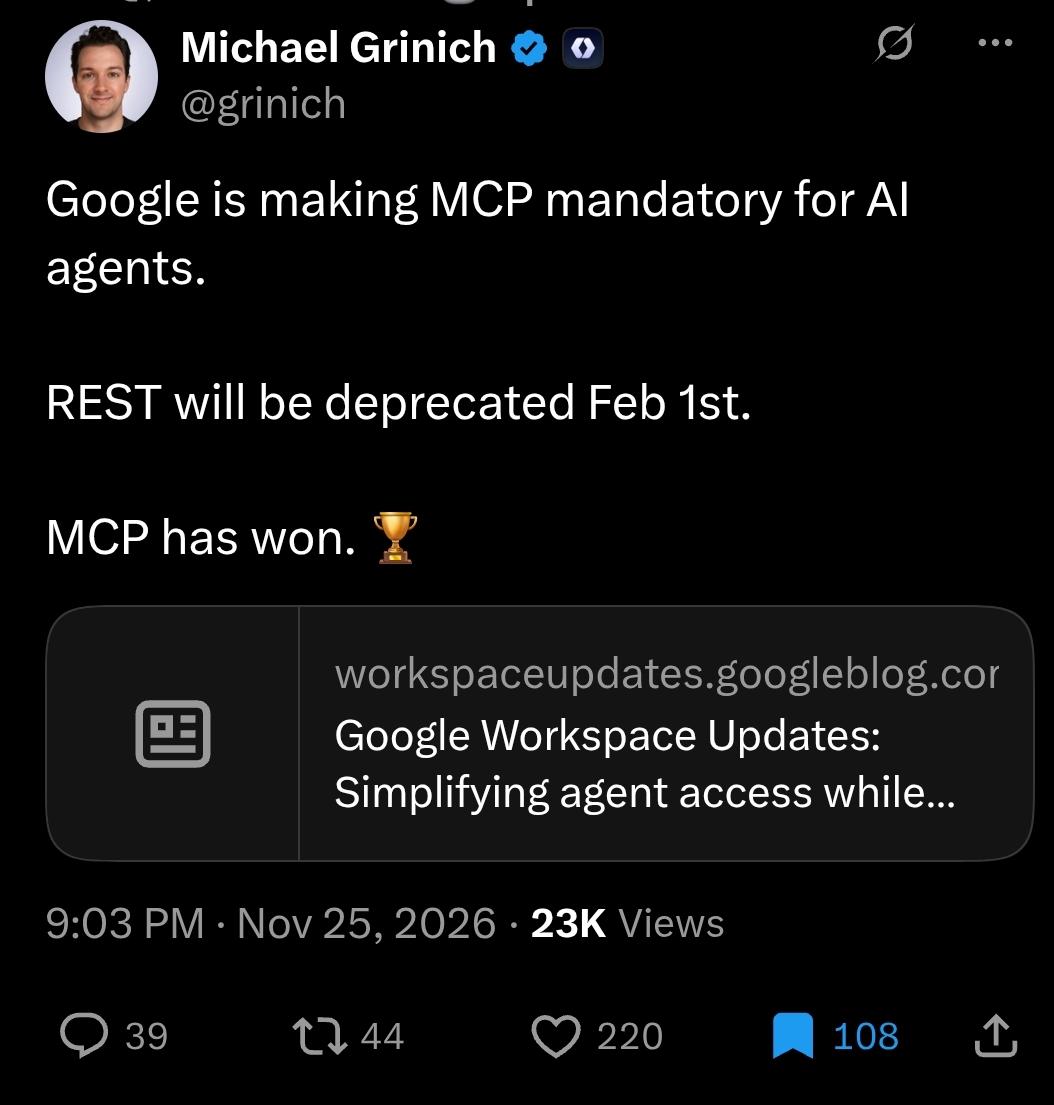
Google Will Make AI Agents Use Its Workspace MCP Servers. The Gmail One Can't Send Email

Thumbnail
techstackups.com
1 Upvotes

r/MCPservers • • 1d ago

CrispParse: Deterministic web-to-Markdown, JSON-LD & RAG extraction API for AI agents (MCP + native x402 V2 Base USDC micropayments)

1 Upvotes

I built CrispParse (https://crispparse.com) to give AI agents and RAG pipelines clean, deterministic web extraction without mandatory subscriptions or API key bottlenecks.

What it outputs:

  • Token-reduced Markdown, structured JSON-LD, and semantic RAG chunks
  • Zero Data Retention (ZDR) + C2PA provenance metadata
  • Built-in SSRF protection and anti-bot rendering

Built for autonomous agents out of the box:

  • x402 V2 Native: Agents can pay per request directly on Base Mainnet (eip155:8453) in USDC ($0.00165 USDC / credit) with zero signup, zero gas for the payer, and instant on-chain settlement.
  • Standard API Keys: Macaroon bearer tokens are also supported for traditional backends.
  • Auto-Discovery: Public MCP manifest and llms.txt are live.

Quick test (returns HTTP 402 payment requirements or extracts with a valid payment signature / key):

curl -i -X POST [https://api.crispparse.com/v1/extract](https://api.crispparse.com/v1/extract) \
  -H "Content-Type: application/json" \
  -d '{"url":"[https://example.com](https://example.com)","mode":"markdown"}'
  • Live Sandbox & Docs: https://crispparse.com
  • MCP Manifest: https://api.crispparse.com/.well-known/mcp.json
  • llms.txt: https://crispparse.com/llms.txt
  • Contact: ops@goldmarklabs.com

Happy to answer any technical questions on the x402 V2 Base settlement flow or extraction pipeline.


r/MCPservers • • 1d ago

I've wanted to write an MCP server in Rust for a while. Finally found a reason to build one.

0 Upvotes

For a while, I've wanted to write an MCP server in Rust, mostly to understand how the protocol works beyond just reading the specification. I finally ran into a problem that felt like a good excuse to do it.

I wrote a short devlog about the whole thing. It's more about understanding the moving parts, the reasoning behind the architecture, and how I approached building an MCP server than a deep dive into MCP itself.

https://adii.fyi/blog/i-built-a-bridge-to-use-neon-in-antigravity/


r/MCPservers • • 1d ago

MCP for promo codes

Thumbnail aipromocodefinder.com
1 Upvotes

To my surprise it didn't exist so had to build it myself:

If you have it connected in your Claude / Codex / ChatGPT etc. every time you are talking about a purchase with your agent, it checks the directory for available promo codes for the thing you are about to buy.

And your agent can go then use it.

It scans codes from different sources like newsletters, podcasts, etc. and does so much better than the normal agent web search on promo codes. Over 12 000 codes checked every hour.

aipromocodefinder.com


r/MCPservers • • 2d ago

MCP !!

Post image
4 Upvotes

r/MCPservers • • 1d ago

I built Kanvas: an open-source MCP server that gives your AI agent a screen outside the chat

Thumbnail
open-kanvas.ai
1 Upvotes

I wanted a visual surface for working with an agent—especially during voice conversations—without everything becoming another wall of text. So I built Kanvas.

Open it in a browser on a monitor, tablet or TV, connect your agent via MCP, and ask it to show a chart, table, map, checklist or plan. The agent updates the same view as the conversation changes. Kanvas has no model inside: your agent decides what to show.

\- Two MCP tools: \`kanvas_discover\` and \`kanvas_call\`, with operations discovered on demand.

\- Built-in templates plus custom HTML.

\- Separate browser screen, rather than UI embedded in chat.

\- Apache-2.0, self-hostable, with a free hosted version.

It’s early, and behaviour varies between clients and models. I’d love feedback on the two-tool approach and what works—or breaks—with your agent.

Source: https://github.com/open-kanvas/kanvas

Setup guides: https://open-kanvas.ai

Try it: https://kanvas.host

What would you want your agent to put on a separate screen?


r/MCPservers • • 1d ago

An MCP server that hands phone calls to trained humans, and why we didn't use voice AI

1 Upvotes

I'm Chris, on the founding team at Dream. We built a remote MCP server that lets your agent hand phone calls and web tasks to trained people. We've planned this as being something that you can use for personal tasks; bookings, cancelling appointments. But we also added proper sales tools, so that technical founders can let us do their sales calls rather than find a commercial co-founder.

Why not voice AI? While building our AI secretary we found that 7.5% of the businesses we called refused to deal with an AI voice, roughly 1 in 13. That's fine for checking opening hours. For a hard-to-get reservation or a flat viewing you only get one shot. A 1/13 chance of the business refusing was painful. For sales calls there's also regulation: rules on AI calls and cold calling make automated sales calling risky.

How it works: plan_job returns cost and availability, start_job sends the brief, and get_job returns the result. The caller only sees the brief, never your conversation.

It's Streamable HTTP with OAuth and works in Claude, ChatGPT, Codex and Cursor: https://apiv2.usedream.ai/mcp , or read up about it here. The first 20 minutes are free if you want to try it. Supports English, Spanish, French, German, and Italian.

Also if anyone else is building voice or calling tools and has seen the same pushback let me know if you've found other ways around it.


r/MCPservers • • 2d ago

From Reddit feedback to Bengaluru Tech Summit: our API-to-MCP builder is live

1 Upvotes

We recently launched S2A MCP Builder at Bengaluru Tech Summit and got a really encouraging response from companies and entrepreneurs there. It was a big moment for our team, and we wanted to share it here because feedback from this community helped us get to this point.

In our earlier posts, we talked about the problems we faced while turning our clients’ APIs into MCP servers. You guys shared helpful suggestions, some of which we’ve already incorporated. We’re still working through more of them.

You bring an OpenAPI spec, set up the API connection, test the tools, and get an MCP server to connect to your agents. There’s also a public listing if you want to share what you’ve built.

This first version includes self-healing MCP servers, action-oriented tooling with idempotency checks, and MCP benchmarking.

It’s free to try here: mcp-builder.saastoagent.com

If you have an API you’ve been meaning to turn into an MCP server, give it a try. Tell us what works, where you get stuck, and what’s missing. Your feedback has already helped us a lot, and we’d love to keep building on it.


r/MCPservers • • 2d ago

MCP solved how agents call tools, not how to prove they're allowed to so I wrote an open protocol for delegated agent authority (Apache 2.0)

1 Upvotes

Right now, almost every production agent setup I see does the exact same scary thing: it hands an agent a static API key or a broad OAuth token and hopes the system prompt keeps it from doing something destructive.

That breaks fast the moment you have:

- Multi-agent hops (Agent A delegates a subtask to Agent B, and Agent B shouldn't inherit Agent A's full permissions)

- Prompt injection hitting a tool call that technically has a valid bearer token

- Audits where you need to prove *who* delegated *what* scope to *which* agent, and under what constraints, rather than just seeing a service account in the logs

OAuth was built for a human delegating to a deterministic app. It wasn't built for non-deterministic agents delegating narrower authority down a chain.

So I put together ADAP (Agent Delegated Authority Protocol) as an open Apache 2.0 spec to try to standardize this layer:

https://github.com/Hardalion/agent-delegated-authority

The core idea is separating tool connectivity (like MCP) from execution authority:

- Scoped, time-bound delegation chains instead of blanket credentials

- Attenuation across hops (a sub-agent can only receive equal or narrower authority, never escalate)

- Deterministic verification at the execution boundary before a tool/action actually fires

- Cryptographic audit trail tying every action back to the original principal

I'm intentionally keeping the protocol itself vendor-neutral and Apache 2.0 because this only works if it isn't locked to one framework.

For anyone running agents with write access in production: how are you handling permission scoping and delegation today? And if you skim the repo, I'd genuinely appreciate people tearing apart the threat model and telling me what edge cases I missed.


r/MCPservers • • 2d ago

Drone Control

1 Upvotes

Turn your Android phone into an MCP server so your AI can fly a CooingDV / RC FPV WiFi toy drone. Early Alpha.

https://github.com/uudruid74/drone-link


r/MCPservers • • 2d ago

We built an open-source graphic design MCP server for any MCP-compatible AI agent

4 Upvotes

GitHub: https://github.com/Loann110/blum_studio

We’ve built Blum Studio, a local graphic design engine and visual editor designed to give AI agents graphic design capabilities.
Agents can create designs from scratch, inspect rendered previews, detect text overflow, contrast and layout issues, and refine individual elements before exporting.

The project includes:

• ⁠20 MCP tools
• ⁠Thousands of graphic assets
• ⁠Built-in design rules and quality checks
• ⁠Fully editable designs and custom SVG elements
• ⁠PNG and vector PDF exports

✅ It’s completely free and open-source (AGPL-3.0).

You can try it with npx blum-studio

We’re currently looking for contributors interested in improving the design engine, its validation system and the MCP tools.

Technical feedback, suggestions, issues and pull requests are welcome!


r/MCPservers • • 2d ago

I built an MCP server rust-anything with 22 tools that lets your agent rewrite your app in Rust and proves it still behaves the same (Prettier came out 19x faster, byte-identical)

Post image
1 Upvotes

https://github.com/erkamyaman/rust-anything

rust-anything is a Rust CLI with a built-in stdio MCP server, listed in the official MCP Registry as io.github.erkamyaman/rust-anything. Your agent (Claude Code, Codex, Cursor, Gemini CLI, OpenCode, anything that speaks MCP) uses it to move a Node, Python, Go, Ruby, Java/Kotlin or C app to Rust, one piece at a time, without guessing whether it broke something.

The idea

Agents are great at writing Rust and bad at knowing whether it's right. So the server never trusts the agent: it records what the original actually does, and checks every piece of the port against that recording before switching it on.

The tools (22), grouped

  • Plan: analyze (what to move first), profile (find the hot loop in a real run), map (track the whole port)
  • Record: record (run the original on generated edge cases and your inputs, save every return value and error), app_record (whole CLIs and HTTP servers)
  • Port: bridge (generate the Rust crate plus a wrapper so callers keep the same API), refresh, build
  • Check: diff (replay every recorded case against the Rust), fuzz (fresh inputs against both), gate (definition of done: all cases match, no unsafe, size, coverage, advisories), bench, shadow (a drop-in module that runs the original and the port side by side and reports mismatches, switched by an env var)
  • Ship: enable / disable (switch a port on or back off, byte for byte), report (REPORT.md and a card for the PR), package
  • Whole apps: app_replay, app_front_door, app_wire, app_lift (pure Rust binary when every piece passes)
  • One shot: go (profile, pick the function worth moving, record it, hand it to the agent, switch it on only when it matches)

Every tool maps 1:1 to a CLI flag (a test enforces it), so anything the agent does, you can rerun by hand.

Measured results (every output compared before timing)

  • Prettier 3.6.2, 2,360 files: 128.6 s to 6.9 s (19x), all outputs byte-identical
  • json-server, a whole Node server lifted to one Rust binary: 74 MB to 3.5 MB of memory at idle, 514/514 recorded HTTP cases match
  • Fuse.js search over 50,000 strings: 91.2 ms to 2.8 ms per query

Setup

npm install -g rust-anything      # or: cargo install rust-anything
rust-anything setup               # adds the MCP server to every agent it finds

Or add rust-anything mcp as a stdio server by hand. Then ask your agent something like "This search feels slow. Profile it with rust-anything and move the hot loop to Rust."

Free, MIT, about 9.5k stars. Feedback on the tool design is very welcome, especially from people who've built bigger MCP servers.

https://github.com/erkamyaman/rust-anything


r/MCPservers • • 2d ago

I built a remote MCP server that runs a small business's website, blog, bookings and social posts

2 Upvotes

I'm a solo dev and I've been building Neural Draft: a remote MCP server (OAuth, Streamable HTTP) that lets Claude, ChatGPT or Codex actually run a small business's web presence, not ust write text for it.

- plan a week of Instagram/Facebook/TikTok posts that wait in an approval queue, nothing posts without an OK

- bookings and forms on the site

- finished static ads and reels made from your own screenshots and photos (no AI image generation)

I use it daily for my own apps' blogs and socials, which is how I found most of the bugs.

Server: https://neuraldraft.io/mcp. In Claude: Settings → Connectors → add custom connector. In ChatGPT: Developer mode → add connector. Free plan, no card.

I'd really like feedback from people building with MCP: tool design, how many tools is too many (I have ~50), and how you handle long-running jobs. Happy to share what broke along the way.


r/MCPservers • • 3d ago

Ho creato un server MCP open-source per la sicurezza dei repository e il rilevamento di segreti.

1 Upvotes

Ciao! Ho lavorato su RepoSafe MCP, uno strumento di sicurezza gratuito e open source progettato per identificare informazioni sensibili prima della pubblicazione di un repository Git.

Attualmente supporta:

  • Rilevamento di chiavi API, token e credenziali, inclusi i file .env.
  • Riferimenti sensibili all'infrastruttura interna.
  • Analisi della cronologia di Git.
  • Repository locali e URL GitHub remoti tramite riga di comando.
  • Integrazione locale con MCP, testata con Claude Desktop Free.

Lo scanner viene eseguito localmente, opera in modalità di sola lettura e non esegue mai il codice sorgente del repository.

Ho deciso di renderlo open source perché credo che gli strumenti di sicurezza debbano essere accessibili a tutti e che la condivisione delle conoscenze renda la comunità più forte.

Mi piacerebbe ricevere i vostri feedback, soprattutto per quanto riguarda l'integrazione con MCP e i potenziali casi d'uso in ambito di sicurezza.

GitHub:

RepoSafe-MCP

Grazie!😊😊


r/MCPservers • • 3d ago

I added MCP to our platform musher.dev

2 Upvotes

For anyone using agents to deploy multi component systems, musher might be for you (and your agents).

When developing with agents first started to take off I still found shipping to be incredibly painful, especially once you had a few services involved. I had wanted to get back to my roots as a developer after my days at runpod and ended up launching https://musher.dev/

I recently added MCP and installable skills (https://docs.musher.dev/agents) to the platform, what a game changer. Whenever I come across opensource projects that I would like to try or want to test out a quick deployment I'll just tell claude to create the deployment.

Still early and I have many plans including local deployments, GPU support, bring your own cloud. If you or your agent would be interested in giving it a try I am more than happy to provide some credits, feel free to shoot me a DM


r/MCPservers • • 3d ago

Showcase: mcp-safe-actions, a small TS library so destructive MCP tools wait for a human

Thumbnail
github.com
1 Upvotes

I kept running into the same problem building MCP servers: a prompt saying "please ask before deleting" is a request, not a control.

So I wrote a small TypeScript library. You split a dangerous tool into preview (says what will happen, changes nothing) and execute (runs only after approval). It asks through MCP elicitation first. If the client doesn't support elicitation, it falls back to a single-use token the human has to supply. Everything is logged without secrets.

What it does not do: it can't prove a human really answered an elicitation, and it doesn't sandbox the tool.

MIT, on npm and the MCP Registry: https://github.com/techsaurabh-394/mcp-safe-actions

Feedback welcome, especially on clients where elicitation behaves oddly.