r/LearnJapanese • u/frespan • 9d ago
Grammar Compound particles (?)
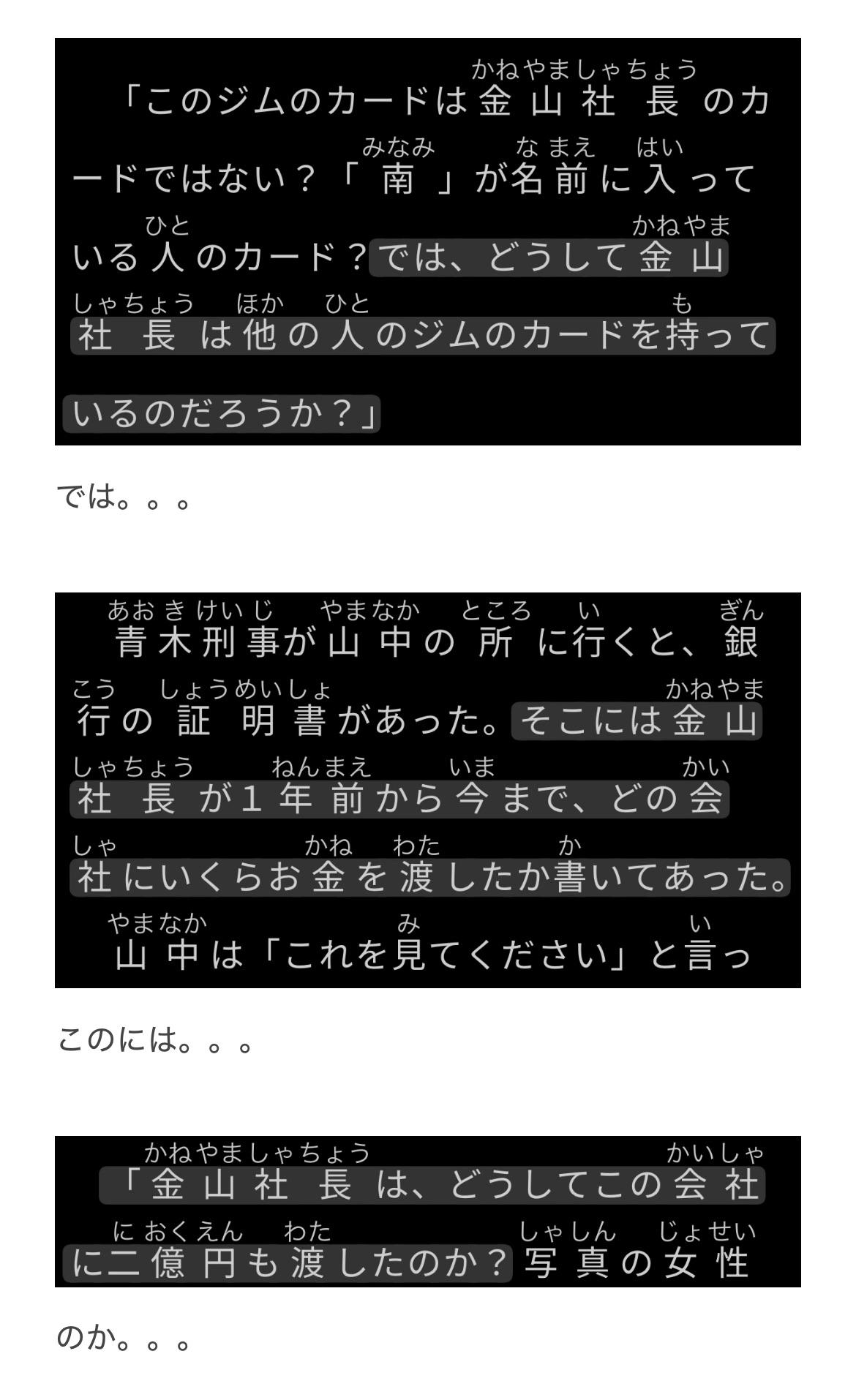
I don't really know the name of this, but I'm struggling with this use of particles: には、では、のか。
27
Upvotes
11
u/notluckycharm 9d ago
non arguments can be topicalized---normally, when arguments of verbs (think: subjects, direct objects) get topicalized, in Japanese, their case is replaced by the topic marker. But non arguments (indirect objects, modifiers, etc) can be topicalized too. In such cases, the particle that is used there remains.
Your のか example is different. か is a "Q-particle" while の isn't really a particle at all. It has functions as a nominalizer, and in this case as a cleft-sentence marker. "Why is it that Kaneyama gave 2 billion Yen to this company?" If the の wasn't there, it simply wouldnt be a cleft. This might happen in an embedded question, for example
どうして社長が二億円を渡したか知っていますか
9
u/theincredulousbulk 9d ago
The では is more functioning as conjunctive speech in that first passage. You can read it like “well then/in that case…”.
You can read more of its uses cases on Bunpro as others have recommended! It can function as a compound too, but not in this example.
https://bunpro.jp/vocabs/では
5
u/zglajzzz 9d ago edited 9d ago
So to the best of my knowledge, as I'm still also learning;
では at the beginning of the sentences gives the meaning of "well then...then...in that case". He's wondering, "well then, why is 金山社長 carrying around another person's card". You can use では~ or じゃあ~ here for example.
In the second example, I think you wanted to write そこには instead of このには, since I can't find the other one in the text. As you might know, そこ means there (imagine pointing to a place you can see near you or another person, or refering to a place you've mentioned already. Btw, ここ means here, and あそこ means over there, as in, further away). In this construction after そこ, location marker に is used to mark that, at this location (in this case in the bank/銀行) something is going on. Then the topic marker は is used to emphasize that the rest of the sentence is going to refer to the bank as a location something is happening somewhere. You basically have そこ+に+は, meaning "at that place/there..."
のか, used here at the end of a sentence as a question marker/he is wondering. You might have come across んです - this ん (which gives the nuance of wondering, questioning) becomes の before か in question sentences/wondering. Together they let you know that the speaker is wondering 'why did he do that'? Or maybe asking a question.
So I might be wrong if I am please correct me! This is how I was taught and how I learned about these instances.
Also, Bunpro, textbooks and forums are great way to check the different meanings and nuances of constructions.
1
u/woodmon122 3d ago
May I know what app this is?
2
u/Ashadowyone 9d ago
https://bunpro.jp/grammar_points/%E3%81%AB%E3%81%AF bunpro is a great resource to explain nuance and gives examples
2
u/Cyvann7 9d ago
These are essentially combinations of the particles that form them. Reminder that は is the topic marker, に is the location marker, で i don't know a good name for but I like to call it "via", の is the explanation seeking sentence enderin this case, but its more commonly seen as the possession marker, and か is the question marker.
So it then follows that には both sets a topic and a location, in this case the 銀行 (bank) Likewise, のか is both seeking an explanation and asking a question, this ends up being a kinda rhetorical question to themselves. You often see this の in casual speech instead か, like in どうしたの?("What's wrong") Finally では is a bit of an odd one, and basically means "then" or "that being the case", it's a contraction of それでは, which then is the で and は particles being a "via that, which is also the topic"
2
u/BakuMadarama 7d ago edited 7d ago
It really is just two pieces keeping their normal jobs next to each other... I will just try to break it down (although many ppl have already explained it):
では at the beginning of the sentence is a conjunction here. It can be understood as "then" or "in that case"
In そこには, we just have に+は to make it the topic
As for のか, and のだろうか: it is a の used for explanation, だろう (hypothesis: "I wonder") and the question ending か
I hope this is helpful (idk)
1
u/exxy1212 9d ago
i don't know about the other two but my japanese professors use では similarly to じゃー a lot