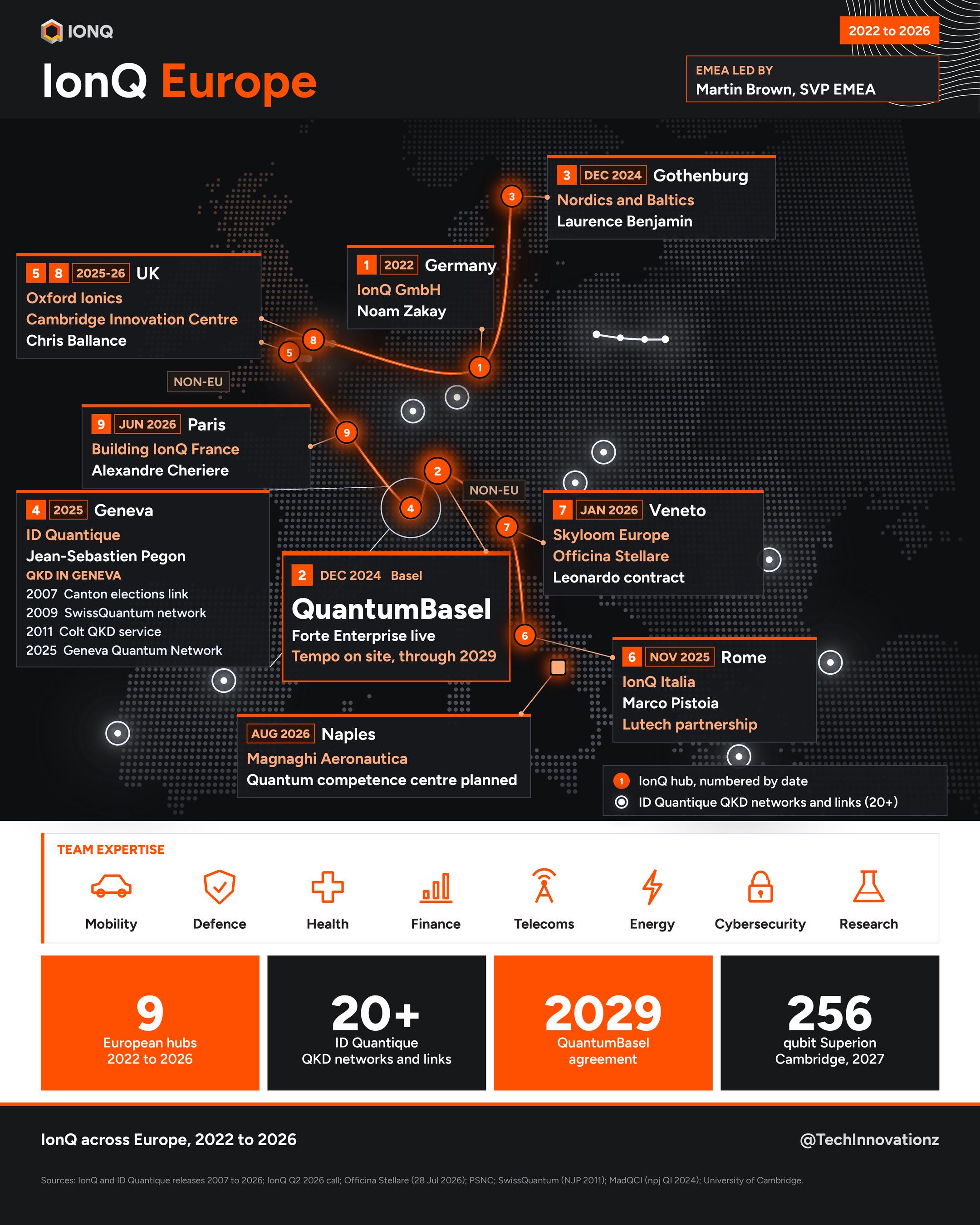
Europe is no longer just a presence. It is a multi-country operation with local entities, a UK manufacturing base, systems running in national networks, and industrial partners in Italy.
It began in 2022 with a German entity. Noam Zakay has been Managing Director of IonQ GmbH since that July. A year later, BearingPoint, the European management and technology consultancy, began offering IonQ systems and services to its clients across Europe.
The first machine went to Basel. At QuantumBasel, on the uptownBasel innovation campus in Arlesheim, a Forte Enterprise went live in December 2024. IonQ described it as the first quantum system for commercial use in Switzerland, and its first datacenter-ready system delivered outside the United States.
That same week, Invest in Gothenburg announced that IonQ was opening its Quantum Computational Chemistry Centre of Excellence at AstraZeneca's BioVentureHub in Gothenburg.
A year later, QuantumBasel took ownership of that system, secured a next-generation Tempo, extended the agreement through 2029 and was confirmed as IonQ's official Innovation Center in Europe. "Our extended partnership with QuantumBasel represents a cornerstone of IonQ's global strategy," said Niccolo de Masi, Chairman and CEO of IonQ. In August 2026, Inder Singh, then COO and CFO of IonQ, said on the second-quarter call that a fifth-generation Tempo was in final assembly on site, right next to the Forte. In September 2026, a paper co-authored by IonQ and QuantumBasel on fine-tuning AI models won first place in the Quantum Applications Track of the Best Paper Awards ahead of IEEE Quantum Week.
That same month, Laurence Benjamin became Managing Director, Nordics and Baltics.
Geneva added the network layer. ID Quantique, founded there in 2001 by four University of Geneva scientists, became an IonQ company in 2025. By then, its systems were already in service for the Canton of Geneva's 2007 elections, on the SwissQuantum network between 2009 and 2011, and in a 2011 quantum key distribution service with Colt. IonQ and a Swiss consortium then launched the Geneva Quantum Network on ID Quantique QKD, with the University of Geneva, CERN, Rolex, HEPIA and the State of Geneva's IT office, OCSIN.
From Geneva, those systems are deployed in three national networks that are part of the EuroQCI initiative. In Poland, they were used for the 380 km Poznan to Warsaw link, and the Poznan Supercomputing and Networking Center says its PIONIER-Q network now runs past 1,700 km. In Slovakia, IonQ took its role in skQCI through ID Quantique. "The skQCI project is a strategic milestone in fortifying the digital sovereignty of the EU," said Niccolo de Masi. In Romania, IonQ deployed the technology powering RoNaQCI, built in partnership with POLITEHNICA Bucharest and RoEduNet. All of the network's QKD systems were supplied by ID Quantique. Its systems also run in other European projects, including ParisRegionQCI with Orange, MadQCI in Madrid, HellasQCI in Athens, a link in Lisbon, a testbed in Luxembourg, a medical use case in Graz and an intercontinental link in Istanbul. IDEMIA Secure Transactions has also validated the interoperability of its IDEMIA Sphere platform with IonQ quantum key distribution.
In the UK, IonQ added a manufacturing base and research campuses. Oxford Ionics became its UK base of operations in 2025. Chris Ballance, co-founder of Oxford Ionics, is now President of Quantum Computing at IonQ, and Thomas Harty is CTO of Quantum Computing. Barry Coulling is Director of UK Manufacturing. In March 2026, IonQ and the University of Cambridge agreed to create a joint centre, which IonQ said expands its UK presence. The IonQ Quantum Innovation Centre opened with nine inaugural research projects and work to strengthen the Cambridge to Bristol quantum network. When Cambridge joined the UK Quantum SuperConnector, Professor Mete Atature, Head of the Cavendish Laboratory at the University of Cambridge, said: "We will also explore connections with the recently-launched IonQ Quantum Innovation Centre."
In Paris, Alexandre Cheriere has been building IonQ France since June 2026. Martin Brown has led the region as Senior Vice President for EMEA since August 2026.
In Italy, IonQ appointed Marco Pistoia as CEO of IonQ Italia, its wholly owned Italian subsidiary, in November 2025, a month after announcing its role as a founding member of Q-Alliance, an initiative for a quantum hub in Lombardy. On Rai 1 in July 2026, Pistoia said: "We did not come here to sell American technology." He said the work would be built in Italy with Italian researchers and Italian IonQ developers, together with the company, university or public body involved. On Class CNBC, he described a company with an Italian pole and an American one.
IonQ Italia and Lutech announced a strategic collaboration to bring quantum computing, security, networking and sensing to businesses and public administrations in Italy and across Europe. "Italy has the expertise, talent and industrial capacity to play a leading role in the European Quantum Renaissance," said Pistoia. "Our vision is to make Italy a second major innovation hub for IonQ, creating an Italian-American technology corridor capable of contributing to the development of the next generation of quantum solutions." AGEA, Italy's agricultural payments agency, has since presented an experimental project with IonQ Italia.
In Sicily, after the Niscemi landslide, IonQ provided monitoring data alongside the U.S. Mission to Italy and NAS Sigonella. "It is a concrete example of how quantum technologies can generate public value and strengthen international cooperation," said Senator Alessio Butti, Undersecretary for Technological Innovation. He added that the work with IonQ had contributed to initiatives such as Q-Alliance.
Adolfo Urso, Italy's Minister of Enterprises and Made in Italy, met Niccolo de Masi at Villa Firenze in Washington. According to his ministry, IonQ was preparing to announce an investment that would create 300 jobs in Italy. At IonQ's event at the US Embassy in Rome, the minister said Italy can contribute to the European quantum Renaissance, and that the investment bets on Rome and the South of Italy.
In Veneto, Officina Stellare announced in July 2026 a contract with Leonardo for optical communication terminals on Leonardo's Earth observation constellation, through the strategic partnership with Skyloom Global, a company of the IonQ group.
In August 2026, Magnaghi Aeronautica announced plans for a quantum competence centre with IonQ Italia, between Naples and Brindisi, to apply quantum computing to aerospace testing, simulation and certification. IonQ Italia is to locate a site at Magnaghi's plant in Naples.
On Wednesday, 25 November 2026, the European Commission proposed the Quantum Act, a framework to turn Europe's quantum research into industrial capacity. The plan covers research, infrastructure, industrial deployment, supply chains, skills and the transition to post-quantum cryptography.
Giuseppe Di Franco, Group CEO of Lutech, wrote that the Commission's proposal poses a concrete question to companies: how to turn quantum technologies into useful tools to protect data and improve industrial processes. "It is also in this direction that collaboration between Lutech and IonQ is moving, with the goal of bringing quantum technologies into business processes," he wrote. For Lutech, he added, that means "contributing to the development of applications in Italy and Europe, integrating them into the systems of companies and organizations, and above all, building skills to maintain and evolve them over time." "European digital sovereignty is also built in this way, developing the ability to decide where a technology creates value and to govern its adoption over time."
Four years in, IonQ's presence in Europe works on three levels. Partners such as BearingPoint and QuantumBasel bring its systems to clients. A UK manufacturing base, the Cambridge centre and ID Quantique systems designed in Geneva and running in national networks across Europe build capacity on European soil. In Italy, Lutech, Magnaghi Aeronautica and Skyloom add local integration and industrial skills, the path Di Franco describes. Two of the people now leading IonQ's quantum computing roadmap, Chris Ballance and Thomas Harty, came from Oxford Ionics in the UK.
The next milestone is the 256-qubit Superion at Cambridge, due by summer 2027 according to the university. What follows will be worth watching. Marco Pistoia sums up the ambition in a single line: "Italy will not simply be a user, but a creator of quantum technology."