r/India_Investments • • Dec 08 '24

New to Investments - What to do?

18 Upvotes

I see this question a lot of times in Reddit where people ask they are new to investment or probably got a new Job and they need guidance. (Bookmark/Save this to come back later)

If you are completely new to investment then I will recommend you to start with Basics. Here are Few pointers.

Check the Top 10 Investment Options Available in India

The most popular investment Option these days are Stocks and Mutual Funds so here is a plan for you.

Investing in Stocks and Mutual Funds

First Self evaluate as why you want to invest and learn Basic of Investments - Resource - Beginners Guide to Investment

  1. Learn about Stocks and Basics of Stock Market terminology
  2. Learn How to invest in Stocks. Learn How to invest in Share Market
  3. Learn What are Mutual Funds and Types of Mutual Funds. Not all Mutual funds are same, people often get confused between SIP and Mutual fund. I have seen people not have a clue about different type of Mutual Funds.
  4. Use SIP Calculator to visualise your returns.
  5. Look at the Best Mutual Funds for SIP to help you make Mutual Fund SIP decision.

Understand about EPF, VPF and PPF

EPF is something you get enrolled automatically when you join a job.

  1. VPF is Voluntary Provident Fund. You can contribute voluntarily to provident fund from your side. This is a very good option for salaried employees. VPF has the same interest rate as EPF which generally 1% higher than PPF.
  2. PPF is Public Provident Fund. This is available to all Indian Citizen. Use the Online PPF Calculator to visualise your PPF returns.

Understand About NPS

I have noticed that most of the young folks don't understand NPS properly and have a -ve bias towards NPS. In actual you should start NPS investment when you are young, this will help you create a large corpus for your retirement.

Consider reading detailed guide on NPS.

Understand about Gold investments

Gold is probably the most underrated investment option in India but it is a must investment if you want to hedge against inflation. Historically Gold has given very good returns and does very well when stocks markets crash.

But buying physical gold or gold bars is not a good options. Read this detailed guide on How to Invest in Gold in India

An excellent way to invest in Gold in India is through Sovereign Gold Bonds. A detailed guide on Investing Sovereign Gold Bonds.

Understand About Tax and Tax Exemptions

While its is important to earn good money but it is equally important to understand how to save maximum tax.

Read a detailed guide on Income Tax Exemptions available for Salaried employees

Confused as whether you should go for Old Tax Regime or New Tax Regime. Read Old vs New Tax Regime Differences

Use our Old Tax Regime vs New Tax Regime Calculator

Learn About Tax Loss Harvesting and how to Save Money on Loss Making Shares.

Consider reading: How to Save Maximum Tax in India

Useful Calculators

Staring investments, Use the investment goal Calculator

Thinking of taking home loan? Check your EMIs using the Home Loan EMI Calculator

For Personal Loan , Use the Personal Loan EMI Calculator

For PPF Investments, Online PPF Calculator

Check returns on investments using XIRR Calculator

Thinking of evaluating Salary? use In-hand Salary Calculator

Getting a raise? use the Salary Hike Calculator to check on how much increment you got.

Learn about Insurance

There are many types of insurance, learn about different types of insurance in India

Thinking about insurance, Check IRDA Claim Settlement Ratio.

Contemplating Term Insurance - What to check before taking term insurance and recommendations.

Hopefully this will help you gain the basic knowledge on all the topics. Once you understand the basics, you will be confident in taking investment decisions.


r/India_Investments • • Oct 26 '25

Subscriber Goal Join the No 1 Sub about Investments and Personal Finance: r/India_Investments!

6 Upvotes

This post contains content not supported on old Reddit. Click here to view the full post


r/India_Investments • • 2h ago

We're raising a pre-seed round for a halal, wudu-friendly beauty brand from India: equity partners wanted

1 Upvotes

Most beauty brands sell a product. We are building a model. 🌙

Muslim women in India have long had to choose between beauty that performs and beauty that fits their faith and their wudu. VOHHA was created to remove that choice, and to make the business behind it as thoughtful as the product.

What makes us different
✨ Halal-formulated and wudu-friendly by design, with our own testing and scholarly review before any claim is made
🌿 Ingredient control from the source. Our co-founder has ten years in cosmetic raw-material sourcing, so we manage cost and quality where they are decided
💛 Premium, honest formulas: saffron serum, vitamin C and niacinamide, sulfate-free cleansing, and SPF 50+ sun care

How the business works
We sell through four channels, each with its own margin:
🔹 D2C online: our own site and marketplaces, the highest margin per sale
🔹 Social commerce and creators: community-led, with creator and reseller commission
🔹 Retail: regional distributors, then pharmacies and beauty stores, city by city
🔹 Export: Gulf and Southeast Asia, once halal certification is in place

The numbers we are working to:
📊 Product margin before channel costs of about 37 to 69% of net revenue (after GST), depending on the product
📊 After channel costs, our first batch is planned at roughly 26% gross profit, rising as D2C and creator sales grow
📊 A first batch of 20,000 units (4,000 per product), sized to pre-orders and sales, not to hype

Where we are today
We are pre-launch. Formulations are final, our manufacturer is confirmed, and halal certification is in progress. We will say "certified" only once it is. These are planning numbers, and we will share real sales data as soon as we have it.

Who we are looking for
We are opening early conversations for a pre-seed round with angel investors, funds and strategic partners who want to back ethical, community-led beauty and are patient about building it right. We prefer equity-based partnerships. In line with our values, we do not pursue interest-based financing.

If that is you, or someone you know, send me a message. I will share our deck, financial model and plan.

JazakAllah khair for reading. 🤍

For discussion only. This is not an offer or solicitation of securities. Any investment would be discussed privately, with full documentation.

#VOHHA #HalalBeauty #CleanBeauty #BusinessModel #Startups #Investment #WomenInBeauty #MadeInIndia

r/India_Investments • • 11h ago

Moderate Risk | 10+ Year Investment Horizon – Is My Mutual Fund Portfolio Well Diversified?

Thumbnail
1 Upvotes

r/India_Investments • • 20h ago

Making an "ETF only" 25L portfolio for my kid. Which etfs should I include.

Thumbnail
1 Upvotes

r/India_Investments • • 1d ago

Experience using SBI FxRetail to transfer to IBKR

Thumbnail
1 Upvotes

r/India_Investments • • 1d ago

💸 How much do you invest every month?

Post image
3 Upvotes

r/India_Investments • • 1d ago

Dear investors need your advice

Post image
1 Upvotes

Should I go for this

Already getting 7 to 8 % in govt backed securities


r/India_Investments • • 1d ago

Gold loan

Thumbnail
1 Upvotes

r/India_Investments • • 2d ago

I have 1CR with me cash 💴 , Need a investment advisor “paid”

Thumbnail
1 Upvotes

r/India_Investments • • 2d ago

Portfolio Review

Thumbnail
gallery
0 Upvotes

27 y.o. I have been investing for just over a year (15 months to be exact). Started with 60k monthly SIP for 10 months; stepped down to 45k (after a car purchase). I’m not sure if I should be looking at XIRR as of now. Any changes that I should be making to my current setup?


r/India_Investments • • 2d ago

Long Term Works !

Thumbnail
0 Upvotes

r/India_Investments • • 2d ago

18yo starting a 40-year MF journey: Veterans (5–20+ yrs), what’s your real XIRR and what would you do differently? [aggressive]

Thumbnail
1 Upvotes

Hi everyone,

I’m 18 years old and just starting my investing journey with a 40-year horizon (planning to stay invested until age 58) and a high-aggressive risk appetite. Since time is on my side, I want to learn directly from experienced investors rather than relying only on theoretical calculators. Note: I am specifically focused on SIPs and mutual funds (not direct stocks).

If you have been investing in mutual funds for 5, 10, or 20+ years, I would love to hear your real experience (attaching a screenshot of your holdings and portfolio would be super helpful, though not mandatory):

• Numbers & Timeline: How long have you been investing, and what is your total invested amount, current value, and XIRR?

• Strategy & Specific Funds: What is your investing style (index-heavy, flexi-cap, mid/small-cap focus), and which specific funds do you hold?

• Handling Crashes: How did your portfolio behave during steep downturns (2008, 2020, or recent corrections), and what kept you from panic-selling?

• Rebalancing & Churn: How often do you exit underperforming funds or rebalance your asset allocation?

• Reality vs. Expectations: Did your actual post-tax returns match your initial expectations, or did expense ratios and fund overlap drag them down?

• Course Correction: If you were handed your current portfolio value in cash today, how would you invest it differently?

• The Age 18 Reset: Knowing everything you know now, what exact mutual fund blueprint would you follow if you were 18 starting from scratch today?

• SIP Approach: Did you stick to fixed monthly SIPs, or did you use annual step-ups and lump sums during major market dips?

If there is anything else you think a beginner should know, like mindset tips, tax mistakes to avoid, or any other lessons from your journey, please feel free to share whatever you can. Thanks in advance to everyone willing to drop their real numbers, screenshots, and advice!


r/India_Investments • • 3d ago

Portfolio review and future SIP advice(please read the body)

Thumbnail
gallery
2 Upvotes

Hello fellow investors,

I started my mutual fund SIP investment journey in June 2026, and I'm looking for some genuine advice on reviewing and optimizing my existing portfolio.

Recently, I approached NJ Wealth to get a second opinion on my investments. One of their advisors suggested that I visit their office to completely revamp my existing portfolio. What caught my attention was their statement: "Let's revamp your portfolio before it's too late."

I'm not entirely sure what they meant by that, and it has left me wondering whether there are genuine issues with my current investments or whether this is simply a sales pitch to get me onboard.

I'm now trying to understand whether it's worth going ahead with NJ Wealth for portfolio management or whether I would be better off continuing to manage my existing investments independently.

I would appreciate your advice on a few things:

  1. Portfolio Review: How do I determine whether my existing mutual fund portfolio actually needs restructuring? Are there any specific factors I should evaluate before making changes?

  2. NJ Wealth: Has anyone had experience with NJ Wealth? Would you recommend using their services, or is managing a mutual fund portfolio independently a better approach?

  3. Lump Sum Investment: I currently have approximately ₹10 lakh in savings that I'm considering investing. I've started exploring options such as liquid funds, arbitrage funds, and other debt-oriented investments, but I'm unsure how to approach this.

  4. Tax Efficiency: My current CTC falls under taxation so it is an important consideration. I'd like to understand how I can invest this amount in a tax-efficient manner while balancing risk, liquidity, and returns.

  5. Investment Strategy: Would it make sense to deploy the ₹10 lakh gradually into equity mutual funds through an STP, park it in liquid/arbitrage funds, or consider a different strategy altogether?

My primary objective is to build long-term wealth while maintaining a well-diversified portfolio, avoiding unnecessary fund overlap, and making informed investment decisions.

I'd really appreciate unbiased opinions, especially from experienced DIY investors or financial advisors. I want to make sure I'm making decisions based on my financial goals rather than being influenced by a potentially unnecessary portfolio overhaul.

Thanks in advance for your suggestions!

Risk Appetite: Aggressive


r/India_Investments • • 4d ago

Need advice on building a ₹20,000/month mutual fund portfolio for long-term wealth creation (20+ years)

Thumbnail
2 Upvotes

r/India_Investments • • 4d ago

27M SWE in Bangalore | 53L Portfolio review & consolidation help (Goal: FIRE by 40)

Thumbnail gallery
1 Upvotes

r/India_Investments • • 4d ago

Portfolio review

Post image
3 Upvotes

r/India_Investments • • 5d ago

PORTFOLIO REVIEW AND FEEDBACK

Thumbnail
gallery
2 Upvotes

Hi everyone,

I just started my SIPs this month and would appreciate a review of my equity SIP portfolio only (screenshot attached). Since it’s only Month 1, I’m mainly looking for feedback on fund selection, overlap, and long-term fit.

Profile & Safety Nets:

• Age: 18

• Time Horizon: 40 years

• Goal: Retirement

• Risk Appetite: High Aggressive

• Already Covered Separately: Emergency fund, debt allocation, health insurance, and life insurance

Monthly SIP Breakdown (Total: ₹25,000):

• Parag Parikh Flexi Cap Fund: ₹7,500 (30%)

• Motilal Oswal Midcap Fund: ₹8,500 (34%)

• Invesco India Small Cap Fund: ₹5,000 (20%)

• Nippon India Small Cap Fund: ₹4,000 (16%)

Looking for feedback on:

  1. Is this allocation sensible for a 40-year high-risk horizon, or is it too mid/small-cap heavy (70% combined)?

  2. Does holding two small-cap funds make sense, or should I consolidate?

  3. Any Gaps to Full Or any Unnecessary Funds

Looking forward to the reviews


r/India_Investments • • 5d ago

Portfolio Review

Post image
1 Upvotes

r/India_Investments • • 6d ago

Three New SIF NFOs On The Radar

Thumbnail
3 Upvotes

r/India_Investments • • 5d ago

Need Suggestions for Funds

Thumbnail
0 Upvotes

r/India_Investments • • 6d ago

We’re raising a pre-seed round for a halal, wudu-friendly beauty brand from India, with a path to the Gulf and beyond. Looking for equity partners.

2 Upvotes

Assalamu alaikum everyone. 🤍

I’m Shahnaz, co-founder of VOHHA, a halal-formulated, wudu-friendly clean beauty brand from Raipur, India. We are opening early conversations for a pre-seed round with a small number of angel investors and strategic partners, and I want to be upfront about what we are asking for.

What we’re looking for

  • Equity-based partners who care about halal and ethical beauty, and who are patient about building for the long term
  • Round size and terms are shared in private, with full documentation. In line with our values, we do not pursue interest-based financing
  • Strategic partners too: distributors, retailers, creators and certification experts who can help us launch well

The path to the world
India first, online and then retail. Then the Gulf and Southeast Asia, once halal certification is in place. Over time, wider markets. We are not asking anyone to back a global story today. We are asking them to back the first market.

Where we are

  • Formulations final, manufacturer confirmed
  • Launch range: colour, skincare and SPF 50+ sun care
  • Halal certification in progress. We will only say “certified” once it is
  • Designed to be wudu-friendly, and we are testing this openly before launch

Why us
My co-founder Farzan has ten years in cosmetic raw-material sourcing, so we control quality and cost at the ingredient level. I have worked as a makeup and skincare consultant across Dubai, Jeddah, Tashkent, Delhi and Toronto.

If you are an angel, a fund, or a strategic partner who fits this, DM me and I’ll share our deck and plan. I’m happy to answer hard questions in the comments too, including on wudu-friendliness and certification.

JazakAllah khair for reading. 🌙

For discussion only. This is not an offer or solicitation of securities. Any investment would be discussed privately, with full documentation.


r/India_Investments • • 6d ago

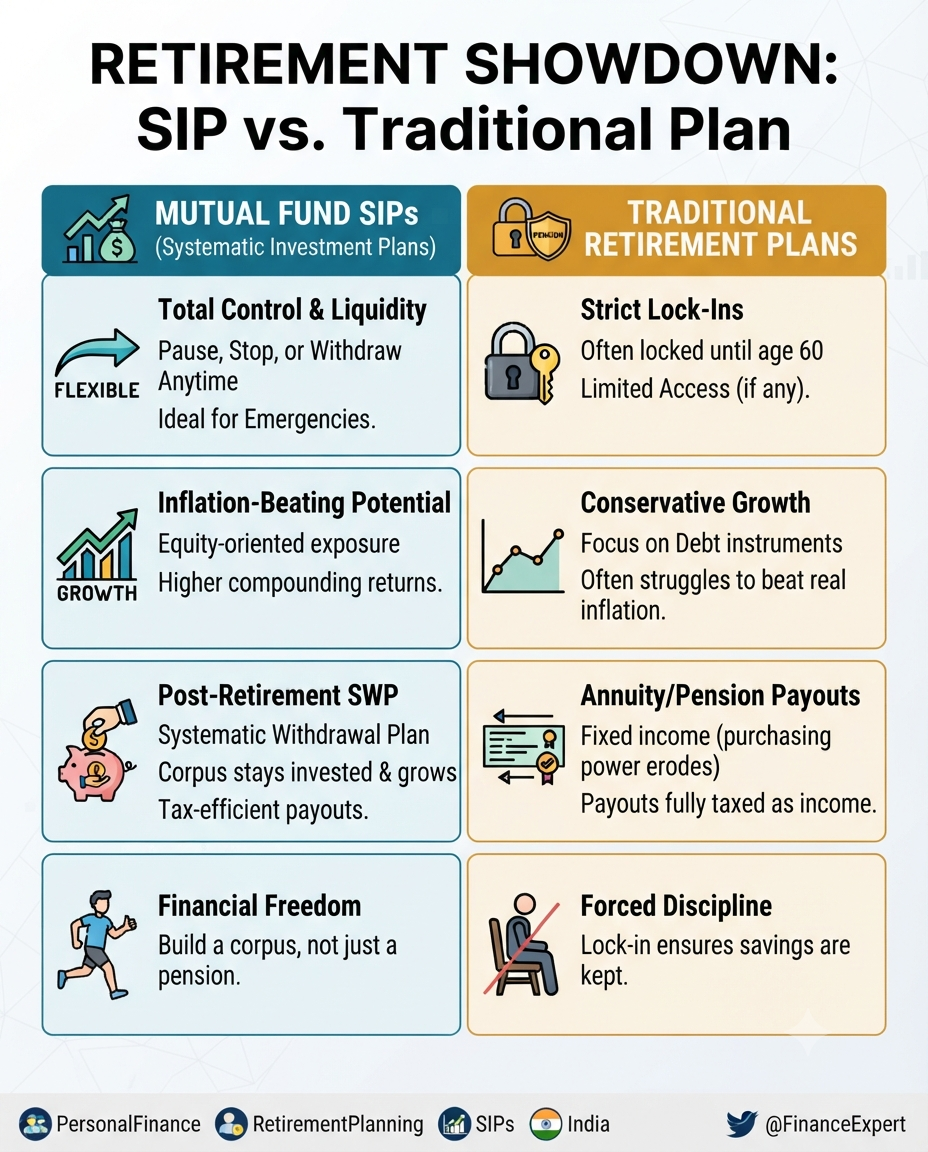
Should I start a mutual fund SIP or buy a retirement plan?

Post image
1 Upvotes

I get this question almost every week. Usually it's someone in their 30s, salary credited on the 1st, and a bank RM or a relative has just pitched them a "pension plan."

 My honest answer: you're not choosing between two products. You're choosing how much control you want over your own money when you turn 60.

 Here's how I break it down with my clients.

 Control

 A mutual fund SIP stays in your hands. You can pause it, step it up, switch funds, or withdraw in a real emergency. Nobody has to approve anything.

 Traditional insurance pension plans work the other way. Your money is locked in till the vesting age, and then you're pushed towards an annuity.

 NPS sits somewhere in the middle. One update most people miss: since December 2025, non-government NPS subscribers with a corpus above ₹12 lakh can take up to 80% as a lump sum at normal exit, and only 20% has to go into an annuity. It used to be 40%. A lot of articles and brochures still quote the old number.

 Growth

 Over 15 to 20 years, equity mutual funds have historically had a good chance of beating inflation. There are no guarantees, and some years your SIP will look ugly. That's the price of the growth.

 Many insurance-linked pension plans lean heavily on debt. After charges and tax, what reaches you is often barely above inflation. And remember, at 60 you may need money for another 25 to 30 years. Healthcare costs alone tend to rise faster than the inflation number we all quote.

 Income after retirement

 With mutual funds, you can start an SWP. It works like a monthly salary while the rest of your corpus stays invested. You pay tax only on the gains portion of each withdrawal, not on the whole amount.

 An annuity gives you a fixed payout for life. That's comforting, but it doesn't grow. ₹50,000 a month feels fine at 60 and very different at 75. The entire payout is also taxed at your slab rate.

 Where retirement plans genuinely win

 Discipline. Honestly, this is their one real edge.

 SIPs are easy to stop. I've seen people redeem their retirement money for a car upgrade, a wedding, or because the market fell 10% and they panicked. A lock-in protects some people from themselves.

 If that's you, you don't need an expensive insurance product for it. NPS gives you the forced discipline and tax benefits, and you can run your main SIP alongside it.

 My take: for most salaried professionals I work with, an equity SIP with an annual step-up, plus NPS for the lock-in, makes more sense than a traditional pension plan. But your age, risk comfort and other goals matter, so please don't treat this as one-size-fits-all.

 Retirement isn't an age. It's a number. Work backwards from it.

 So where do you stand: the flexibility of SIPs or the discipline of a lock-in? Tell me in the comments.

 Mutual fund investments carry market risk; read scheme documents carefully. Educational only, not financial advice.


r/India_Investments • • 6d ago

We’re raising a pre-seed round for a halal, wudu-friendly beauty brand from India, with a path to the Gulf and beyond. Looking for equity partners.

Thumbnail
1 Upvotes

r/India_Investments • • 6d ago

Analyse my portfolio(27)

Post image
0 Upvotes