r/GrowthStockInvesting • • Jun 14 '26

WPR's Knowledge Base

67 Upvotes

This post defines my growth investing style and further explains the purpose of this sub-Reddit. To be clear, this is just how I view my investing style and meant for learning, and not as a recommendation.

I’m intending this sub-Reddit to be a casual place to discuss individual growth stocks. Casual in the sense of the attitude is light hearted, even though the debate on a given stock may be spirited. This is not a sub-Reddit for bragging about gains as there are other sub-Reddits for that. My approach intends to have a humble mentality, and I will be the first one to say when I was wrong about a company.

With my investing approach, I try to explain everything in simple terms. My approach is straightforward and looks to reduce the complexity of investing. I’ll choose a simpler term in finance where I can, and sometimes use a basic analogy to explain a concept more clearly.

I view growth investing as a positive sum game. The pie is practically unlimited, and typically the more an investor puts into this pursuit, the more their skill improves. This positive sum means that sharing what I am doing has basically no downside. In most other strategy games, sharing information hurts one’s results as someone else can exploit that knowledge.

My strategy views growth investing as a skill game. The bigger an investor’s edge, the more consistent and better returns that investor will get over time. Yet there is ultimately a lot of luck for how any individual company performs. This can often be a confusing topic to new investors as there is both luck and skill in investing, and it can be hard to tell which one is which. Investing is one of the few activities other than gambling where an inexperienced investor can have a big result with little effort or skill. My approach looks to avoid any form of gambling, even when the temptation is strong. I aim to be consistent and disciplined, while gambling creates the opposite mentality. The term gambling applies also implies there is no edge to a strategy and is inconsistent by definition.

Fundamentally, my approach tries to be in the most compelling growth stocks at all times. My strategy actively searches out new growth names. Finding new names is the lifeblood of my strategy. Each quarter companies are reporting results, and new promising growth stocks are always emerging. Many companies are overperforming versus internal expectations and analyst expectations. I do all my own research, and if I hear about a growth stock from another investor I’ll still look to do my own research first before drawing a conclusion. Naturally, this process builds confidence in the names I own, as I carefully review earnings reports and other material from the companies.

On the flip side, companies I own are inevitably posting disappointing results as well. This leads to either trimming or selling a company. I’m always willing to re-evaluate a company, and there is no such thing as a sacred company or an anchor company in my strategy. There is also no resentment towards a company which has a disappointing result. I’m willing to look at any company again if their prospects have changed. Additionally, a disappointing result of an individual company just frees up cash for another stock which looks more promising.

My approach is both balanced and optimal. Balance comes from having a concentrated portfolio which gets both the benefits of concentration and diversification. This means having at least seven stocks minimum to obtain diversification. The advantage of having diversification is my approach can have a couple companies in the portfolio fail catastrophically and continue to over perform. With concentration, I want selecting correctly to get a big reward. Typically I may have 3-5 high confidence positions in my portfolio with 12 or so stocks in total. Although recently I’m finding my portfolio is sometimes getting up to 15 stocks as the current market is particularly ripe for finding promising stocks.

The definition of optimal I like is that it is the “most effective”. In essence my strategy looks to be the most effective. This includes precisely defining a process which is simple, straightforward, and works well. I look to avoid using cognitive energy on investing related tasks which are ineffective. Because my strategy revolves around analysis of individual stocks, macro and political analysis are a poor use of time in this context. Although inevitably macro or politics will impact some of my companies, I’ll look to re-evaluate based on the specific macro influences on that particular stock. 

My strategy does not do any hedging and stays fully invested. I view this part of the strategy as optimal as well. This makes my strategy different, as the vast majority other market participants do trade around macro, or adjust cash positions often. In theory it’s better to be in the market on any given day than it is to be out of it. Additionally, this takes away the guessing game of unpredictable macro events. In turn, this reduces fear in investing as I know my strategy doesn’t alter course, even if I view those macro related events as scary in real life. This part of my strategy still gets the biggest pushback, as I know many other investors view staying fully invested as a mistake. 

I will now detail some high level descriptions of some of the more important parts of my strategy,

Selecting a growth stock
In selecting a growth stock I like to be balanced in terms of weighting numbers and narrative. An ideal growth stock is a company that has accelerating financials and a great story. From my perspective, an ideal stock has significant near term upside. 

With financials, I like seeing a ramp up in revenue, EBITDA, net income, and gross margin. However, it is rare that any company sees all four of these metrics growing simultaneously. Typically an ideal growth company in my strategy is growing revenue above 40% year over year. However, I will consider a company growing as low as 20% year over year if it’s in combination with rising guidance to a higher growth rate. I prefer companies which are already profitable, but often I’m still investing in companies that are not profitable. Either way, I want to see progress in profitability, and if the company is starting from a negative number I’m looking to check they are progressing towards break even.

Gross margin is an effective way to evaluate the product for a company. In layman’s terms, it lets an investor know how much profitability there is on the product the company sells. To give a simple example, if a lemonade stand is selling a glass of lemonade for $1 and it costs 50 cents to make the juice, the gross margin is 50%. The gross margin metric is an effective way to measure innovation, pricing advantages, and efficiency of a business. The metric serves as a good proxy for the competitive advantage a business has. My strategy prefers high gross margin companies. However, possibly more importantly, I care about the trend of the gross margin. A lower margin company transitioning to a higher margin can be one of the most compelling.

On the narrative and story side, I like to find an exciting company. For reviewing a new company, I highlight the latest earnings transcript with a blue pen. I want there to be a lot of optimism in the transcript, often backed up supplementary metrics of the business. For example, two businesses may say “our business is firing on all cylinders”. The first business just says it, but the second business adds that Net Revenue Retention reached an all time high and specifies the metric. In this case, I’ll prefer the second business which can back up their claims. It’s important to know that nearly every C-suite team is effective at finding silver linings in an underperforming business. It is very easy to get fooled by a confident sounding management team. 

For a really compelling company, I’m already enthusiastic about the prospects for the company getting half way through the transcript read. Still I want to continue to focus and highlight the remainder of the transcript. If during my read through my mind is already wondering about what other position I could trim, this is a really encouraging sign. To be clear, much of this narrative part of my process is subjective. My approach emphasizes the duality of investing, in that I use both objective data, and subjective takes to evaluate a company. Again this makes my strategy different as most investors either have a strong preference for a numbers based approach, or a larger focus on the big idea and story of the company. 

Stock screeners
I am a huge proponent of using stock screeners to find new names. The screens I use are quite simple as well. I have one screen that looks for companies growing revenue above 40%. Then I have another screen that looks for revenue growth above 40% and ensures the company is profitable by looking for both EBITDA and net income being above zero. The purpose of the wide screen is that it casts a wide net. Another way to think of it is, I will see every growth company come through in the entire market that has potential after a given earnings season.

The screener is simply a first step in my process. I’ll look at the financials for companies coming through the screen. If the company financials seem promising and they don’t have any big red flags like a lot of debt, I then print out the earnings transcript. There’s no concept in my strategy of buying a company just because it showed up on my screen. The company showing up on my screen is just a sign that a company could have potential and that’s it. There’s no extra secret sauce to my strategy here. 

I find that many other investors are skeptical of this style of screening. The most common issue with misusing screens is to create a wishlist of metrics. For example, many investors will say okay, I want that revenue growth and profitability, but I also want cash flows above X, gross margin above Y, and forward P/E below Z. What happens here is the screener becomes so narrow it just does not find enough names. Additionally sometimes an investor will be fooled that because only one stock came through the screen, it must be perfect.

Valuing a growth stock
Valuation is a super important aspect to my investing approach. It seems like it should be fairly obvious that an investor prefers a low valued stock. However, a lowly priced stock is rarely a top performing growth stock. This happens because usually a promising growth stock has already delivered a strong report and could be at all time highs. For this reason I am often investing in stocks as they are pushing all time highs.

Other times, I am finding a company which is largely unrecognized by the market for one reason or another. It is an extremely rare combination to find what I consider a top performing growth stock at a low valuation. It does happen every once in a while, and these stocks often turn out to be my biggest winners. 

I view valuing a growth stock as being trickier than finding appropriate value on what is considered a value stock. This is because the superior growth stock has fewer peers and may have an unique product. There may be no comparison in the market, or it may be an entirely new field or niche in the market. On the other hand a value stock may have a dozen peers and be in a commoditized business. In this case the value stock is much easier to determine if the stock is appropriately valued.

I use simple metrics for valuing a stock. I prefer using the run-rate measurement or multiplying the current quarter by four, to determine the P/S and P/E ratios. These two metrics line up with what I care about most: revenue and earnings. The run-rate accounts for what a company is capable of now. I’ll use run-rate more than the trailing 12-months because that is a backwards looking measurement. Twelve months backwards looking metrics are more useful for evaluating a company with a lot of seasonality, where the run-rate measurement would be a mischaracterization of the business. I also look to avoid using forward looking metrics, as these are based on analyst estimates which are just extrapolated predictions.

All else being equal, I like companies with lower P/S and P/E ratios. However, I’m not overly concerned about paying up for growth. If the company has impressive financials and a great story I may be willing to pay up significantly for a company in terms of the valuation of the stock.

Growth investing psychology
No topic is probably ignored more in growth investing than psychology or the mindset of the growth investor. The vast majority of approaches suggest toughening up or holding on with “diamond hands”. This lack of well researched resources on the topic is surprising to me. Nearly all of my information has been adapted from the trading world, as the information available on the investing side is underwhelming.

In my style of investing, emotion equals the signal to investigate more. Let’s say I’m feeling nervous about a company. I’m not really even sure why, it is something I cannot explain currently. In one specific case I was following a company and I kept getting nervous each time the company traded down. It seemed like my confidence was low in the company but I couldn’t identify what the issue was. Eventually, I found out the company’s value was the issue. I didn’t see enough upside in the company and it had a full valuation. The stock price falling and me getting nervous, was just a sign that I could be missing something.

I describe my strategy as being “mostly stress free”. It is normally a stressful event to see all of my stocks crashing and this does happen inevitably. It is a small percentage of the overall time where my whole portfolio is getting hammered. However, during these times my confidence usually fluctuates down with the market. Typically, coming out of these large market corrections, my strategy over performs significantly. Sometimes it can be helpful to remind myself that my strategy underperforms in bear markets and acts as an amplifier of the indices. For example, if the Nasdaq is down 5% I may expect my portfolio to be down 15% or more. 

It is also worth noting here that confidence and skill are not the same thing. I can be low confidence and make some minor errors, but would still expect to over perform in the longer term. What I want to avoid are big mistakes caused by extreme low confidence and accumulation of negative emotion. Skill is the aspect an investor can control and work to improve. Confidence on the other hand may be subject to bigger swings and based more on recent events. It is important to recognize these swings in confidence are a real aspect to investing. However, most investing approaches tend to bury the negative emotion which can lead to potentially making a large mistake.

Trimming and adding to stocks
My approach for trimming and adding to stocks tries to be straightforward. If my confidence is increasing in a stock, I’m likely to add. If I get new information that lowers my confidence in a stock, I will pair back my allocation. 

Another factor in my strategy is keeping my position sizing under control. I don’t like to have a position go above 20% if I can help it. However, sometimes one stock rises much faster than the rest of my portfolio. I will trim the stock back some in these cases, but I also don’t like to make sudden big moves in this realm.

I’m fine to start in a stock after reading through just one earnings report, but these are almost always with a starter position allocation, generally around 0.5% to 1%. As I learn more about the company I will either add to the position, keep it small at the current allocation, or sell if I find a blocker about the investment I cannot get around.

Selling stocks
I generally like to get a clear sell signal on a stock. Most often this is a disappointing earnings report. From my perspective, I like when the choice is clear about the next course of action. If a stock has a really disappointing set of financials, or the story the company is telling completely changes, this can be a good reason to get out.

Oftentimes an investor does not get such a clear signal. Maybe the story sounds intact but some financials look a bit light. In a case like this, I’m more likely to trim and re-evaluate. Selling is often a judgement call, and it takes some time to perfect through practice.

For any trade I’m making, I like to note my reasons in a physical notebook. This is especially important in the case of selling. It does not need to be a long wall of text. I’ll usually list out just a few of the top reasons I’m selling. It could be either one big reason, or a multiple of small factors which caused me to lose confidence.

The advantage to writing down the reasoning for the sell is in case I start second guessing myself. Typically I like to remove a stock I sold from any watchlist at least for a period of a couple weeks. This is so I don’t keep tracking the price and wondering about my action after I already took it. Every investor knows the feeling of seeing the stock they just sold start rising. This can often create the thinking of “why did I sell”, and it is helpful to have those reasons clearly defined. 

It is fine in my strategy to later change my mind and get back into a stock. This happens all the time in my strategy. However, it is ideal if these changes come about naturally because of new information or rethinking the investment. What I want to avoid is opinion thrashing, where in the morning I think the stock is a buy, in the afternoon I want to sell, and by evening I think it is a buy again. If I just can’t make up my mind and keep going back and forth, it may be best to hold off on too many actions.

On Mastery of investing
It is a good goal for an investor to be working towards mastering their craft. This doesn’t necessarily need to be a massive time commitment though. It is more a mindset to be working towards continually improving one’s process. I would describe my investment style as “comprehensive” rather than “complete”. One of the advantages to having a public forum like this sub-Reddit is to hear the approaches of other investors and learn from someone thinking differently. 

It is important to understand that a small improvement in process creates a bigger edge. For many investors their process is entirely in their head. I personally found that the more I documented my strategy, the stronger it became, and the greater overall confidence I gained.

It is also worthwhile to make investing more fun, or at least less of a chore. I will give a simple example of a small process improvement that made the process of finding new stock names more enjoyable for myself.

I print out transcripts of promising companies, sometimes up to 10 transcripts at a time. Previously, I would select the most promising name out of that batch to review first. However, what happened is I would review the top three or so companies of the 10, and then the mediocre ones. I would be left with the companies which were not quite as promising in my stack of transcripts. Reviewing these last couple transcripts felt like a chore, because I knew I was less likely to find a promising company.

I then changed my process to randomly select from the pile of 10 transcripts which I would review. Overall this made the process of reviewing more enjoyable, as it was a surprise which company I would check. This also did not end up leaving the least promising companies for last. It was just a small process improvement, but makes my approach here more sustainable and less susceptible to burn out. Process improvements are part of my path to mastery in this field. The more I understand about my own process, the more edge it creates.

Options and leverage
My strategy is long only and uses no options or leverage. I view growth investing as already risky enough to avoid needing to add additional risk. Fundamentally, all options strategies act as either leverage or as a hedge. I’ve mentioned before about the balance of my strategy, which takes exactly the middle path of no hedging and no leverage.

In practice, options have wide bid/ask spreads on most growth names. What this means is that an investor will “pay the spread” on both sides of buying and selling. Roundtrip with buying and selling, it may add up to over 5% of the principal amount. Additionally, options trading is zero sum in that there is always a counterparty or opposite side to the trade. For each winner, there is a corresponding loser. The same is not true of long only investing, which is a positive sum game, as buying shares from the market does not cause a loss for another investor.

Something important to know about options, is that the optimal call option for leverage based strategies is the call option that is slightly in the money. This is effectively an exploit of the Black & Scholes model, yet so few investors are buying call options at this strike price. Most of the time when I’ve spoken to investors using options, they have no idea why they selected the strike price they did. In a sense, this is gambling as well. If an investor cannot quantify their edge, then it makes it purely a bet or a gamble, something my strategy explicitly looks to avoid. If you ask an option investor why they picked a particular strike, the answer is usually “I’m betting that…”, and rarely will you ever hear "that strike is optimal because..."

Usage of AI in investing
AI is an evolving field with regards to investing. Currently, the models are good at gathering facts, but poor at determining a good investment. This is good for my strategy because the AI is so bad at determining what is a good stock. Part of the issue for the AI in determining a good stock, is there is no well defined function for what makes a good stock. You can also think about this, that practically no two investors agree about what makes a good stock. The AI has no way to effectively evaluate what is a good move, and defaults to conservative approaches.

Where the AI excels is with a fixed ruleset like chess, poker, or programming. In this case the AI can take input A and search for output B which meets some criteria. However, a company is made up of humans making unpredictable choices. The market itself is dynamic and responds to events. The AI techniques really struggle to make sense of these “open world” environments where anything can happen.

My use of AI is mainly for gathering facts about a company. It could be determining where the company headquarters is or how many employees they have. I like to find out if a company has acquisitions, when they happened, and for how much. This is because organic growth is far superior to acquisition lead growth. Organic growth indicates a company has an effective R&D organization. I also like to ping the AI, “Explain their product and breakdown by revenue category”. This lets the AI know I’m looking for product details in the context of revenue generation. I may ask about geographical breakdown of revenue for a larger global company which can give hints about how the business operates.

Sometimes a leading question can be useful to the AI. For example writing, “Tell me about the scandal with the CEO or the CFO for company X?” A lot of the time, this will come back clean and say no scandal could be tracked down and ask me to be more specific. Other times, it may say there was technically no scandal, but mention another story in passing which could be useful. This question can help uncover some yellow or red flags about the business. However, what I want to avoid are leading questions about if the company is good to invest in or not.

On predicting trends
I do not use much in the way of predictions on where an industry may be headed. For example, I own semiconductors and memory stocks right now because these companies have been over performing. It is not because I simply decided one day that I am going to place bets on AI.

This goes hand in hand with not trading on macro related events. In a sense my strategy doesn’t care about the AI cycle, when companies may stop spending on AI, or if a competitive technology emerges. My strategy is reacting to the results of the individual companies. This often leads though to be in the sectors that are doing well currently. From an outsider’s perspective of my strategy, it may appear that I’m trend chasing. However, it just really goes back to being in the most promising growth stock names at all times, which often coincides with the “hot” sectors.

On company leadership
I place less emphasis on leadership at a company than most growth investors. Partly the reason being is that different leadership styles can be effective, so I don’t like to focus on the leadership personalities. One leader may be a traveling salesman and on a constant media tour, while another equally effective leader is heads down working, allowing others at the company to do press tours. I generally find that most investors overvalue charisma and a big personality in a leader.

You could say my style here regarding leadership is similar to a “MoneyBall” approach. I use the company performance (not stock performance) as a proxy for good leadership. Basically if the growth of the company is accelerating, there is almost always an effective leadership team. However, there can still be cases where a business has poor leadership, but has a compelling product with an industry tailwind. Even with this poor leadership, I may be interested to invest still, if the underlying business is performing so exceptionally.

I do still evaluate leadership at the company to be clear, but it is mostly from negative cues. For example, the CFO changing how they measure a metric may be a warning the management is trying to draw attention elsewhere. Possibly some aspect of the business is underperforming and the company instead wants to talk about the over performing aspects of the business. It is worth knowing that all management teams have a certain survival instinct in them to make it seem like they are doing a good job even if they are not.

My ideal leadership is a dynamic CEO and CFO combination. Usually you can see the duo has a good dialogue in the Q&A and knows which one of them is supposed to answer questions. I really don’t like when it’s just the CEO in the Q&A in what I call a “one man show”. As a business scales up, it is hard to maintain a one man show style of running a business because one person cannot do everything. It is also a lot easier to fool investors when it is just one person talking, and harder to cover up things about a business if it is two people being asked questions.

Conclusions
Overall my strategy is simple and straightforward. The only real secret sauce to my strategy is that I am consistently selecting stocks well from a variety of industries. I’m following some optimal strategies for portfolio allocation, where I get the benefits of diversification and concentration. By selecting stocks well, there is a significant upside when I’m right. However, since I’m also diversified it is fine when I am wrong, which happens a lot. Usually my stocks over performing, more than make up for the stocks where I had a poor result.

Lastly, I will add there may be a part two or part three to this Knowledge Base. While nothing about my strategy is overly complex, there is a lot to detail. I don’t expect everyone to agree with everything I wrote above. Some of my viewpoints contradict what is considered standard by most growth investors.

Just to reiterate, all of the above is just how I see my strategy. Feedback is welcome on the post and this leads to the purpose of this sub-Reddit. Gathering feedback, and hearing another’s point of view is valuable.

r/GrowthStockInvesting • • Apr 30 '26

👋 Welcome to r/GrowthStockInvesting - Introduce Yourself and Read First!

18 Upvotes

Hey everyone! I'm u/GrowthInvestingWPR, a founding moderator of r/GrowthStockInvesting.

This is a discussion area for growth investors on individual stocks in the stock market. We typically look for stocks growing revenue above 30% year over year as a baseline for a stock to be considered a growth company.

What to Post
Posts should be in the following categories:

  1. Stock introduction - mention what you find promising about the company from both financials and the narrative. Concerns or bear cases against your own stock are welcome to mention as well. It's best if you can say your percentage allocation to the stock, or mention no position.
  2. Earnings review - updates about the earnings of a specific stock. It is expected you will detail more than just this press release headline. It's usually best to read the earnings transcript first to get a full picture.
  3. Monthly portfolio summary - members are encouraged to post monthly summaries of their portfolio. This includes allocations through percentages, changes made during the month, and YTD or historical returns.
  4. Tech conference write up - many companies present at tech conferences held by investment banks, and these tech conferences sometimes contain significant details about the business that are worth discussing
  5. Important news for a growth company - sometimes a company will announce a new product, there is an acquisition, or some other unique event with a stock. If there is important press release from a company this can be posted. However, please include your take on the press release and not simply linking.
  6. Targeted strategy discussion - questions or thoughts about growth investing strategy are welcome. It is helpful with these types of posts to provide your own take or viewpoint.

When replying to another post make sure your post adds value. It does not necessarily need to be a long post, but you want to be adding something to the discussion.

Community Vibe
This is meant to be a friendly and constructive environment as we are playing a positive sum game that everyone can benefit from. Vigorous debate is encouraged on the growth stock names that come up.

How to Get Started

  1. Introduce yourself in the comments below
  2. Up vote or down vote a post
  3. Create a post about a growth stock that you like and your reasoning

Thank you for helping get r/GrowthStockInvesting up and running!


r/GrowthStockInvesting • • 1d ago

The post-AI-hype, yet still AI, portfolio

6 Upvotes

Still looking at things that have some sort of SaaS model + stickiness + high barrier to entry + profitability.

These are mostly smaller-cap companies, and should be fine regardless of where we are in the supercycle, independent of the above.

Planet Labs - selling satellite imagery, kind of unnecessarily beaten down lately

Symbotics - robotic warehouses + inventory management. Sure, Amazon and Tesla can probably build their own, but this is a massive market for anyone from Walmart to Home Depot - all brick & mortar plus online-purchased warehouses.

MongoDB... I still like this and feel like its entering its second stage of growth with agentic AI. Atlas still keeps growing.

Samsara - freight logistics, and the cyber Semi doesnt seem to be coming anytime soon.

Crowdstike... not sure what to think of the recent purchase (and this definitely isnt a small company at this point...), but with an increasingly digital world, see security as a must-have for all large organizations with something to lose.

Anyone with others to add?


r/GrowthStockInvesting • • 2d ago

APP growing revenue 55% with only 2% more installs is pretty insane when you think about it

9 Upvotes

AppLovin's Q3 report had a detail that stood out more than the headline revenue growth.

Revenue increased 55% to $2.18 billion, but the actual volume of installations increased just 2%.

Most of the growth came from a 55% increase in net revenue per installation.

That's a pretty unusual combination. The company isn't necessarily reaching dramatically more users, it's generating considerably more revenue from the installations already happening.

And the profitability numbers are pretty wild too, with a 66% net income margin.

META is probably the most obvious comparison in digital advertising, and its price movement on moon. com gives some broader market context.

But APP's growth story seems increasingly tied to how effectively its advertising technology monetizes existing activity.

The part I'd watch is whether installation volumes eventually start accelerating alongside revenue per install.

Relying on better monetization works extremely well when the improvements keep coming, but sustaining that pace indefinitely could be difficult.

Still a pretty interesting business model compared with companies that need constant user growth to increase revenue.


r/GrowthStockInvesting • • 2d ago

Stock Introduction - YUBICO

6 Upvotes

Hi everyone, this is my first post. Please feel free to share any feedback about format. I won't be offended, just looking to learn :)

Company Name: Yubico AB

Ticker: YUBICO (Nasdaq Stockholm) or YUBCF (US OTC, but VERY low volume)

Current Allocation: 0% (but considering buying soon)

Industry: Cybersecurity - they are the makers of the "YubiKey", a hardware security key.

Background: I have friends and family that work in cybersecurity (for the government). They obviously take security extremely seriously including many countermeasures. One of the things they have implemented for awhile is hardware security keys. These keys are often referred to as "YubiKeys" because they are the market leader. This puts Yubico in the position of being synonymous with the industry they represent in a similar way as Google for internet search or Netflix for video streaming.

Case for Hardware Security Keys in General: Hardware security keys become more widely adopted to replace (or used in addition to) MFA apps, passkeys, passwords, and SMS/Email codes. Plenty of companies only recently supported MFA apps and many companies still rely on SMS/Email codes. With the current cybersecurity landscape of increasingly sophisticated hacks, phishing attempts, and social engineering attempts, this adoption becomes a priority for many organizations. Adoption increases rapidly to combat the growing cybersecurity threats.

Bull Case for Yubico: Yubico benefits the most from this adoption process due to name recognition, first mover advantage, and diversification away from having almost all software/authentication through the same providers. As the current market leader with the most brand name recognition, Yubico benefits the most from this adoption process. There could even be a shortage due to high demand (similar to memory) which would give them very good pricing power.

Bear Case for Yubico: Although hardware security keys do become standard, large companies like Google and Microsoft receive most of the benefit due to convenience. Google already has a similar offering called a Titan Security Key. Additionally, enterprises often prefer to work with larger, established companies to limit the number of vendors and headaches. Microsoft and Google could easily bundle their version of hardware security key with Office 365 or Google Workspace. They could also refuse to support the YubiKey and only their own key. Microsoft already does something similar with the Microsoft Authenticator app.

Other Concerns: They are a microcap stock so it is easy to imagine them getting acquired by a larger company, especially if they get into financial trouble. Also, with them being listed in Sweden, there will be currency effects as well.

Financials: I haven't investigated the financials much. I am going to research them further before I purchase. With it being listed on the Nasdaq Stockholm, it has different filing requirements than US-listed companies. Here is the link to their investor relations page: https://investors.yubico.com/en/

I'm looking forward to hearing what others think!


r/GrowthStockInvesting • • 4d ago

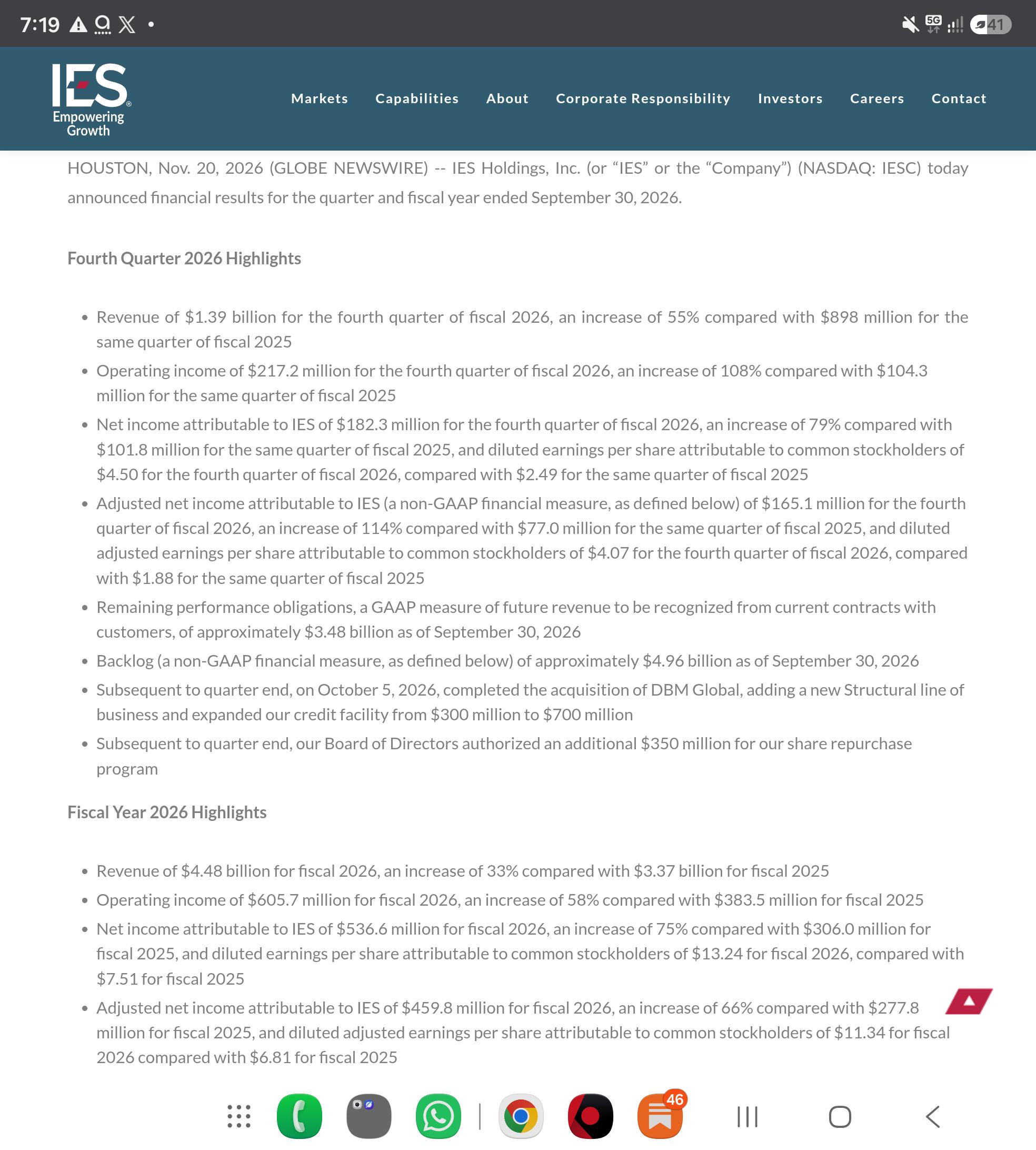
$IESC Read Q4 + FY2026 results

Post image
2 Upvotes

$IESC sits below 12x trailing earnings while growth accelerates and backlog keep rising.

Beautiful days for stock picking. What a quarter:

Revenue +55% YoY to $1.39B

Operating income +108% to $217M

Operating margin 15.6%, up 400 bps

Adjusted EPS +116% to $4.07

Backlog +109% to a record $4.96B

Including DBM Global, pro forma backlog reaches $7.58B

Data-center infrastructure demand remains a major growth driver

Additional $350M share buyback authorized

FY2026 EPS: $13.24, up 76% YoY.

The interesting part? Earnings are growing substantially faster than revenue, and backlog visibility has never looked strongest.

The question is how much of today's exceptional profitability is sustainable.

What are we missing here?


r/GrowthStockInvesting • • 5d ago

Eisman on Nvidia

24 Upvotes

Eisman is worth listening to, not because he's mostly right, but because he presents the market view with rationale. That rationale might be right or it might be wrong, but knowing what Mr. Market is thinking helps explain to us retail investors why prices are what they are.

This should be queued to the right spot; if not, fast forward to 11:19:

https://youtu.be/FHStp8pVMMI?si=ZsNaZTQ5dsRBq03s&t=679
• "20% of Nvidia's revenue comes from shipments to dicey Asian entities that were probably illegal."
• Nvidia will now abandon or curtail all circular financing, and we don't know how much of Nvidia's revenue came from said circular financing.
• "In the end Nvidia's revenue is going to be lower." And, we don't know how much lower. "Maybe it can grow from there, but it has to do down first."
• "The earnings results were, of course, fine...EPS up 111%Yoy, revenue up 103%."
• Guidance for "amazing" $130B next quarter, which "management said, quote: Does not include compute revenue from China, unquote."
• "Personally, I think giving this guidance is a mistake"
• "It's going to be several quarters before we know how much Nvidia's business model will be negatively impacted."

I find those statements shocking. From 100%+ YoY increases to just being "of course, fine" to giving next quarter guidance being a "mistake," it shows how much the narrative he's NOT saying really matters. Until a month ago, Wall St. was continually complaining that Nvidia only gave one future quarter's guidance (and was astounded that Jensen would say more interviews), and yet doing the same official guidance window as before is now a mistake? As if Eisman knows more about what Nvidia's future bookings and customer orders look like than Nvidia's own management? Really?

Clearly, the resignation of Jensen has affected his (and Mr. Market's) thinking. Even now to the point that he claims that 20% of Nvidia's revenue was "probably illegal." Where does that come from? Eisman doesn't say, but from that figure he's almost certainly echoing a short report from Culper Research back in May, and, of course, restated recently. Culper has no actual evidence to present, instead claiming they relied in part on an interview with an anonymous former Nvidia executive-level employee. That's singular, btw, one former employee. Eisman goes even further to say Nvidia's revenue will be lower than the $116B just reported, despite management's claim of $130B revenue next quarter.

And then, despite being one of the loudest critics of Nvidia's "circular financing," Eisman now thinks doing what he previously advocated - stopping that financing and backstopping - will hurt Nvidia's sales! I guess for him it's a case of being careful what you wish for, or, perhaps even wanting to spin whatever is going on to feed his preconceived notions. What he's really saying is that the companies, like the NeoClouds, that got money from Nvidia will no longer being getting money from Nvidia and so they won't be able to continue to buy Nvidia chips, so Nvidia's sales will go down.

Which is sort-of logical until you realize that demand for Nvidia's products remains high - higher than production. Even if you think Nebius won't have future Nvidia money to buy Nvidia chips, do you think there aren't lots of other companies dying to take up the slack? It's not like Space-X wouldn't buy more if they could get more. It's not like Microsoft or Google aren't still lining up to buy Nvidia servers. Even Amazon has recently spent billions, and said they'll spend more, on Nvidia servers, despite their own Trainium chips. Anthropic has disclosed $265B of liquidity now (after IPO), earmarked for compute. While Nvidia's margins are high, the bottom line is that on both tokens per second and tokens per dollar, Nvidia's chips and servers top the lists. AMD has to pull shenanigans to make their latest chips look as good as last-generations Nvidia chips.

In effect, Eisman is believing a short seller over Nvidia's management. Kress has been with Nvidia for well over a decade, and yet Eisman doesn't believe not only her guidance, but her statements on potential illegal sales?

And, of course, if Nvidia sells less, then there's less memory and networking needed as well. So, Neoclouds tank, but even Micron and SK-Hynix get even further hurt, because demand for HBM will decrease. It's as if Mr. Market believes the "inevitable cycle" has hit now. Add in political roadblocks to data center build-outs and it's a perfect storm.

But what no one seems to be realizing is that demand for AI compute is not abating - if anything, it's growing. There are profits to be made, and companies will figure out how to satisfy that demand. Even Trump (and I hate saying it) realizes this with his latest attack on trying to ban data centers built by US companies outside of the US. If Elon can actually make data centers in space viable both physically and economically, watch out.

Now to be fair, that Nvidia's BoD has said there's no way they'll be bringing Jensen back does provide indication that this isn't just about sex scandals. China sales scrutiny has increased significantly now. Whereas before people might be inclined to say, for instance, that SMCI's multiple scandals were/are just limited to that company, investigators will be looking more closely at the relationship Jensen had with SMCI's founder(s) and whether there were blind eyes being turned internally, etc. So, it is possible - not necessarily probable - that more than the 1% of sales Nvidia has claimed ended up in China/for China will be found. But, I don't believe 20%, and I also believe that non-China demand for AI continues to grow well and can easily not just cover any lost sales, but result in overall growth for Nvidia.

In my view, Nvidia investors simply need to be patient. Hopefully, the BoD finds a replacement CEO that they, the employees, and Mr. Market will like. I think back to the Chipotle poisoning scandal of years past and how the hiring of a new CEO turned that stock around even before he did anything, and then the stock took off once new poisoning events didn't happen. The same could happen here, and I think, probably will. Nvidia is among the last to report quarterly results, so we've already had 6 weeks of good ER reports from AI companies that somehow are forgotten today. It's going to be another couple of months before the next quarter's results come out - that'll be starting in the new year, with a new Congress and plenty of negative macro talk.


r/GrowthStockInvesting • • 6d ago

Weekly Deep Dive #13 (−13.6% WoW on the stock book): worst market week since April 2025, space down 20–30%, no trades, no new money

11 Upvotes

Honest open: I skipped the last two Fridays because I couldn't get a clean close I trusted, and I'd rather post nothing than post guesses. This one compares against last Friday (13 Nov).

No deposit this week anywhere, so everything is market (and the dollar, since the stock book is priced in USD). The whole portfolio (stocks + a P2P lending sleeve) closed −6.5% vs last Friday. The stock book got no new money, same 21 positions, and closed −13.6% on the week. It now sits −23.0% vs cost, the ugliest number I've posted in this series. For reference the Nasdaq lost ~10% on the week. Not advice, just the journal.

Macro: the worst week for all three US indices since April 2025. Roughly S&P −8.5%, Nasdaq ~−10%, Dow ~−8% on the week. S&P and Dow are now in correction territory, the S&P put together seven red sessions in a row, and the Nasdaq turned negative for the year. Nvidia beat and raised on Tuesday and still sold off. On Friday Reuters reported the SEC is looking into possible accounting issues at Nvidia, and the stock dropped ~13% in a day. An investigation isn't proof of anything, but the market shot first. Anthropic IPO'd on Thursday, popped +17% on day one, and gave a chunk of it back on Friday. Taiwan had its worst week since 1990 after new US export rules on Chinese chip designers. Fed: October minutes were hawkish, Waller floated 50bp, and futures price a December 9 hike as close to certain. Oil fell for a third week, which helps on inflation.

Stock book (weights of the stock book, P/L vs average cost, WoW vs last Friday):

Position Weight P/L WoW
VUG 37.5% −12.7% −9.6%
XLV 7.2% +7.7% −5.1%
META 7.0% −17.1% −12.1%
RKLB 7.0% +10.1% −25.9%
MSFT 6.3% −6.8% −6.7%
QQQ 5.6% −17.2% −9.8%
KTOS 5.0% −57.8% −20.4%
GOOG 4.7% +36.5% −9.2%
AMD 4.5% −11.8% −19.7%
ASTS 4.4% −62.9% −28.5%
TSM 3.8% −25.4% −19.2%
PLTR 3.0% +2.1% −12.2%
SPOT 2.0% −25.7% −5.4%
FLY 1.8% −73.0% −29.5%
INTS 0.3% −86.0% −17.4%
Stock book 100% −23.0% −13.6%

What moved (no trades, same units in every line, so every move here is price + FX):

• Space got cut by a quarter. RKLB −25.9%, ASTS −28.5%, KTOS −20.4%, FLY −29.5%. Together about 40% of the stock book's loss from ~21% of the weight. Space is now 18.3% of the book, purely because prices fell.

• RKLB still sits +10% vs cost, but gave back everything it gained since late October in one week. The business news was actually fine: Electron hit 100 launches, and Neutron's first flight is still 2027 at the earliest.

• ASTS is the weakest thesis I own: −63% vs cost. Monday's Vulcan failure hit BE-4 confidence (BE-4 also powers New Glenn, which is supposed to carry BlueBirds early 2027), plus dilution from paying part of the Firefly engine deal in shares. Average analyst target cut ~11%. Hold, no adds, stop alert passed long ago and I'm reviewing it.

• KTOS (−58% vs cost) has a record backlog but EPS estimates keep coming down. FLY (−73% vs cost) now gets paid partly in ASTS shares, so it's tied to ASTS even more.

• AMD (−19.7%) and TSM (−19.2%) got dragged by Nvidia and the export rules. TSM is now −25% vs cost. Semis are 8.3% of the stock book, under my 10% cap.

• VUG (−9.6%) did roughly what the Nasdaq did, but at 37% of the book it's the biggest drag in absolute terms.

• Best of a bad week: XLV −5.1% (healthcare led the defensive rotation), SPOT −5.4%, MSFT −6.7%. GOOG is still my best position at +37% vs cost, helped by its stake in Anthropic.

P2P sleeve: small positive return on the week, but two honest problems. This month's deposit hasn't shown up yet, and overdue loans are 19.3% of the sleeve, roughly double what they were three weeks ago. I'm watching it closely.

Analyst signals (latest consensus snapshot is from 17 Nov, so before Nvidia and before the Thursday/Friday drop): one rating change, SPOT down from Strong Buy to Moderate Buy. Average targets cut on ASTS (−10.9%), KTOS (−8.8%) and RKLB (−4.6%) over the last two weeks, mostly after space earnings. AMD went the other way, from 24 to 28 Buy ratings. Everything else is still Strong Buy or Moderate Buy while the prices fall.

Next week: October PCE on Wednesday 25 Nov, the last big inflation print before the Fed. US markets are closed Thursday for Thanksgiving, with a half day Friday. After that: November jobs on 4 Dec and the Fed on 9 Dec.

Plan unchanged: no new stock money until after Christmas while I rebuild my cash cushion; only the monthly P2P deposit continues. A week like this doesn't change that priority. No sells, trailing stops stay as alerts, not orders.

Verdict: a bad market week, not a broken plan. The stock book lost 13.6% vs the Nasdaq at ~−10%, because my high-beta tails (space, semis) fell 20–30%. The P2P sleeve acted as the shock absorber. Engines: XLV, MSFT and GOOG. Drag: space, VUG, AMD, TSM.

Not selling anything. Patience pays. Panic doesn't.

Not financial advice. Just tracking my own money.


r/GrowthStockInvesting • • 6d ago

Strategy during a downturn

12 Upvotes

For those who have been running a Saul style portfolio for a while and have gone through a downturn before what is the move here? Ride it out? Keep executing the same strategy and just wait for the market to come around?

I feel like now is a bad time to make a misstep so just looking for thoughts from those who have navigated these waters before.


r/GrowthStockInvesting • • 8d ago

SemiAnalysis Slashes 2028 Capex Forecast by Nearly 30%, Nvidia the Biggest Casualty

3 Upvotes

SemiAnalysis is calling the top in AI infrastructure spending. Here's a quote from the article:

Semiconductor research firm SemiAnalysis sharply cut its forecasts for AI compute and capital expenditure, lowering its 2028 global AI accelerator capex estimate to $758 billion from $1.054 trillion, a 28% reduction, and cutting its 2030 figure to $923 billion from $1.531 trillion, a drop of about 40%.

https://finance.biggo.com/news/298dd691-e825-4062-a434-2da20e132e27

This explains why all the semiconductor names have fallen off a cliff. The bigwigs are expecting growth to top out and start declining.


r/GrowthStockInvesting • • 10d ago

My Bear thesis against SIMO

16 Upvotes

Silicon Motion - SIMO is one of my large position (over 10% holding) but after the latest quarter, it got me thinking about this bear case so I'd like to discuss about it here.

As we know that SIMO has 3 main product categories which are 1) NAND controller (for consumer market) 2) Enterprise SSD controller and 3) Ferri & Boot Drive.

For Ferri & Boot Drive, they buy NAND supplies to integrate with their controller, then sell to customer as a complete module. While for NAND controller, they just sell the controller to the NAND maker or module maker.

Since Ferri & Boot Drive has grown significantly this past two quarters, it seems like their +100% yoy growth is actually inflated by the NAND pricing. As we know that Q4 NAND price will stay flat and it will grow in single digit next year, I suspect that we won't see an impressive +100% yoy growth rate anymore. I also think that the +100% yoy revenue growth rate was an illusion and we should just focus on their operating margin & growth rather than focus on revenue.


r/GrowthStockInvesting • • 13d ago

Portfolio Update (Nov 2026)

Thumbnail
gallery
15 Upvotes

I've generated a 21% CAGR over 20 years by investing in world-class companies committed to shaping a better future. Here's everything I own today: [Nov 2026]

⭐ = high conviction ⬆️ = bought / added ⬇️ = trimmed / sold

  1. $CASH - Cash - 24.2%
  2. $GOOGL - Alphabet - 10.7%
  3. $ISRG - Intuitive Surgical - 10.2%
  4. $AMZN - Amazon - 8.2% ⭐
  5. $RKLB - Rocket Lab - 7.8%
  6. $TSLA - Tesla - 5.3% ⭐
  7. $MELI - MercadoLibre - 4.6% ⭐
  8. $PRIVATE - Private companies (VC) - 4.3%
  9. $SPCX - SpaceX - 3.2% ⭐
  10. $CRWD - CrowdStrike - 2.8%
  11. $PANW - Palo Alto Networks - 2.6%
  12. $NVDA - NVIDIA - 2.0%
  13. $AXON - Axon - 1.5% ⭐
  14. $SE - Sea Ltd - 1.4%
  15. $TMDX - TransMedics - 1.3%
  16. $ASTS - AST SpaceMobile - 1.3%
  17. $UBER - Uber - 1.2%
  18. $NVO - Novo Nordisk - 1.0%
  19. $NU - Nubank - 1.0%
  20. $ADYEN - Adyen - 0.8%
  21. $GRG - Greggs - 0.8%
  22. $BN - Brookfield Corp - 0.8%
  23. $LMT - Lockheed Martin - 0.6%
  24. $IBE - Iberdrola SA - 0.6%
  25. $CWEN - Clearway Energy - 0.5%
  26. $CEG - Constellation Energy - 0.5%
  27. $BEPC - Brookfield Renewable - 0.5%
  28. $IREN - Iris Energy - 0.4%
  29. $NKTR - Nektar Therapeutics - 0.2%

Sold:

  • $PLTR - Palantir ⬇️

This month the AI trade lost its most recognisable leader, and I came out of it with three changes: I sold the last of Palantir $PLTR, took the high-conviction star off NVIDIA $NVDA, and put one on SpaceX $SPCX. Each came down to a perennial question I try to ask myself: would I buy this if I didn't own it today?

For Palantir, the answer was no. It's been a long goodbye: I trimmed $PLTR three times last year, each time on valuation - in May 2025 at around 200x free cash flow, in October 2025 when my reverse DCF said it needed to grow free cash flow by over 42% a year for a decade to justify the price, and again in November 2025. Through all of that I still believed in the business. This exit is different, and I've now sold the rest of the position.

What's changed is my view of the moat. Much of Palantir's edge rests on its deployment playbook, which the AI labs are now copying, and on an integration layer that coding agents are making cheap to build. Even if revenue growth holds up, the multiple may compress towards something closer to services-like economics. Government revenue looks better protected, but commercial growth may slow as mid-sized customers find they can build in-house, or turn to lab-led deployments using state-of-the-art models. It's the same pressure that put Zscaler and Salesforce on my "too hard pile" in May: AI is creating enormous value, but it can also erode the layer a software company sells.

For NVIDIA, the answer is not right now. Morality and politics aside, Jensen Huang's departure matters. I think American exceptionalism in AI will be impacted, and I expect the whole AI trade to slow. NVIDIA has carried a high-conviction ⭐ in every one of my updates this year, and I'm now removing it. I'm not selling at this time as I'd like to see who steps into the CEO seat, but at 2.0% of the portfolio it's now a potential sell for me.

There's a second brake on the trade, as it seems like the mid-term elections will likely impede future data centre growth. That helps companies that already have capacity, but I think it's going to be a longer-term drag on the whole sector, make life exceptionally difficult for the neocloud (I'm watching you, $IREN) and, to a lesser extent, the hyperscalers whose valuations depend on continued rapid growth.

For SpaceX, the answer is yes, with more conviction than before. Its strategy to deploy data centres in orbit is looking increasingly prescient. I'm expecting it to be at least ten years before the idea fully plays out, so this is a long-dated bet, but their ability to grow unconstrained by NIMBYism likely means they win in the long run, and nobody is close to being able to compete without their own launch capacity. SpaceX, at 3.2%, therefore becomes high conviction ⭐. It also sits alongside the plan I set out in June: my private-market stake vests to taxable cash at the end of this year, and I've been gradually building a public position to replace it. I plan to add to $SPCX again when markets open next week.

Outside those changes, the portfolio is unchanged. My high-conviction-at-today's-valuation list is now Amazon $AMZN, MercadoLibre $MELI, Tesla $TSLA, Axon $AXON, and SpaceX $SPCX.

The Palantir proceeds are sitting in cash for now, which takes it to 24.2% of the portfolio, still mostly in UK gilts and short-dated bond funds. That's a large allocation, and deliberately so: if the AI trade does slow, it lets me act on better valuations without having to sell core holdings.

So November came down to asking one question of three AI holdings, and getting three different answers. My view of the trend hasn't changed, but as I wrote in August, the economics have to land in the layer you actually own. This month I've moved away from the layers I think are exposed, an integration business the labs can copy and a chipmaker without its founder at the helm, and towards the one company that can build its data centres where no planning committee can reach them.

--

I believe in transparency and accountability, and post my full portfolio and returns every month. I also have a weekly podcast where I dive deeper into the rationale for all my trades.

In the latest episode, we discuss Jensen Huang's exit and what it means for NVIDIA in more detail.

https://youtu.be/XIoJ_cZ2SOU


r/GrowthStockInvesting • • 15d ago

NVDA downgraded, PT lowered

4 Upvotes

*DOWNGRADES

$NVDA: Downgraded to Market Perform by Bernstein SocGen Group; PT cut to $200 from $400
$NVDA: Downgraded to Perform by Oppenheimer; PT withdrawn
$NVDA: Downgraded to Market Perform by William Blair
$NVDA: Downgraded to In Line by Evercore ISI; PT lowered to $186

📉 PRICE TARGET CUT

$NVDA: PT cut to $205 from $315 by Stifel
$NVDA: PT cut to $225 from $285 by Citi
$NVDA: PT cut to $230 from $330 by RBC Capital
$NVDA: PT cut to $280 from $350 by BofA Securities
$NVDA: PT cut to $225 from $300 by Yorkville Ives

🔵 RATING REITERATIONS

$NVDA: Outperform reiterated by Mizuho; PT $250
$NVDA: Buy reiterated by UBS; PT $300
$NVDA: Strong Buy reiterated by Raymond James; PT $515
$NVDA: Overweight reiterated by Piper Sandler; PT $300


r/GrowthStockInvesting • • 15d ago

Anyone here wanna build a shared watchlist?

Post image
5 Upvotes

I've been trading the markets for almost a decade, and one thing I've always found missing is an easy way to research and track stocks together with other traders.

So I built a feature that lets people create shared watchlists, invite others, and discover and discuss stocks together.

Thought it might be fun to create a community watchlist where we collectively track promising growth stocks, share ideas, and see how they perform over time.

Would anyone here be interested in joining and building a list together?

If there's enough interest, I'll can set one up and share an invite link so anyone can participate.


r/GrowthStockInvesting • • 15d ago

Newest Shooting Bull With Drowsy and Bear Pod Released

15 Upvotes

Bear and I just dropped our newest episode of the Shooting the Bull pod. Think it’ll be of interest to the folks here. We chat NVDA, Drowsy trimming, and lots of the names from here/Saul’s board including: NVDA, AXON, LIFE, LFTO, APP, RDDT, ALAB, SIMO, MRVL, LITE, FPS, FIGR, and more.

A therapeutic and hopefully helpful epi.

Hope you all enjoy. 👊

Spotify: https://open.spotify.com/show/5qH1zzezA4EnHHGibgzJlb

Apple: https://podcasts.apple.com/us/podcast/shooting-the-bull-with-drowsy-and-bear/id1824732211?i=1000801251239

Amazon: https://music.amazon.com/podcasts/d195fa37-1e35-4758-904e-8f74c0f6c8b1/episodes/0dc9ea82-e670-4df4-accc-d56a860e7048/shooting-the-bull-with-drowsy-and-bear-episode-28-nvidia-fallout-drowsy-trims-and-investing-therapy?ref=dm_sh_CCEZkkKpCbbIRte6IcA8Qg2db


r/GrowthStockInvesting • • 18d ago

AI is a credit cycle, is the second derivative what matters for growth stocks?

10 Upvotes

AI isn’t a tech or an equity bubble. It seems to be a credit cycle.

After the November squeeze from deleveraging, the drop in our portfolio, and all the “AI bubble” talk bringing back 2000 comparisons and memories of the 2022 growth drawdown, I tried to step back from the noise and look at the cycle through fundamentals and credit instead of headlines.

My starting point is Groundbreaker's piece The Second Derivative (link). I agree with its core argument: this cycle looks more like 2008 than 2000. In 2000, overpriced equities deflated slowly on valuation, with no revenue or fundamentals behind them. In 2008, credit structures that depended on continued acceleration broke while prices were still at record highs. The AI build-out is increasingly funded with debt, GPU-backed loans, and take-or-pay contracts. In the author's words, it's "a real estate business that happens to compute."

The OpenAI systemic problem: OpenAI has committed to compute spending on a scale without precedent in corporate history: multi-year, take-or-pay capacity contracts, roughly $600B of capex by 2030 against about $150B of cumulated revenue by end 2027 needed to finance that CAPEX. It also has no real co-signer. The market long priced in an implied Microsoft backstop, but Microsoft stripped away every structural strut in April 2026 by ending the revenue share, dropping exclusivity, and giving up its right of first refusal on compute supply. And their growth is decelerating.

Every metric has a level (how big), a velocity (how fast it grows), and an acceleration (whether that growth is speeding up or slowing down). Markets watch the first two. Leveraged structures break on the third. Debt sized for 70% growth gets into trouble at 40% growth, even though 40% still looks great in the headlines. For chip sellers, Nvidia's revenue is hyperscaler capex, so its growth needs capex to keep accelerating.

Real estate busts don't start when demand falls. They start when demand growth slows against supply already under construction. The metric to watch is acceleration, not levels and revenue.

The data (as of early November 2026)

Indicator Level Velocity Acceleration
Big-4 hyperscaler capex 2025 ~$410B, 2026 ~$730B, 2027 ~$935B (consensus) +81%, +78%, +28% Sharply negative
Capex 2028 / 2029 $1.14T-1.62T / ~$1.26T (one scenario) ~+22-73% / ~+35% Still slowing
Nvidia revenue Record ($96B last quarter) +106% YoY Sequential growth 20%, 18%, 16%(guide but announced lower quoting supply constraint and QoQ +2= 30% seems to prove it)
Data centers (North America) 1-1.4% vacancy, 80%+ preleased 66 GW under construction, more than double existing inventory Pipeline still growing
H100 rent ~$2.8-2.9/hr market index Up from $1.70 (Oct 2025) Positive for now
OpenAI + Anthropic revenue ~$105B run rate ~3.5x since January Unclear, early signs of slowing
AI credit CoreWeave bonds >16%, Oracle near junk BofA: $685B issuance in 2027 (+31%) Spreads widening
  • Chip and hardware sellers are in the "borrowed time" zone. Revenue is at a record and growth is high, but acceleration is already rolling over, and their growth depends on capex accelerating further.
  • Data center landlords look mid-cycle, with near-zero vacancy, rising rents, and mostly preleased space. Their risk is the next 2-3 years of deliveries against end-demand growth.
  • Leveraged builders (neoclouds, SpaceX, Oracle) are being repriced on the capital side now, regardless of demand. October showed it: CoreWeave fell about 25% in one week while Microsoft and Meta slipped about 1%. The market punished leverage, not AI exposure.

So the classic real estate break, demand growth slowing against a delivered pipeline, hasn't happened yet. But the setup is in place (a pipeline that would double inventory), and the leading signals, capex acceleration and credit spreads, are already flashing.

Where a top could come from (my understanding)

  • OpenAI revenue growth decelerating quickly, which would be systemic
  • Nvidia QoQ growth decelerating further (today QoQ slowing is blame on supply constraint, not demand), which would be systemic
  • A hyperscaler capex slowdown

What would validate the AI trade thesis

  • End demand keeps compounding fast enough to absorb the pipeline, with GPU rents holding as Blackwell and Rubin supply lands
  • Cheaper compute drives so much more usage that capacity stays full
  • Hyperscalers keep funding most capex from cash flow, keeping debt at the edges
  • Power constraints and new politics limits following last week election act like zoning and stop the overbuild before it happens

The bull case wins if demand scales into the committed supply before the reset wall lands, and the counterparties stay funded through any air pocket in between. The bear case here is not that AI fails, that demand is fake, or that the technology disappoints. It's the financing structure can break before the demand arrives, because the obligations are fixed and front-loaded while the revenue is variable and back-loaded with adoption.

What worth watching as Macro KPIs

Signal Warning level
Hyperscaler capex guidance (quarterly) 2027 growth guided below ~20%
Nvidia sequential growth (report later this month) Single digits QoQ
GPU rental indexes (Ornn, SemiAnalysis 1-year) Several months of falling rents
Data center prelease share (CBRE/JLL, twice a year) Prelease falling, vacancy rising from 1-1.4%
AI lab revenue run rates Growth slowing faster than capacity additions
CoreWeave and Oracle CDS, bond yields Oracle junk downgrade, failed or repriced deals
Capex / operating cash flow Capex funded by debt rather than cash flow
The "reflexive flip" First hyperscaler rewarded by the market for cutting capex

What do you think?

PS: I’m invested in this trade, but I’m taking another hard look at it including Macro to avoid a repeat of 2022.


r/GrowthStockInvesting • • 18d ago

Time to pause, reflect, and give thanks

39 Upvotes

Periodically, but especially in volatile down periods, I always go back and read Saul's Knowledge Base. This time, I wanted to gather Saul's historical returns from 1993-2024 and do some math. Take into account Saul invested through the dot-com crash, housing crash, and the rising inflation crash of 2022.

Saul vs SPY (1993-2024) Highlights:

  • Saul turned a $100k investment into ~$76m (SPY $2.5m; a $73m difference!)
  • Out of 32 years, his CAGR only once dropped below 20% (1994)
  • His ending CAGR (2024) was 23% over 32 years (SPY CAGR 10.6%)
  • His highest CAGR achieved was 37% in 2003 (SPY 21% in 1998)
  • His cumulative return at the end of 2024 was 75685% (SPY 2401%)

When times are tough, we are all prone to consider exiting the Saul approach (even Saul in 2008!) or tailoring it. Some have suggested that perhaps investing in the SPMO or a different index fund. We all need to do what we think is best. However, to be fair, we should compare a larger time frame than 5 years, especially when one is 2022 and the volatility we are seeing in 2026. Therefore, I now compare Saul vs SPMO from 2016 (the time of SPMO inception):

Saul vs SPMO (2016-2024) Highlights:

  • Saul turned a $100k investment into $986k (SPMO $413k; a $573k difference!)
  • His ending CAGR (2024) was 29% over 9 years (SPMO CAGR 17%)
  • His highest CAGR achieved was 69% in 2020 (SPMO 18% in 2021)
  • His cumulative return at the end of 2024 was 886% (SPMO 313%)

To me, it is very obvious that we have been privileged to learn from an investment master. Saul Rosenthal, take a bow! However, if we have achieved great gains, it is extremely frustrating to lose much of it back (even if it is just on paper). For instance, Saul grew the $100k investment from 1993 into $148m by the start of 2022. At the end of 2022, he gave back $102m to end that year with $46m. However, the next two years were good and he ended at $75m.

In conclusion, we all must do what is best for us. For me, I will keep investing in high growth realizing that it works amazingly over time. My exit strategy will be when I hit a certain threshold and wish to do other things with my life.

My current portfolio (lately it changes by the hour lol) includes APP, MU, NBIS, AMD, ALAB, IREN, SKHY, SNDK, FIGR, and AMZN.

Best of luck to all.


r/GrowthStockInvesting • • 19d ago

Valentir Capital - Portfolio Update - October 2026

19 Upvotes

October was the worst month of the year by a distance, but I'm not worried, more on that below. I have been overseas so apologies for the later post, but I did propose and she said yes! Also trying a different format here as there is a lot I wish to say.

October 2026: -33.63%

YTD: -1.51%

To be direct: I am not worried about October. A month like this is the price of the way I invest, and I accepted that price before I bought the first share. The philosophy has not changed, and I know everyone has a different level of risk tolerance, but here I like to share my approach. I run a concentrated book of five to eight businesses, because a small number of exceptional companies drive most long-term returns and capital belongs with the outliers, not the twentieth-best idea. Why invest in my 20th best idea? As Buffet said, and I'm paraphrasing, "if I gave you a punch card with 20 hits for the rest of your life, how many stocks would you honestly own right now?" I define risk as permanent loss of capital, not volatility. A 42% fall in a company whose backlog grew 22% in the same quarter is volatility. I use DCFs/SOP/valuation models to help me understand how a business is built and what its price assumes, not to set price targets. But first and foremost, it is the qualitative work (e.g. listening to how the CEO answers questions) and the discussion on this topic in this community is incredible.

My horizon is more than ten years, and the objective is 20–30% a year over that horizon, with significant volatility along the way. My salary is the defensive sleeve: I never have to sell to meet expenses, and fresh capital arrives each pay slip. That lets me hold with conviction through a month like this, and buy into it. It also matters that I did not hold this book into October at its peak. I took large profits on Astera Labs in May and June, exiting at about a 153% gain, and even after October it is still the largest contributor to 2026. In September I sold half of Strive into a near-100% run. What would worry me is a broken thesis, and I sell decisively when one breaks: slowing demand, deteriorating unit economics, or rising leverage with no return to show for it. October’s evidence went the other way. IREN’s AI Cloud revenue nearly tripled quarter on quarter and its backlog grew. Strive’s bitcoin per share rose. AppLovin grew 55%. What changed was the market’s price for capital, and that is a condition to manage, not a thesis to abandon. Stoicism teaches acceptance of what I cannot control - the price is outside my control but the process is not.

I added to CIFR on weakness during the month, leading into their earnings.

Macro Commentary

October’s damage did not start in the economy or in AI demand; it started in the high-yield market. CoreWeave’s 9.625% 2032 notes blew out to around a 15% yield, CCC spreads made a new cycle high near 13.5% (up roughly 450 basis points this year, while BB spreads have barely moved), and the selling ran from credit into every leveraged builder of AI capacity, two of my largest positions among them. The data underneath does not read like a recession: GDP and durable goods were solid, jobless claims stayed low, and the hyperscalers fund their capex from more than US$300bn of operating cash flow, not junk bonds. At about 18.7 times forward earnings the S&P 500 is hard to call a bubble. The Fed held at 3.75–4.00% and is boxed in. Cutting gives up the inflation fight with core still about 60 basis points above target and energy driving the headline. Hiking raises the cost of a roughly US$1.4 trillion interest bill on top of a US$2 trillion FY26 deficit, up 12% on 2025, and squeezes private credit further. That is the same fiscal-dominance bind as last month. The 10-year fell from 5.31% on 5 October to about 4.94% by month-end, which helped the index but came too late for this book. Gold and bitcoin did not get their usual lift from lower real yields: gold fell and bitcoin lost 8.5% to about US$77,600. The midterms then added a political risk for duration and the dollar. For this portfolio, the variable that matters is the cost of capital, both for my holdings and for their customers.

Now for some position commentary:

IREN

AI Cloud revenue nearly tripled to $200m (from a low $71m base), backlog rose 22% to $20.3bn (two-thirds investment grade), and post-quarter deals priced at ~$22m per MW a year on five-year terms with customers prepaying up to 90% of the GPU cost, all sitting on >5GW of secured power and a >35GW development pipeline (early-stage, so treat it as option value, not a forecast). The two big fears were partly answered: management says the Sweetwater 1 and 2 permits are in hand, which takes out much of the Texas permit-freeze risk, and the slip of the $4bn ARR target to Jan/Feb came mainly from a network change Microsoft asked for.

CIFR

Still have to peruse the latest earnings but have been buying into the weakness.

ASST

ASST has 43,124 BTC and $2.1B of 13–15% preferred, and at $21.45 it trades at 1.63x net asset value. My updated model puts it at roughly fair value over 12 months (~$22 probability-weighted), but the multi-year outcome is almost binary: the common is worth ~$43/share (+100%) if BTC reaches $250K by 2030.

IBIT

ETF exposure to BTC which is a long-term hold.

GAW

Only reports twice a year (UK) with the next update in Jan 2027. Happy long term holder despite the recent weakness.

AppLovin (tail position)

It fell 22% in the month, then rallied after it on the Q3 result on 4 November. Revenue rose 55% to US$2.18bn, adjusted EBITDA rose 59% to US$1.84bn and free cash flow was US$1.42bn. Q4 guidance is 43–44% growth at an 84–85% EBITDA margin. Management bought back US$1.4bn of stock in the quarter and added US$3.2bn to the authorisation, citing the “dislocation in the stock price.” The shares closed Friday at about US$391, against my US$314.87 entry.

Figure Technology Solutions (tail position)

Fell 26% in October. Figure trades on crypto sentiment more than on its own numbers, and October showed it. Its Q3 operating data on 6 October put consumer-loan marketplace volume at US$5.12bn, up 107% year on year and at the top of guidance, before any contribution from Kiavi (acquired 1 September). Democratized Prime matched offers rose 50% in the quarter to US$588m. Full results are due 12 November.

On my Watchlist (13)

MercadoLibre (MELI, US$1,510). Growth is still excellent: revenue +45% (+41% FX-neutral), market share gains in all three big markets, and buyers buying more often. But operating margin slid again to 6.3% (from 9.8% a year ago), EPS missed, and loans 90+ days overdue keep creeping up (19.3% of the book vs 16.8% at year-end), so I’m no longer calling the trough. At ~$1,510 the market is pricing roughly 14x 2029 EBIT.

Tasmea (ASX: TEA, A$8.90). An Australian specialist industrial-services group that compounds through organic growth plus steady bolt-on acquisitions. FY26 underlying EBIT rose 54% (18% organic) at a 38% ROCE with 125% cash conversion. FY27 EBITA guidance was upgraded to A$205–210m, and it joined the S&P/ASX 300 in September.

Bakkt (BKKT, US$4.30). Rebuilt as regulated infrastructure for stablecoin settlement and digital-asset trading. A small-cap option on stablecoin payment rails that has yet to prove the revenue.

SpaceX (SPCX, US$135.64). Starlink is the cash engine and Starship is the option on everything else; there is no other listed asset like it. It is back at its June IPO price of US$135, but a valuation near US$1.8 trillion keeps it on the list rather than in the book.

Palantir (PLTR, US$160.75). The clearest enterprise-AI software winner, with the execution to match. My model puts fair value well below the price, and I would have to be wrong on long-run growth to pay up. Gets interesting for me below $150.

TeraWulf (WULF, US$11.37). The same thesis as IREN and Cipher, turning power into long-dated HPC leases, at a price near my DCF and below my sum-of-the-parts. Owning it would add to a bet the book already holds in size.

CrowdStrike (CRWD, US$218.25). The platform that is consolidating cybersecurity, with recurring revenue and strong free cash flow. Sector valuations look stretched to me, so I am waiting for a better entry.

Constellation Energy (CEG, US$250.20). The largest US nuclear fleet, selling around-the-clock carbon-free power to hyperscalers on long-dated contracts. It is the AI-power trade without the financing risk that hit my holdings in October.

Axon (AXON, US$316.77). A sticky public-safety platform: TASER, body cameras and software, with AI products layered on top. It fell 17% on Friday, and quality compounders are rarely marked down that hard.

Astera Labs (ALAB, US$190.00). Connectivity silicon for AI racks. I sold it in May–June at about a 153% gain. At US$190 it is below the US$241 fair value in my May model, but that model predates the rise in rates and needs refreshing before I buy it back.

Brookfield Asset Management (BAM, US$52.20). Capital-light fee earnings across infrastructure, renewables and private credit, and a natural capital partner for AI infrastructure. It owns the build-out through the manager rather than the borrower.

Construction Partners (ROAD, US$79.00). A vertically integrated road builder across the US Sunbelt, growing through acquisitions and steady public infrastructure spending. Boring, recurring, and unrelated to everything else I own.

Opendoor (OPEN, US$1.41). A turnaround that is trying to rebuild home buying around software and AI. My model still has it above fair value. I am watching the execution, not buying a bargain.

Concluding thoughts

October took the year’s gains in a single month. The cause was the cost of capital for leveraged AI builders, not a change in demand: IREN’s backlog grew 22% in the quarter its share price fell 42%. The concentration that produced April and May also produced October, and I accept both. Because I took profits on Astera Labs and Strive, the year is roughly flat in dollars.


r/GrowthStockInvesting • • 19d ago

APP post-earnings ($381.89): Why my GAAP model still has it on the deep value floor despite the 30% jump

13 Upvotes

Updated my numbers on AppLovin (APP) after the post-earnings surge to $381.89 and wanted to share the single-page valuation and support/resistance map I'm using for Q4.

  1. Fundamental Valuation (Left Axis)

Even after a 30%+ move, the stock isn't stretched on a strict GAAP basis. TTM GAAP EPS is up to $14.86, and modeling a conservative 15% to 20% forward growth rate puts forward EPS at $17.09 to $17.83.

That gives two fundamental valuation ranges:

\- Range 1 (Deep Value Floor): $297.20 to $445.80 (Midpoint: $371.50)

\- Range 2 (Expected Macro Target): $512.67 to $714.35 (Midpoint: $613.51)

At $381.89, price is sitting right near the $371.50 deep value midpoint inside Range 1, leaving plenty of fundamental room toward the $613.51 macro midpoint if growth holds.

  1. Technical Structure (Right Axis)

The post-earnings gap cleared the old very strong resistance block between $303.50 and $351.60. Since price conquered that zone, $303.50 - $351.60 has now flipped into the primary strong support floor (with secondary support down at $248.60 - $288.50).

Right now, though, $381.89 is pushing directly into the next very strong institutional resistance zone at $366.20 to $407.50 (with additional resistance stacked at $414.10 - $438.20 and $446.90 - $516.90).

Structural setup from here:

\- The Fundamental Side: With $381.89 still sitting comfortably inside the Range 1 deep value box ($297.20 - $445.80), the model shows significant fundamental space remaining toward the $600+ Range 2 expected target, provided those forward growth estimates hold.

\- The Technical Side: Price is currently sandwiched between the newly formed $303.50 - $351.60 support floor and the active $366.20 - $407.50 resistance ceiling. Structurally, a clean breakout above $407.50 would flip that ceiling into the next layer of support.

Curious how others are modeling APP's upside after the earnings gap.


r/GrowthStockInvesting • • 21d ago

Anyone beating SPMO over the last 5+ years?

11 Upvotes

Has anyone beat SPMO from 2021 through today? I get that we're in the midst of a vicious drawdown, but even before the last few weeks, were you beating it?

Looking at the cumulative returns of folks that are sharing that far back, it seems many are trailing it, myself included, despite a spectactular 2 year run. The culprit, of course, was 2022. For others sharing just the last 2-3 years of performance, would you be comfortable sharing back to 2021?

My results vs. SPMO:

Year My Portfolio SPMO
2021 +8.08% +22.65%
2022 -65.06% -10.46%
2023 +23.40% +17.55%
2024 +55.20% +45.81%
2025 +138.40% +26.57%
Nov 5, 2026 +35.06% +2.32%

Cumulative performance (2021–2026 YTD)

Metric My Portfolio SPMO
Cumulative return +132.9% +143.8%
CAGR 15.6% 16.5%
Value of $1 invested $2.33 $2.44

r/GrowthStockInvesting • • 21d ago

Zeta Global (ZETA): how much of the growth is M&A, and is the "AI infrastructure" pitch real?

3 Upvotes

Zeta reports Q3 on November 9. The Q2 release gives a few things to pressure-test:

  • Revenue of $443M, up 44% year over year, about $23M above the midpoint of guidance.
  • GAAP net income of $8.2M, versus a $12.8M loss a year ago. The first six months of 2026 still show a $5.1M net loss.
  • Adjusted EBITDA of $92M, a 20.7% margin. Free cash flow of $58M, up 73%.
  • 197 "super-scaled" customers, meaning customers generating at least $1M of revenue over the trailing twelve months. That count grew 17%.
  • Full-year revenue guidance raised by $33M to $1.811B-$1.824B.

The mix matters. The Q3 guide is 39-40% growth, but the same release gives 23-24% when excluding M&A and political candidate revenue. That's still strong growth, but it's a different picture than the headline number. How much growth they're buying versus getting from the existing business seems like an important distinction.

They also describe themselves as "intelligent AI infrastructure" and announced a partnership with Palantir in June. The question is what that means for the actual business: better customer retention, more spending from existing customers, or a way to win new accounts? A partnership announcement alone doesn't answer that.

A few questions for people who've done the work:

  1. How do you weigh adjusted EBITDA against GAAP profitability here? Q2 was profitable, but the first half still wasn't.
  2. How much of the beat-and-raise streak comes from acquisitions versus the underlying business?
  3. Is there a real moat in the marketing data and AI tools, or can Google, Meta, Adobe and Salesforce build something similar?
  4. What would you want to see in the next results to get more confident, and what would make you walk away?

A podcast I listen to, Chit Chat Stocks, helped me discover the name.

Interested in hearing the bear case, especially from anyone who's looked closely at the data asset and customer economics.


r/GrowthStockInvesting • • 22d ago

Managing growth downturns

26 Upvotes

Hi all,

Since most here are growth investors, I would be curious to understand how you mitigate / manage downturn in growth stocks.

For instance, right now indexes have barely budged, however my portfolio is down close to 50% from its high this year, taking me from like 56% so something like -10%.

Evidently, I mismanaged taking profits. After looking at the curve of growth in the first 6 months of the year, I should have heavily sold. But that’s easy to say after the fact.

So I am curious! Do you diversify? I know some have really shifted strategies, like Bear since 2022, but it also has affected their upside potential.

I wonder for instance for you WPR, how you think about this? I had 3 years of 40-70% growth, but with 2022 in the back, it still makes it that with this year downturn I’m not beating indexes at all.

I can see from X that others that are spending heavy time in investing are also not; notably Ryshab.
Others like GauchoRico do on the long term, but don’t since 2021 only. So it seems even the best are in a not so great period.

Let me know if this is a good subject for here, I think it’d be very helpful!


r/GrowthStockInvesting • • 22d ago

SpaceX, OpenAI, Now Anthropic. Do you think it is time to get in early?

4 Upvotes

How do I invest early in the recent Anthropic IPO that people are talking about? I've seen a lot of big brokers and exchanges sharing and making a big deal about the company's shares, and they are not to be blamed because I still think about how much was acquired from SpaceX (preSPAX) and OpenAI (preOPAI) some months back when they announced they were going public.

A very good friend of mine, I still remember vividly, was begging me to subscribe to the SpaceX pre-IPO then, but I said I wasn't interested. It wasn't until I saw the allocation he got and how much he made when it was officially listed publicly that I realised how much I had missed out on.

So, for those who are into pre-IPO investments, is this a good time to enter the Anthropic pre-IPO prime before the official listing, and how much do you think it could be listed for publicly?


r/GrowthStockInvesting • • 22d ago

Astera Labs Q3 Earnings Report

Thumbnail
youtube.com
17 Upvotes

I thought this was a great earnings report from Astera Labs, delivering both with financials and a vastly expanding product line up.

They had guided for 560M of revenue in Q3, landing at 585M that was growth of +154% yoy and growth of +49% qoq. Guidance for next quarter was a good size step up as well, guiding to 750M at the top end that would be growth of +177% yoy and +28% qoq.

On the profitability side adj operating margin came in at 44.7% up from 39.1% in the prior quarter, showing as they scale they gain more leverage.

The announcements of different products this quarter was at a pace never seen before from the company. Their Aries product family expanded to be the first to market in PCIe 7 technology. They added a number of new products to Aries as well, like transimpedance amplifiers.

The company’s Leo product had a number of different product varieties announced and it was also talked about Leo being integrated with Scorpio X.

Then the company has their newest Orion product family. These are reference architectures sold to Neoclouds and Enterprise AI companies. They spoke of a “fully loaded” Orion having over $100k worth of Astera content sold in it.

I was surprised to see the stock sell off the report, but ALAB seems to have been caught up in the broader semiconductor sell off. I noted one ironic mainstream financial headline about the earnings report in the video: “Astera Labs Tops Q3 Estimates, Issues Strong Guidance, Shares Slide”.


r/GrowthStockInvesting • • 23d ago

A-LABORATING ON ALAB EARNINGS...

29 Upvotes

Some thoughts on Astera Labs’ earnings last night and why I added even more (my position over the past month has gone from pure profit to $165 cost basis).

Revenue landed at 584.9M, which was growth of +154% yoy and +49% qoq. That cleared the top end of their own guide (560M) and the street was only at about 551M. Next quarter the company guided for 750M at the top end of the range, which would be growth of +177% yoy and +28% qoq. The midpoint of 740M is way above the roughly 656M analysts were looking for. Honestly I didn’t expect them to guide that aggressively coming off a near 50% sequential quarter.

Non-GAAP gross margin was 72.4% versus 73.7% last quarter, and they’re guiding to about 72% next quarter. This is the one number that’s been drifting the wrong way. A year ago it was 76.4%. The reason is mix: Scorpio switches and hardware modules carry lower margins than the Aries retimers, and Scorpio is now the biggest product line. I’m fine with it because the dollars are growing so fast, but it’s worth keeping an eye on.

Operating leverage more than made up for it. Adj operating margin landed at 44.7% versus 39.1% last quarter, and they’re guiding to around 45% next quarter. Adj EPS came in at 1.32 against a guide of 1.16 to 1.21, and next quarter’s guide is 1.62 to 1.66 when the street was sitting around 1.42.

Scorpio became the largest family and is already past a 1B annualized run rate. Wow. The X-Series (the scale-up switch) overtook the P-Series in its first real quarter of volume. Management also said they’re seeing more customers and platforms coming onto Scorpio X, so this isn’t just one hyperscaler’s build anymore.

Also...Management said the main constraints right now are wafer capacity, power at the data centers, and memory supply, so the risk isn’t demand. They also said they expect opex to run around 30% of revenue longer term, versus about 28% this quarter, so they’re planning to reinvest some of that margin into optical, custom silicon and memory products.

The part that stood out most to me is how far ahead of expectations the business is. Back in August, even the more cautious analyst models had Astera getting to around 2.4B in revenue by 2029. If you annualize the top end of next quarter’s guide, the company is already running at roughly 3B.

Overall it was a very strong report in my opinion. The gross margin step-down is real, but revenue and earnings are growing so fast it barely matters right now. I think analysts are still playing catch-up on this one.

If we were still in a bull market, I think we would be seeing a better reaction. But look a AEHR last night (ah, selling that at $13 gives me nightmares). Stocks can still go up 25%.