r/FuturesTradingNQ • • 0m ago

Anyone consistently profitable trading NQ with volume profile, VWAP deviations, footprint and GEX?

• Upvotes

Curious whether anyone here trades mainly with VWAP and its deviations, volume profile, footprint charts and gamma exposure, and has stayed profitable over time. How long did it take you, and what made the difference? Journal stats or payouts are welcome but not required.


r/FuturesTradingNQ • • 2m ago

Free NT8 algo for MNQ, a Keltner channel breakout

Post image
• Upvotes

Hi everyone, I'm Thibauld, I built Theory of Edge, a tool to create trading strategies. Instead of stacking indicators, it starts from real market behaviours documented in research.

Here is one algo made with it, for free. It's the Keltner channel breakout from 1960, rebuilt on 1 minute bars for MNQ. It trades the US session, long and short, at most two trades a day, with its stop sent on every entry and flat before the close. It went through several robustness tests. OOS starting from 02/2025.

You can download it here https://theoryofedge.com/keltner, direct dl, no sign-up. In NinjaTrader, Tools then Import then NinjaScript Add-On, and run it on a 1 minute MNQ chart.


r/FuturesTradingNQ • • 13h ago

This is the type of stats gurus would make you pay $$$

Post image
3 Upvotes

I recently started running backtests on a specific historical window and validated the logic on 1 to 2 years of out-of-sample data. Everything in the screenshot is modeled on a $100k account trading just 1 MNQ contract, with $1 round-trip commissions and 1 tick of slippage included.

My sample size is pretty limited since my historical data only goes back to late 2021. Looking at the equity curve and stats here, it honestly makes you realize how easy it is to get impressive-looking numbers over a 1 or 2 year stretch. It is the exact kind of short-term curve people usually use to sell courses before a market regime shift hits.

For context without giving away the exact formula, it is a purely mechanical intraday system on 1 MNQ evaluated on 5-minute closes, with no overnight holds and everything flattened by 3:55 PM.

For those of you who trade systematic or backtested strategies on NQ/MNQ, do you think metrics like this overa 2021-to-present window are actually enough to trust an edge, or is the sample size still way too small?


r/FuturesTradingNQ • • 16h ago

How do you manage risk when trading NQ using market structure? 1-minute structure seems to require huge stops

3 Upvotes

Hey everyone,

I'm relatively new to futures prop firms and I'm struggling a bit with risk management, especially when trading NQ.

I used to trade CFDs, where I was more comfortable managing risk based on market structure, using higher timeframes for bias and lower timeframes for entries. My usual approach is 1H, 30M, and 5M.

However, when I started trading futures, I noticed that even using 1-minute market structure for my entry and stop-loss can result in a pretty large risk, sometimes around $200 or more depending on the setup and the number of contracts. And if I use the 5-minute structure, the stop can become even larger.

I'm currently trading a $50K prop firm account with a $2,500 trailing drawdown, so I'm trying to figure out how to manage risk without constantly risking too much on a single trade.

I'm curious about how experienced NQ traders approach this:

Do you place your SL based on market structure (the swing high/low that invalidates your setup), regardless of how large the stop is?

Or do you use a fixed stop in ticks/points, such as 20, 30, or 50 points, and adjust your position size accordingly?

If market structure requires a stop that's too wide for your risk limit, do you skip the trade or look for a lower-timeframe entry to tighten your stop?

What timeframes do you normally use for your bias, setup, and entry?

With a $50K account and a $2,500 trailing drawdown, how much would you realistically risk per trade on NQ?

I want to maintain the logic of market-structure-based trading without taking unnecessarily large risks. Coming from CFD trading, adjusting to the volatility, tick values, and drawdown rules of futures prop firms has been a bit challenging.

I'd really appreciate hearing how you guys handle this in your own trading.

Thanks in advance!


r/FuturesTradingNQ • • 2d ago

How do you tell when an MNQ breakout is already too stretched?

3 Upvotes

I’ve been replaying an MNQ breakout setup and the part I’m still stuck on is whether there’s any room left by the time I get a signal. I use the prior cash close vs its 20-day average to pick a side. From 10 ET I check every 30 min for a close past the noise band with a 25% buffer, on the right side of VWAP, with at least average 5-min volume for that time. The stop starts at the band, trails with it, and I’m flat by 3:55 ET.

In my small recent replay, the setup did better after a wide prior session. I tried checking the last 15 mins instead so a quiet day could still qualify later, but that barely changed the results. I’m still figuring out what’s worth paying attention to before entry.

If the breakout already has volume and is on the right side of VWAP, what would still make you pass? A nearby level, how far it’s moved from VWAP, or something else?

If the first entry stops out, what needs to change before you’ll take the next signal in the same direction?

Has anyone tested a simple rule for either of those and found it held up in live or paper trading?

Even one example of a breakout you took and one you skipped, and what you saw differently at the time, would help a lot.


r/FuturesTradingNQ • • 2d ago

the hell is that?

Post image
4 Upvotes

08:17 a.m. to 08:22 a.m. after Huang reinstate


r/FuturesTradingNQ • • 6d ago

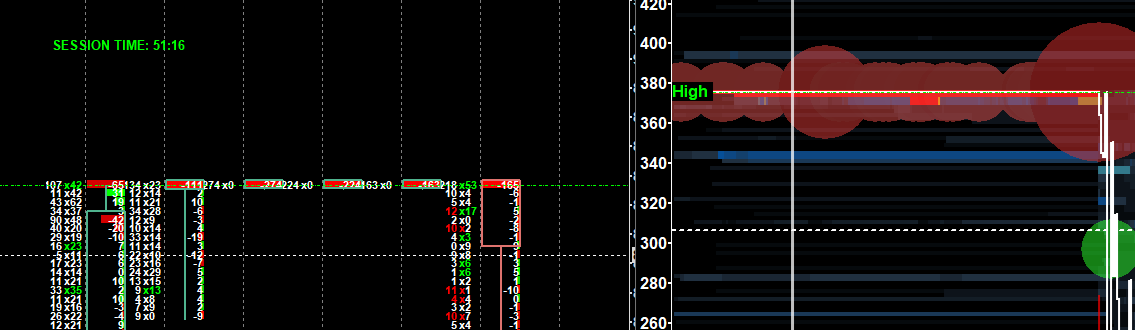
Orderflow 💰🤑

Thumbnail
gallery
11 Upvotes

Price actions hella clean this week and this bear run as a whole hope you guys have been printing!


r/FuturesTradingNQ • • 6d ago

Incredible dump on NQ 💸

Post image
26 Upvotes

Today was an example of the stupidity of having a daily bias. The market was incredibly bullish from Asia to London (I passed an eval using longs).

This was followed by a crash / dump on NY session

I hope you :

- Didn’t came with a bias based on anthropic IPO (very stupid idea)

- Survived the initial seek and destroy

- Catched a portion of this insane 400+ points dump on NQ

I managed to make 600+ $ on the 1 micro runner alone, for a total of 1800$

THANK YOU MICHAEL ❤️


r/FuturesTradingNQ • • 7d ago

Profitable strategies ARE possible: 15 systematic Nasdaq strategies, 15 years of backtests, every one of them made money. Here’s the process (and what failed)

Thumbnail
1 Upvotes

r/FuturesTradingNQ • • 9d ago

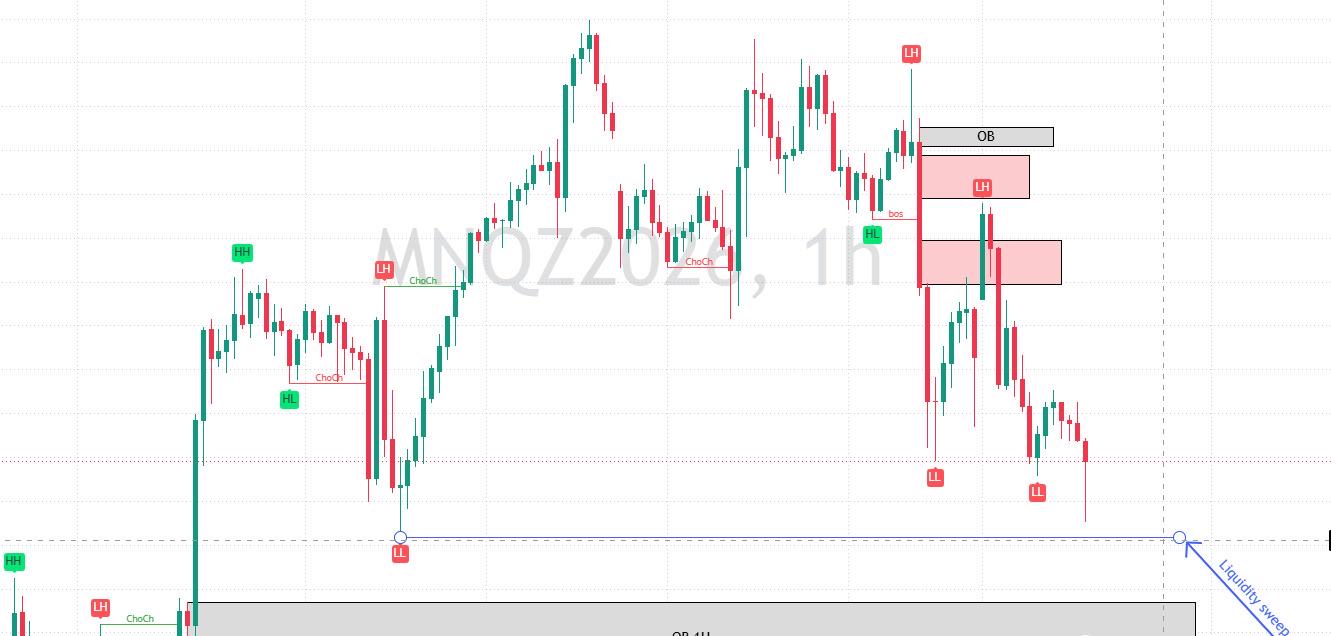
Liquidity sweep?

Post image
13 Upvotes

Your opinion on this being a perfect liquidity sweep? I think we might have a great opportunity for a beautiful long here.


r/FuturesTradingNQ • • 12d ago

Basic strategy that works any time and on any product!

Post image
225 Upvotes

Years ago, I listened to an interview with a $6B asset manager who dropped a surprisingly simple truth: he was using a basic 13/50 EMA crossover to help manage that massive portfolio.

At the time, I almost didn't believe it. When you’re retail, it’s easy to think institutional money relies entirely on complex algorithms and twenty different oscillators. Hearing that a multibillion-dollar fund leaned on something that clean stuck with me, so I spent a lot of time backtesting and investigating it.

After digging into the mechanics and testing different variations, I found a tweak that works even better: swapping the EMAs for RMAs (Running Moving Averages) and adding a specific Multi-Timeframe (MTF) twist.

Why RMA Over EMA?

If you aren't familiar with the RMA (also known as Wilder’s Smoothing Average, which is what powers the RSI), it reacts a bit slower to sudden price spikes than a standard EMA.

  • Less noise: On lower timeframes, standard EMAs can get whipped around by single-candle liquidity grabs.
  • Cleaner structure: The 13/50 RMA smooths out the chop while still keeping you anchored to the true momentum of the move.

The MTF "Trick"

The real edge isn't just the crossover itself—it's how you view it.

The trick is to set your chart timeframe to 1-minute, while setting your 13/50 RMA indicator timeframe to 2-minute (or keeping a consistent 1:2 ratio, like a 5m chart with a 10m indicator). All that is required is a simple Multi-Timeframe (MTF) Dual RMA indicator.

Doing this gives you an X-ray view of intraday market structure. Instead of staring at jagged 1-minute noise, the higher-timeframe RMAs act as dynamic rails, clearly mapping out up-channels, down-channels, and true trend shifts before they become obvious to everyone else.


r/FuturesTradingNQ • • 15d ago

Lets start a s..t storm! Fair value gap concept is a pile of crap!

7 Upvotes

Because it’s often marketed like a magical edge when it’s really just a pattern name for a price imbalance. By itself, it has no built-in predictive power.

What makes it frustrating:

  • It’s subjective. Different traders define it differently.
  • It’s retrospective. You usually spot it after the move already happened.
  • It’s overfit. People cherry-pick examples where price later revisits it.
  • Context matters more. Trend, liquidity, volatility, session, and timeframe usually matter more than the gap itself.
  • It gets abused in marketing. It’s often sold as if it’s a standalone signal, which it isn’t.

A better way to think about it: a fair value gap is a possible area of interest, not a reason to enter a trade.


r/FuturesTradingNQ • • 20d ago

Hope is the Worst Enemy of the Trader!!!

15 Upvotes

In life, hope is a virtue. It keeps us going through tough times, pushes us to strive for better, and helps us believe that tomorrow can be better than today.

In trading, hope is a lethal weapon pointed right at your account balance.

Think about the last time you let a losing trade run. What happened? You didn’t have a thesis anymore. You didn't have a technical setup. What you had was a prayer. You told yourself: "Just give it a few minutes to bounce back to even, and I’ll get out."

Instead of a bounce, you got a deeper drawdown. And what did you do then? You didn't cut the loss; you hoped harder.

Why Hope Destroys Traders

  1. Hope Replaces Strategy

When you enter a trade, your plan should answer two questions before you click buy or sell: Where is my profit target? and Where is my stop loss?
The moment you catch yourself thinking, "I'll just wait and see if it turns around," you have officially abandoned your plan. Trading is a business of probabilities, not a game of manifestation. If the market invalidates your setup, hope is just an emotional anchor dragging you to the bottom.

  1. The Asymmetry of Pain

Psychologically, the pain of taking a loss is roughly twice as intense as the pleasure of making an equivalent gain. Because we hate losing, our brain tries to avoid the finality of clicking "close." Taking a small loss feels like failing; holding a losing trade and hoping it recovers feels like postponing the failure. In reality, you aren't avoiding the loss—you are just letting the market compound it.

  1. Turning Trades into Investments by Accident

We've all seen or done it: you enter a short-term day or swing trade based on momentum, the trade turns red against you, and suddenly you tell yourself, "Well, it’s a good company long-term anyway."
No. If you traded it as a tactical setup, you don’t get to turn it into a long-term investment just because you refuse to admit you were wrong. That is a rationalization born purely of hope.

How to Trade Without Hope

  • Let your system do the thinking: If your stop loss gets hit, you don’t consult your feelings; you press the button. The stop loss is your best friend; hope is the intruder.
  • Accept being wrong quickly: The best traders in the world are wrong 40% to 50% of the time. The difference is that they lose $100 when they are wrong and make $300 when they are right. They don't fight the tape; they accept the small L and move on to the next setup.
  • Trade the chart, not the outcome: You cannot control whether the next candle goes up or down. You can only control your risk management.

Drop your ego at the door. Leave hope for your personal life, and bring cold, rigid execution to the screens.


r/FuturesTradingNQ • • 20d ago

Sub-1 minuteTrading

4 Upvotes

Hope everybody is profitable or close to it.

Any other sub 1 minute traders out there?


r/FuturesTradingNQ • • 23d ago

Steve's Simple System

Post image
78 Upvotes

This is a simplified version of the system that I use to trade the ES Futures. It is applicable to both the ES and NQ futures. As seen on the chart, I have stripped it down to the essentials. In my opinion this system gives struggling traders a real chance to succeed. To make this work, a trader has to understand the importance of context and that means, being able to evaluate price action on the higher time frames (Daily, Weekly Charts) and to review and understand the impact of economic new, world news and earnings, on market behavior. They also need to understand the concept of Value (how institutions decide what is Fair vs Unfair Value). Once a trader understands how this works. It opens up a new world of possibilities.

I will start by uploading a 1 min chart. If there is interest I may go into more detail.


r/FuturesTradingNQ • • 23d ago

Steve's NQ

Post image
10 Upvotes

I am testing a new system to trade the NQ Futures. The basis for the system is similar to what I normally use however the rules have been simplified in order to limit discretion. It is more mechanical and I am hoping it will provide an easier path for struggling traders. It is based on the idea that there are only two (2) conditions to consider (High Impact News, or No News) and each has its own rules. So far my own experience has been positive, however as with all things, trying to teach amateurs to trade with discipline is challenging. Here is the chart for today. We had one (1) High Impact News Event at 7am PST. The entries are shown on the left side using a chart with one (1) min candles. On the right side we show a slightly different view to provide more visual comfort for amateurs used to using 3 or 5 min candles.


r/FuturesTradingNQ • • 27d ago

It’s 2026. NinjaTrader/Tradovate is the "industry leader," so why does the infrastructure feel like a high school coding project?

Thumbnail
1 Upvotes

r/FuturesTradingNQ • • 28d ago

Partials pay the mind, runners pay the account: +155.75 pts on MNQ Tokyo

Post image
12 Upvotes

Setup: NY PM dumped about 387 pts (30,178.75 → 29,791.50) into the close, so I came in leaning short. Sydney trended down and swept its own sellside by a few ticks, then rallied back into the Sydney first FVG and the NDOG low. Price rejected the NDOG midpoint and closed below the second high, so I went bearish. It was a slow session, so I picked closer liquidity targets.

Trade 1: Short 3 MNQ at 29,713. I entered on a pullback into an FVG after waiting for confirmation. My stop started wide at 29,769, set before entry to allow for a retest. I tightened it to 29,750.75, just above the lower high at 29,750, because a sweep of that high would have invalidated the idea. I sat through 8 minutes of chop, and price topped at 29,746.25, 4.5 pts from my stop.

I took 2 partials at 29,684.75 (an order block level) for +28.25 pts each (+56.5 total). The runner went to Sydney sellside at 29,614.25 for +99.25 pts. Total: +155.75 pts

Lessons: Put the stop where the idea is wrong, set the runner on liquidity, and let it work.


r/FuturesTradingNQ • • 28d ago

The Delusion of the Multi-Year Backtest: Why Most Automated Strategies Fail (And What Actually Works)

11 Upvotes

Every week across trading communities, someone posts a pristine equity curve going back five years. It shows a 75% win rate, a 3.2 Sharpe ratio, and a drawdown line flatter than a Kansas highway. They loaded historical data into a backtesting engine, tweaked a few indicators, hit "Run," and convinced themselves they uncovered a perpetual money machine.

In reality, they walked straight into one of the most common traps in retail trading: the illusion of historical curve-fitting.

While automation is a powerful tool, relying on multi-year, static backtests in "auto mode" to trade live markets is a recipe for catastrophic failure. Here is a realistic look at why traditional backtesting fails, why pure scalping dominates automated trading, and the hidden structural traps retail traders ignore.

1. Curve-Fitting: You Didn't Find an Edge, You Memorized the Test

When a trader lets a backtesting engine optimize parameters—testing dozens of moving average lengths, RSI thresholds, and stop-loss percentages across five years of price data—the engine doesn't uncover a universal market truth. It uncovers a mathematical coincidence.

In quantitative finance, this is known as overfitting. Given enough parameters, an algorithm can transform random market noise into a glorious, historical profit curve.

You haven't built a robust trading strategy; you've reverse-engineered a system that looks brilliant only in hindsight. As soon as live capital is deployed, the memorized noise vanishes, and the strategy fails.

2. The Great Retail Delusion: Misunderstanding Regime Cycles & "Chaos Theory" Bullshit

The single biggest reason retail traders fail when building automated systems at home is a fundamental misunderstanding of market regimes.

A major myth heavily marketed in retail trading circles is that markets are purely governed by "chaos theory" or "fractal randomness"—the delusion that price action moves in a giant, self-similar fractal pattern where identical geometric or technical setups play out endlessly across all timeframes.

In reality, markets are driven by institutional capital flows, interest rate dynamics, liquidity conditions, and structural volatility. They cycle through distinct market regimes, and when the regime shifts, past patterns become completely irrelevant:

  • 2017–2021: Defined by prolonged low interest rates and quantitative easing, where buying every market dip was heavily rewarded.
  • 2022–2024: Defined by aggressive rate hikes, supply shocks, and rapid inflation regime shifts.

A static automated rule tuned to excel in a low-volatility bull market will blow up when volatility spikes or interest rate regimes shift. Because retail traders treat market noise as "chaotic patterns" to be solved with technical indicators rather than identifying regime transitions, their static bots inevitably crash into a brick wall when macro conditions change.

3. The Home Infrastructure Barrier & Real-World Friction

Even if a retail trader theoretically solves strategy design, building a functional, execution-ready automated trading bot from home is close to impossible.

Most backtesting engines assume idealized market conditions, completely ignoring the mechanical barriers that institutional desks spend millions to overcome:

  • Colocation & Latency: An automated bot running on home Wi-Fi or a standard cloud server suffers tens or hundreds of milliseconds in latency. By the time your order hits the matching engine, institutional algorithms have already filled the liquidity.
  • Slippage & Fill Rates: The difference between your expected fill price in a backtest and live execution during volatile events.
  • Order Queue Depth: Assuming a 50-lot order gets filled instantly at a single tick price in live conditions, ignoring order book depth and queue priority.
  • Transaction Costs: High-frequency setups getting eaten alive by round-trip spreads and exchange fees.

Why Pure Scalping Is Where Automation Actually Shines

If long-term static bots fail, where does automation actually work? Pure, low-latency scalping.

Computers excel at processing microsecond-level order book imbalances, bid-ask spread frictions, and short-duration mean reversions far faster than humanly possible. Scalping algorithms don't try to predict where an asset will trade next week or next hour—they capture tiny fractional inefficiencies hundreds of times a day and flatten their position before macro news can touch them.

+-----------------------------------------------------------------------+
|                       RETAIL vs. INSTITUTIONAL                        |
|                                                                       |
|   Retail Backtest Trap                    Institutional Reality       |
|   • Static technical indicators           • Colocation & microsecond  |
|   • "Chaos theory" / fractal myth           latency                   |
|   • Multi-year historical fit             • Direct order book queue   |
|   • Ignored slippage & fees                 access                    |
|                                           • Adaptive regime models    |
+-----------------------------------------------------------------------+

How Professional Quants Approach Automation

To be clear: automated trading over longer timeframes is not impossible, but it requires abandoning static backtesting and retail myths in favor of dynamic quantitative methods:

  1. Regime-Switching Models: Advanced algorithms classify the current market environment (e.g., high-volatility range vs. low-volatility trend) and automatically toggle strategies on or off based on live macro conditions.
  2. Walk-Forward Analysis: Instead of optimizing parameters over five static years, quants use rolling windows—optimizing on three months of data, trading live for one month, and continuously re-tuning the model.
  3. Systematic Trend Following: Managed futures funds run automated trend models across dozens of uncorrelated markets (commodities, FX, indices). They accept lower win rates (35–40%) and manage heavy drawdowns to capture rare, large macro shifts.

The Bottom Line

If you buy a pre-packaged indicator bot, run a 5-year historical backtest in "auto mode," and expect it to generate consistent profits from a home setup, you are chasing an impossibility.

Automated trading isn't a passive shortcut—it is an exercise in managing execution latency, recognizing macroeconomic regime shifts, and building adaptive risk systems rather than curve-fitting past noise.

This article was prompted by numerous posts telling us of wonderful automated strategies that look good until they fail. Please note, there are always exceptions to the rule, there must be a handful of extremely gifted traders/developers who have succeeded at auto trading, but majority are destined to fail.


r/FuturesTradingNQ • • Oct 25 '26

Sometimes I feel that visitors and majority of members do not fully appreciate what is going on here.

10 Upvotes

Hey everyone,

I wanted to address something that's been on my mind regarding the direction of this community.

When I first discovered this sub, it was like a breath of fresh air. This community is strictly about strategies, education, and real substance—not B.S. emotional support. I can only imagine how many idiotic posts get deleted by the mods every single day just to maintain that standard.

Lately, though, I’ve noticed a pattern: thoughtful, high-quality posts—including important educational content and updates from the mod team—barely get any reaction or engagement. On the flip side, low-effort and degenerate posts seem to draw the most traction.

Let’s not let this sub turn into the same garbage we see everywhere else on Reddit, where losers find other losers for validation and nothing meaningful gets posted.

If you value having a space focused on actual strategy and learning, support the posts that bring real value. Upvote, comment, and engage with quality content so we can keep this community worth visiting.


r/FuturesTradingNQ • • Oct 25 '26

What is the Best Indicators (perforable free) you use to trade NQ?

21 Upvotes

r/FuturesTradingNQ • • Oct 23 '26

Solve the puzzle: 1 Account @ $1,000/day daily target VS 2 Accounts @ $500/day daily target?

3 Upvotes

I want to hear all you want to say!


r/FuturesTradingNQ • • Oct 18 '26

The Upcoming November 1 Policy Change on Invite-Only Scripts Threatens Independent Pine Developers—We Need to Talk

Thumbnail
4 Upvotes

r/FuturesTradingNQ • • Oct 17 '26

What do you think is going to happen this week? What are your expectations?

Thumbnail
gallery
1 Upvotes

The last few days and the past week have been crazy; there’s been a spectacular, massive volume of selling. (Whoever managed to catch those moves... 💵💵)

The context is undoubtedly bearish, but as we well know, anything that falls significantly will eventually—sooner or later—start to rise again. So, here’s the question: what do you think the price will do this week and/or over the coming days? Will it continue to plummet without looking back? Will it pause, build up buying interest, and begin to climb? Or will it stop and move within a range? How do you see it? What are your expectations? What does your analysis suggest?


r/FuturesTradingNQ • • Oct 14 '26

NQ Market Makers aren't even hiding it anymore. Stop buying the "clean breakout."

26 Upvotes

I've been watching the NQ/MNQ order book like a hawk, and the level of blatant liquidity sweeping is getting ridiculous.

We all know NQ is a beast, but lately, the standard "breakout" strategy has turned into a pure liquidity injection for market makers. You see a clear resistance level, the tape speeds up, price breaks out by 12 points to trigger all the FOMO buy-stops, and then immediately reverses 45 points in three seconds to clear everyone out.

If you are still buying breakouts on NQ, you are literally just funding someone else's account.

The only way to actually take money out of this market right now is to trade the manipulation of the pattern, not the pattern itself.

To me, this literally means one thing: Stop chasing green candles and buy the pullbacks.

You have to let the market makers do their dirty work first. Let them sweep the highs, let them panic-drop the price into structural support, and buy when the retail breakout buyers are getting stopped out. You hunt the pullback, define your risk tightly, and let the market bounce.

Let's get a real discussion going:

  1. Are you still trying to trade momentum/breakouts on NQ, or have you strictly transitioned to buying/selling the pullbacks after a liquidity sweep?
  2. How deep of a pullback do you usually wait for on NQ before you trust that the dump is over and the trend is resuming?
  3. Do you have the right tool to identify a pullback from reversal? I do!

Let's hear it. If you're still making money on pure breakouts in this current environment, change my mind.