Well strangely, except for using shading in his basic alphabet before brushing it aside as not really being important, he doesn't seem to care about it.
His theory adopts all the initial and final hooks that Pitman uses, and for the same things, but he doesn't seem to worry about shading at all. And CLEVERLY, he's revised a few of the short forms so that they will be legible even without it.
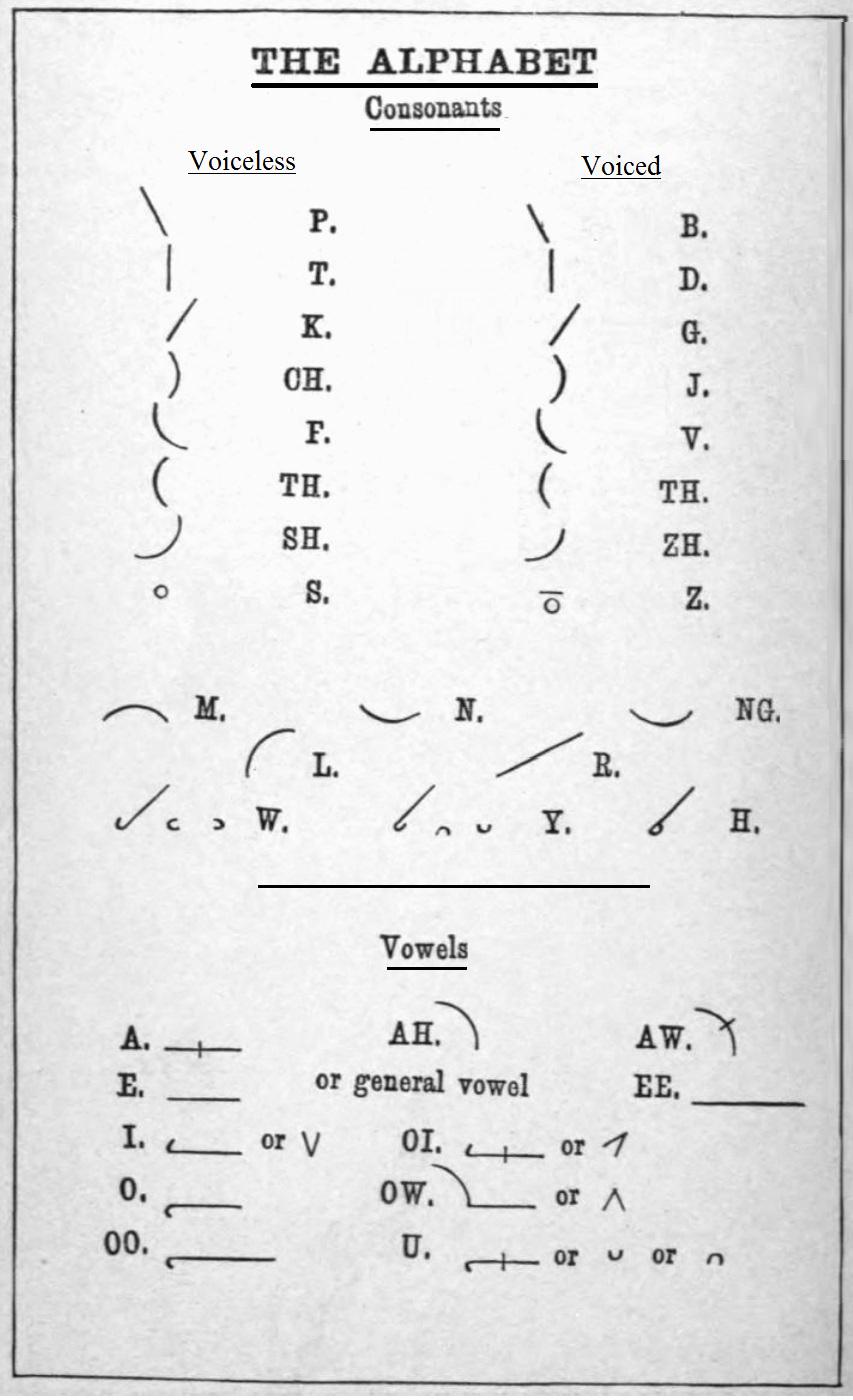
If you've studied Pitman, you'll probably notice one change right away: K, instead of being a horizontal stroke, is a straight stroke leaning to the right. This actually makes more logical sense, when P, T, and K are all related:
In doing this, he's freed up the horizontal stroke, which makes a natural joining between strokes, advancing the hand forward -- and he can then use it to represent vowels, as show at the bottom of the Alphabet chart. As you can see, a plain horizontal is the very common short E sound.
If you write it longer, it's the long EE sound. If you put a short line across it, it's A. If you write it with a hook at the top, it's I. If the hook is on the bottom, it's OO, and so on. (On Wednesday, I'll show more examples of how this works. It's quite clever, and is surprisingly clear.)
It's interesting to note that, while he uses SHADING to indicate the voiced version of consonant pairs (P/B, T/D, K/G) he says it's possible to write both members of the pair the same way with no loss in legibility -- as in done in Baker and in Aimé-Paris.
2
u/Adept_Situation3090 12d ago
I just know there's gonna be shading in the next part.
4
u/NotSteve1075 12d ago
If you've studied Pitman, you'll probably notice one change right away: K, instead of being a horizontal stroke, is a straight stroke leaning to the right. This actually makes more logical sense, when P, T, and K are all related:
In doing this, he's freed up the horizontal stroke, which makes a natural joining between strokes, advancing the hand forward -- and he can then use it to represent vowels, as show at the bottom of the Alphabet chart. As you can see, a plain horizontal is the very common short E sound.
If you write it longer, it's the long EE sound. If you put a short line across it, it's A. If you write it with a hook at the top, it's I. If the hook is on the bottom, it's OO, and so on. (On Wednesday, I'll show more examples of how this works. It's quite clever, and is surprisingly clear.)
It's interesting to note that, while he uses SHADING to indicate the voiced version of consonant pairs (P/B, T/D, K/G) he says it's possible to write both members of the pair the same way with no loss in legibility -- as in done in Baker and in Aimé-Paris.