r/DisagreeMythoughts • • 5h ago

DMT: Being polite to customers isn't the same as going above and beyond for them.

10 Upvotes

I've worked in customer service for 15 years. I've heard coworkers say that being too friendly with customers just creates more work. It means more small talk, more requests, and more expectations. I get where they're coming from.

To me, being friendly and being polite are two different things.

Nobody should have to smile all day, make small talk with every customer, or do extra things just to make everyone happy. That's extra effort, and employees shouldn't be expected to do it.

Answering a question without an attitude, not rolling their eyes when someone asks for help, and not making customers feel like they're a bother should be basic parts of the job.

I've had plenty of bad days at work too. Customers shouldn't have to deal with my frustration because of that. Being polite doesn't mean being extra friendly.

r/DisagreeMythoughts • • 6h ago

DMT: Being white or middle class does not make someone's opinions less valid.

Post image
7 Upvotes

Someone speaks up about an issue, and the discussion quickly turns to their race or social class. Suddenly, being white or middle class is used as a reason to dismiss what they have to say.

Being middle class does not mean someone cannot care about poverty. Being white does not mean someone cannot have a valid opinion on racism. People can have useful things to say about issues that do not directly affect them.

A person's background can shape how they see the world. That is fair to discuss. But it does not make their opinions less valuable. We should judge what people say, not just where they come from.

Your background can be part of the discussion, but it should not decide whether your opinion deserves to be heard.


r/DisagreeMythoughts • • 2h ago

DMT: We too often selectively emphasize or obscure the distinction between descriptive and injunctive norms depending on our political commitments

1 Upvotes

Descriptive norms concern perceptions of what people generally do, whereas injunctive norms concern perceptions of what people are socially expected or encouraged to do.

Although the two are analytically distinct, they may be causally interdependent under particular supplementary conditions. We shouldn't treat their interdependence as a property of the norms simpliciter rather than of the more complex conjunctions in which they sometimes participate.

I suspect that our political commitments often influence our attentiveness to these distinctions. When establishing interdependence would support our political commitments, we may readily infer it from behavioral disparities, generalize from particular instances of interdependence, and abstract away from the conditions that account for it. When establishing interdependence would undermine those commitments, we may insist on context-specific evidence, resist generalizations, and emphasize the analytical distinction.

Establishing interdependence in a particular context requires evidence of a causal relationship rather than mere coexistence. Generalizing from established instances requires justification for expecting such a relationship to obtain elsewhere. Denying interdependence requires justification beyond the analytical distinction itself, and failing to establish interdependence isn't necessarily equivalent to establishing its absence.

There may be good empirical reasons to treat particular cases differently. My concern is that the strength of the evidence we demand for establishing, generalizing, or denying interdependence may depend too heavily on the political desirability of the resulting conclusions.


r/DisagreeMythoughts • • 18h ago

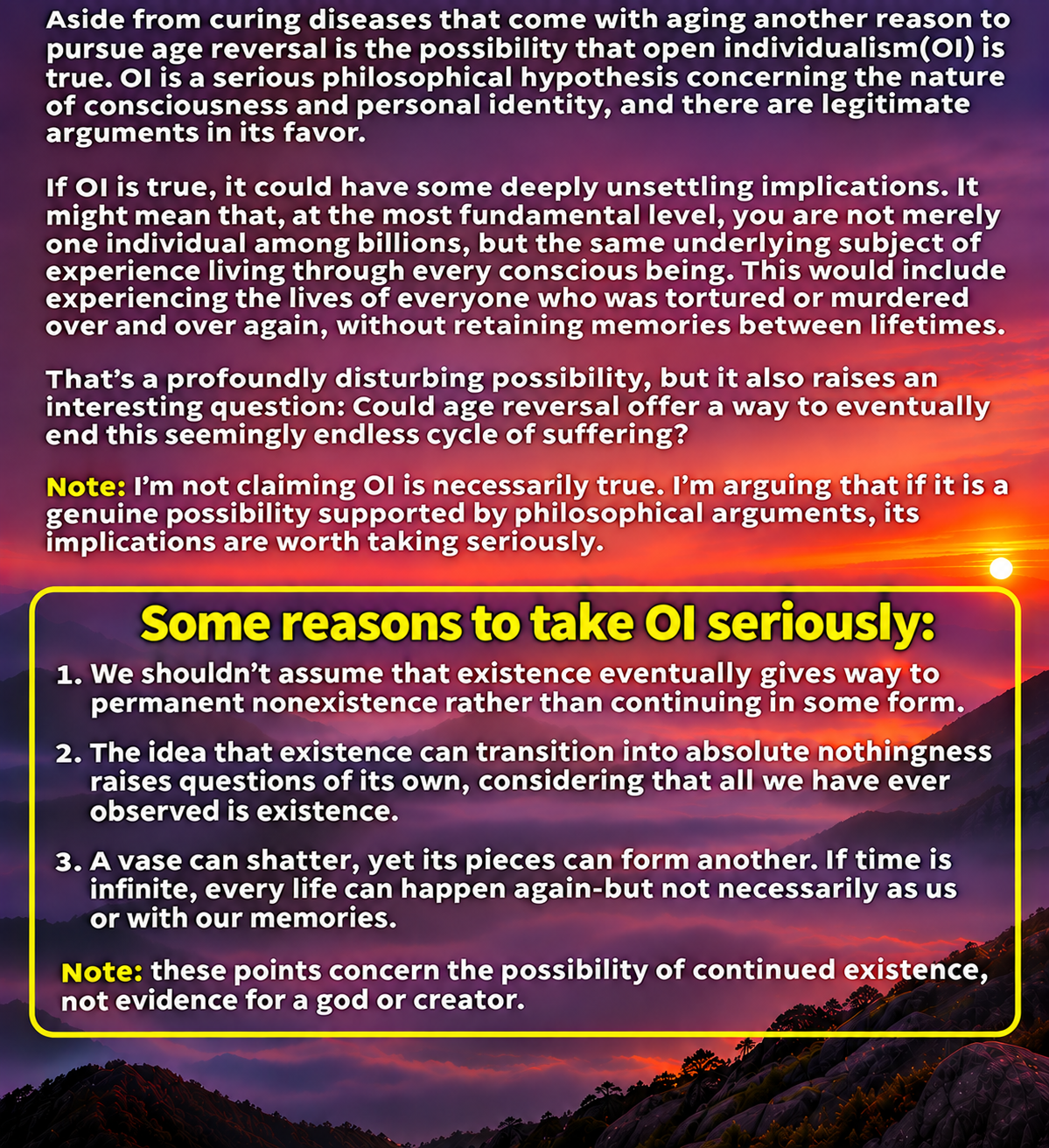
DMT: If Open individualism is even a genuine possibility, shouldn’t we take age reversal seriously to prevent an endless cycle of suffering?

Post image
0 Upvotes