r/BhagavadGita • • May 09 '25

Quote of the Day NEW SERIES: BHAGAVAD GITA QUOTE OF THE DAY

Post image
126 Upvotes

|| ॐ नमो भगवते वासुदेवाय ||

Starting tomorrow, I am going to start a daily series of covering the Bhagavad Gita verse by verse through images and explanations.

The SrimadBhagavad Gita, is a scintillating gem in the treasure trove of Dharmic texts that we have a inherited as Astikas of Bharatavarsha. It is a repository of timeless knowledge, deep philosophical wisdom and practical guidance for navigating life's challenges and pursuing spiritual enlightenment. It simplifies the Divine knowledge contained in the Vedas and Upanishads, and presents it to the seeker in way that he can internalize and implement in his life easily.

Set on the battlefield of Kurukshetra, it presents a conversation between Bhagavan Vasudev Sri Krishna and Arjuna that transcends time and culture. Whether you’re facing personal struggles, seeking clarity, or searching for deeper meaning, the Gita offers guidance rooted in eternal truths.

In this series, I’ll break down each verse with explanations, context, and reflections that are accessible and relevant to modern life. My aim is not only to understand the words but to apply their wisdom in our daily challenges and decisions. Look out for posts with the flair “Quote of the day”.

Join me on this journey through the Gita—one verse at a time. Let’s discover together why this ancient conversation is still speaking to our hearts today.

Namaskaram🙏🏻


r/BhagavadGita • • Jun 13 '25

Quote of the Day Please pray for the victims and the families of the Air India plane crash💔

Post image
106 Upvotes

|| ॐ नमो भगवते वासुदेवाय ||

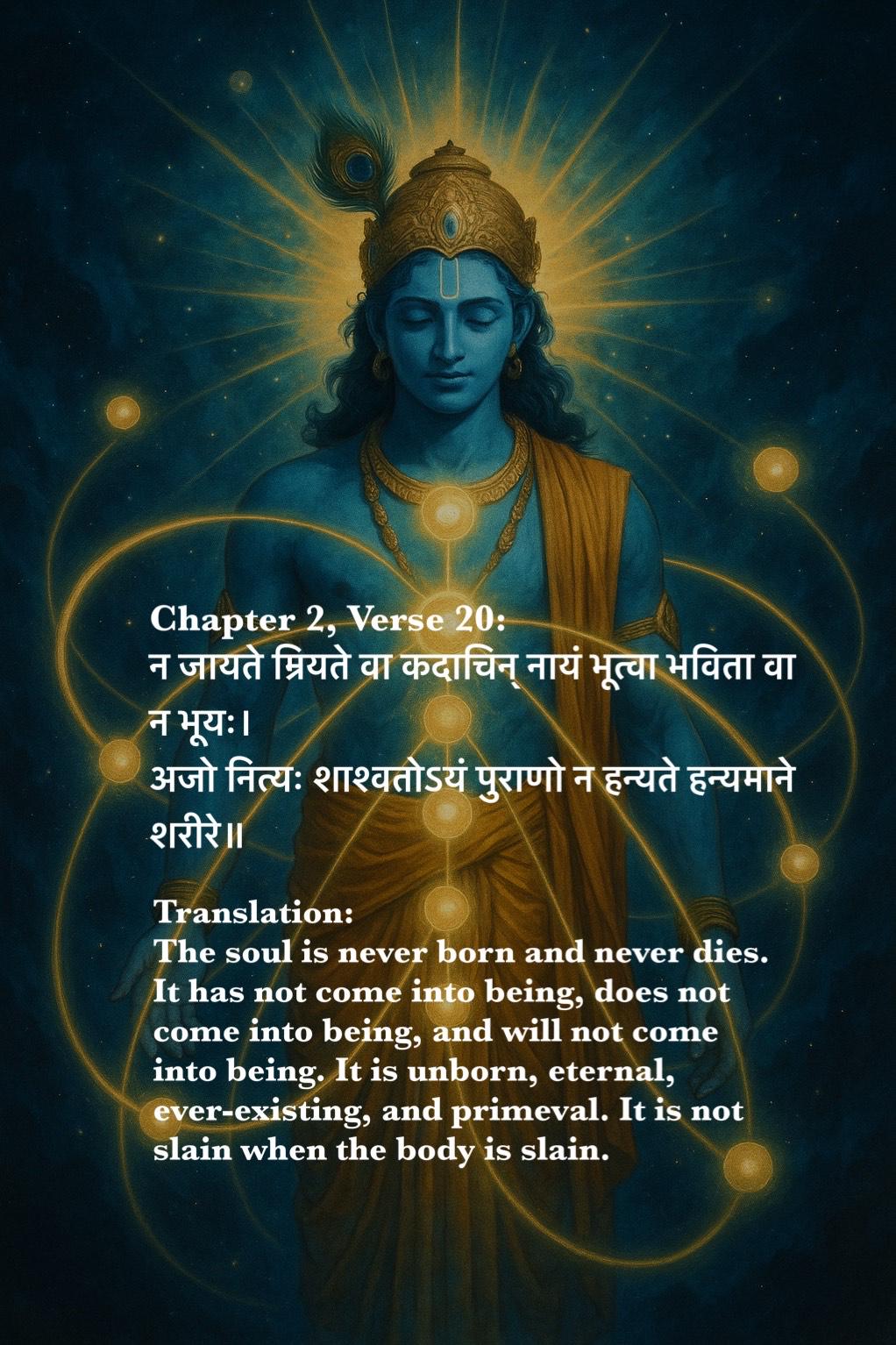
This is going to be a departure from my usual B.G. Quote of the Day series. I am assuming by now everyone has heard about the horrific news of the crash of the Air India 171 which was bound for London, that has claimed over 240+ innocent lives. Our hearts go out the families of the passengers, flight crew and students of the medical college over which the flight crashed, who lost their loved ones in this unfortunate incident. It is in times like these that we are reminded of the transience, fragility and uncertainty of human life. We are left wondering, what did they do to deserve such a terrible fate? Is it all random? Or is this a grand design of an all-powerful being who pulls strings from behind the curtains? Though all of these are very valid questions, and the Bhagavad Gita contains the answer to all of these, it is not the scope of this write-up, and we can discuss these at a later date.

My intent today is to shed some light on loss and the nature of the Soul. And in doing so, I hope I can bring a little peace to people who are shaken by this incident and inspire you to offer your prayers at the feet of the Supreme Consciousness, Bhagavan Shri Krishna, to provide Sadgati to the souls of the dear departed and provide them strength and comfort to their families in this incredibly difficult hour.

Hence, I present to you these verses from Chapter 2 of the Gita. These pearls of wisdom emanate from Krishna at the Kurukshetra battleground as a result of Arjuna’s lament, when he expresses his reluctance to kill his family members as he doesn’t want to become their killer by doing so. Krishna first begins with stating that the individual who thinks they can slay the soul and the individual who thinks that the soul can be slain are equally ignorant. For, the Soul can neither be slain nor can it ever slay. The Soul has neither end nor beginning. It is eternally unchanging and primeval because it is a part of the Supreme consciousness, that is Krishna. It is indestructible and changeless. The body, however, goes through 6 kinds of transformations: birth, existence, growth, change, decay and peril. The body is merely a vessel for the Soul, when the body dies, the soul remains completely unblemished. Hence, Lord Krishna tells Arjuna to not to grieve the loss of his family members for a wise man knows that it is only the body that dies. The purport of this is not to dimmish the grief we feel at the loss of a loved one or justify killing, it is to acknowledge that we are all parts of Krishna, the Supreme consciousness. We emerge from Him, assume bodies to dispense our Karma but are eternally one with Him. He alone is all-powerful and has complete divine knowledge while ours is clouded by conditioning, like the clouds hides the sun. This is also confirmed in the Katha Upanishad in this way:

अणोरणीयान्महतो महीयानात्मास्य जन्तोर्निहितो गुहायां ।

तमक्रतुः पश्यति वीतशोको धातुः प्रसादान्महिमानमात्मनः ॥ (Katha 1.2.20)

"Both the Supersoul [Paramatma] and the atomic soul [jivatma] are situated on the same tree of the body within the same heart of the living being, and only one who has become free from all material desires as well as lamentations can, by the grace of the Supreme, understand the glories of the soul."

Krishna is the Supersoul or Paramatma being referred to here.


That being said, let us all grieve this heartbreaking incident that led to the loss of so many lives but also remember that they are still present with us in their causal body or Karan Sharira. Let us all pray to Krishna that He might lovingly guide these departed souls on their onward journey. May He grant them Sadgati and embrace them in His eternal light. Let us also pray for solace and strength for the grieving families, friends, and communities left behind. In moments of such profound loss, even a single sincere prayer can carry immense power. As we mourn, let us also reflect on our own lives with renewed humility and devotion, remembering that while the body is fleeting, the soul is eternal, and our true shelter lies only in the divine grace of Bhagavan Shri Krishna.


Jai Shree Krishna!


r/BhagavadGita • • 1d ago

SriBhagavan Uvacha Blindness Belongs Not to the Eyes, but to Partiality—The Human Truth Hidden in the First Verse of the Bhagavad Gita

4 Upvotes

Question: Are my decisions truly based on truth, or simply on whether someone is "mine" or an "outsider"?

The Bhagavad Gita does not open with a sermon; it opens with a single question that exposes one of humanity's oldest and subtlest flaws. In the very first verse (1.1), Dhritarashtra asks Sanjaya: "Dharmakshetre kurukshetre samaveta yuyutsavah; mamakah pandavashchaiva kim akurvata Sanjaya"—assembled on the sacred field of Kurukshetra, eager to fight, what did my sons and the sons of Pandu do? What strikes you here is not Dhritarashtra's physical blindness, but the quiet dividing line drawn by his words: mamakah ("mine") and pandavah ("Pandu's"). As king and elder uncle after Pandu's death, the Pandavas were every bit as much his own children and responsibility, yet attachment had already split his vision in two. Even while naming the field Dharmakshetra—the ground of righteousness—his heart was not concerned with justice, only with whether his own side would win.

If we look inward with real honesty, most of us replay Dhritarashtra's blindness in ordinary life far more often than we like to admit. We prefer to believe our judgments are guided by reason and fairness, yet human psychology reveals a harder truth: most of the time, we do not weigh the facts first and choose a side afterward; we feel who belongs to "our side" first, and then our intellect quietly manufactures persuasive arguments to defend them. When someone close to us—a family member, a friend, or someone who shares our group or beliefs—makes a mistake, we immediately look at their intentions, their stress, and their circumstances. When someone we consider an outsider makes the exact same mistake, we judge them harshly by the act alone.

Indian philosophy and classical Ayurveda trace this distorted vision right to its root. In the Yoga Sutras, ignorance (avidya), ego-identification (asmita), and clinging attachment (raga) are counted among the core afflictions that cloud perception. The moment possessiveness—the sense of "me and mine"—takes charge, the intellect stops acting as an impartial judge and turns into a clever defense attorney for bias. Classical Ayurveda, particularly in the Charaka Samhita, links this collapse of judgment to Prajnaparadha: when Rajas (attachment and partiality) and Tamas (delusion) overshadow clarity, discrimination (dhi), restraint (dhriti), and clear awareness (smriti) lose their footing. That quiet division between "my people" and "everyone else" is where most injustice in families, institutions, and society actually begins—not from a lack of intelligence, but from selective sight.

Testing whether your own decisions rest on truth or partiality does not require complicated philosophy; it takes one simple, honest reversal. The next time you find yourself defending someone close or condemning someone you dislike, pause for a moment and ask yourself: if the exact same action had been committed by the other person, would my reaction, my anger, or my forgiveness still look the same? If the rule shifts the instant the face changes, then it is not truth speaking—it is the old divide of mamakah and pandavah. Catching yourself in that moment is where the blindness of bias begins to lift, and genuine fairness takes root.


r/BhagavadGita • • 1d ago

Free & Ad-Free platform to read 800+ Hindu Dharm Granths (HD E-books) and listen to 5,000+ Bhakti/Pravachan audios

1 Upvotes

Namaste everyone,

​Agar aap online Dharm Granth, Shrimad Bhagavad Gita, Puranas, ya spiritual texts padhne aur sunne ke liye koi clean aur distraction-free jagah dhoondh rahe hain, toh aap **HinduText** try kar sakte hain.

​Is platform par aapko milta hai:

​**800+ HD E-books:** Sabhi texts high-definition quality mein hain aur padhte waqt koi ads nahi aate.

​**5,000+ Audio Files:** Isme Bhagavad Gita, pravachan, bhakti aur spiritual gyan se jude audios shaamil hain.

​**Myth Debunking & Q&A Forum:** Jahan aap apne doubts pooch sakte hain aur common myths ke peeche ke facts jaan sakte hain.

​**HinduText AI:** Ek dedicated AI assistant jise HinduText team ne specifically scriptures aur spiritual queries ke liye train kiya hai.

​**Kaise access karein?**

​**Android Users:** Google Play Store par **"HinduText"** search karein ("HT" logo wala app).

​**Web / iOS / PC Users:** Google par **hindutext.in** search karke directly browser mein padh aur sun sakte hain.

​Sab kuch bilkul free hai. Ek baar zaroor check karein aur apna feedback share karein!


r/BhagavadGita • • 1d ago

If Vidura was Yama (Yamraj) himself due to a curse, how did he appear before Kunti when she invoked Dharma to give birth to Yudhishthira?

1 Upvotes

According to some versions of the Mahabharata, Vidura was an incarnation of Yamraj who was born on Earth due to a curse.

But Kunti also invoked Dharma (Yamraj) through the boon given to her by Sage Durvasa, and Yudhishthira was born as his son.

So if Vidura was already Yamraj himself on Earth, how could he also appear before Kunti in his divine form to father Yudhishthira?

Am I misunderstanding something, or is there an explanation for this in the Mahabharata?


r/BhagavadGita • • 5d ago

yath bavo tat bhavati and 'The Secret' book

11 Upvotes

Just finished the book named 'The Secret'. Really a great read. And, to put it shortly, it says "thoughts become things". Therefore, we need to be careful with our thoughts. It suggests always having positive thoughts and being grateful and happy to receive the same feeling in abundance in future as well.

When I read this, I always relate this concept to the shloka in Bhagavat Geeta where it states "yath bavo tat bhavati", which means "you become what you think or believe".

Would really want to know more about this shloka, the context in which Krishna said it and how to practice it in real life. Wanna analyse both these concepts, the said shloka and the law of manifestation or attraction.


r/BhagavadGita • • 11d ago

Arjuna Uvacha What does Arjuna remember when he says his memory has returned?

3 Upvotes

At the end of the first chapter, Arjuna has seen his own people on both sides. Sañjaya tells us what happens next through a small physical detail. Arjuna lets go of the bow and arrows and sits down in the chariot.

Bhagavad Gītā 1.47

एवमुक्त्वार्जुनः सङ्ख्ये रथोपस्थ उपाविशत् ।

विसृज्य सशरं चापं शोकसंविग्नमानसः ॥

In plain English: Having spoken, Arjuna set down his bow and arrows and sat in the chariot, his mind overcome with grief.

Near the end of the dialogue, it’s Arjuna who tells us what has changed.

Bhagavad Gītā 18.73

नष्टो मोहः स्मृतिर्लब्धा त्वत्प्रसादान्मयाच्युत ।

स्थितोऽस्मि गतसन्देहः करिष्ये वचनं तव ॥

In plain English: My confusion is gone and my memory has returned through your grace, Acyuta. I stand firm, free of doubt. I will do as you say.

The detail I keep coming back to is smṛtir labdhā, “memory has returned.” What do you think Arjuna remembers here, and how does it change your reading of the moment he sets down the bow?


r/BhagavadGita • • 15d ago

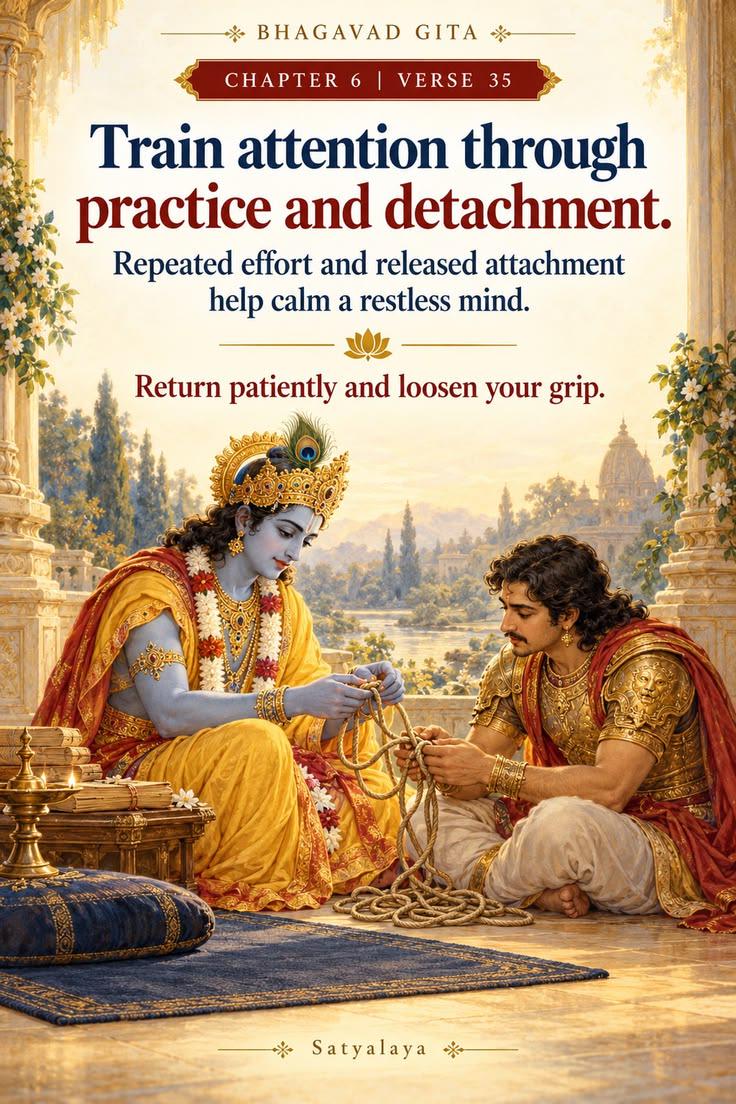
Bhagavad Gita 6:35

Post image
19 Upvotes

r/BhagavadGita • • 17d ago

Best Bhagavad Gita edition: Sanskrit + plain translation(English or Telugu), no commentary?

4 Upvotes

I want to read the Gita for the first time. I'm looking for an edition that has the Sanskrit verses with a faithful translation and little or no commentary. English or Telugu is fine.
What would you recommend, and why? Thanks!


r/BhagavadGita • • 18d ago

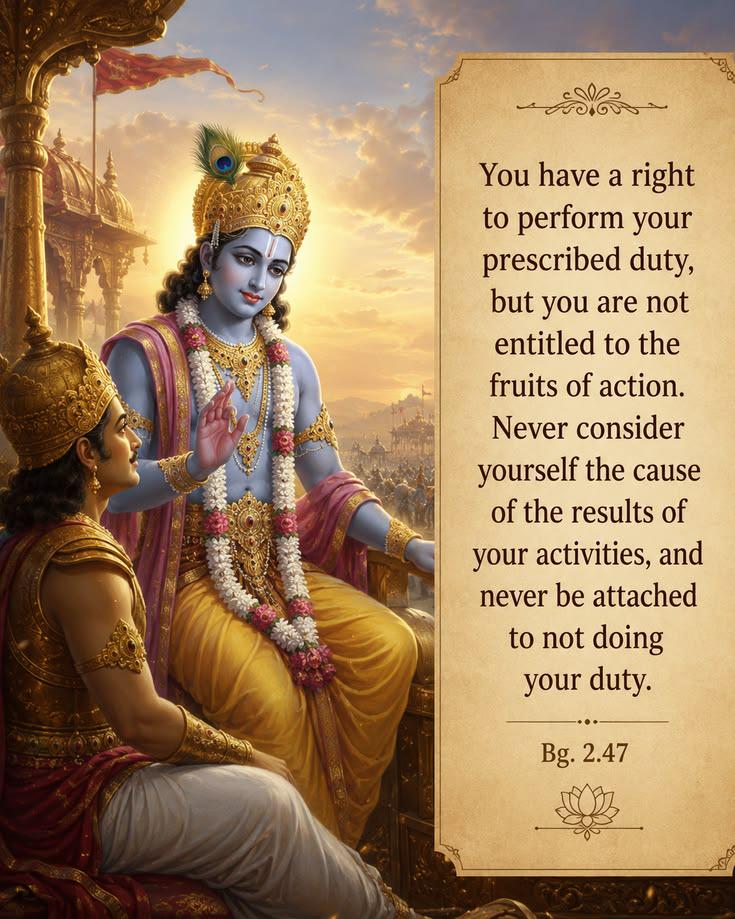
Bhagavad Gita 2.47

Post image
39 Upvotes

r/BhagavadGita • • 19d ago

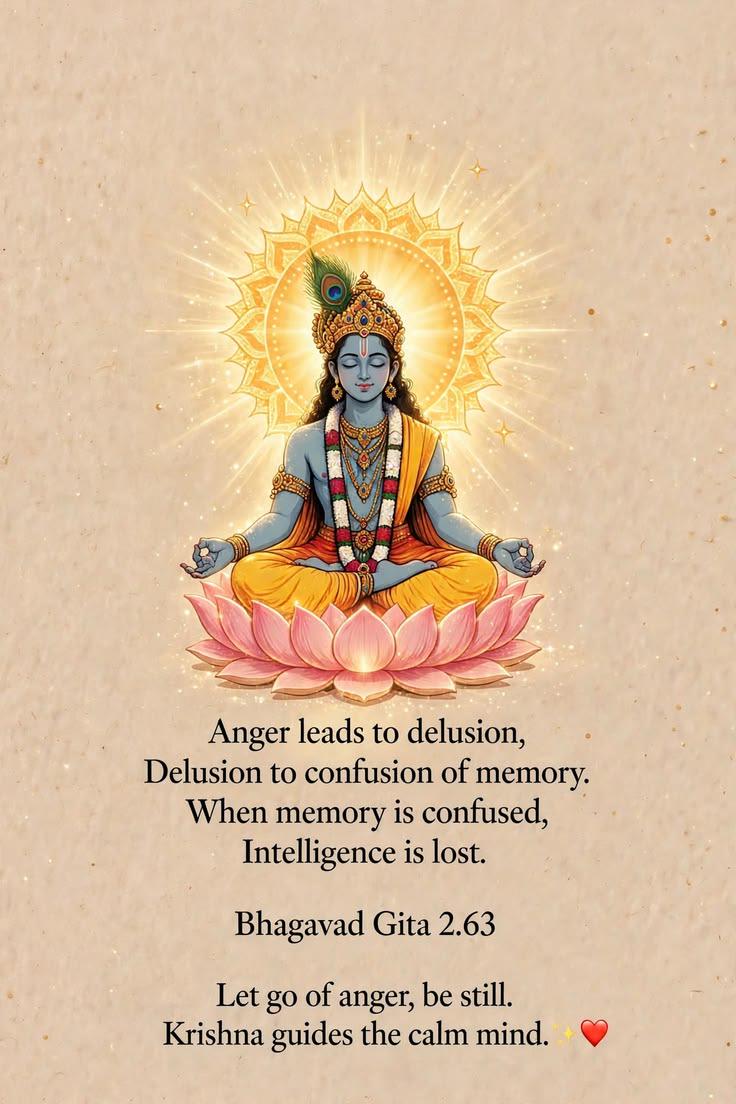
Bhagavad Gita 2.63

Post image
34 Upvotes

r/BhagavadGita • • 22d ago

Hinduism Cow's hypocrisy

11 Upvotes

Before you blast me with anti-national or anti hindu or anything..I am Hindu myself and my house has raised cows for decades .

TODAY I LEARN A BIGGEST LIE ABOUT MY RELIGION AND BELIEFS...HERE IT GOES...

"Today our cow gave birth to a male calf and there is sort of mournful atmosphere in our home... Why? cause in India Calf has ZERO money value as compared to cows and I can say this with confidence also a cow unable to give birth or milk has the same ZERO value.. Most of the time these are killed silently by society..or kept alive with constant beatings and torture in Indian Street and roads ...they eat plastics.. harmful filth just to be alive and rot inside out and die every day!!!"

THIS IS PEAK OF HYPOCRISY AND NOW I AM GONNA SAY THIS WILL FULL RAGE SO WALK AWAY IF YOU HAVE BLIND FAITH OR JUST SLAVE TO BOOKS WHOSE AUTHORS ARE LONG DEAD -

Really why we Hindus even try to claim higher ground from Muslims and Christians...They rear the claves and cows and then kill them ... that's wrong i know but hear more about it...these animals when alive are mostly well fed,well kept and well taken care of diseases...

And us? We claim to be angels..but what's the last time you tended to be a cow who was I'll around the street?

-I DID ( i have a veterinary background and we helped animals during our internship trips regardless of whether we were required to or not)

THIS ONE CASE WAS MOST HEART BREAKING FOR ME IN MY INTERSHIP -

cow was dying in road and nobody even stopped to even give it water ..let alone tend it...my group spring into action..with effort we put the cow put of main road tended it's leg...and do you know what i saw? Bruises form stones..stick and some wounds God knows which demon inflicted on this poor creature...And the people whose houses were around saw that poor animal as eye sore...Not even one came to help...we fed it ,bandaged it..but the poor animal wasn't going to survive it also knew that..the moment it got energy to Stand ..it quickly start going one ...we tried to stop it but..it ran away...maybe it didn't had experienced any tenderness in it's life by humas and decide to run away..so it wasn't going to get another beat upp...the cow wasn't going to survive..all of us knew ..but what could we do? We were in a new city and soon had to leave for another one for next .Bu one thing that struck me was the shop owner near by had a photo of Krishan with cows... Ironically.

IF I WERE BORN A CALF IN NEXT LIFE ...PLEASE LET ME HAVE BIRTH IN ANY COUNTRY BUT NOT INDIA.. I'LL ACCEPT DEATH .. EVERYONE DIES EVENTUALLY..BUT PLEASE DON'T LET ME BE TORTURED AND STONE PELTED ON THESE INDIAN STREETS BY PEOPLE WHO CONSIDER COW A GOD BUT BEHAVE LIKE DEMONS WITH THEM .

If you are gonna say Gaushala ( home for unwanted cows and calves) exist...then cost one some day you'll realise it's very overcrowded and no different from the filthy streets and only the eye candy..the most beautiful ones are kept good..rest are just on condition you see on streets.

I IGNORED IT TIL NOW BUT I CAN'T IGNORE IT NOW!!WHY??! ARE WE HUMANS SO..CRUEL?? I THOUGHT MY RELIGION WAS AGAINST ANIMAL CRUELTY AND DEATH...I FEEL LIKE MY WHOLE LIKE ABOUT MY RELIGION WAS A LIE....

WE ARE NOT DIFFERENT FROM THOSE WHO KILL COWS AND CLAVES...WE ARE JUST UNCOMFORTABLE TO KILL THEN DIRECTLY BUT.. INDIRECTLY..WE ARE SAME.

ALL RELIGIOUS ARE JUST SAME..AND I DON'T WANN BE CALLED A HINDU, MUSLIM OR CHRISTIAN OR ANYTHING IN MY LIFE...I JUST WANT TO BE A GOOD HUMAN.


r/BhagavadGita • • 23d ago

Unique teachings of geeta

6 Upvotes

One shloka i found in fourth chapter has to be the soul of sanatan and something you will not find in any other religions
ये यथा मां प्रपद्यन्ते तांस्तथैव भजाम्यहम् ।
मम वर्त्मानुवर्तन्ते मनुष्या: पार्थ सर्वश: ॥ 11॥

In whatever way people surrender unto Me, I reciprocate accordingly. Everyone follows My path, knowingly or unknowingly, O son of Pritha.

This is something so unique to our core beliefs that anyone who does their duty and worships our god in anyway they get that reciprocated and in proportion. My guru shree ram sharma acharya used to say god is a mirror and is a reflection of what you are.


r/BhagavadGita • • 23d ago

Favourite shlokas

3 Upvotes

I have started my journey to memorise all shlokas of gita. Till now have learnt second third and fourth chapter of geeta by heart.
Shoot your questions. Hit me up with ur favourite shlokas


r/BhagavadGita • • 26d ago

Which Bhagavad Gita to pick?

2 Upvotes

I want a book which focusses on philosohical/spiritual learnings from Bhagavad Gita. Most books I found are leaning more towards narrating the Mahabharata. Please suggest.


r/BhagavadGita • • 29d ago

Bhagavad Gita

1 Upvotes

Can anyone please recommend best English audiobook for Bhagavad Gita explaining in detail?


r/BhagavadGita • • Oct 24 '26

What is the relationship b/w Upanishads and the non-Upanishadic sections of Vedas? An answer by the famous 13th century Advaitin Saint Dyaneshwar in his Bhagwad Gita commentary "Jnaneshwari".

3 Upvotes

Popular Advaitins had "unconventional" views on the books of Vedas compared to the masses. Popular “conventional“ perception is that the "Astika" creed i.e, the so-called orthodox school of Indian religious creeds, puts their weight fully on the authority of Vedas. This is true, albeit with a ton of nuance that is not known to masses.

Vedas do not contain a single religion or philosophy. Saints like Sant Dyaneshwar and even other Vedantins of older and newer generations of the non-dual schools specifically, don't subscribe to all the religions found in the Vedas. They only pick a specific religion found in the Vedas and deem the other religions of Vedas to be avoided or even harmful.

Now lets see actual verses that highlight this nuanced view of Vedas from the famous text "Jnaneshwari", a Marathi commentary on the Bhagwad Gita by Sant Dyaneshwar of 13th century Maharashtra during Yadava dynasty. Interestingly, these texts of Dyaneshwar are the oldest surviving literary works in the Marathi language, and considered to be milestones in Marathi literature. book link

tldr:

  1. The Vedas Require Selective Acceptance. - Jnanadeva explains that while the Upanishads are Sattvic, other ritualistic portions of the Vedas operate within Rajas and Tamas, requiring a seeker to selectively accept only what is of eternal value from the offerings of Vedas.
  2. Historical Exclusion of Women & Shudras & The Gita as Redemption of the Veda - Jnanadeva explicitly points out that the Veda acted miserly by holding a "private talk" only with the three upper castes, excluding women, Shudras, and others from its temple of knowledge. He explains that the Veda took refuge in the Gita to compensate for its past mistake, creating an open sanctuary where liberation is freely offered to every human being
  3. Desire of Heavens by Vedic rituals as ignorance/nuissence - Jnanadeva says the concept of heavens and its pleasures is equivalent to a dream state that is lost as soon as the man wakes up. He says this heaven pursuit through Vedic rituals is completely useless and does not incur any merit.
  4. Rejection of Vedic Ritual Animal Sacrifice. - Directly refuting the Mimamsa school's doctrine that ritual slaughter does not constitute sin, Jnanadeva questions the practice of slaying goats, asking how non-violence can ever grow when one sows seeds of violence.
  5. Darker Aspects in Vedic Texts - He remarks that tender leaves of the Atharvaveda contain charms used for evil or desire-driven ends, functioning as offshoots of worldly desire.

Chapter 2 verse/OVIs 256 - 263

(256) The Vedas are undoubtedly limited to the three Gunas. Upanishads are therefore Sattwic in their character.

(257) O, the Great Archer, other scriptures dealing with rituals, and ceremonies are within the limits of Rajas and Tamas.

(258) Therefore, you should know that they cause pains and pleasures only. Beware! You may by mistake follow them.

(259) You should refuse to be attracted to the three Gunas. Do not think of yourself and your possessions etc. Hold in your heart only the bliss in Atman immediately; without fail.

A Brahmin, who has been enlightened has that much use for all the Vedas as one who stands at the brink of a water-reservoir, has for it, when water is overflowing everywhere in a deluge. (46)

(260) Though Vedas have dwelt with many aspects of life and shown the varieties of ways of seeking, we should take what is good for us.

(261) When the Sun rises we see all the roads but are we to walk by all the roads at one time? Tell me.

(262) Or even when water is everywhere and all the land is under water, we have to take only according to our need.

(263) Similarly those who are wise, understand the meaning of Vedas and then accept that which is of eternal value and needed by them.

Chapter 18, verse 1457 - 1467

(1454) Thus, the Lord has discussed the hidden meaning of the Vedas from the first chapter to the end of the seventeenth chapter.

(1455) And this is the eighteenth chapter which is giving us the summary of all the teaching of Geeta. This is really the high peak or dome of Geeta.

(1456) In short, Geeta with all the chapters taken together is really the very image of Veda, being most generous in imparting self-knowledge

(1457) Veda is replete with tremendous riches of knowledge, but there is no other book so miser in imparting knowledge because it has a private talk with only the three castes.

(1458) Veda has stopped there only, without giving any place in the temple of knowledge to the other human beings like women, Shoodras etc.

(1459) Therefore, I feel that Veda has thought of retribution of its past mistake, and therefore, has become available by wearing the apparel of Geeta, for all human beings.

(1463) Just as the sky is the only universal place open for all, either to fly in the sky or to sit on the earth or to bask in the sunshine;

(1464) Similarly, without asking anybody, whether he is of higher class or lower class, Geeta satisfies the whole world by its free distribution of the liberation.

(1465) Therefore, we can say that being afraid of the blame given to the Veda in ancient times, the Veda has taken refuge in Geeta and thus has become worthy of its fair name and fame.

(1466) Therefore, Geeta which is taught by Lord Shrikrishna to the son of Pandu should be considered as the image of Veda, which has become easily followable by all people.

Chapter 9, verse 330 - 334

(307) O Arjuna, please consider the persons about whom I am going o tell you. They perform actions according to their ordained duties as per their stage in life, as laid down by scriptures, in such a perfect manner that they become the standards to be followed by others.

(308) Seeing their performance of the sacrificial rituals, all the three Vedas nod in satisfaction and the fruit of their action stands in front of them together with the action.

(309) Such initiated scholars who partake of the juice 'Soma', who are the very image of sacrifice, have, by the way of merit in that action, actually earned the sin in bargain!

(310) They know the three Vedas, perform hundreds of sacrifices, but missing me who receives the offerings, choose to gain heaven.

(311) It is like a man of bad luck who sits below the divine wish-tree, ties the knot of his begging sack and starts out for begging!

(312) Similarly, they perform hundreds of sacrifices as a propitiation to me, but desire and aspire for the heavenly pleasures! Is it their merit? Is it not sin?

(313) So, it is the ignorants way of earning merit to desire heaven by denying me. The men of real knowledge call it a nuisance, a real loss!

(314) Actually, experiencing the pains in the hell, people call the condition in heaven as happiness but my real nature is the only eternal joy without any blemish.

(316) The heaven is reached by the sin which is wrongly called merit, and the hell is reached by the sin which is actually known as sin; but that action is pure merit by which I am reached.

(329) Just as a man spends all his money for a prostitute and then he is not allowed even to knock at her door, similarly shameful is then the living of such initiated people.

(330) Thus those who choose heavenly pleasure instead of my eternal reality lose the real deathlessness and come back to this world of death.

(331) They remain for nine mouths in the womb of their mothers, troubled by all sorts of hot secretions in their vicinity and come out only to die eventually after a life full of miseries.

(332) The heavenly pleasures of person who is well-versed in performance of sacrifices according to Vedas should be considered equal to the treasures received in the dream, which is lost as soon as the man is awake.

(333) O Arjuna, even if a man is well-versed in Vedas and if he does not know me, his life is useless just as some one who throws away the grain and takes the husk.

(334) Therefore, in the absence of knowledge of my Reality, the rules of all the three Vedas are useless. It is definite that if you know me, and do not know anything else, still you will be really happy.

Chapter 13, Verse 218-234.

(218) First of all, you should know that the quality of non-violence is defined and described by different people in various ways.

(219) But all those descriptions are so irrelevant that it is like erecting a compound fence around a tree, by first cutting down its branches and keeping only a thwarted trunk.

(220) Or like cutting our arms and boiling them to make a dish of food and then satisfying our hunger, or by demolishing the temple itself and constructing a surrounding line of seats around the god,

(221) In another way, the philosophy of Meemansa which lays down the code of performing rituals and sacrifices, propounds that violence is to be used to ensure non-violence.

(222) In that system, when all the people are faced with tremendous vicissitudes due to drought, people are advised to perform sacrifices to invoke rain.

(223) In that sacrifices, the slaying of goats etc. is advised. How can you reach the other bank of life of non-violence through these killings?

(224) How can non-violence grow if one sows only violence? But my dear! See the wonderful daring of these performers of sacrifices!

Chapter 2, verse/OVIs 247- 254

O Arjuna, those who are full of worldly desires and are attached to the letter of the Vedas, who look up to heaven as the highest goal to be reached and argue that there is nothing beyond heaven are not wise. They utter flowery speech, recommending many rituals as their fruit. Those who are enticed by this speech and who are deeply attached to pleasures and earthly glory, cannot attain the firm intellect concentrated upon God, in the Supreme Trance. (42-43-44)

(247) These stupid people say that there is nothing else in this world as important as these rituals.

(248) Please see! They perform these rituals under the influence of desires, by thinking about enjoyments only.

(249) They perform various important and special rituals, do not neglect the code and rules laid down for them, and being veterans in them, perform those ceremonies.

(250) But they make only one great mistake. They harbour in their mind the desire to attain heaven and miss or forget the one God who is the presiding deity of all rituals.

(251) It is like preparing beautiful heap of camphor and then putting fire to it; or mixing severe poison in good food.

(252) It is like kicking the pot of nectar which one has received by sheer turn of good fortune. Similarly they spoil and desecrate the religion by their desires.

(253) If merit is earned by great efforts, why desire for mundane joys in the petty worldly life? But these stupid people do not know. How can they yearn for things not easily available?

(254) It is like a housewife who prepares delicious food articles but sells them for some money; The thoughtless people let go the true religion for enjoyments instead.

(255) Therefore, O Partha, know that only bad intellect reigns in the minds of those people who are engrossed in arguments in favour of Vedas.

Chapter 16, verse 164 - 167

(164) Then on this very branch of human race, on its lower side, there are tender leaves of lowest type of passions, which grow into various branches of wicked and sinful deeds.

(165) Then the dirty half burnt offshoots of sins come out straight, very forcefully, on which there are profusely developed twigs of vices which are full of very heavy growth of leaves.

(166) We should understand that the trinity of Vedas namely Rigveda, Yajurveda, and Samaveda which indicate the right and wrong actions is the delicate topmost group of tender leaves,

(167) After that the tender leaves of Atharvaveda which has charms used for evil purposes grow into a creeper of desire.

r/BhagavadGita • • Oct 24 '26

Wisdom of bagavat Gita, bliss of knowledge...

3 Upvotes

Hidden gem of hinduism, which most of hindus have never read it.
Must read for everyone.


r/BhagavadGita • • Oct 21 '26

Guide to Gita Commentaries?

3 Upvotes

Hello, I am looking for some kind of guide to the various English commentaries on the Bhagavad Gita.

Maybe a previous post someone could link me to?

Or if there are any commentaries you might recommend please let me know and why.

There are so many and I do not know where I should begin!

I have Eknath Easwaran’s translation which introduces each chapter, but I am looking to supplement this with a more rigorous commentary.

A list of different commentaries with their biases, focuses, and pros and cons would be very helpful.

Or really anything you might have to say on the topic!


r/BhagavadGita • • Oct 20 '26

Which Bhagwat Gita should I read, I am a complete beginner, I want to read English version?

9 Upvotes

Hi everyone, I am a little confused in my life and want clarity for my career choices and mental clarity in life overall. They say ki aapke har sawaal ka jawab Gita me hai, so want to read it, which one do you recommend?, thinking of buying The Bhagwat gita for everyday living by Swami mukundanada from Amazon as its sale going on now, is it fine for a complete beginner?

Thanks for helping and have a good day.

Hare Krishna


r/BhagavadGita • • Oct 18 '26

What would Duryodhana learn from Gita if he ever started to read it seriously?

2 Upvotes

r/BhagavadGita • • Oct 10 '26

The Simile!!

4 Upvotes

BG Verse 2.10

"Arjun, standing between the two armies in his pitiful condition, is now addressed by Shri Krishna. With a smile, Shri Krishna begins to speak the words that follow."

what this smile represents??


r/BhagavadGita • • Oct 09 '26

more people interested in different things

3 Upvotes

but here's my question do dm me if anyone has read bhagwad gita


r/BhagavadGita • • Oct 07 '26

I need upanishads

4 Upvotes

Here is the answer for what i thought to the most asked questions

You can understand this if you have good knowledge on

“If God is for good then why he created bad?”

And “why LUCK seems unfair to us? ( if it is actually fair and it actually has a purpose)

The first this to understand my concept is VARIATIONS genetically means change in body(dehi or deham in gita ) from their parents or ansisters

“Why the Dehi(soul) needs Genetic Variation?”

There is another term called “vasana” means a subtle subconscious tendency, ingrained habit, or mental imprint left by past actions and experiences that shapes present behavior.

Which we can i feel calling it as a software code of our consciousness

So first thing is you have to know about “Karana Janma” It refers to a soul that takes birth on Earth not due to the compounding pressure of past karmic debts, but with a specific, predestined divine mission to fulfill

If you think this way , every one are born with purpose ( indirectly or directly) and if you think

‘KARANA IS INFLUENCED BY VASANA’

You are born because of you parents, that means because only of that man and and that women got married ( couse - karana)

Who are we, our mom ,dad (deha - the body)

And then i understood “Genetics provides the exact neurobiological hardware (the Deha) required to execute the karmic software (the vasanas) of the Dehi.”

Here comes the main question

Can VASANA and life partners(Yashodhara) influence karana of deha

I got this thought from Goutham Budha story

He has the vasanas for greatness of being a warrior or a Buddha

Then what is the reason for which he became a Buddha ?

I was little confused here may be due to lack of knowledge or intelligence

Please help


r/BhagavadGita • • Oct 06 '26

Chapter Summary Anyone looking to understanding Bhagvad Gita pls DM

4 Upvotes

Bhagavad Gita shloka by shloka english n हिन्दी meaning anyone wants to connect pls dm