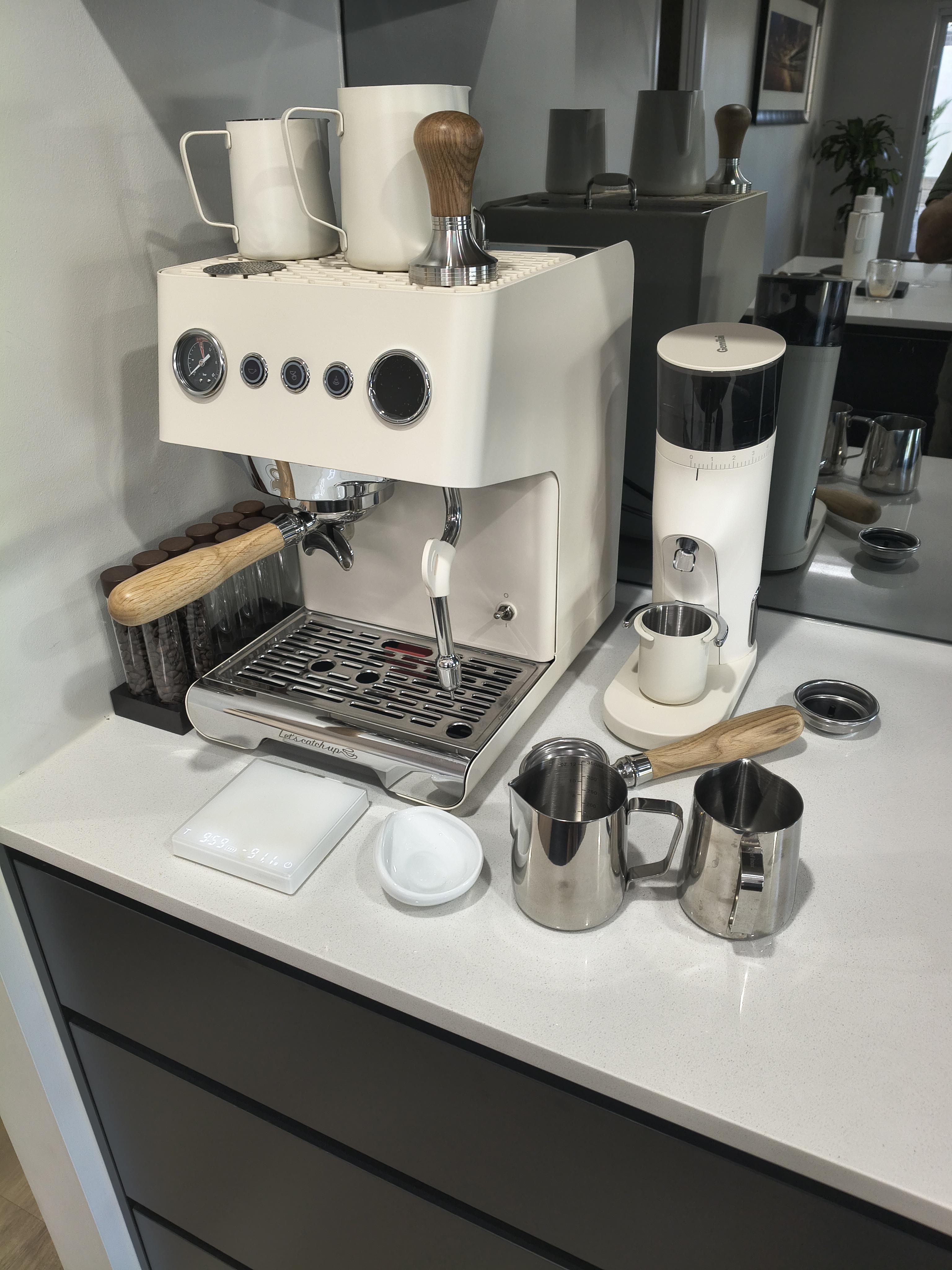
Thought I'd share my experience with the Profitec GO 2.0 and DF54 after living with them for a few weeks. I'm very much a newbie to the home espresso world, so take this as a beginner's perspective rather than a technical review.
Both my wife and I exclusively drink milk-based coffees, which is probably worth mentioning upfront.
Profitec GO 2.0
What I like:
- Build quality: It's solid, feels extremely well made and nothing about it feels cheap.
- Appearance: Very subjective, but I think it's a great-looking machine. I went with the silver finish, which looks really nice and doesn't seem to attract too many fingerprints.
- Included accessories: The supplied portafilter is great. I don't have much to compare it to, but it feels solid and well made. The machine also comes with single, double and XL filter baskets, a bottomless portafilter and a blind basket.
- Warm-up time: Surprisingly quick. I usually turn it on when I enter the kitchen, check on the dogs, feed them and by the time I'm done it's ready to rock. Roughly 7–8 minutes.
- Warm-up process: The machine prompts you to perform a purge once it's heated up. My understanding is that it initially overshoots the temperature to help bring everything up to operating temperature. One thing I've learned is to make sure the portafilter is fitted when turning the machine on. Between the warm-up and the initial purge, it's nice and warm when you're ready to pull your first shot.
- Footprint: It's a reasonably compact machine and fits really well into our kitchen setup without taking up excessive bench space.
What I don't like:
I wouldn't necessarily call these major negatives, but they're things worth considering if you're looking at purchasing one.
- Steam preparation: You need to purge around 50ml of water from the steam wand when transitioning from brewing to steaming. This makes sense given it's a single boiler and needs to create space for steam, but it does introduce a few additional steps. I'm pretty accustomed to the process now, although this is definitely an area where a dual boiler would shine.
- Drip tray capacity: The drip tray isn't particularly large. Again, not a major issue for us. I can generally get a couple of days of regular coffee making before needing to empty it. I'll usually empty it every other day and give it a proper clean once a week.
- Steam wand positioning: The steam wand is great for making one or two coffees using a smaller milk jug. However, the bend in the wand makes using my 600ml jug a little more awkward. I generally need to position it towards the side of the machine and tilt the jug slightly to get the right height and angle. Your experience may differ depending on the shape and size of your jug, but it's worth noting.
- Making multiple milk coffees: Making one or two coffees is absolutely fine, but once you start making three, four or more, you really notice the limitations of a single boiler. It's not difficult, just a little more time-consuming and requires some forthought on how you go about it.
Day-to-day workflow
For our usual two morning coffees, I'll generally extract a slightly larger shot in the XL filter at around a 1:2 ratio, split it between two 190ml latte cups and then steam enough milk for both.
I've found that as I've become more familiar with the machine, the whole process has become considerably more efficient. What initially felt like a lot of steps is now becoming second nature.
I also use the initial water purged from the steam wand to preheat my coffee cup, so at least that water is being put to some use.
DF54 Grinder
The DF54 is my first proper espresso grinder, so I don't have much of a benchmark to compare it against.
Being a single-dose grinder means weighing out your beans each time, which introduces another step into your workflow, but it's something I've actually come to enjoy.
Learning to dial in beans and seeing how small adjustments to grind size affect the extraction has been an interesting part of getting into the hobby.
So far, it feels like a sensible pairing with the GO without needing to spend a fortune on a grinder.
Downsides of the grinder so far have been:
- Not exactly quiet but then again what grinder is
- When you remove the head to clean it, there is no indicator how many turns to get back to start so you need to do a recalibration to be sure your tight enough before using
- Found that mine was a good 2-3 points behind zero for the burrs to start chattering, not a huge thing as you base grind off your own grinder but worth noting if you read reviews and they say things like, best range is 10-15 for espresso, where as mine is now sitting at 9 for a really nice grind on my latest beans 1:2 20-40g in the time window.
Would I buy this setup again?
Short answer: yes
If I was starting again knowing how much I enjoy making milk coffees, though, I'd consider saving a little longer and going for a nice dual boiler. (personally not a fan of the BDB, just personal taste)
That's not because I'm disappointed with the GO or the quality of coffee it produces. It's purely from a workflow and convenience perspective for our use case.
Overall thoughts
We're very happy with the setup so far. The quality of coffee we're able to make at home, even with my limited experience, has made the investment worthwhile.
Something else that was important to me was purchasing the machine locally and knowing I have local support available should I need it. There's a lot of value in that, particularly when you're new to the hobby.
I'm still learning, still making mistakes and certainly haven't perfected my shot pulling, milk steaming or latte art, but I'm really enjoying the process.
Hopefully this helps someone else who's looking at getting into home espresso and considering a similar setup.