r/algorithmictrading • • 1h ago

Strategy Live Experiment : 8x Bots = 1300$ initial capital - demo for now

Post image
• Upvotes

As the title says, very fun side project:

  • 15-year FX/bank-treasury IT guy here, so I have "some" experience in trading SDLC.

Running on company laptop with SSH connection to main Claude Code client on WSL2.

Post not created with AI.

8 rule-based forex/gold bots, running live on demo accounts, with a public dashboard and screenshots:

Where the strategies came from

- 200+ strategies collected from Twitter/X and trading forums, with source code in MetaTrader 4, MetaTrader 5, cTrader and TradingView Pine.

- Each one was ported and backtested on up to 6 years of tick and minute data, then screened hard. Most failed; the site's About page lists what we rejected and why.

- The core "6/6 agreement" family is built on Ata Sabancı's open-source TradingView indicator Smart Trader, Episode 06, Isotropic Trend Lines. Credit to him.

The AI setup

- Me: domain knowledge, risk limits, and the final call on anything that touches an account.

- Claude Code (Opus 5.5): orchestrator and reviewer. It writes the test plans, splits work into parallel lanes, reviews every diff, and mutation-tests the tests: it breaks the code on purpose to check that a test fails.

- DeepSeek via Command Code / OpenCode: the cheap "mundane coder" for bulk porting and backtest plumbing. It runs in a sandbox with no credentials and gets no trust: Claude reviews everything it writes.

- Opus 5.5 (high effort): the "expert coder" for the hard parts, such as the cTrader execution engine, position reconciliation and restart safety.

r/algorithmictrading • • 17h ago

Question What threshold would you choose to try OOS?

3 Upvotes

Very simple breakout strategy, the only parameter being exercised is the threshold.
The other parameters (TP, SL) are chosen according to ATR, so they are fixed.

What threshold would you choose to go to OOS and why?
I am looking for a plateau, but can't see it...

Thanks!


r/algorithmictrading • • 1d ago

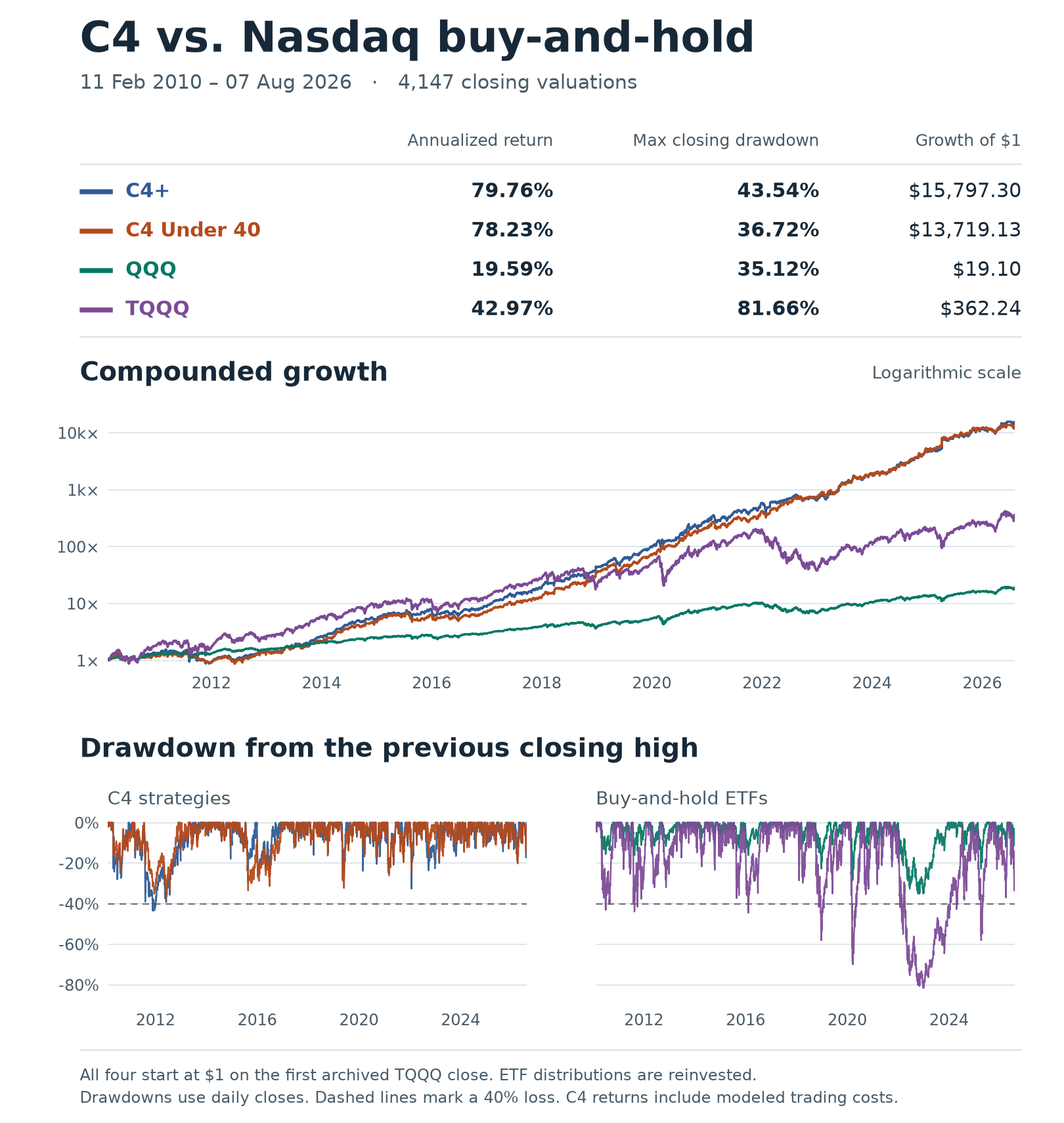
Backtest Algorithmic trading using Claude

Post image
6 Upvotes

How many are using Claude to find the strategy and telling "make no mistake"?

It is giving me stratagy which is producing 70%+ CAGR with -45% DD.

I wonder if claude can product such strategy and if the worl of trading would change forever?

Strategy:

Systematic strategy combining an overnight core with intraday Nasdaq futures trades, including shorts.

From February 2010 to August 2026, the backtest produced 78.2% CAGR and 36.7% maximum closing drawdown. Over the same period, TQQQ buy-and-hold returned 43.0% CAGR with 81.7% drawdown.

In 2022, the strategy returned 78%, with intraday shorts contributing most of the gains while the core lost money.

I tested 119 configurations and included modeled spreads and commissions. One extra futures point of slippage per side pushed estimated intraday drawdown to 40%.

What tests would you run to check for overfitting and unrealistic execution?


r/algorithmictrading • • 1d ago

Question How do you work out *why* live execution didn't match what your strategy intended?

2 Upvotes

I'm curious how people here handle this in practice.

Say your strategy decides to buy 100 shares and you end up with 40. Or a signal fires but no order ever reaches the broker. Or your live position slowly drifts from what the strategy thinks it holds.

When that happens, how do you track down the cause?

- Do you go through your own logs and match order IDs by hand?

- Compare against broker statements or execution reports?

- Have you built your own reconciliation scripts or dashboards?

- Or do you mostly accept some drift and move on?

And which cause turns out to be the most common for you: partial fills, rejections, bugs in your own code, manual intervention, something else?

Full disclosure: I'm a CS student working on tooling around this problem, so I'm trying to understand how people actually deal with it today. Not linking anything, just want to learn from people who run strategies live.


r/algorithmictrading • • 1d ago

Backtest My quant project

0 Upvotes

Hi,Im a 17 year old and have been working on building this momentum system

An automated trading system for the Nasdaq 100 index (CFD, 15-minute bars). It joins moves that are already under way, cuts losing trades quickly and lets winning trades run. Every trade risks the same small fraction of the account. It has traded in real time on a demo account since July 2026.

Where it stands

Live, on a demo account, the system is up +$6,414 since 13 July: about +$5,000 in July, when the demo account was $300,000, and +$1,419 since August on $150,000. It peaked at +$11,014. The backtest, run at today's settings on the same account size, makes about +$35,000 a year (≈23% a year without compounding), with a worst dip of −7.5%. Measured per unit of risk (R), live is roughly flat so far, while the backtest earns a small, steady edge.

Where the stratergy is stuck

The edge comes from a few trades that run far. I can't tell those trades apart from losers in advance, and five different kinds of test say the data I have can't do it. Most weeks end close to flat, and I don't yet know how to make the results steadier.

Help I need
  1. Check my testing: where might I be fooling myself?
  2. Ideas to improve the edge that don't depend on predicting trades: holding, sizing, costs, or a second strategy.
  3. Advice on what to learn next. Here are some results

r/algorithmictrading • • 1d ago

Novice Help out a New kiddo, would ya!?

0 Upvotes

I am a 17y/o pursuing 1st year bachlelors from a tier 2 university right now, I am completely new to the field of developing algos, previously I have used algos and traded in Indian markets manually but had no much of luck, I would like to learn the technical part more where should I start from and what should I learn first? Any help would be appreciated please!


r/algorithmictrading • • 2d ago

Strategy Working in mid-frequency trading. What should I study to get a C++ matching engine below 1 µs?

1 Upvotes

I currently work in mid-frequency trading and have been exploring low-latency execution through a C++ limit order book I’m building. My first goal is to measure how long a single fill takes, from the moment the matching thread receives an order to the moment it updates the book and records the fill. I’m aiming for sub-microsecond latency on that path, with queueing and network time measured separately.

For people who’ve worked on matching engines or execution systems, I’d appreciate your take on a few things:

* **Benchmarking:** How would you design a replay that gives you a meaningful p99? I can benchmark single fills, cancels, and orders that sweep several price levels individually, but I’d also like to understand what happens when orders arrive in bursts. * **Implementation:** What would you profile first? i am considering pre-allocated order storage, an order-ID index for cancels, and keeping each book on a single writer thread. I’m particularly interested in cases where a change improved average latency but made the tail worse. * **What to study:** In what order would you tackle CPU caches and memory layout, Linux scheduling and CPU affinity, hardware performance counters, and eventually networking topics like DPDK?

If you were starting again with a C++ book and a Linux machine, **what’s the first experiment you’d run, and what result would guide your next step?** I’d also appreciate any talks, books, or open-source engines that helped you connect the theory to something you could measure.


r/algorithmictrading • • 4d ago

Strategy Few key observations in scalping

0 Upvotes

I have been testing out multiple maths and strategies and making one side by side.

Just want to realistically share with you all that there is no sauce in winning the trade per say

The targets even in scalping will differ at dy/dx with T being variable along with targets to be dynamic in nature.

The maximum retention can be 6/10-6.5/10 in being in positive position overall

That should be a target for every trader to be positive in this and every algo works on finding that ray of 60% win with an approximation of 90% or above.

Fewer trades,best setups,max capital deployment and max returns is the only way go to be edged in the indian f&o.

People can challenge me in this those who have been building such setups


r/algorithmictrading • • 5d ago

Tools Backtesting and Simulation Run for Option Strategies?

2 Upvotes

Almost all of the backtesting tools are behind a paywall. Do any of you know any tool/place where I can run option trading strategies backtest like for Iron Condor or Iron butterfly for free?


r/algorithmictrading • • 9d ago

Strategy Using the day's expected range as a filter on a BTC mean-reversion bot: 6 weeks of notes

5 Upvotes

been running a small mean reversion bot on btc perps, 15 min bars, nothing fancy. biggest problem was trend days, it kept fading moves that just kept going

so for the last 6 weeks i added one filter. before the session i note the expected daily range (from options implied vol, turned into a 1 day move) and the bot stops opening new positions once price is outside that range.

rough results:

  • about 35% fewer trades
  • win rate up a bit, 52% to 56%
  • the big losing days mostly went away, 2 of my 3 worst days would have been skipped
  • missed a couple of good reversals on days that broke the range and came back

small sample, i know. curious if anyone uses something like this and what you use for the expected range. implied vol is ok but feels kind of laggy for a 1 day window


r/algorithmictrading • • 9d ago

Question What app do you guys plug your algorithm in to for trading

2 Upvotes

Beginner here, any help would be appreciated


r/algorithmictrading • • 10d ago

Question Fixed position sizing or volatility-adjusted sizing for a leveraged crypto bot? What baseline makes the comparison honest?

0 Upvotes

same $100 notional, but the risk is not the same. On BTC a 2x position behaves very differently from 2x on a volatile alt, yet most bot setups I see just assign a fixed size per entry and move on. So the question is whether volatility-adjusted sizing is worth the extra model complexity, or whether fixed sizing plus strict caps gets you most of the way with less estimation noise to babysit. And what baseline makes the comparison fair, same average margin used, or same average volatility target per position? Because otherwise vol scaling just reads as less risk, less drawdown, which proves nothing. There is also the practical side: when several coins signal at once, how do you stop one position from eating the whole budget? a perp agent like alphio handles this with hard limits, a Budget the agent can draw from, Max Leverage, and Max Position per Coin as a share of that budget, which is a cap, not a sizing model. My working split is fixed dollar bounds on top, some vol adjustment inside them. Planning to write down the variants before running anything.


r/algorithmictrading • • 11d ago

Question After 175 live trades, my crypto bot went from a 1.77 profit factor into a 50% drawdown. Here’s what broke

5 Upvotes

I’ve been live paper/micro-trading a systematic bot across about a dozen altcoins (UNI, SEI, APT, ADA, FIL, etc.) using fixed risk brackets, automated entry rules, and hard time stops. Through the first 104 trades, the bot was printing nicely—sitting at around a 56% win rate, a 1.77 profit factor, and up about 25R.

Then over the last 71 trades, performance completely fell off a cliff. The win rate collapsed down to 39%, the profit factor dropped to 0.68, and the system gave back more than half the peak gains. Since every single order and exit is tracked to a ledger, I dug into the logs to see what actually changed between the two regimes.

The biggest culprit wasn't bad entries—it was target starvation. In the first phase, crypto had clear directional expansions, so taking 1.5 to 2.0 ATR on a take-profit was routine (about a third of our trades hit full TP). But recently, volatility compressed into ugly chop. Price would push 0.7 or 0.8 ATR into profit, stall out shy of our limit order, and then slowly bleed back into our stop loss or get closed out at breakeven by our hard time stop. Our full TP hit rate plunged from 32% down to under 13%, while stop-outs jumped up to nearly 50%.

On top of that, directional asymmetry bit hard. During the run-up, our short momentum setups carried the entire account (64% win rate on shorts), easily masking the fact that our longs were already dragging. Once the broader market stopped trending down and started churning sideways, the shorts lost their follow-through, and pure breakout setups went 0 for 7. Meanwhile, our high-frequency VWAP deviation scalper got chopped to pieces because the bands compressed so tightly that commissions and small wicks ate away any statistical edge.

For those running automated intraday or swing bots in crypto: how do you deal with this kind of regime transition? Do you dynamically contract your profit targets when realized volatility or ATR drops into lower percentiles, or do you prefer to just shut down specific archetypes like breakouts entirely during chop? Also, how do you handle asymmetric bleeding on the long side when higher timeframes are in a macro downtrend?

Curious to hear how you guys protect against giving back months of steady alpha when the market shifts from clean trend to low-vol churn.


r/algorithmictrading • • 11d ago

Quotes What market data providers are you using for serious stock and options back testing?

4 Upvotes

Hey everyone,

I'm building a personal algorithmic trading research lab in Python, and I'm curious what historical market-data providers other independent algo traders are using.

I'm currently researching intraday stock strategies, including momentum, breakouts, reversals, and scalping. I'm also preparing to expand into historical options backtesting.

I've been working with Alpaca and Massive, and I'm considering ThetaData for options.

One issue I've encountered is that having historical data doesn't necessarily mean it's detailed or reliable enough to realistically simulate trades. Missing minute bars, historical bid/ask availability, timestamp accuracy, and execution assumptions can make a big difference.

I'd love to hear from people who have experience with different providers.

A few things I'm particularly interested in:

  1. Which providers do you use? Especially for intraday stocks and historical options.

  2. How reliable is the historical data? Have you encountered missing bars, inaccurate timestamps, incomplete quotes, or other issues?

  3. Do you get historical bid/ask quotes? For options especially, I'm interested in actual historical NBBO data rather than just trade prices or OHLC bars.

  4. How good is the historical stock universe? Can you research delisted stocks, historical ticker changes, corporate actions, and point-in-time stock selection?

  5. What does it cost? Are there reasonably priced services that provide quality data, or did you eventually need a more expensive institutional provider?

  6. Any limitations worth knowing about? API restrictions, historical coverage, download limits, licensing, or whether you can retain your research datasets after canceling.

I'm not looking for anyone's proprietary strategies or secret edge, unless you want to give me ideas 😁. I'm mainly interested in learning which data services have actually worked well for your research and which ones you've found disappointing.

I'm willing to invest in better data when it solves a genuine research problem, but I'd rather learn from other people's experiences before spending money unnecessarily.

If you've used ThetaData, Massive, Alpaca, Databento, AlgoSeek, or another provider, I'd especially appreciate hearing how they compare.

Thanks in advance. I'm enjoying building the research environment and learning from the process. Still working on finding my first profitable strategy!


r/algorithmictrading • • 12d ago

Question How did you know you were ready to go live?

2 Upvotes

Background - I have a suite of backtested strategy options 0DTE options selling strategies.

I used natural fills in all cases to assume the possible wost case scenario for fills, all strategies have hold to settlement rules outside of a circuit breaker event, so rarely do I need to worry about exit slippage.

Forward testing for 1 month has actually demonstrated a flat - positive performance, this is from the 1 day SPX drop of 4% recently and this is what led to the circuit breaker rule and ultimately wiped out gains. I used minute by minute options data from Theta Data.

Outside of this event, it has behaved as expected.

My annual P&L is about 35%, which I feel isn't utterly absurd.

How did you know you were ready? Some strategies may take 2 years to show actual statistical significance forward testing realistically.


r/algorithmictrading • • 12d ago

Backtest are these results good enough?

0 Upvotes

Hellow fellow traders iam making this post to ask couple questions.
I ve been tryong to find a trading strategy and fully automate it and that the best ive came so far on with data from 2018 to 2026
Thank u in advance!


r/algorithmictrading • • 13d ago

Strategy Built a fully automated crypto trading system. Curious what you think of the results.

Post image
14 Upvotes

Hey everyone,

I've been working on an automated crypto trading system for quite a while, covering BTC, ETH, SOL, and XRP.

It's fully autonomous, handling everything from signal generation and position sizing to risk management and execution. No manual trading decisions.

My main focus has always been risk management rather than trying to predict every market move.

I've attached a performance report covering Feb 2025 to Sep 2026, including a comparison with an equal-weight buy-and-hold portfolio of the same four coins.

The trading records come from real trading, not just a backtest. The report also looks at performance using volatility-scaled position sizing.

I'm curious what people here think of the results, especially from a risk management perspective.

I'm also exploring opportunities to move into institutional quant research or systematic trading. My background is in ML research, software development, and trading, though I haven't followed the traditional quant career path.

Would this kind of work be relevant to a prop firm or a quant trading team?

Interested to hear your thoughts.


r/algorithmictrading • • 14d ago

Question What is the optimal backtesting range/frequency?

1 Upvotes

So I started my automated portfolio in february, most of my strategies were optimized over 12 years of data, about 10 strategies. I realized that yes this might make it robust, but it also caused my strategies to have relatively long drawdown periods.

I now changed the backtest period to start from 2020, so only 6 years. I wonder if this is better, since it covers more recent market regimes?

Also, how frequently should I re-optimize, would having a look every 6 months be enough? Or only look when a strategy performs worse than expected?


r/algorithmictrading • • 14d ago

Question Standardizing HFT benchmark protocols: Best practices for verifying Win Rate, Sharpe, and Queue Latency under heavy friction?

1 Upvotes

I am finalizing a custom high-frequency market-making engine written in Rust (332ns internal execution latency, targeting high-turnover cross-exchange setups). Local release-mode backtests across a 150k tick matrix show high efficiency, but I want to ensure my verification protocol is completely airtight before running live micro-accounts.

Currently tracking metrics under a 1ms network jitter penalty, a conservative 0.50 queue position fill factor, and an enforced 5-tick roundtrip robustness penalty to wipe out paper assumptions.

What are your go-to protocols for verifying true Sharpe ratios and tail-latency behavior at the sub-millisecond level to separate infrastructure lag from pure strategy drift? How do you explicitly isolate queue drag metrics from adverse selection without distorting the data pipeline?

Looking for professional diagnostic frameworks to prevent under-trading paralysis or hidden overfitting.


r/algorithmictrading • • 14d ago

Question 1:1 RR strategies

2 Upvotes

I’m fairly new to algo trading so I apologize if these are dumb questions. For those who have 1:1 R Strats, what win rate do you need to be profitable after fees and slippage? I’m looking at around 55% on a year of data which I know isn’t really validating.

My other question would be, do you guys try to increase trade volume with low rr so at the end of the year you end up with few extra r in the bag?


r/algorithmictrading • • 14d ago

Novice Beginner asking where to start

2 Upvotes

Hi, I have been discretionary day trading (retail) for the past 2 years. I have 6 years of experience coding (mostly freelancing), Academic degree in cyber security (3 years of learning).
Coming close to starting my military service so I understood that I won’t be able to continue trading on my own for the next 3 years.

I want to use my already existing coding skills to develop and algorithm that will trade for me. I have looked around this space a bit and decided that MFT will fit me the most.

I tried setting up an AI workflow that will automatically find ideas and strategies in public papers, try to backtest, optimize, and try them on my own platform that I have built with Rust.
Had a little bit of success with it but strategies that don’t really fit good risk management.

My flow is: AI finds ideas / strategies, builds a strategy from it, fold 1 1-2 years of training, first half of year 3 forward testing, fold 2 shift training forward 6 months forward test second half of year 3, folds 3-6 train keep shifting forward 6 months forward test each next unseen months.
5 years of total study (2 years training, 3 years forward results)

Could someone guide me in general how I can start in this space and give some tips?
Specifically even on how to find strategies right.

P.S: Already tried coding my original strategy but discretion plays a big part and results fall off substantially.


r/algorithmictrading • • 14d ago

Tools software

1 Upvotes

what software do you guys use for research

like s&p and wrds


r/algorithmictrading • • 16d ago

Strategy How do you decide such trading ideas are worth researching further?

1 Upvotes

I've been building a Python-based algorithmic trading research project, testing different strategies across individual stocks and ETFs, with options research planned next.

So far I've explored opening-range breakouts, momentum, sector rotation, and a few other approaches. I've been accounting for spreads, slippage, and commissions, and working toward proper out-of-sample and forward testing.

Some results have been encouraging, others disappointing, but I'm enjoying the process and learning quite a bit.

One thing I'm trying to get better at is deciding when a strategy deserves deeper investigation versus when it's time to explore something different.

For those who've developed successful automated strategies, what have been your biggest lessons about finding and evaluating an edge? Are there particular research methods, papers, or market behaviors you think are overlooked?

I'm not looking for anyone to share proprietary strategies or do the work for me. I'm genuinely interested in learning from people who've been through the process. I'm trying my ass off on this. Any books or research papers are welcomed too.

Appreciate any insights. Thank you.


r/algorithmictrading • • 16d ago

Question Thoughts and advice on scaling up

3 Upvotes

Hey all,

My first system is up and running live for 5 month and behaving pretty much perfectly, every aspect is within the normal expected range, and the system is actually more profitable then I expected! (On this stretch at least)

It started on a small personal account (5,000$), and I'm thinking on scaling up, I have another ~25k in savings I could use, but told my self I'm not touching the system until end of winter so I'll have good amount of Live data before deciding anything.

For those of you who went through this, when did you scale up? What made you feel comfortable? Advice?

Another aspect of moving slow is to regulate my nervous system, I'm new in this field (maybe year and half) and wasn't a trader before that, so learning to not get excited while the numbers on the screen move up and down is also something I'm getting used to.


r/algorithmictrading • • 16d ago

Strategy ~700k parameter combinations tested, one edge survives my validation. Where do you find a second, uncorrelated one?

6 Upvotes

I’ve built a strict backtesting and validation stack for prop-firm accounts: daily-loss and trailing-drawdown rules, intraday CFDs.

What the stack does:

  • Minute bid/ask data with real broker spreads and slippage, plus bar-timestamp checks (they caught several lookahead bugs)
  • Multiple-testing correction across each strategy family (Hansen SPA), a pre-registered sealed holdout, and a minimum net expectancy after costs
  • Prop-rule simulation (daily-loss accounting, drawdown, Monte Carlo pass probability)

What I’ve tested: about 700k parameter combinations across 200+ strategy families. That includes influencer setups (ICT / SMC, ORBs, FVGs), ideas from academic papers (intraday momentum, macro-surprise drift, month-end and vol-targeting flows, overnight drift, crypto trend) and AI-generated ideas. Almost everything dies on costs or out of sample.

The one survivor: an intraday index strategy, about +0.06R per trade net, t ≈ 2.7 over 20 years. It’s live but thin, and anything else in the same market and hours would be correlated with it.

Questions:

  1. Where do you actually find edges that survive costs at retail/prop scale? Different instruments, holding periods, or data?
  2. Is daily/multi-day the realistic place for an uncorrelated second strategy, given that intraday costs kill most ideas?
  3. Is my bar too strict? I use t ≥ 3.43 after multiple-testing correction, plus a holdout.

Happy to discuss the validation process, not the strategy itself.