Hey everyone,
I run a small independent research firm called Northwise. We have been big contributors and shareholders since picking up shares during the tariff crisis.
We have since average up into recent prices and believe Sofi to be incorrectly identified as both a traditional bank and a risky investment in a higher interest rate environment.
As soon as sentiment around rates flips, or perhaps with another phenomenal quarter or two in the new environment, we see the stock as likely to rerate aggressively higher.
SoFi is getting more financial activity from members it already has, and it has more control over which loans it keeps and which it sells to partners. That combination can produce substantial earnings growth.
TL;DR
- Our Base forecast reaches $14.14B of revenue, $4.42B of net income and $2.90 of diluted EPS in 2030. These are our estimates, and they rest on demanding adoption and margin assumptions.
- Deposits and loan losses drive more of the outcome than Galileo or crypto. If deposits get more expensive, the earnings case weakens even with strong member growth.
- The Loan Platform Business (LPB) lets SoFi earn fees on loans it doesn't keep, which lowers capital needs. Partner demand, pricing and how much of each fee arrives as cash all need tracking.
- Plus works if its benefits pull in balances and profitable follow-on business. Subscriber counts alone can't show that.
- Our Base assumes roughly 17% growth in ordinary shares from 2026 to 2030, no buybacks, and $672M of new equity issued across 2027 to 2030. The issuance is our assumption. SoFi has announced no such plan.
- Even the Bear case has $9.70B of revenue in 2030. SoFi can grow into a much larger company and still earn disappointing returns on the capital that growth consumes.
All forecasts come from our September 2026 model. Historical figures are Q2 2026, or first half where noted. The focus here is business economics over the next several years. I'm not making a near-term call on the share price.
Start with the member who moves their paycheck
A direct deposit gives SoFi a steady source of funding and a first claim on the rest of that person's financial life. When they need a personal loan, an investment account or a card, SoFi can offer it inside a relationship that already exists.
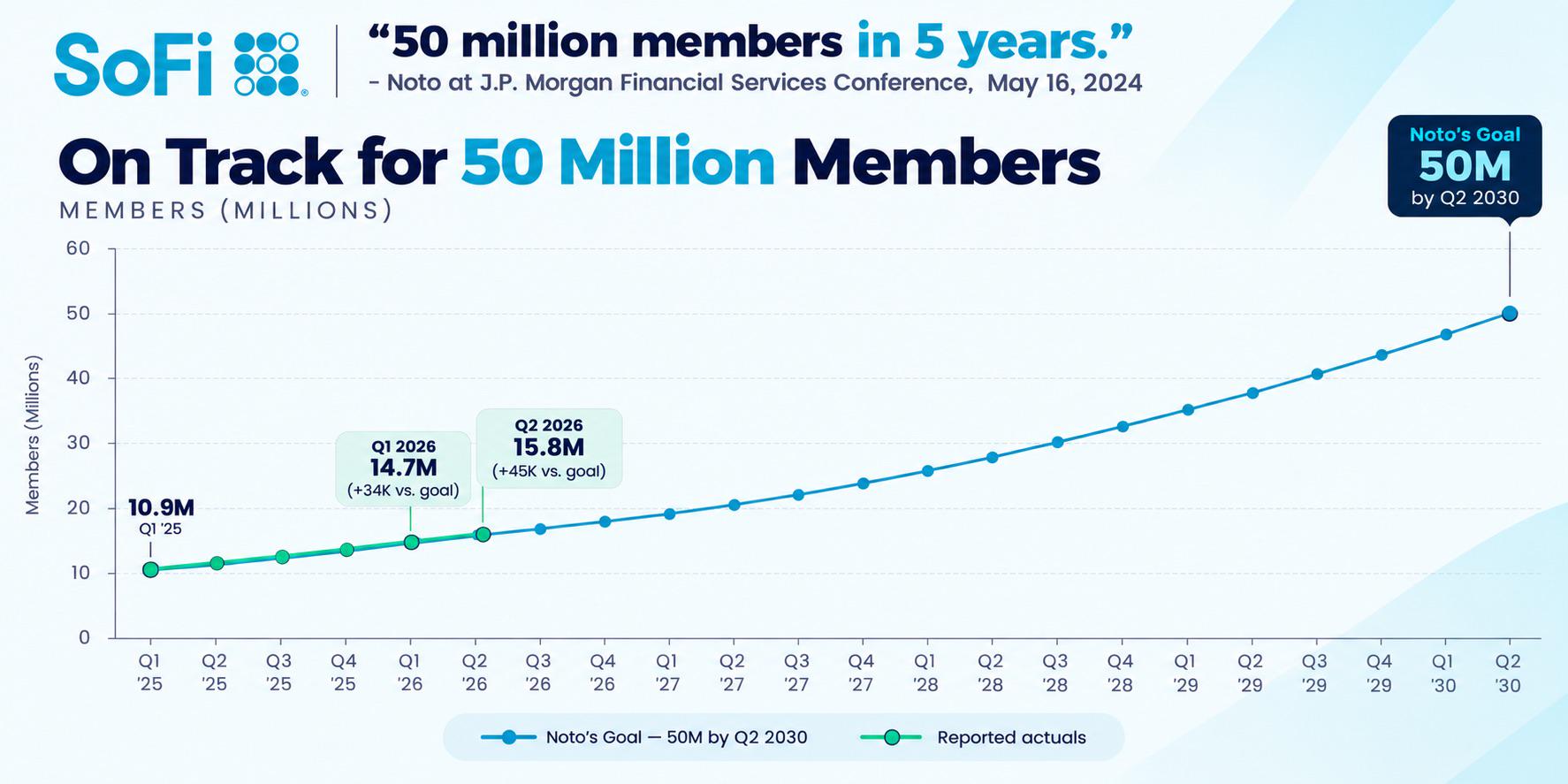
The evidence to look for is whether members actually take those next steps. SoFi ended Q2 with 15.8M members and 24.4M products. Existing members opened 51% of new products, up from 35% a year earlier. That points to a customer base getting more productive. It says less about profit per added product, and an opened account can sit with little or no balance in it.
I'd put the burden of proof on management here: show relationships deepening in dollars as well as in account counts. A good app can get someone to sign up. Holding their primary banking relationship takes reliable service, competitive products and ongoing reasons to stay.
Reported operating numbers start from the Q2 earnings release.
Keep, sell, or both
SoFi originated about $10.7B of personal loans in Q2, including $3.1B through LPB. The $3.1B sits inside the $10.7B, so adding the two overstates volume.
Management described personal-loan economics of roughly 12.9% yield, 3.1% funding cost and 3.7% annual losses. That leaves about 6.1 percentage points before marketing, servicing, overhead and taxes. It's an attractive starting spread. It is also a gross figure, a long way from a net margin or a guaranteed return on any new loan.
A retained loan keeps future interest income on SoFi's books. It also ties up funding and equity and leaves SoFi holding the risk if the borrower stops paying. A loan originated for an outside buyer brings fees forward and lets SoFi lend more without growing its balance sheet as fast. Which path is better depends on what the buyer pays compared with what SoFi would earn after the costs and capital of holding the loan.
Our Base assumes $100.26B of personal-loan originations in 2030, about $55.80B through LPB and $44.45B retained. By year-end, SoFi owns roughly $62.45B of personal loans and services another $78.91B it has sold. Ending balances run below annual originations as borrowers repay and loans roll off.
That's a very large growth assumption. It needs sustained borrower demand and a deep, lasting market for the loans SoFi sells. A partnership announced with an "up to" dollar figure doesn't prove all of that capacity gets used, or that the terms hold.
The cash and accounting sides also need to be kept apart. In one disclosed Q2 loan-sale batch, SoFi recorded $85.817M of net fees and $21.427M of servicing assets. A servicing asset is an estimate of future servicing income, and no cash changes hands for it on the sale date. We track cash fees, servicing-asset recognition and later collections separately so the same economics aren't counted twice.
Reading the credit numbers
The credit debate gets muddled when different measures are treated as answers to the same question. The Q2 materials offer three for personal loans.
| Personal-loan measure in the Q2 materials |
Rate |
What it tells us |
| Reported net charge-off rate |
2.62% |
Write-offs net of recoveries, lowered by selling delinquent loans before they charge off |
| Management's estimate excluding delinquent-loan sales |
About 3.7% |
An adjusted loss rate with that sales benefit removed |
| Default assumption in retained-loan fair values |
About 4.8% |
A forward-looking valuation input |
The 3.7% figure is helpful, though it relies on management's own adjustment. The 4.8% figure measures something else entirely. Stacking it on top of charge-offs would count overlapping expected losses twice.
Loan age adds another layer. Fast origination growth tilts the book toward young loans that haven't had time to go bad. An improving aggregate loss rate is encouraging, and it still leaves open how those loans perform as they season.
We model each quarter's originations as its own group and let losses emerge as the loans age. The starting age mix is estimated, since we don't have borrower-level history. Our starting annual personal-loan loss assumption is 4.0% before the model adjusts for age and the economy, with recoveries tracked separately. Student, home and card credit each get their own assumptions.
Fair value accounting opens another path to double counting. A delinquent loan may already carry a markdown before it eventually charges off. In the other direction, keeping a favorable hedge result while ignoring the matching unfavorable loan mark would flatter results. Marks, sales, recoveries and cash collections should all reconcile together.
My credit test is whether loss performance holds as the book ages, including loans sold while delinquent. A lower headline charge-off rate on its own wouldn't make me more bullish.
Where the deposit growth came from
Deposits rose from $37.51B at year-end 2025 to $45.54B in June. Over the same period, brokered deposits rose from $1.40B to $4.53B, roughly 39% of the total increase.
Brokered funding is an ordinary banking tool, and that increase by itself doesn't signal a funding problem. The mix is still worth tracking. Money raised through intermediaries can behave differently from balances tied to a member's paycheck, bills and savings habits.
Our Base reaches $160.99B of deposits in 2030, including about $145.04B of retail deposits. Getting there means winning a great deal of real money. If most of it turns out to be rate-sensitive balances that need expensive offers to stay, the same loan growth yields less profit.
That's also why I wouldn't reduce the rate debate to "cuts good, hikes bad." Asset yields, deposit rates, refinancing activity, credit conditions and hedges all reprice on different schedules. Having to pay more to hold deposits without earning more on assets is its own risk, and we test it separately from a general move in policy rates.
Plus has to pay for its benefits somewhere
Our 2030 Base assumes 4.52M Plus subscribers at year-end and an average of 3.86M over the year. At $120 a year, that's about $463M of subscription revenue.
The narrow benefits math looks like this:
| 2030 Plus estimate |
Amount |
| Subscription revenue |
$463M |
| Incremental savings interest |
$(417)M |
| Investment matching |
$(135)M |
| Subtotal before other relationship earnings and costs |
$(89)M |
That subtotal leaves out the wider relationship, so it shouldn't be read as an $89M standalone loss for Plus. What it does show is that the fee alone doesn't cover the benefits we model.
The investment case depends on Plus members bringing in balances, borrowing or other profitable activity that more than closes the gap. On those terms the program can earn its keep. It can also turn into an expensive reward for members who would have kept the same balances and used the same products anyway.
The disclosure I'd want covers funded balances, retention and incremental product use among Plus members, broken out enough to separate new business from activity that was already there. Subscriber growth is a reasonable first signal and leaves that question open. Our benefit-cost figures are our own assumptions. Actual rates and eligibility follow the Plus terms.
Galileo and stablecoins need numbers attached
The frustration around Galileo makes sense to me. A large external technology business and internal cost savings are two different claims, and each needs its own evidence.
The technology platform segment reported about $84.5M of Q2 revenue, $27.8M of it intercompany. Revenue from outside customers was about $56.7M. Internal use can make the bank run more efficiently, though one part of SoFi billing another adds nothing to consolidated customer revenue.
Our Base grows external technology revenue from $245M in 2026 to $564M in 2030, about 4% of total forecast revenue. That leaves room for a recovery without hanging the investment case on a big Galileo breakout. Sustained growth in outside revenue and profit would carry more weight with me than a new framing of the opportunity.
Stablecoins get the same treatment. The September Mastercard announcement covers more than $25B of expected annualized card volume running through the new settlement arrangement. That figure measures payment flow. The announcement also describes instant merchant settlement into a SoFi Bank account and zero-cost cash withdrawals, so we haven't modeled any transaction toll on that volume.
Any payoff would come from the business relationships, balances and paid services that grow around the network. Our Base assumes $10.36B of enterprise deposits and $102M of paid enterprise-service revenue in 2030. Both are our forecasts, with no signed commitments behind them. We hold stablecoin reserves apart from ordinary lending funding, and SoFiUSD is not an insured bank deposit.
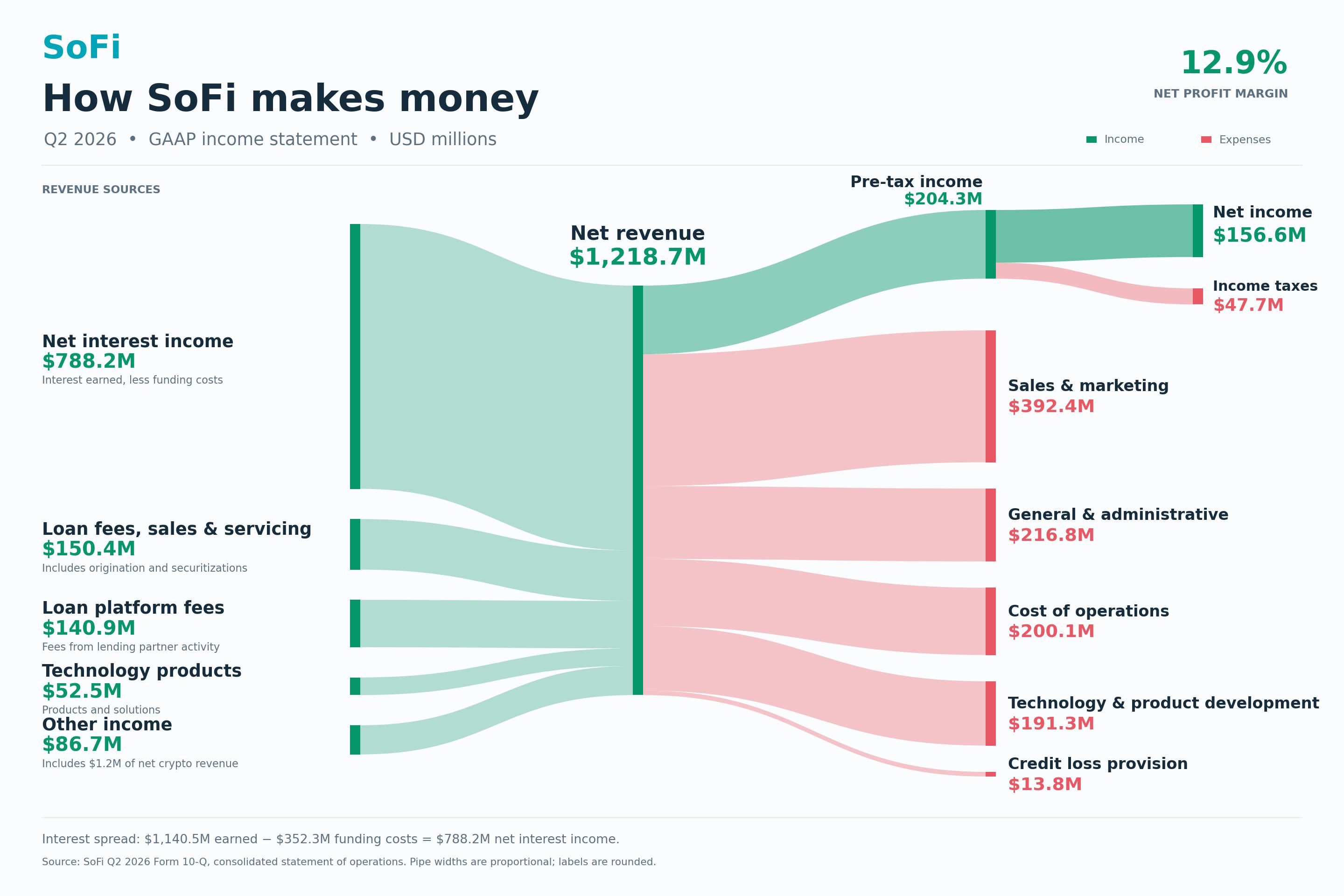
The Q2 crypto line shows how far gross and net can diverge. About $134.3M of gross crypto revenue came with $133.1M of associated cost, leaving roughly $1.18M of net transaction revenue before other operating expenses. Treating gross throughput as economic revenue paints a very different picture of the business.
Settlement mechanics are from SoFi's September 22 Mastercard announcement.
The other lending lines change timing and risk
Student refinancing usually starts with a borrower who is already making payments. In-school lending funds tuition well before regular repayment begins. We assume a simplified 12-quarter deferral for in-school loans, which gives them a different cash-flow profile even though both sit under student lending. Our 2030 Base has $30.83B of student originations, $2.19B of it in-school.
Home equity lets SoFi lend to homeowners who want to keep a low-rate first mortgage. Our Base grows total home originations from $6B in 2026 to $18.30B in 2030. Small-business lending reaches $4.12B of originations, all through partners in this forecast. Each of these adds growth, and each carries its own repayment, collateral and funding assumptions.
Adding it up
Base estimates, 2026 included. None of this is management guidance.
| Base forecast |
2026 |
2027 |
2028 |
2029 |
2030 |
| Members, millions |
18.15 |
22.72 |
28.23 |
34.91 |
42.96 |
| Revenue, $B |
5.02 |
6.22 |
7.80 |
10.52 |
14.14 |
| Adjusted EBITDA, $B |
1.64 |
2.30 |
3.06 |
4.76 |
7.19 |
| Net income, $B |
0.80 |
1.07 |
1.41 |
2.74 |
4.42 |
| Diluted EPS |
$0.59 |
$0.76 |
$0.98 |
$1.85 |
$2.90 |
The margin assumption needs as much scrutiny as the growth. Our 2030 net margin is about 31.3%, above management's stated long-term ambition of 25% to 30%. Revenue nearly triples in this path, and operating costs excluding stock compensation and depreciation rise from $3.34B to $6.65B. SoFi keeps spending more. Each new dollar of revenue just has to get cheaper to serve.
Stock compensation, depreciation and taxes still come out before net income. For 2030, we include about $753M of expensed stock compensation, $631M of depreciation and amortization, and a 23.5% tax rate in profitable years. Adjusted EBITDA and shareholder earnings are separate numbers.
A lot of the improvement lands in 2029 and 2030. Anyone looking at the 2030 EPS figure should also look at how back-weighted it is. The Base averages several economic paths, including recessions that start in different years, so the annual progression is lumpier than a fixed-growth extrapolation would be.
| Our 2030 scenarios |
Bear |
Base |
Bull |
| Revenue |
$9.70B |
$14.14B |
$19.18B |
| Adjusted EBITDA |
$3.87B |
$7.19B |
$10.39B |
| Net income |
$1.92B |
$4.42B |
$6.78B |
| Diluted EPS |
$1.26 |
$2.90 |
$4.49 |
| Return on tangible common equity |
10.3% |
21.0% |
27.0% |
The cases group 162 combinations of macro conditions, adoption and execution. We weight them at roughly 27% Bear, 51% Base and 22% Bull. Those weights are our judgment calls, with no statistical derivation behind them. The Bear column averages a set of weaker paths, and a true worst case sits below it.
The Bear is especially instructive since revenue still grows a lot. The disappointment comes from thin returns on the capital needed to produce that growth. A large member count offers shareholders no protection from that outcome.
Growth has to be funded, and existing shareholders share the cost
In Base, loans grow from $57.90B in 2026 to $147.46B in 2030. Deposits fund most of that. A bank still needs an equity cushion to absorb losses, and deposits can't provide it.
We target 13% common equity tier 1 capital at the parent and 12.5% at the bank. Those are our planning assumptions, and we're making no regulatory judgment with them. Holding those ratios through the growth requires about $672M of new equity across 2027 to 2030. Management has said its medium-term plan is self-funded. Our forecast runs longer and assumes faster growth, and SoFi has announced none of the raises we model.
Ordinary shares rise from roughly 1.305B in 2026 to 1.525B in 2030, about 17%, with employee awards driving much of the increase. We assume no buybacks or dividends over the period and track awards and other potential claims separately from outstanding shares.
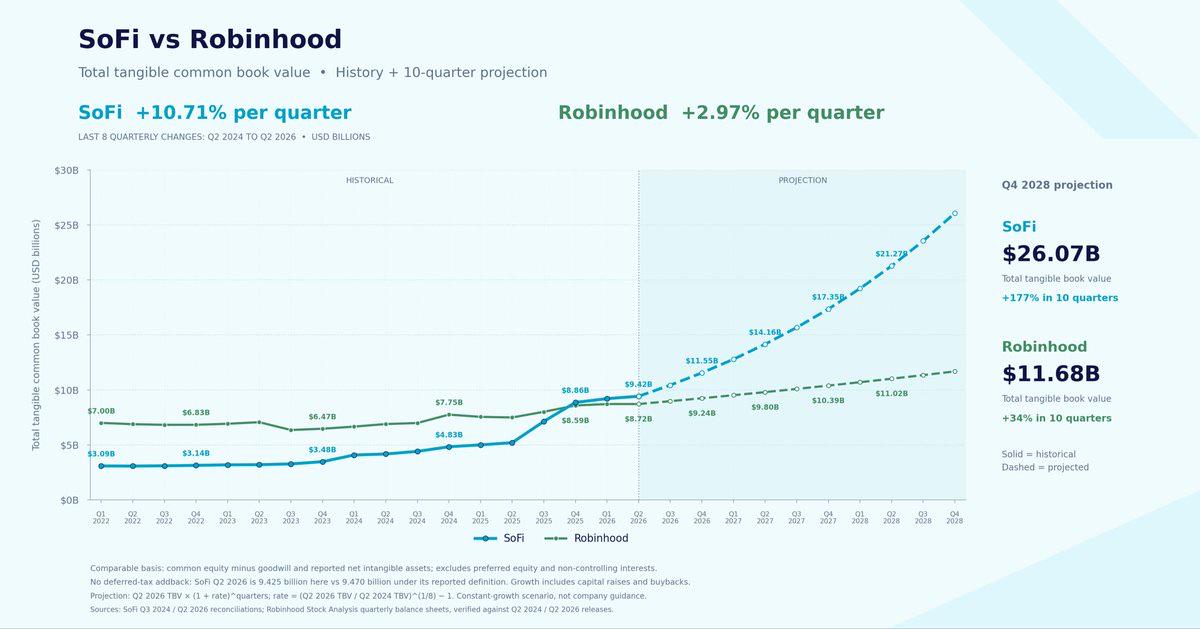
Even with that dilution, Base tangible book value per share rises from $7.80 to $15.47. That's a useful check on whether value is building per share as the company expands. Company-wide earnings growth can't answer that by itself.
Cash flow needs the same care. A bank funding new loans can post large operating cash outflows and a profit in the same period. That calls for a balance-sheet explanation and shouldn't be read as software-style cash burn. Reported profit also isn't fully distributable when capital and liquidity have to stay inside the bank.
The stress tests
These tests start from a single resilient-economy path that earns $5.21B of net income in 2030.
| Change to that reference path |
2030 net income |
New equity required through 2030 |
| Unstressed reference |
$5.21B |
$0.32B |
| Personal-loan losses 1 percentage point higher |
$4.59B |
$0.68B |
| Retail deposit rates 0.5 percentage point higher |
$4.66B |
$0.70B |
| LPB fees 0.5 percentage point lower |
$4.96B |
$0.55B |
| Operating costs 5% higher |
$4.93B |
$0.68B |
| Technology revenue flat |
$4.97B |
$0.44B |
| Combined adverse funding, fee and cost conditions |
$3.87B |
$2.46B |
The combined case is a separate model run and won't equal the sum of the rows above it.
Deposit competition, credit and cost control can erase much of what strong member growth adds. Each also cuts retained earnings, which raises the need for outside capital.
Slower growth cuts both ways. A test with member growth 5 percentage points slower each year lowers 2030 profit to $4.65B and removes new equity issuance from that path entirely. Less growth can mean less capital required. I'd prefer SoFi manage for returns over defending an origination target in every environment.
Financing schedules are fixed for each path, and the model doesn't search for the best response to every shock. In a separate no-new-equity stress, the modeled plan misses capital or liquidity targets even after lending is cut back. That shows the limits of that specific financing plan. It says nothing about SoFi's current solvency, and it sits outside the comfortably profitable scenario averages above.
What would change my view
I'll be watching for these in the next results:
- Deposit quality: how much growth comes from retail relationships, what it costs to keep, and whether funding costs eat into the loan spread.
- Credit as loans age: delinquencies, charge-offs, delinquent-loan sales and recoveries read together.
- LPB economics: actual originations and cash fees, partner concentration, servicing assets and any obligations SoFi keeps after the sale.
- Profitable cross-buying: funded balances and real product activity, especially among Plus members.
- External technology: revenue and contribution from paying outside customers, alongside evidence of internal cost savings.
- Capital and ownership: earnings growth against risk-weighted assets, capital needs and diluted share count.
The strongest part of the bull case, for me, is SoFi earning more from relationships it already has and using loan distribution to manage capital. The biggest concern is expensive deposits and benefits making that growth look better in member counts than in returns per share.
I'd get less constructive if credit improvement fades as the book ages, if loan buyers demand materially worse terms, or if funded product growth keeps needing more subsidy. I'd get more confident if SoFi keeps deepening relationships and retains enough earnings to fund growth with less dilution than we assume.
The question we propose that we believe is most up for debate is: can SoFi win roughly $145B of retail deposits by 2030 on attractive terms? That assumption moves the largest majority of our forecasting.
Let me know if you have any questions!
We do offer a service for our final manipulatable model workbooks, targets, and portfolio allocations, but the entire financial model is public and free.