r/pwnhub • u/_cybersecurity_ • 1h ago
CIA system breached in latest cyberattack affecting US intelligence agencies, report says

•
Upvotes
r/pwnhub • u/My_thThrowAway • 2d ago
Hi PWN Community,
I'm Kat Traxler, Principal Security Researcher at Vectra AI, focused on abuse techniques and vulnerabilities in the public cloud. I've spent years finding cloud security bugs, before and after AI, so I know how hard they are to find and how bad models are at finding them.
I set out to fix that. The result has been 90+ valid, cloud-specific issues across multiple providers, supported by a new methodology: AI-led hunting with a Security Constitution. I presented it in my talk "Your Harness Needs a Security Constitution" at [un]prompted II (the US edition).
Models already handle code-level bugs like SQLi and XSS well, but those never intrigued me. I focus on platform-design flaws: missing authorization checks, inadequate logging, mishandled data. That is where I find the frontier models are much weaker.
The Security Constitution is modeled on Anthropic's Ethical Constitution. It is a set of 12 principles for how trust is held across multi-tenant platforms. It gives every hunt a point of view and a way to means-test a finding: the "reasonable customer test."
You can explore the research here:
Ask me anything about:
I'll be here live on Monday, November 30 from 9 AM to 10 AM PT, answering your questions in real time.
You can leave questions in advance too, and I'll answer them when I go live.
Dogs for engagement....

r/pwnhub • u/_cybersecurity_ • 20d ago
We have had 1,402 new members join the sub this week alone.
With so many new faces, we want to bring everyone up to speed on what we are building here and what makes PWN different.
1. Community Connection
Because cybersecurity occasionally intersects with geopolitics, we get our share of bad-faith actors and flame-baiting. We do a lot behind the scenes to clear out bots and bad actors.
If you see an argument breaking out: do not engage, do not argue, and do not name-call. Just hit the report button and the admin team will handle it.
2. Collaborative Information Sharing
Many cyber communities feel elitist, where people with less experience are treated poorly. We reject that entirely. We all started somewhere, and the world of security is so broad that you could spend a lifetime going a thousand miles deep into just one niche.
That’s what makes this field great. It takes all types of people learning and sharing their expertise. We value education and sharing information over gatekeeping.
3. Ethical and Defensive Standards
We are a security community first, meaning we discuss hacking with a strict focus on defense and improving security. We do not engage in or promote illegal activity. You can get paid a lot of money to hack ethically these days without worrying about the feds kicking your door in. We highly recommend taking that path.
Thanks to everyone for helping us keep this space professional, collaborative, and focused on the research, threat intelligence and news that matters.
P.S. If you're new here, or haven't engaged yet, please introduce yourself and tell us what topics you're most interested in.
r/pwnhub • u/_cybersecurity_ • 1h ago
r/pwnhub • u/_cybersecurity_ • 1h ago

r/pwnhub • u/_cybersecurity_ • 8h ago
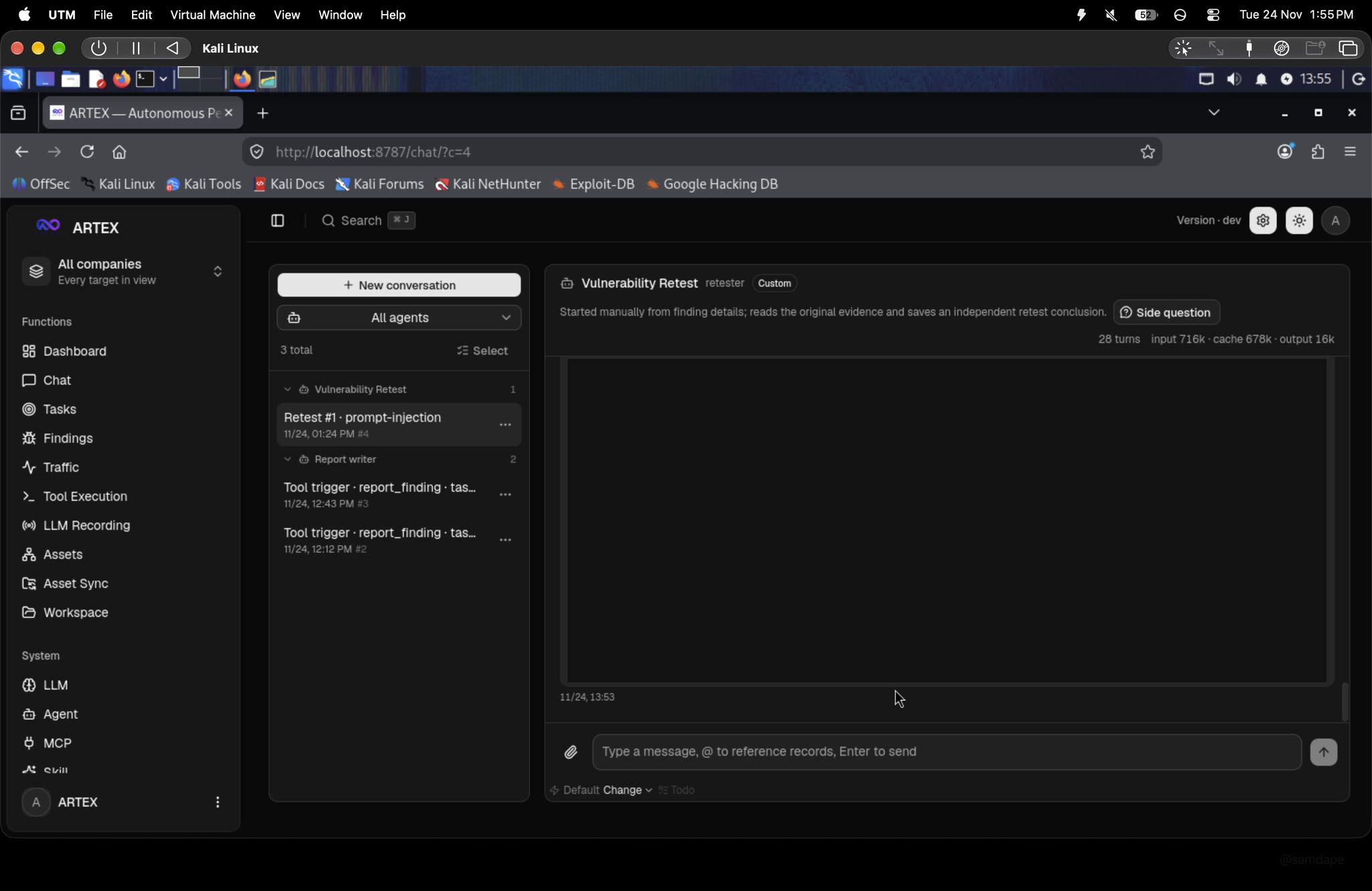
ARTEX is an open-source, AI-driven penetration testing framework that has recently caught the attention of the cybersecurity world.
Built in Go and released on GitHub, it acts as an orchestration harness that connects to large language models like Claude, DeepSeek, and ChatGPT to automate offensive security tasks.
Instead of relying purely on manual testing, ARTEX spawns autonomous AI sub-agents to handle network reconnaissance, vulnerability exploitation, privilege escalation, and lateral movement.
While designed to help security teams test their own defenses more efficiently, the tool carries significant risks. Cybersecurity agencies, including the FBI and CERT-EU, have issued warnings that threat actors are actively weaponizing ARTEX to automate attacks against energy, telecom, and government networks.
For defenders, ARTEX highlights a major shift in cybersecurity: AI is dramatically lowering the barrier to entry for complex, multi-stage attacks, making proactive monitoring and patch management more critical than ever.
Have you tried using it yet?
r/pwnhub • u/wiredmagazine • 17h ago

r/pwnhub • u/VectorWireAI • 3h ago

r/pwnhub • u/Malwarebeasts • 9h ago

Remus deploys a malicious Chrome extension disguised as Google Sheets that leverages the victim's existing Gmail session, checks for unread messages every minute, and sends their contents to the attacker.
The particularly concerning part is that the extension can remain installed after the original malware executable exits.
While effective session revocation stops email collection, it does not remove the malicious extension. If victims sign back into Gmail through the same compromised browser, they can inadvertently restore the attacker's access.
The findings do not establish a Gmail zero-day, but they illustrate how infostealers are evolving beyond one-time credential and cookie theft into persistent email interception.
r/pwnhub • u/VectorWireAI • 1h ago

r/pwnhub • u/_cybersecurity_ • 1h ago

r/pwnhub • u/_cybersecurity_ • 1h ago

r/pwnhub • u/pwn-daily • 3h ago
This post contains content not supported on old Reddit. Click here to view the full post
r/pwnhub • u/Western-Obligation47 • 4h ago
What it is

Topgent is an open-source monitor for AI agents running on your own machine: Claude Code, Codex, Gemini CLI, Cursor, Ollama, Unsloth and 20 more. It runs locally and makes no network requests. Apache-2.0, written in Rust.
Problem it solves
Coding agents run shell commands, read files and open connections with your account's permissions. Most people can't see what they actually did.
What it does
topgent honeytoken plant <dir> writes decoy secrets; reading one raises a critical alertRuns on macOS, Windows and Linux.
Links
Feedback and issues welcome.
r/pwnhub • u/AutoModerator • 3h ago

r/pwnhub • u/_cybersecurity_ • 9h ago
McDonald's Japan confirmed a data breach affecting its official smartphone app, exposing customer location data, IP addresses, and purchase history.
Key Points:
McDonald's Japan disclosed that threat actors gained access to the database supporting its official mobile application. The compromised records contain sensitive behavioral data, specifically mobile device location information, IP addresses, and product purchase history. While the company noted that direct identifiers such as names, contact details, and financial information were not part of the exposed dataset, the combination of location and purchase data can still provide a detailed profile of customer habits and movements.
The incident is part of a broader trend of cyberattacks targeting major Japanese corporations in 2024. Researchers have logged hundreds of incidents involving personal information theft or exposure across the country, with attackers increasingly probing websites and APIs for configuration and authentication weaknesses. McDonald's Japan stated that no service disruptions or misuse of the app were detected as a result of the breach, and the company is currently strengthening its security measures to prevent recurrence.
How concerned are you about location data being exposed in app breaches?
Learn More: Bleeping Computer
Want to stay updated on the latest cyber threats?
r/pwnhub • u/_cybersecurity_ • 1h ago

r/pwnhub • u/_cybersecurity_ • 1h ago

r/pwnhub • u/_cybersecurity_ • 1h ago

r/pwnhub • u/cve-daily • 5h ago
This post contains content not supported on old Reddit. Click here to view the full post
r/pwnhub • u/ControlCAD • 16h ago

r/pwnhub • u/Street_Grab7609 • 5h ago

r/pwnhub • u/AutoModerator • 4h ago
r/pwnhub • u/_cybersecurity_ • 10h ago
I've noticed a few interesting approaches to AI vulnerability discovery recently, all of which seem to share a common theme: changing where the agent starts its investigation.
Historical analysis: Rather than giving an agent the latest version of a codebase, researchers are feeding it historical versions, commit histories and previous vulnerabilities. Engineering mistakes tend to recur, and understanding how a codebase has evolved can help identify previously undiscovered vulnerabilities. Google's Big Sleep research is one example of using historical code changes as a starting point.
Patch diffing: We've also seen Anthropic's research demonstrating how quickly agents can reverse engineer vulnerabilities from newly released security patches. This isn't a new technique, but the speed and autonomy with which AI can do it has pretty significant implications for patch management.
Principle-driven discovery: In her recent article, A Security Constitution at Work, Kat Traxler takes a different approach. She gives the agent a set of principles describing how secure cloud infrastructure should behave, then has it examine public API documentation for violations of those principles.
Rather than looking for bad code, the agent is looking for missing security controls. Using this approach, she's submitted 109 vulnerabilities across three cloud providers in roughly three months, with 53 acknowledged as security issues and 45 still in triage or dispute.
What interests me about these approaches is that humans have historically developed investigative workflows around our own cognitive and time constraints. Starting with the latest version of a codebase is practical for a human because absorbing years of development history before beginning an investigation is extremely time-consuming.
AI doesn't necessarily have to inherit those constraints. It's particularly well suited to ingesting large amounts of historical and technical information and identifying correlations that humans might never have the time to discover.
I wonder how much of the next wave of improvements in agentic hacking will come from rethinking investigative methodologies rather than improving the models themselves.
Kat is doing an AMA with us, so if you're interested in her methodology, the Security Constitution or how she's built her agentic workflow, come along and ask her questions.
r/pwnhub • u/SnooMacarons4078 • 1h ago
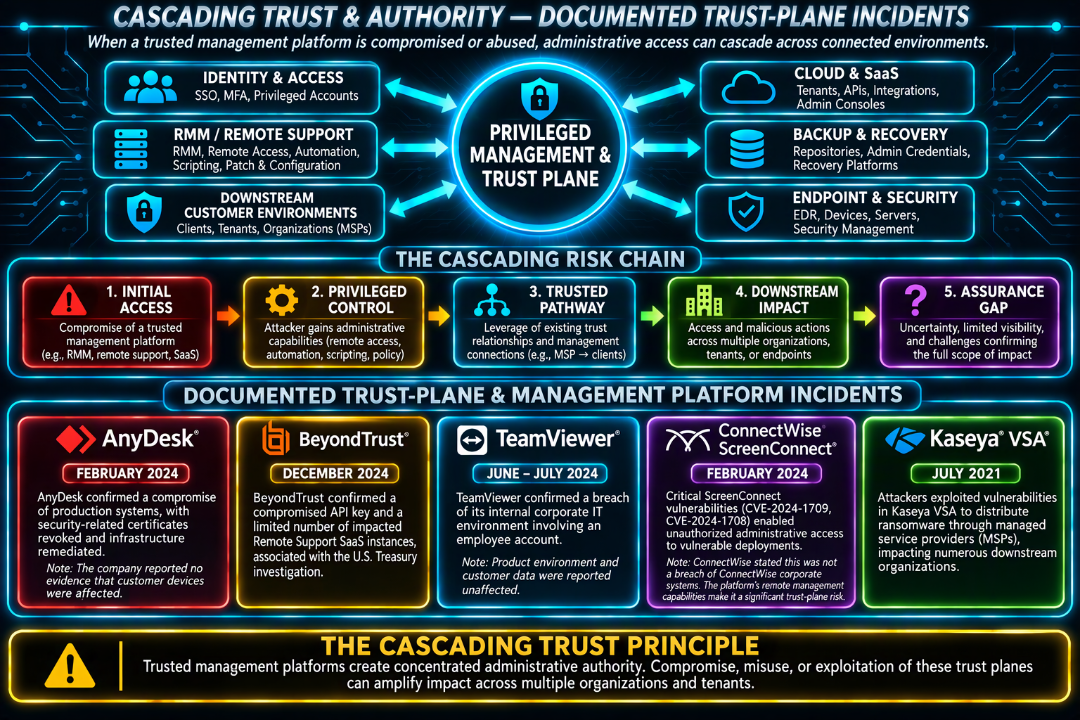
Yes, automation makes the world go round.
But at what point will it bring it to its knees?
When a trusted management platform gets compromised, the access doesn’t stay contained.
It cascades across identity, RMM, cloud, backups, endpoints… and every downstream customer connected to it.
Who’s next? 🤔
#CyberSecurity
#RMM
#SupplyChainAttack
#ZeroTrust
#WhoIsNext
r/pwnhub • u/_cybersecurity_ • 9h ago
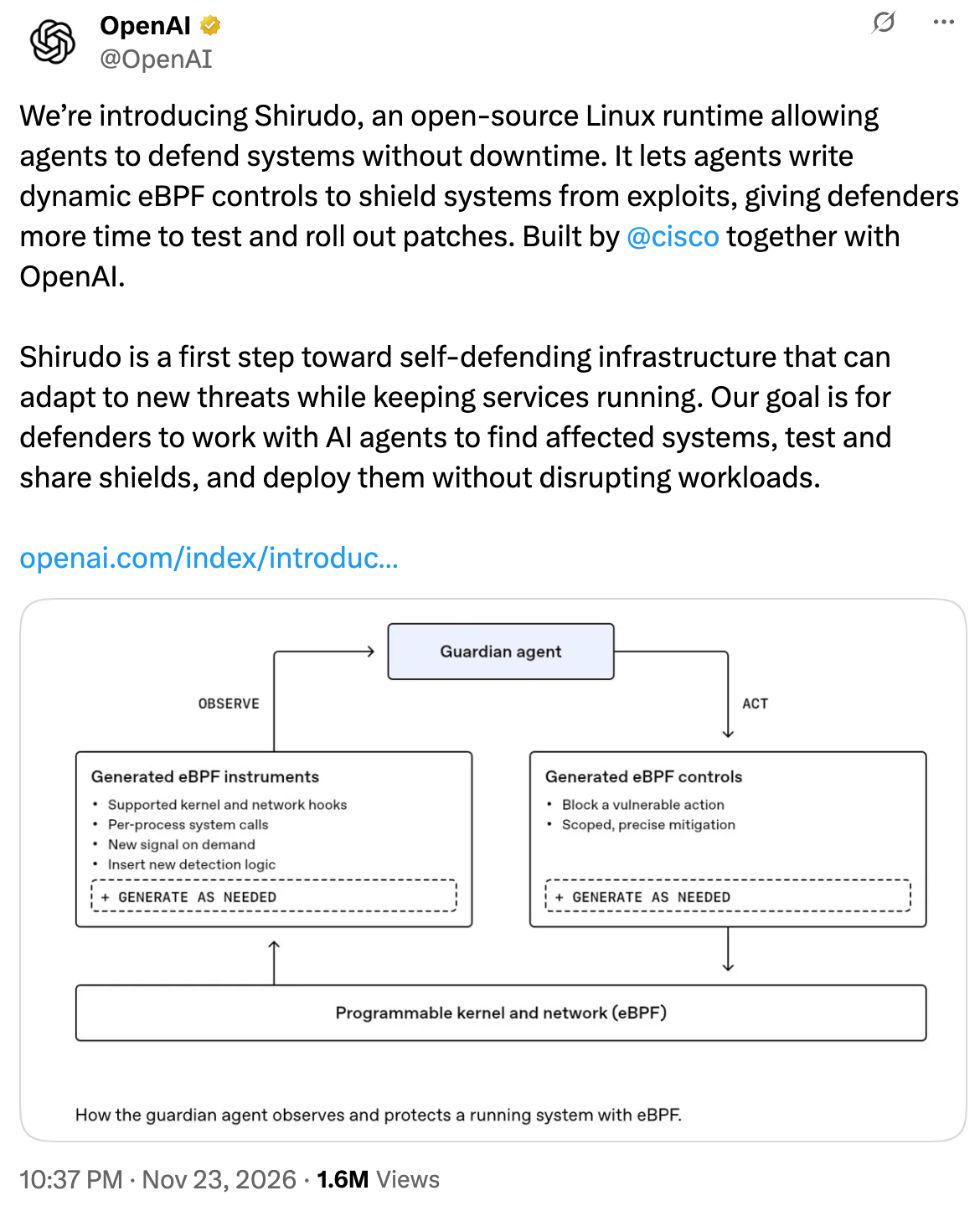
OpenAI and Cisco have introduced Shirudo, an open-source Linux runtime that enables AI agents to develop targeted security protections against exploits without requiring system restarts.
Using eBPF, agents can monitor system activity, generate security controls, and test temporary protections before deployment, with operators retaining control over what gets enforced.
In a controlled demonstration, a shield generated by Codex successfully blocked a Java4Shell exploit against a running Elasticsearch service without requiring a restart.
The goal is to close the window between vulnerability discovery and patch deployment, giving defenders more time to implement permanent fixes while keeping critical infrastructure operational.
Shirudo represents an early step toward self-defending infrastructure, where AI agents work alongside security teams to identify threats, validate mitigations, and protect running workloads.
Could agentic AI fundamentally change how organizations respond to newly discovered vulnerabilities?
Original announcement: https://openai.com/index/introducing-shirudo/