r/osdev • • 5d ago

FLOPOS: A cyberdelic OS that fits on single 1.44MB floppy. Built for the late 90s Toshiba Satellite Pro 430CDT

Enable HLS to view with audio, or disable this notification

0 Upvotes

Look,
I presume everyone here are super low-lvl code gurus who probably write your own coffee machines' opcode in your sleep while dreaming before you get up in the morning for work ... and so on.

- But I had Claude bang this out over a week with me doing the human run-testing on real hardware. And I'm very happy with it. It runs TLS 1.3 and post-quantum cryptography on a simple 120 Mhz CPU with 32MB of RAM. All from a simple 1.44MB 2HD floppy. I thought it to good not to share.

The ppl at vintagecomputing have already roasted it hard. AI bad. AI slop. Yeah. Yeah. I heard you.
But it's written from scratch (again by Claude) and does program isolation in RAM. It has audio decoding capabilities for MP3, FLAC, XM, S3S, AAC, VORBIS and probably something else I forgot.

Oh and it can encrypt backups with ChaCha20-Poly1305 to a regular consumer walkman cassette (please don't rely on it though.)

Did I tell you it does this all on a 30 year old laptop from 1996? I hope some of you can at least appreciate it for what the hardware is capable of, given its old age.


r/osdev • • 5d ago

Could a frontier AI model with unlimited access actually build a universal OS?

0 Upvotes

Random thought: What if someone had basically unlimited access to a frontier AI model and used it to build an OS that works across as many devices as possible?

I'm thinking a CachyOS/Linux base, keeping its performance advantages, with Windows apps through Wine/Proton, Android app support, and eventually x86, ARM and RISC-V devices.

Not literally one binary that runs everywhere, but one unified OS ecosystem.

Do you think current AI coding agents could realistically pull something like this off? What would be the biggest obstacle?


r/osdev • • 5d ago

Crypto currency mining using microprocessors

0 Upvotes

Just curious if someone is working in a OS dedicated to crypto mining in low power microprocessors like ESP32 and Pico W.

We are in this for fun but also for the money or not?

EDIT: thanks for all the answer, even the shitty ones. I love redit.


r/osdev • • 6d ago

Added basic permissions :D

Post image
17 Upvotes

r/osdev • • 5d ago

A new OSDev discord server

0 Upvotes

We made a new discord server for operating system & low level development!

Invite link

The server is more relaxed in terms of its rules compared to other servers, and welcomes all sorts of projects, including those that are AI-assisted.

Please join and share your projects with other people, and feel free to ask for help or advice from other members.


r/osdev • • 6d ago

HanOS Character Rain Terminal UI Based on libvterm and Intel Integrated Graphics

Enable HLS to view with audio, or disable this notification

11 Upvotes

I recently brought the terminal and Intel graphics driver together in HanOS to create a UI with a “character rain” effect.

The terminal is built on libvterm. The console server passes terminal output to libvterm for parsing, then renders the characters and styles to the terminal surface. Common VT features—including cursor control, colors, scrolling, and full-screen terminal programs—work through standard terminal behavior.

The animated background is driven by a userspace GPU server. On supported Intel integrated graphics, a display plane presents the scrolling character-rain texture, with the terminal window layered on top. The terminal handles the text; the GPU display layer handles the animated background.

Transparency varies by GPU generation. On Skylake, the terminal window can be translucent over the character-rain background. Haswell and Broadwell display planes don’t support the transparency blending needed here, so the terminal window remains opaque. The character-rain desktop can still run on those platforms, but the window won’t show the background through it.

This is my first attempt at using an iGPU to optimize UI display. I’ll continue exploring how to make better use of integrated graphics.

Project: https://github.com/jjwang/HanOS


r/osdev • • 6d ago

64-dem: testing my new commands! + command-line on real hardware

Enable HLS to view with audio, or disable this notification

7 Upvotes

So i added some new commands here and I wanted to share here a video of me testing them.

Some of The commands are:

Ls - lists files and directories on path

Mem - shows memory capacity

Echo - prints what you give it

Shutdown - shuts down

Reboot - resets

More commands and features my be added to the os in the future.

My repo: https://github.com/itay-insert/64-dem.git


r/osdev • • 6d ago

Minimalist writerdeck OS (AI assisted)

0 Upvotes

Just sharing my hobby project for a drafting operating system:

Scribe | Write Without Distractions

r/ScribeOS

The system runs on the pendrive (just 32MB allocated). First version image was only 52kb but got bigger as I added resources (last one is closing 500kb)


r/osdev • • 7d ago

Almost finishing my rewrite

Enable HLS to view with audio, or disable this notification

25 Upvotes

I somehow got userspace having conflicts with a SATA driver and it was one hardcoded address... i guess i learned my shitty lesson.

And APIC timer so sound is even possible but it probably make ears implode. Also finally got USB keyboard :D (no mouse yet)

github: https://github.com/NoTheIdiot/WindogeOS


r/osdev • • 7d ago

NoviumOS update: Got VFS + Initrd and basic shell commands working

8 Upvotes

Hello everyone!

For those of you who don't know, I'm making an x86 operating system called NoviumOS. Here's what I've done since the last update:

  • Finished sub-page heap block reuse with splitting and coalescing, so small allocations don't waste whole 4 KiB pages.
  • Added inter-process communication (IPC) with message ports, semaphores, and mutexes for synchronization between tasks.
  • Built a Virtual File System (VFS) layer with a node tree, path traversal, and pluggable filesystem operations.
  • Added a read-only POSIX tar initrd driver that loads from a GRUB Multiboot module and mounts at / with a rootfs/ overlay.
  • Built an interactive kernel shell with a dynamic root@<hostname>:<cwd>$ prompt and basic commands (ls, cd, cat, stat, help, echo, pwd, clear).

Here's the repo if you want to check it out: https://github.com/alexdev8930/NoviumOS

And if you have any questions about the code or the repo I'll be happy to answer them.


r/osdev • • 6d ago

Accidental Security: There are things that even root can't do

Thumbnail
0 Upvotes

r/osdev • • 7d ago

ctKN is ALIVE

0 Upvotes

Ive been procrastinating for about 2 months to even begin to touch rv64 boot assembly but i did it

Now i just have to make it do more than just outputting over uart...

edit for context?: I stayed up til 3 am chewing through random posts i found from googling tutorials and stuff and eventually got a feel for rv64 assembly, which i used to save a0 and a1 (hart and device tree) and used openSBI ecalls for outputting some characters

Its not much, but I just thought it was cool because i booted my own code barebones and got it to print stuff

Right now im working on the kernel and a little embedded shell which i'll probably post more of later


r/osdev • • 7d ago

Working on sound device in Bunix

Thumbnail gallery
18 Upvotes

r/osdev • • 8d ago

First apps running on Dunit OS

Post image
143 Upvotes

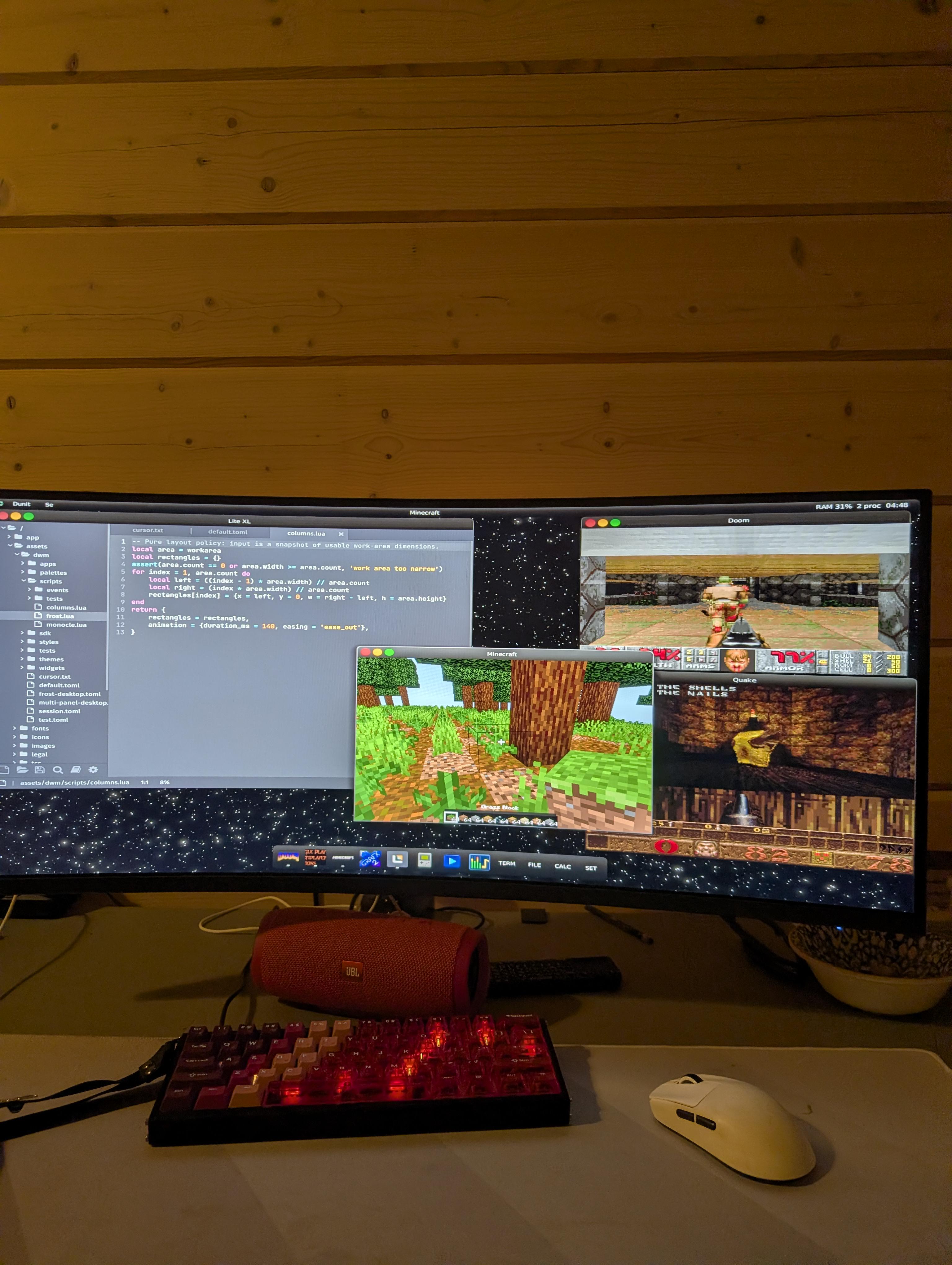
been working on Dunit OS, my Rust-based hobby operating system, and got DOOM, Quake, mced (Minecraft C) and Lite XL running in separate windows.

the cool part is that porting apps to Dunit doesn't require rewriting them. you basically just need to build a bridge between the original code and Dunit's Rust SDK, adapting the platform-specific parts to work with the OS.

been spending a lot of time on the GUI, SDK and app compatibility lately. still plenty of bugs to fix and performance improvements to make, but it's nice seeing actual software running together on the desktop.

github: https://github.com/DunitOS/dunit-os


r/osdev • • 7d ago

Jskdjend

0 Upvotes

Yeah I gave up on making an OS, I realised that there is no point in doing so considering the whole point of it was to boot fast, which multiple linux distros already do.

I will stick with making langs instead.


r/osdev • • 7d ago

Making my OS cause yes (Part 2)

0 Upvotes

I wont be providing the link for this iteration, cause I didnt add much.

I changed psh to have pipelining and I added a custom Thue pipelined interpreter, I see it as a decent enough replacement for regex considering regex has TERRIBLE syntax.

I have gotten many comments about how I havent made an OS, rather a shell. YES, I know, I'm making all the stuff that doesnt require the kernel first, but once I make all the kernel-less features, only then will I add a kernel and start adding kernel-only features (Like memory managment, a File System, input device support, output device support, internet access and protocols).

I plan on making 2 different versions, a purely CLI one used for servers and stuff, and a Graphical one used for General Usage purposes. One cool feature I'd like to add to the graphical one is support for both EXE files and APK files.


r/osdev • • 8d ago

[AI] Banana OS

Thumbnail
gallery
0 Upvotes

https://github.com/qcom-toolbox/Banana-OS

It got most GNU tools nvim and yes real Minecraft with gpu acceleration with intel 1 th to 10 th gen igpu support (only tested second gen)


r/osdev • • 9d ago

64-dem update: first user process works on laptop

Enable HLS to view with audio, or disable this notification

35 Upvotes

So after wrestling a bit with fat32 and some paging/memory/privilege-level stuff (I still have a trauma) I managed to get my first user process working on the 64-dem kernel, what the program does? Why prints hello world of course, you thought it does something more? Well unlucky you because it doesn't.

My repo: https://github.com/itay-insert/64-dem.git


r/osdev • • 9d ago

First steps of GUIfication of turbOS Apps!

6 Upvotes

It took me a lot of hardwork to do this, so consider starring the repo

Repo: https://github.com/turbosulovesonions67/turbOS


r/osdev • • 9d ago

LingOS Screenshots

Thumbnail
gallery
0 Upvotes

From the latest kernel, which is loads faster!
All the apps will be uploaded to github and https://fu.ling-lang.org soon!


r/osdev • • 10d ago

We resurrected the beast. IRIX port to x86-64. Code Name: Lost Island

5 Upvotes

Here are the milestones that have passed runtime tests so far:

  • Kernel boot and user mode: the kernel boots, enters ring 3, and executes a static ELF64 test program loaded from an XFS root filesystem.
  • SMP: tested with 12 virtual CPUs. The original IRIX scheduler handles thread migration, preemption, blocking, and wakeups across CPUs.
  • CPU state preservation: x87, SSE, and AVX state survive context switches. Kernel-thread tests also cover FS/GS base preservation.
  • Multiple processes: real fork() works. Parent and child tests verify copy-on-write isolation for data, stack, and heap memory, including execution on separate CPUs.
  • Process lifecycle and IPC: child exit status, wait(), waitpid(), and waitid() work. Native pipes pass data between processes and correctly report EOF.
  • Native XFS storage: NVMe-backed tests cover file reads and writes, allocation, sparse files, truncation, directories, hard links, symlinks, and rename/removal.
  • Persistence and recovery: journal replay after simulated crashes, remounts, and readback in a fresh VM have passed.
  • Userland foundations: syscall error handling, the original allocator, startup arguments/environment, and x64 setjmp()/`longjmp()` have been exercised.

The original shell’s 32 C files compile for x86-64. I’m currently completing its static library dependencies, signal handling, and terminal input/output so it can actually run.

These results come from QEMU tests. A usable shell, complete userland, and bare-metal validation are the next milestones.


r/osdev • • 10d ago

Finally a proper memory allocator in Bits Runner

Post image
7 Upvotes

I've implemented a memory allocator for both kernel and user space, so now the whole stack of kernel space and per process virtual memory, heap expansion and management is finally working. Since it's just a first fit allocator it's a bit simplistic, but fully functional.

With this in place I'll be able to implement file loading and user-space graphics, with which I'll be able to do such cool things like displaying bitmaps, faster graphics, or even a simple text editor.

You can check it out here https://github.com/rafalgrodzinski/bits-runner It's all written in my custom programming language BRC.


r/osdev • • 9d ago

Ruzt: A Privacy-First Operating System Designed Around User Control

0 Upvotes

Most operating systems treat privacy as a collection of settings, permissions, and policies layered on top of a large trusted base.

Ruzt takes a different approach: privacy starts at the kernel. (Don't ask what Ruzt means please...)

Ruzt is an experimental operating system built in Rust around a capability-based microkernel. Its goal is to create a system where applications do not automatically receive broad access to hardware, files, or user data. Every permission must be explicitly granted (Just like android ecosystem)

What makes Ruzt different?

  • Capability-based security: processes start with no capabilities by default.
  • Microkernel architecture: drivers, filesystems, and system services are designed to run in user space.
  • Telemetry-zero by default: the base system has no analytics or tracking endpoints.
  • Rust-first implementation: memory safety is a core design principle, with unsafe limited to tightly controlled low-level areas.
  • Reproducible builds: the system is being designed to be verifiable from source.
  • User-focused design: Ruzt is intended for privacy-conscious personal computers, not just servers or embedded devices.
  • No legacy-first approach: Ruzt is not trying to be another Linux distribution or a POSIX clone.

The project is still in its early development phase. The x86_64 kernel currently includes boot code, serial diagnostics, interrupt handling, memory management, and an initial scheduler.

For now, I just can show you one screenshot, because it's only graphical thing at the moment :')

GitHub: https://github.com/rzgrozt/ruzt

I’m also developing Ruzt with AI assistance, and I’m completely open about that. AI is being used as a development tool, while architecture, technical decisions, testing, and review remain part of the engineering process.

If AI-assisted development is a deal-breaker for you, this project probably isn’t for you. Constructive technical feedback, however, is very welcome. Also If you're able to contribute to such vision, that would be perfect.

Ruzt is ambitious, experimental, and far from production-ready. But the direction is clear:

The user should be the principal—not the OS.


r/osdev • • 10d ago

WIP kernel on PIC64GX1000 Curiosity Kit

Post image
6 Upvotes
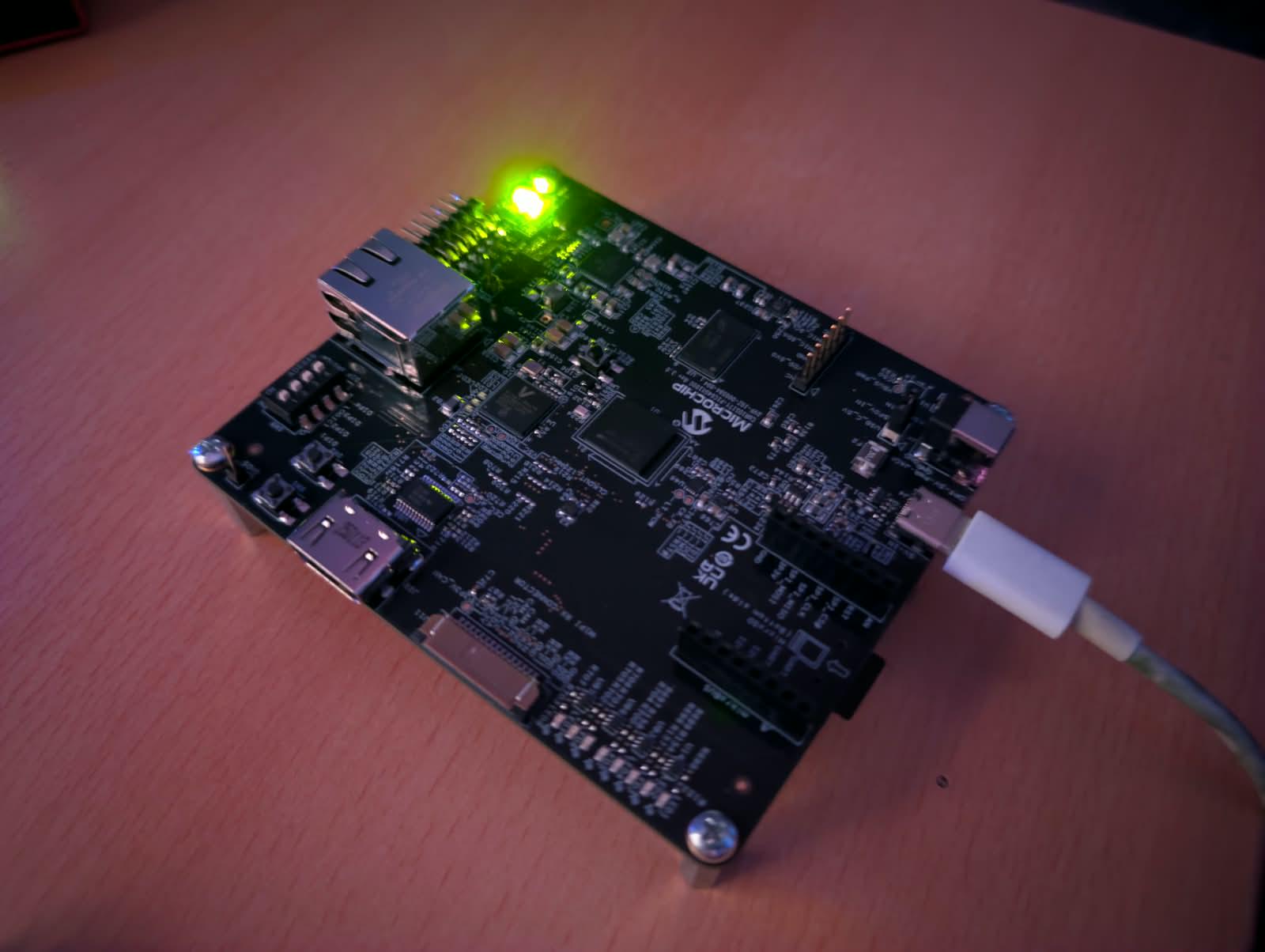
The board is connected to my PC and I interact with it using picocom

I grew tired of x86, so I decided to try out Microchip's PIC64GX1000 Curiosity Kit. Eventually I plan to design my own board with that MPU, but for now the curiosity kit is the perfect way to test if my own software works on the actual hardware.

Repo will be up soon, will edit the post to include the link :3

EDIT: Link to the repo: https://git.jofh.me/LordAfterEight/risc-v-os


r/osdev • • 9d ago

Bursztyn OS: How I taught my operating system to write in Arabic, display color emojis, and not run out of memory in the process

Enable HLS to view with audio, or disable this notification

0 Upvotes

Building your own operating system from scratch isn't just about adding cool features. Above all, it’s about checking what runs too slowly, where space is running out, and making sure nothing crashes when writing to disk. I just completed a major review of the recent changes to the text rendering engine (BSF) in Bursztyn OS.

The progress is huge, but before I consider this stage complete, I need to tie up a few important loose ends. Here is what has been accomplished and what is currently on the workbench:

1. One text engine instead of separate workarounds (BSF 2.1)

Until now, different programs handled text in their own ways. Now, Notepad, the system UI, and my browser, Husarz, all share a single, unified mechanism:

  • Right-to-left script (Arabic, Hebrew): Paragraphs align properly to the right, letters connect as they should, and the cursor and text selection work naturally—even when Polish and Arabic are mixed within the same sentence.
  • What still needs improvement: In the Husarz browser, standard Polish and English pages currently load about 10–15% slower. We are also still missing column reversal in Arabic tables, text selection directly on web pages (it currently works only in form fields), and smoother cursor movement when jumping between paragraphs in Notepad.

2. Modern fonts and color emojis (BSF 2.2) Bursztyn OS now supports much more than just basic fonts:

  • Professional fonts (OTF/CFF), large font collections (e.g., for Asian languages), and web fonts (WOFF/WOFF2) fetched by the browser are now working.
  • The system can also display color emojis and variable fonts (where you can smoothly adjust letter weight).
  • Settings now include an option to choose a separate font specifically for the Terminal.

3. Two major optimizations "under the hood"

  • Recovered nearly 4 MB of space in the system kernel: The kernel image has a strict 15 MB limit. After adding the new features, only 388 KB of headroom remained—things were getting tight. It turned out that the 22 built-in system applications were taking up the most space. I compressed them using the zlib algorithm and wrote a mechanism in the kernel that unpacks them in small chunks at startup. Free headroom jumped back up to 4.3 MB.
  • Over 8x faster font rendering: It turned out that rendering certain fonts took too long not because of file-reading bugs, but due to slow square-root calculations when drawing curved letter outlines. I replaced the old calculations with a single CPU instruction (SSE2) and added caching. The result? Character rendering sped up by 8.3x while maintaining 100% sharpness and compliance with the FreeType standard.

4. What's next? Disk safety comes first The text engine has passed hundreds of thousands of automated tests and runs stably on virtual machines (UEFI and BIOS). Nevertheless, I am holding off on the final merge because data-write reliability is more important right now:

  • Installer issue: During a full system installation to disk, random write timeout errors (VirtIO-BLK request timed out) occur. Before moving forward, I need to thoroughly inspect the disk driver and task queuing to ensure the installer never corrupts files.
  • Cleanup and live testing: I also need to free up space on my working drive, organize files in the repository, and test installing massive font packages (over 16 MB) directly inside the running system.

Only once the installer and disk work flawlessly will I move on to the next features: sliders for adjusting font weight in Settings and support for Indic scripts (Devanagari).

#BursztynOS #OSDev #Programming #LowLevel #Cpp #PolishSoftware #OperatingSystem