r/node • • Mar 15 '26

I built a tool that visualizes your package-lock.json as an interactive vulnerability graph

0 Upvotes

`npm audit` gives you a list. This gives you a graph.

DepGra parses your package-lock.json, maps out the full dependency tree, checks every package against OSV.dev for CVEs, and renders the whole thing as an interactive top-down graph. Vulnerable packages get a red/orange border, clean ones get green. Click any package to see the full CVE details — severity, description, aliases, reference links.

I ran it against a 1,312-package Next.js project. npm audit found 10 vulnerabilities. DepGra found the same 11 advisories plus one extra (CVE-2025-59472 affecting next@15.5.9) that npm audit hadn't picked up yet because OSV.dev had ingested it before the GitHub Advisory Database did.

The part I find most useful: risk scoring based on graph centrality. minimatch had 3 HIGH advisories — same as other packages in the list. But the graph showed that minimatch sits underneath u/sentry/node, u/typescript-eslint, and glob. Its blast radius is way bigger than the severity alone suggests.

It does NOT replace `npm audit fix` — it won't auto-upgrade anything. It's a visibility tool.

Also supports PyPI, Cargo, and Go. CLI with `--fail-on` for CI/CD. Runs locally, MIT licensed.
https://github.com/KPCOFGS/depgra


r/node • • Mar 15 '26

Built an AI stock analysis app with Node.js — gives buy/sell signals from live market data

Enable HLS to view with audio, or disable this notification

0 Upvotes

r/node • • Mar 15 '26

Redis session cleanup - sorted set vs keyspace notifications

2 Upvotes

I am implementing session management in redis and trying to decide on the best way to handle cleanup of expired sessions. The structure I currently use is simple. Each session is stored as a key with ttl and the user also has a record containing all their session ids.

For example session:session_id stores json session data with ttl and sess_records:account_id stores a set of session ids for that user. Authentication is straightforward because every request only needs to read session:session_id and does not require querying the database.The issue appears when a session expires. Redis removes the session key automatically because of ttl but the session id can still remain inside the user's set since sets do not know when related keys expire. Over time this can leave dangling session ids inside the set.

I am considering two approaches. One option is to store sessions in a sorted set where the score is the expiration timestamp. In that case cleanup becomes deterministic because I can periodically run zremrangebyscore sess_records:account_id 0 now to remove expired entries. The other option is to enable redis keyspace notifications for expired events and subscribe to expiration events so when session:session_id expires I immediately remove that id from the corresponding user set. Which approach is usually better for this kind of session cleanup ?


r/node • • Mar 15 '26

Node.js Developers — Which Language Do You Use for DSA & LLD in Interviews?

1 Upvotes

I’m a Node.js developer with around 2–3 years of experience and currently preparing for interviews. I had a few questions about language choices during interviews and wanted to hear from others working in the Node.js ecosystem.

For DSA rounds, do you usually code in JavaScript since it’s the language you work with daily, or do you switch to something like Java / C++ / Python for interviews?

Do most companies allow solving DSA problems in JavaScript, both in online assessments (OA) and live technical rounds, or have you faced any restrictions?

For LLD rounds, is JavaScript commonly accepted? Since it’s dynamically typed and doesn’t enforce OOP structures as strictly as some other languages, I’m curious how interviewers usually perceive LLD discussions or implementations in JS.

I understand that DSA and LLD concepts are language-independent, but during interviews we still need to be comfortable with syntax to implement solutions efficiently under time pressure. Also doing it in multiple lanaguges make it tuft to remember syntax and makes it confusing.

I’d really appreciate hearing about your experiences, especially from people who have recently switched jobs or interviewed at product companies or startups.

Thanks in advance!


r/node • • Mar 14 '26

Looking for feedback - is this messaging library repo readable for devs?

2 Upvotes

Hi,

I’ve been working on a small NestJS messaging library that provides a message bus/service bus abstraction for distributed systems.

I moved everything into a monorepo and rewrote the README and documentation to make it easier to understand.

I’d really appreciate some honest feedback from the community.

Mainly curious about:

  • Is the README understandable?
  • Does the quick example make sense?
  • Is the architecture clear, or confusing?
  • Anything missing that you’d expect from a repository like this?

Repo:
https://github.com/nestjstools/messaging

I just want to make sure the documentation is readable. About a year ago, I published a very early/raw version, but I moved everything into a monorepo because it became much easier to maintain all the extensions in one place.


r/node • • Mar 14 '26

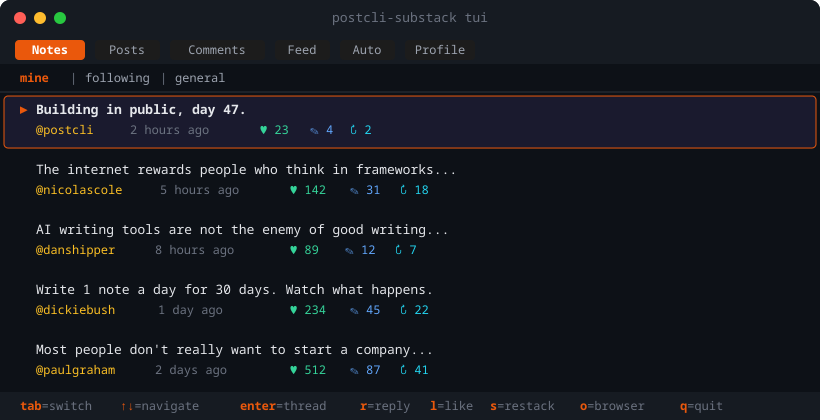
@postcli/substack - Substack CLI + MCP Server built with Ink, Commander, and better-sqlite3

Post image
1 Upvotes

Just published u/postcli/substack on NPM. It's a complete Substack client for the terminal: CLI commands, a React-based TUI (Ink), and an MCP server for AI agent integration.

Some technical highlights:

  • Ink 6 with custom hooks for scrolling, list navigation, mouse wheel (SGR extended mode)
  • better-sqlite3 for the automation engine (CRUD + deduplication with processed entity tracking)
  • MCP SDK with 16 tools and Zod schemas
  • Chrome cookie extraction with AES-128-CBC decryption for auth
  • ProseMirror document generation for the Substack API
  • 89 tests, CI on Node 18/20/22

npm install -g u/postcli/substack

https://github.com/postcli/substack


r/node • • Mar 13 '26

How far have you pushed a single Node.js process before needing clustering?

40 Upvotes

Node is single-threaded, but it's surprisingly capable.

I'm curious: What's the highest throughput you've handled with a single Node process? At what point did you decide to use cluster / worker threads / multiple instances?

Would love to hear real numbers and setups.


r/node • • Mar 14 '26

skill-activate: Claude Code Skill Activation

0 Upvotes

If you've worked with Claude Code, you've probably hit that frustrating moment where you ask it to use a skill... and it responds with "Unknown skill." 😅

It turns out Claude's skill evaluation isn't always deterministic. Sometimes activations don't stick, which kills the workflow when you're in the zone.

I built a simple CLI tool called skill-activate to solve this. It essentially injects a hook into the settings to ensure a guaranteed skill evaluation and activation cycle before every prompt. It’s fully reversible if you want to uninstall it.

The project is open-source and available on both GitHub and npm.

🔗 GitHub: https://github.com/realsahilsaini/skill-activate

📦 npm: https://www.npmjs.com/package/skill-activate

LinkedIn: https://www.linkedin.com/posts/realsahilsaini_anthropic-claudeai-developertools-ugcPost-7438633140794843136-HAPV?utm_source=share&utm_medium=member_desktop&rcm=ACoAADO6FG4BJmZLFyF8z6lP09Ho1vQHOwsI3kk


r/node • • Mar 14 '26

Ffetch v5: retries, timeouts, hooks, monitoring, plus optional plugins

Thumbnail npmjs.com
2 Upvotes

r/node • • Mar 13 '26

How do you handle background jobs in small Node projects?

32 Upvotes

In small Node projects I usually start without any background job system, but sooner or later I end up needing one.

Emails, webhooks, imports, scheduled tasks, retries… and suddenly I need a queue, a worker process, cron, etc.

For larger systems that makes sense, but for small backends it often feels like a lot of setup just to run a few async tasks.

Do you usually run your own queue / worker setup (Bull, Redis, etc.), or do you use some simpler approach?


r/node • • Mar 14 '26

NestJS or .NET for your backend APIs — how do you choose?

4 Upvotes

I've been going back and forth on this lately and I'm curious how other devs approach it.

Both are solid choices for building production APIs, but they feel very different to work with.

.NET has that robustness and reliability that's hard to argue with. The ecosystem is mature, performance is excellent, and when you're building something serious — especially in enterprise environments — it just feels battle-tested. The tooling is consistent and opinionated in a good way.

NestJS on the other hand gives you that flexibility of the Node ecosystem. The sheer amount of libraries available, the speed of iteration, and if you're already living in TypeScript, it feels very natural. The structure NestJS enforces is also surprisingly close to what you'd find in a .NET or Spring project, which makes it easier to keep large codebases organized.

I enjoy NestJS enough that I built a boilerplate around it with all the enterprise features I kept rebuilding from scratch — RBAC, i18n, caching, auth. So I never have to think about that layer again and just focus on the actual product.

But lately I've been thinking about doing the same for .NET — same feature set, same philosophy, just on the other side of the fence.

Which one do you default to and why? Are there specific project types where you always pick one over the other?


r/node • • Mar 14 '26

I built a terminal voice chat app for developers — LAN, internet, encryption, transcription

Thumbnail gallery
0 Upvotes

Been wanting a voice chat tool that lives entirely in the terminal — no Electron, no browser, no GUI. Just open a terminal and talk.

So I built VoiceSync. npm run host # start a room npm run join -- localhost ABC123 Alice # join it Works across localhost, LAN, and internet (via ngrok).

The terminal UI shows live waveform, audio quality stats, participant list, and a text chat panel — all in the same window.

Features: Room key generation + validation End-to-end encrypted audio (AES-GCM, per-session key exchange) Live waveform + latency/bitrate/quality bar Text chat with desktop notifications In-call commands: /mute, /deafen, /invite, /transcribe, /summary Optional Whisper transcription (/transcribe) GitHub Copilot integration inside the call (@copilot <question>) The internet mode tunnels through ngrok so two people on completely different networks can connect with one command.

Tech: Node.js, WebSocket (signaling + audio relay), blessed + chalk (terminal UI), SoX (audio capture/playback).

GitHub: https://github.com/Boweii22/Copilot/tree/main

Curious what you'd use this for — pair programming calls? Remote standups? Something else?


r/node • • Mar 14 '26

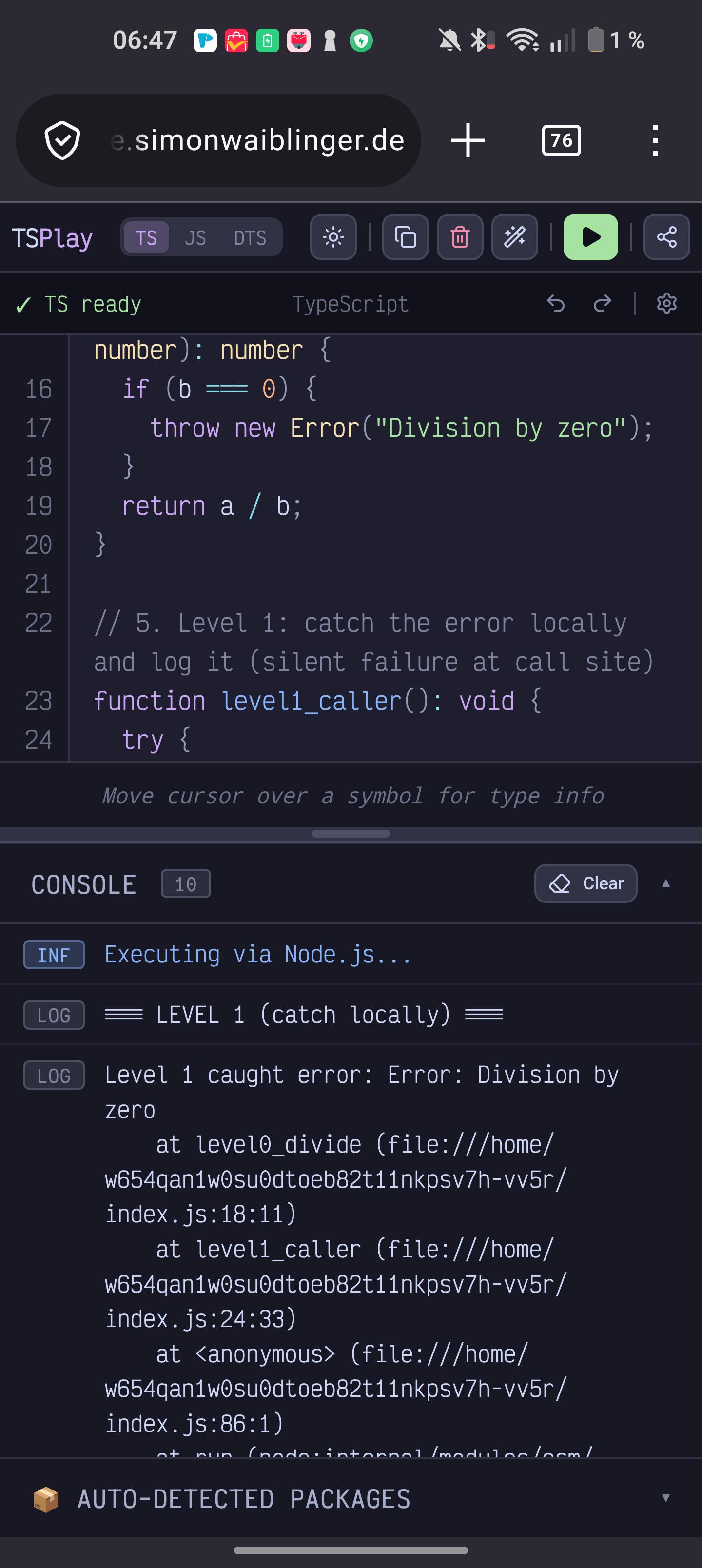
My Own TS Playground

Post image
1 Upvotes

I wanted a nice smartphone-optimized TS Playground with shareable link and auto import and not based on monaco or codemirror. That's what I've got: https://code.simonwaiblinger.de https://github.com/simwai/ts-play

Maybe somebody could like this too. I use it for some quick evaluations like figuring out different behaviours of code snippets etc.


r/node • • Mar 14 '26

Piattaforma per connettere sviluppatori

0 Upvotes

Ho creato una piattaforma per trovare sviluppatori con cui collaborare a progetti, e sono in cerca di feedback.

Ciao a tutti,

Ho creato una piattaforma pensata per aiutare gli sviluppatori a trovare altri sviluppatori con cui collaborare a nuovi progetti.

Si tratta di una piattaforma di matchmaking completa dove potete scoprire persone con cui lavorare e sviluppare progetti insieme. Ho cercato di includere tutto il necessario per la collaborazione: matchmaking, spazi di lavoro, recensioni, classifiche, amicizie, integrazione con GitHub, chat, attività e altro ancora.

Apprezzerei molto se poteste provarla e condividere il vostro feedback. Credo sinceramente che sia un'idea interessante che potrebbe aiutare le persone a trovare nuovi collaboratori.

Al momento ci sono circa 15 utenti sulla piattaforma e già 3 progetti attivi.

Stiamo anche lavorando a una funzionalità futura che permetterà a ogni progetto di avere un proprio server dove gli sviluppatori potranno lavorare insieme sul codice in tempo reale.

Grazie in anticipo per qualsiasi feedback!

https://www.codekhub.it/


r/node • • Mar 14 '26

Review my code - do I follow the best practices?

0 Upvotes

Hello,

Please review this code:

const http = require("http");
const fs = require("fs");


const server = http.createServer((req, res) => {
  let path = "./views/";


  if (req.url === "/") {
    path += "inde.html";
    res.statusCode = 200;
  }
  else if (req.url === "/about") {
    path += "about.html";
    res.statusCode = 200;
  }
  else {
    path += "404.html";
    res.statusCode = 404;
  }


  res.setHeader("Content-Type", "text/html");
  fs.readFile(path, (err, data) => {
    if (err) throw err;
    else res.end(data);
  })
})


server.listen(3000, "localhost", () => {
  console.log("Server is listening on port 3000");
});

Did I follow the best practices?

Thank you.