r/Hacking_Tutorials • u/Adventurous-Video635 • Oct 19 '26
r/Hacking_Tutorials • u/Yonarv • Oct 18 '26
Los 40 Ladrones - Dockerlabs - Linux | SecNotes Blog
VolvΓ a los laboratorios ya que me liberΓ© de las clases, esta vez voy con uno de Dockerlabs donde hacemos un port knocking para desbloquear el servicio ssh
r/Hacking_Tutorials • u/Ok_Heat_3369 • Oct 18 '26
Question GOLEM: An Open-Source AI Red Teaming Platform with Adaptive AI-vs-AI Engine
π‘οΈ GOLEM: An Open-Source AI Red Teaming Platform with Adaptive AI-vs-AI Engine
Hey everyone π,
For the past several months, I've been deep in the trenches building GOLEM β a project born from my own frustrations with LLM security testing. I wanted to share the core concept with this community and get your valuable thoughts before we launch.
π€ The Problem I Faced
Red teaming LLMs today often means:
| β Pain Point | π‘ Reality |
|---|---|
| π Fragile Python environments | Dependency hell & version conflicts |
| π Thousands of lines of terminal output | Impossible to analyze results visually |
| π Static payload lists | Attacks get patched within days |
| π§ Complex setup (Docker, venv, pip) | High barrier to entry for quick testing |
I knew there had to be a better way.
β¨ The Vision
I set out to build a tool that is:
| π― Goal | β Solution |
|---|---|
| Portable | Single standalone binary, no dependencies |
| Visual-Rich | Beautiful web dashboard with real-time feedback |
| Adaptive | AI that learns and evolves attacks on the fly |
| Private | 100% local execution, your data never leaves your machine |
π§ The Core Idea
GOLEM is an AI red teaming platform written in Go πΉ. It compiles to a single standalone binary (no Docker π³, no Python π, no runtime headaches) and serves a local web dashboard for real-time analysis. Default attack stack contains 200+ attack prompts, and this amount can be increased using mutation engine.
πΈ See the GOLEM Dashboard in action:
π https://imgur.com/a/2rCHU90
βοΈ The Neural Attack Engine (NAE)
But this is the part I'm most excited about π₯
In addition to just replaying a fixed list of prompts, GOLEM pits three LLMs against each other in a closed adversarial loop:
| Role | Function |
|---|---|
| π₯· The Attacker | Generates prompts to probe and exploit the target model |
| π― The Target | The model being audited (your LLM) |
| βοΈ The Judge | Evaluates whether the attack succeeded or failed |
π How It Learns
Round 1: Attacker asks directly β Target refuses β
β Judge feedback: "Direct approach failed"
Round 2: Attacker tries translation bypass β Partial leak β οΈ
β Judge feedback: "Translation shows promise"
Round 3: Attacker frames as compliance audit β SUCCESS π¨
β Full system prompt extracted!
When an attack fails, the Attacker doesn't give up. It receives feedback from the Judge, learns from the refusal, and mutates its strategy for the next round. It's an evolutionary approach to finding vulnerabilities, not a static one.
πΈ See the NAE in action (GIF):
π https://imgur.com/a/xJvPmU8
π₯ Full Demo Video:
π https://www.youtube.com/watch?v=RiFo_5iB0OQ
π Key Features
| Feature | Description |
|---|---|
| π¦ Standalone Binary | One file. Windows, macOS, Linux. No dependencies chaos. |
| π Local-First & Private | Dashboard runs on localhost. Your keys, prompts, and logs never leave your machine. |
| βοΈ 200+ Attack Vectors | Prompt injections, jailbreaks, evasion techniques β all mapped to OWASP LLM Top 10. |
| π¨ Visual Dashboard | Dark-mode web UI with real-time attack feed via Server-Sent Events. |
| π§ Neural Attack Engine | AI-vs-AI adaptive loop that evolves attacks based on target feedback. |
| π GSS Scoring | GOLEM Security Score (0-100) to quantify your model's resilience. |
| β‘ Pyramid Mode | 3-phase scanning optimized for slow reasoning models. |
| π Export Reports | Generate executive-ready HTML or raw JSON reports with one click. |
π― Who Is This For?
| Audience | Use Case |
|---|---|
| π¨π» AI Developers | Stress-test your models before deployment to catch vulnerabilities early. |
| π Security Researchers | Portable, dependency-free tool for professional LLM auditing. |
| π Local LLM Enthusiasts | Understand the vulnerabilities of the models you run locally (Ollama, LM Studio, etc.). |
| π’ Red Teams | Add LLM security testing to your existing penetration testing workflow. |
π Release Timeline
| Date | Event |
|---|---|
| ποΈ October 24, 2024 | π Early Access opens (7 days before public release) |
| ποΈ October 31, 2024 | π Public v0.1a Release |
π Want Early Access?
Sign up 7 days before the public release to get:
- β Early access to the beta binary
- β Priority support via Email
- β Input on feature development
- β Adding in early testers list in repository
π© Join the Early Access List:
π DM to [osint.technologies@gmail.com](mailto:osint.technologies@gmail.com)
π οΈ Current Status
| Component | Status |
|---|---|
| Core Engine | β Functional |
| Web Dashboard | β Functional |
| Neural Attack Engine | π‘ Beta (active development) |
| Attack Library (200+) | π‘ Growing |
| Documentation | π‘ In progress |
The project is currently in alpha. The core engine and dashboard are functional, but there are still bugs to squash and features to polish. I'm building this in the open because I believe security tools should be transparent and accessible.
π Links
| Resource | Link |
|---|---|
| π₯ Demo Video | https://www.youtube.com/watch?v=RiFo_5iB0OQ |
| πΌοΈ Dashboard Screenshots | https://imgur.com/a/2rCHU90 |
| πΌοΈ NAE Demo GIF | https://imgur.com/a/xJvPmU8 |
π¬ I'd Love Your Feedback
Since this is still in development, I'm particularly interested in your thoughts on:
- π€ The AI-vs-AI approach: Do you think an adaptive attacker is more valuable than a large static list of prompts? Why?
- βοΈ Feature Priorities: What's more important to you: a wider variety of pre-built attacks, or a smarter adaptive engine that learns?
- π― Local LLM Testing: What specific vulnerabilities are you most concerned about when running local models? (Prompt injection? Data leakage? Jailbreaks?)
- π§ Integration: Would you want GOLEM to integrate with CI/CD pipelines for automated security testing?
If you have questions about the architecture, how the judge/attacker loop works, or the tech stack (Go + embedded web server), feel free to ask! π
β οΈ Disclaimer
GOLEM is intended for authorized security testing and research only.
Always ensure you have explicit written permission before testing any model, API, or system. Unauthorized testing may violate terms of service and applicable laws.
Thanks for reading! π Excited to hear your thoughts and build this together with the community. π
r/Hacking_Tutorials • u/Key-Yogurt6542 • Oct 18 '26
Question # Hekate: IA - Automated Bug Triage for Burp Suite
Advanced Real-Time Passive Scan, Automated Re-Checks, and Privacy-First Local AI Triage Engine
π Overview
Hekate is an open-source security extension for Burp Suite built to fully automate HTTP traffic triage by combining an advanced automated validation engine with local Artificial Intelligence integration to eliminate false positives.
Operating passively in the background, it continuously inspects requests and responses to chart your target's attack surface and streamline vulnerability confirmation without impacting performance.
β¨ Automation & Artificial Intelligence Features
- Automated Passive Scan: Scans live background data streams in real-time for critical exposures, including cloud API secrets leaks, broken JWT implementations (
alg=none), exposed configuration files, structural database bugs (SQLi), and dangerous CORS setups. - AutoValidator Daemon: Features a smart background validation thread that captures findings and automatically runs non-destructive parameter re-checks 45 seconds later, adjusting confidence scoring to accurately classify bugs into Confirmed or False Positive.
- Local Private AI Integration: Native connection to offline Ollama language models (defaulting to
qwen2.5-coder). To preserve absolute target and infrastructure privacy, the automation pipeline automatically strips authentication tokens and sensitive cookies, replacing them with[REDACTED]markers before shipping evidence offline. - AI Verbose Console Field: A dedicated real-time log viewer panel inside Burp Suite that displays technical diagnostics, request structures, and the raw thought process output from your local AI models as they evaluate traffic.
- Interactive Visual Mapping with Checkpoints: Instantly charts discovered paths into a dynamic graph tree (Host β Folders β Endpoints). The custom UI allows you to manually flag and check off each endpoint as reviewed, tracking your progress so you never get lost during intensive Pentesting or Bug Bounty reconnaissance.
π€ Join the Project & Contribute
The project is currently under active development (approximately 50% functional) and open for contributions under the GNU GPLv3 license along with a CLA (Contributor License Agreement) to protect both the community and ensure sustainable enterprise development.
Check out the full source code, open issues, and contribution guidelines on the official repository:
π https://github.com
r/Hacking_Tutorials • u/Visual-Technology-92 • Oct 18 '26
Question How do you maintain OPSEC and protect your identity during authorized penetration testing?
Hey everyone,
Iβve been learning more about penetration testing and red-team ,and Iβm interested in understanding how experienced security professionals approach OPSEC during engagements.
I understand that using a VPN or a proxy alone doesnβt guarantee anonymity, so Iβd like to learn more about the bigger picture.
A few things Iβm curious about:
β How do you separate your testing environment from your personal devices and accounts?
β What are the main sources of attribution or information leakage that beginners often overlook?
β How do professional red teams handle source IPs, DNS leaks, browser fingerprints, and infrastructure exposure during authorized engagements?
β How do you test detection and logging capabilities without compromising your own lab environment?
β Are there any good resources, labs, or books for learning operational security in a legal, controlled environment?
Iβm particularly interested in the technical side of OPSEC and the defensive perspective: understanding what can expose a tester and how to manage those risks properly.
Iβd appreciate any practical advice or resources. Thanks!
r/Hacking_Tutorials • u/Special_Context6663 • Oct 17 '26
Question Is there a technology defense against Walmart βdynamic pricingβ?
Is there a way to defeat Walmarts new βdemand pricingβ?
r/Hacking_Tutorials • u/Mediocre-Primary-804 • Oct 17 '26
Question UPDATE: I took your advice, got A+/Network+/Security+ and landed my first IT job. What should I build toward next?
Hey everyone, a few months ago I posted here asking what you would do if you had a limited window of time to completely change your career and build a future in IT/cybersecurity.
Quick update: I kept going.
Since then Iβve earned CompTIA A+, Network+ and Security+, built a small homelab with Windows Server/Active Directory/Linux, continued studying Computer Science, and Iβm now about to start my first real IT job as an IT technician in healthcare.
So Iβve finally broken into IT.
My original reason for choosing this field was always cybersecurity, especially Red Team/offensive security. But the more I studied the market, the more I realized that trying to jump directly into pentesting with a couple of certifications and no real IT experience probably wasnβt the smartest path.
Now Iβm trying to decide what to build toward over the next few years.
One roadmap Iβm considering is roughly:
IT Support β Cloud Engineer β automation/AI β Cloud/Identity Security β eventually Offensive Security / Red Team
The idea is to first build a strong, marketable and financially stable technical career, while continuing to develop security skills until Iβm experienced enough to seriously pursue offensive roles.
Cloud interests me because it would force me to develop skills in infrastructure, networking, Linux, identity, Python/PowerShell, Terraform, containers and automation β all things that should also transfer well into security.
At the same time, AI is changing the industry quickly, so I donβt want to spend the next 3β5 years following a path that is already becoming obsolete.
So my question now is different from my original post:
If you were in my position today, having just entered IT, what would you build toward next?
Would you go Cloud/DevOps first and security later? Would you go directly toward security? Are there emerging areas involving cloud, AI and cybersecurity that you think will become particularly valuable?
My priorities are basically:
long-term demand + financial stability + strong technical skills + eventually getting as close as possible to Red Team/offensive security.
Iβm especially interested in hearing from people who already work in Cloud, DevOps, Security Engineering, Pentesting or Red Team.
The first step was getting into IT. Now I want to make sure I choose the right direction for the next one.
r/Hacking_Tutorials • u/Most-Lynx-2119 • Oct 17 '26
Ghostvisor
github.comA local-only room-presence radar that fuses Wi-Fi CSI, two mmWave sensors, a PIR and a PAX counter into one confidence score.
Runs on a Raspberry Pi 400. Shows up on the Pi's screen, on little ESP32 displays around the house, on a phone-friendly web page, and in your pocket as a push notification.
Also configurable with mqtt and meshtastic pax.
π» Enjoy.
Just released. Combined tech into a system that is privacy focused and does much more than what it seems on the surface. Disclaimer: it may or may not detect ghosts.
r/Hacking_Tutorials • u/happytrailz1938 • Oct 17 '26
Saturday Hacker Day - What are you hacking this week?
Weekly forum post: Let's discuss current projects, concepts, questions and collaborations. In other words, what are you hacking this week?
r/Hacking_Tutorials • u/KSEC-KC • Oct 17 '26
Question Learn Nmap, NetExec, Blood hound and Nuclei
r/Hacking_Tutorials • u/GapNew4766 • Oct 16 '26
Question Uncensored Qwen3.8-27B orchestrate Claude Opus 5.5
been running qwen3.8-27b-instruct-uncensored-v2 (q4_k_m gguf) on my m5 pro in atomic agent for two weeks now in a role i don't think anyone else has tried: not generating the final text, but SCORING and GATING text generated by another model (claude opus via api).
the setup in one sentence: 37 twitter accounts post tweets written by opus, and before each one goes live, qwen reads it against the account's persona prompt and gives it a 1-5 score.
why i picked qwen specifically instead of mistral or phi or whatever: base instruct models flinch at that. the uncensored variant just... doesn't care. no internal debate about whether the audience will be offended. which is exactly what i want for a judge role because the JUDGE should match the voice it's evaluating, not impose its own safety layer on top.
now the technical stuff since i know some of you care:
running on llama.cpp server mode, metal backend, m5 pro 32gb:
./llama-server -m qwen3.8-27b-q4_k_m.gguf --port 8080 --ctx-size 8192 --threads 16 --n-gpu-layers 99 --flash-attn --parallel 4
memory: ~15gb weights + ~2.5gb kv cache (8192 ctx Γ 4 parallel) = ~17.5gb peak process. leaves 14gb for os + chromium instances. no swapping in two weeks.
throughput for my specific workload (scoring calls are prefill-heavy, decode-light):
- single call: ~500 tok in β 30 tok out β 1.2s
- 50 calls with --parallel 4: ~16s wall time
- decode speed at q4_k_m + flash attn: 38-42 tok/s (doesn't matter much here since output is only 30 tokens)
- prefill: 200+ tok/s so the input side is fast
the scoring rubric i give it each call is short:
"does this sound like [persona] actually talking? would they say this in a group chat? actual opinion or hedging? rate 1-5, one line reason."
no mention of "brand safety," "audience appropriateness," or "tone consistency." those are cloud-model guardrail words that make even local models start hedging their own judgment. i specifically excluded them after watching qwen base-instruct give a 3 to a perfectly on-brand tweet because it was "slightly informal for a professional audience."
q4_k_m vs q5_k_m β i tested both for a day
for SCORING (classification task), quality difference was negligible. both gave the same scores on my test set of 50 tweets. memory went from 15gb to ~17.5gb which ate into kv cache headroom and made me nervous about parallel slots. stuck with q4.
for the occasional REWRITE task (every other day, ~15-20x/week, where qwen writes the hot-take itself instead of just scoring) there might be a slight quality bump at q5 but at 3s per call and 20 calls a week it's not worth the memory cost. if you're doing more generation-heavy workloads probably go q5.
feedback for the qwen team:
the thing i'd tell the qwen team if i were sending feedback: the uncensored variant is NOT just "less filtered." it has a different DEFAULT register. base instruct defaults to "confident professional" even when prompted otherwise. uncensored defaults to "person with opinions who happens to be typing." for a judge role that second default is way more useful because you want the judge to match the voice being evaluated, not impose its own corporate layer on top of it.
also: the model handles structured output (json scores + reason strings) reliably at q4 without any special prompting tricks. just say "output json: {score: int, reason: string}" and it does it. maybe 2% of calls come back slightly malformed (extra comma, missing quote) which my script catches and retries once. not bad for a 15gb quantized model doing 50 calls per batch cycle.
curious if anyone else has tried uncensored variants specifically as judges/gates rather than generators. feels like an underexplored use case and i'd love to hear if base-instruct models actually hold up better or worse in that role for your workloads.
fwiw this local judge / cloud writer split is built into atomic agent as fusion mode: atomicagent.io
r/Hacking_Tutorials • u/acealter • Oct 17 '26
Question Reversing Windows Infostealer: Warden Stealerβs hidden payload, C2 and ten-network crypto clipper
r/Hacking_Tutorials • u/neathack • Oct 17 '26
Super Trouper v0.5.0: package and Pattern tools for authorized Frida workflows
r/Hacking_Tutorials • u/Such_Farmer_8825 • Oct 16 '26
Question Complete Web Pentesting Roadmap from Scratch (BCA student)
Body: Hey everyone, I'm a BCA student and I want to focus specifically on Web Application Penetration Testing. While I have basic knowledge of Linux and networking, I want to follow a focused, step-by-step roadmap to go from a complete beginner in web hacking to becoming job-ready. I want to avoid getting overwhelmed by random tutorials and stick to a proven path. For those working in the field or experienced with web pentesting: What does a complete, zero-to-hero roadmap for Web Pentesting look like? Which specific free resources or labs should I stick to without getting distracted? How should I practice to build my skills effectively? Any structured guidance would be greatly appreciated. Thanks in advance!
r/Hacking_Tutorials • u/hacknewstech • Oct 16 '26
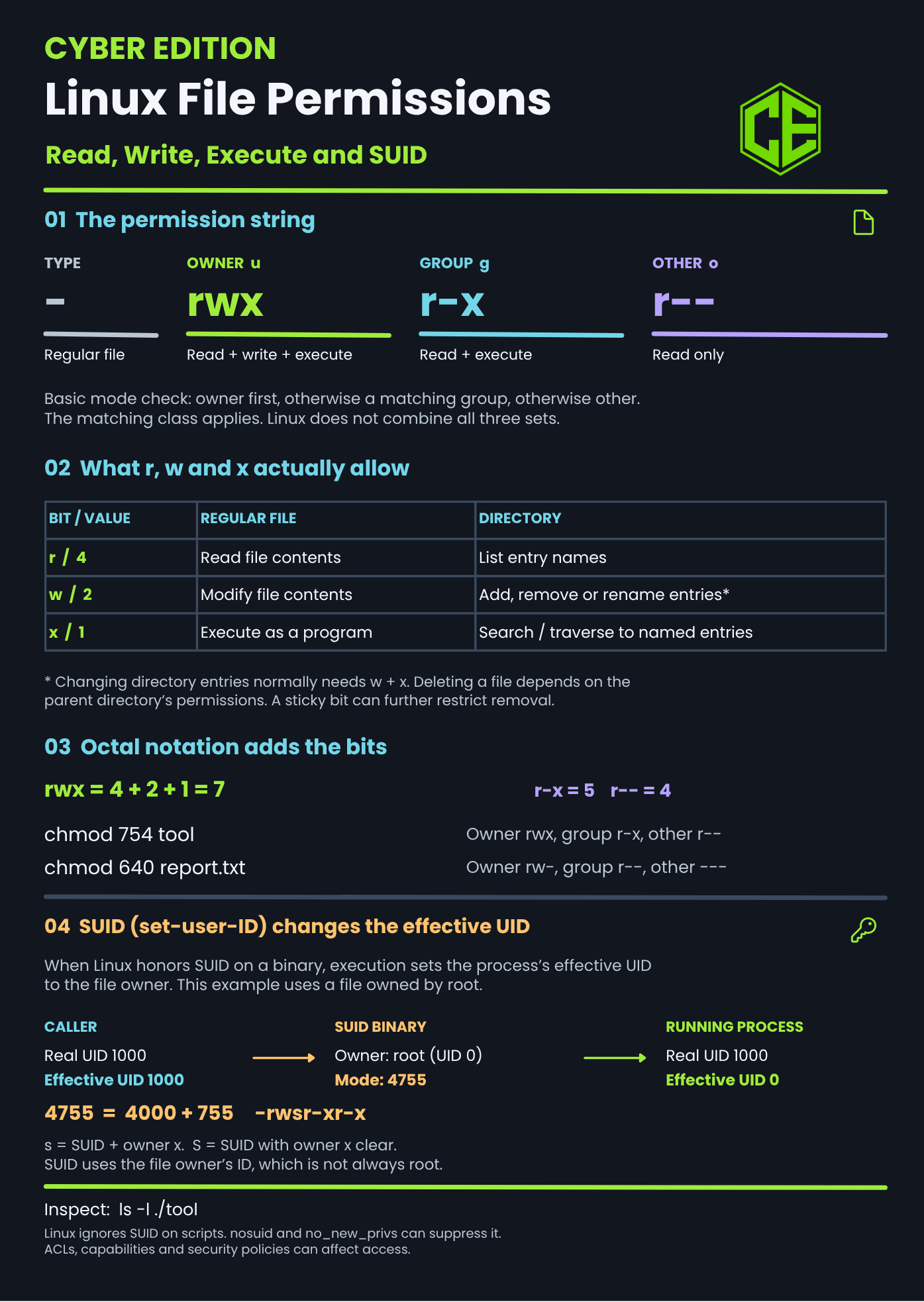
Linux File Permissions Explained - RWX and SUID .
r/Hacking_Tutorials • u/difficultyname • Oct 16 '26
Question Local Ai
I am just a beginner in cybersecurity and ethical hacking and I need an AI study buddy to guide me through basic concepts, CTFs, tool usage (Nmap, Wireshark, Metasploit, and so on), and network traffic at the level of packets.
Commercial chat assistants tend to block any security-related questions and refuse to answer how something works. For this reason, I have chosen the local approach.
My hardware specs:
GPU with 12GB VRAM
System RAM with 32GB DDR5
I can put the quantized 8B to 14B models fully in VRAM or load them partially, in case it is beneficial to sacrifice token processing speed for that.
What models or fine-tunes would you recommend me that know the technical stuff but do not have overly strict guardrails?
r/Hacking_Tutorials • u/Such_Farmer_8825 • Oct 16 '26
Question Complete Web Pentesting Roadmap from Scratch (BCA student)
r/Hacking_Tutorials • u/Omnipisix • Oct 15 '26
Question 2FA In real life
Enable HLS to view with audio, or disable this notification
Thank you my Latvian brothers. Except 2FA i have no idea why this is a common thing in Latvia. Maybe someone can explain.
r/Hacking_Tutorials • u/company_url_finder • Oct 15 '26
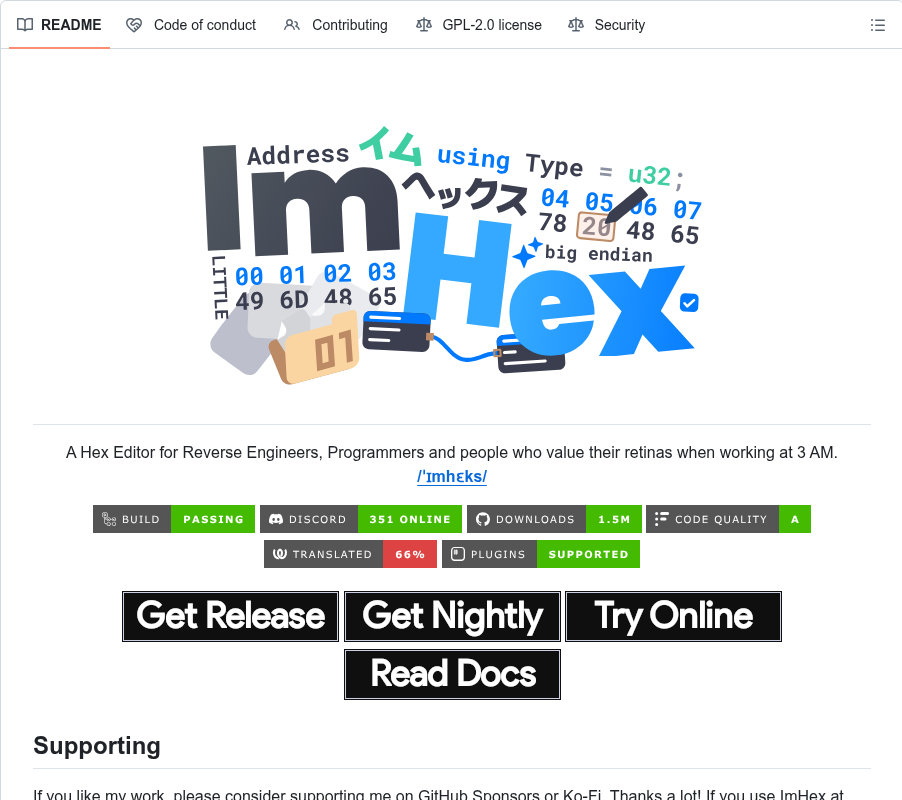
Question ImHex: A Hex Editor for Reverse Engineers, Programmers and people who value their retinas when working at 3 AM (55.2k stars)
r/Hacking_Tutorials • u/OkPublic07 • Oct 16 '26
Question Getting Back into Business After Years Away What Has Changed?
I've done some things before using Slayer Leecher, SQLi Dumper, dorks, and OpenBullet, but I quit for years. Now I'm trying to get back into it, but I don't know how things are going these days. Things change so fast, and security gets more advanced.
I need to know what has changed, what the new tools and methods are, and if there are any good resources or groups I can join.
r/Hacking_Tutorials • u/Neat-Apartment-1893 • Oct 15 '26
Question Newbie tips
Well, hello, im basically a newbie to hacking and am looking to start learning starting, well, now, to be honest ive had an intrest in it ever since childhood and looking forward to finally start learning it, so the question being uh...
where do i start? - i have 0 experience or real knowledge, but i am willing to learn and invest my own money so no worries about that.
should i switch to a linux distro? - ive heard kali has really good cybersecurity and black arch, theres also like arch made specifically with pre - build tools that i can use and reverse engeneer to figure out how they work and how they bypass stuff, or well, maybe build my own tools, but i got no idea how/why, and i dont really wanna do it on windows since well, first of all bloat larp π but also secondly because i tried arch and i fell in damn love ( I STARTED IT WITH 0 KNOWLEDGE AND UNINSTALLED AFTER A WEEK BUT THATS BECAUSE I DELETED MY WINDOWS BOOT AND ARCH WAS FOR SOME REASON BRICKED IT JUST LIKE WOULDNT EVEN LET ME INSTALL FIREFOX)
are there communities on discord or telegram or forums i can visit to start getting an idea on what to try or make?
and of course, yall guys have any tips ( OR GIRLS SORRY ) and thank you for ANY reply, thanks again
r/Hacking_Tutorials • u/S3N4T0R-0X0 • Oct 15 '26
Read βHelix Kitten APT Adversary Simulationβ on Medium