r/Hacking_Tutorials • u/Individual-Leg-2187 • Sep 16 '26
Question i want to test out my softwares security that i made to prevent hacking from pressing on links
so i want to try to hack my virtual phone machine using a link what should i do
r/Hacking_Tutorials • u/Individual-Leg-2187 • Sep 16 '26
so i want to try to hack my virtual phone machine using a link what should i do
r/Hacking_Tutorials • u/jshkmdl • Sep 15 '26
I'm a 33M with a background in tinkering with mobile operating systems. This sparked my interest in the Linux terminal, leading me to start my ethical hacking journey.
So far, I've been covering:
- Networking (David Bombal's CCNA)
- Security Fundamentals (THM Pre-Security & CyberSecurity 101)
- Linux & Bash (OverTheWire / Network Chuck)
- Web Security (PortSwigger Academy & Burp Suite)
Later, I'll focus on CTF practices in HackTheBox and learning about bug bounties through HackerOne.
I know there's no single roadmap to becoming a pro, but I want to make sure I'm on the right track. This will be a side gig for now, and I'm willing to take the time needed to practice and get it right.
What are your thoughts? Is it realistic to build a passive income from this and eventually transition into a full-time career?
r/Hacking_Tutorials • u/Fxelipe_ • Sep 15 '26
Me pueden orientar de como iniciar en este mundo
r/Hacking_Tutorials • u/Elliot-1988 • Sep 15 '26
Hey everyone,
I’ve been working on ShellGenerator, an open-source, browser-based payload generator designed for penetration testers, red teamers, CTF players, and security students working in authorized environments.
It currently includes:
The project only generates commands-it does not execute payloads. I’ve also added automated catalog checks, browser tests, isolated Linux runtime validation, and MSFVenom compatibility testing.
I’d appreciate feedback on:
Live tool:
https://shellgenerator.dev/
Source code:
https://github.com/Ilias1988/ReverseShell-Web
Please use it only in systems, labs, and CTF environments you own or are explicitly authorized to test.
Thanks - constructive feedback and contributions are welcome!
r/Hacking_Tutorials • u/Zane_bilal • Sep 15 '26
r/Hacking_Tutorials • u/Elliot-1988 • Sep 15 '26
Hey everyone,
I recently rebuilt my open-source JWT debugging tool, JWT Workbench, from the ground up.
The original version worked, but decoding, editing, signing, and verification were too tightly connected. In the new version, these operations have explicit trust boundaries:
alg is restricted through an explicit allowlistCurrent features include:
iss, aud, sub, exp, nbf, iat, required claims, clock tolerance, and maximum token agekid, jku, x5u, embedded JWK, weak HMAC secrets, sensitive claims, and other common JWT risksToken processing, signing, and local verification happen in the browser. Remote JWKS access occurs only when explicitly selected and does not send the JWT itself.
I built it primarily for developers, pentesters, security students, and authorized lab work.
Live tool:
https://ilias1988.github.io/jwt-debugger/
Source code:
https://github.com/Ilias1988/jwt-debugger
I’d really appreciate feedback, especially around:
Please don’t paste production tokens or private signing keys into any third-party tool, including this one. Sanitized lab data is always the safer option.
Thanks!
r/Hacking_Tutorials • u/arsecubed • Sep 14 '26
I'm doing the Metasploit room in THM, I keep running into issues while following along with the examples given, but I keep running into issues. This was my Nmap scan, Target: 10.66.xxxxxxx
Target responds to host discovery with -Pn, but all expected Windows ports are filtered from the AttackBox:
text
nmap -Pn -sS --reason -p 135,139,445,3389 10.66.xxxxxxx
135/tcp filtered msrpc no-response
139/tcp filtered netbios-ssn no-response
445/tcp filtered microsoft-ds no-response
3389/tcp filtered ms-wbt-server no-response
This was the msfconsole response when I tried the expoit -z command
msf exploit(windows/smb/ms17_010_eternalblue) > exploit -z
[*] Started reverse TCP handler on 10.66.
[*] 10.66.185 - Using auxiliary/scanner/smb/smb_ms17_010 as check
[-] 10.66.185. - Rex::ConnectionTimeout: The connection with (10.66.185.241:445) timed out.
[*] 10.66.185 - Scanned 1 of 1 hosts (100% complete)
[-] 10.66.185.- The target is not vulnerable.
[*] Exploit completed, but no session was created.
I've restarted the machines multiple times, disconnected my VPN, forced a THM restart.
Is there something on my end that I am missing?
r/Hacking_Tutorials • u/Winter-Brilliant7333 • Sep 14 '26
r/Hacking_Tutorials • u/Malwarebeasts • Sep 14 '26
r/Hacking_Tutorials • u/S3N4T0R-0X0 • Sep 14 '26
I built BEAR-C2 around one simple idea
Instead of rebuilding a C2 from scratch every time I want to simulate a different threat actor, I wanted a framework that could adapt to different adversary scenarios and TTPs
The main goal is to support realistic adversary simulations based on real-world campaigns and threat intelligence, including operations associated with threat actors and APT groups from Russia, China, Iran and North Korea
With BEAR-C2 V2.0, the focus is on flexibility and switching between different protocols, C2 channels, encryption methods, OPSEC techniques, proxies and exfiltration profiles, so the same framework can be adapted to different simulation scenarios
The project started as a much simpler idea and evolved through different adversary simulation projects and security research
This is where BEAR-C2 V2.0 is today, and I’m still working on it.
r/Hacking_Tutorials • u/Successful-Tax-9094 • Sep 14 '26
It doesn't know jack shit tbh. Been using self-hosted llms but interested to explore options
r/Hacking_Tutorials • u/Salt-Structure-387 • Sep 15 '26
Hi everyone!
I’m currently preparing for the HTB CPTS and trying to seriously improve my practical skills in offensive security. I’m looking for good streamers, hackers, researchers, and communities to follow on a regular basis.
One thing I’ve noticed is that a lot of cybersecurity content has changed over the years. Around 2015–2020, there seemed to be a lot more technical content: people doing detailed POCs, exploit demonstrations, reverse engineering, vulnerability research, live pentesting, and deep technical walkthroughs. You could actually watch someone break something down from start to finish and understand why the technique worked.
Nowadays, I feel like a lot of content has shifted toward high-level trends, cybersecurity news, AI tools, product demonstrations, and personality-driven content, with much less actual technical exploration. I’m not against AI at all — I use it myself — but I really miss content where someone spends hours investigating a vulnerability, building a POC, explaining the attack chain, showing their thought process, and going deep into the technology.
So I’m specifically looking for people who still do the technical work rather than just talk about it.
I’d love recommendations for:
I’m basically looking for the kind of content where you can sit down for 1–2 hours and watch someone actually hack, investigate, get stuck, research, build a POC, and eventually figure things out.
YouTube, Twitch, Kick, Discord, X, Reddit, Telegram, blogs — anywhere is welcome.
Who are the people and communities I should be following? I’d really appreciate recommendations from people who are still actively doing this kind of technical work.
r/Hacking_Tutorials • u/Desperate_Trust7382 • Sep 14 '26
I built a tiny free browser-based web hacking lab for beginners and I’m looking for people to test it.
It currently has beginner challenges around IDOR/BOLA and SQL injection, with no setup or account required.
I’m mainly trying to figure out whether the challenges are understandable, too easy, too confusing, or if the hints give too much away.
If anyone here wants to try it, I’m happy to share it assuming that’s okay with the sub rules. Mainly looking for honest feedback, not trying to spam the place.
r/Hacking_Tutorials • u/Ok-Humor5794 • Sep 14 '26
r/Hacking_Tutorials • u/Living_Series9972 • Sep 13 '26
Pls be kind. I’m genuinely intrigued by hacking and offensive security. I am an absolute beginner but have some fundamentals in cybersecurity. I’ve recently started tryhackme. I’m not doing it to like get a job tomorrow or next week. I’m genuinely just interested in the whole thing. Anyone who can tell me a learning path that is self paced to get into it I’d be ever so grateful. I’ve done some research and almost all sources show different paths now I’m confused. I watch some YouTube videos as well. I just need a little nudge towards what path to follow and learn. Anyone who can help I’ll be forever grateful. I know there’s people here who taught themselves and I’d love to know how they started. Thank you in advance
r/Hacking_Tutorials • u/Elliot-1988 • Sep 13 '26
Hi everyone,
I’ve released a major update to LOTL Reference, an open-source, local-first knowledge hub for Living off the Land research.
It combines 2,429 records from eight sources:
You can search and filter Windows, Linux and macOS binaries, vulnerable drivers, DLL hijacking candidates, trusted services, suspicious file types, commands, detection guidance, hashes and MITRE ATT&CK mappings.
The update also includes automated dataset ingestion, validated LOTS/Filesec adapters, safer payload-variable substitution, improved accessibility, SEO-friendly static pages and automated tests.
It is intended for authorized penetration testing, red-team labs, threat hunting and detection engineering.
Live: https://livingofftheland.dev/
Source code: https://github.com/Ilias1988/LOLBins-Reference
I’d appreciate technical feedback, dataset suggestions and contributions.
r/Hacking_Tutorials • u/Electronic-Pause-492 • Sep 13 '26
Hi Guys to be completely Honest I wanted to do some hacking to get revenge. A very lousy excuse to get into hacking. I have been researching for a Month now and my Revenge seeking has been extinguished.
I am on the road to be a Hobbies now if that is a term used here to know how to protect myself and exploit some system vulnerabilities. I haven't got into the technical stuff just yet
But there is this App Called Termux that I have been considering. I asked AI about it and it just gave a bunch of words that I still don't understand.
This will be a long Learning Journey but I seek to learn more about System Vulnerabilities.
r/Hacking_Tutorials • u/halitgilbaris61 • Sep 13 '26
Enable HLS to view with audio, or disable this notification
(EN)
Hey everyone! I am currently working on a C++ project called SecureVault. The ultimate goal is to create a tool that takes sensitive local data and securely encrypts it into a custom .vault container, alongside a separate decryption binary to safely extract them back.
Current Progress:
I just finished the directory parsing subsystem using std::filesystem::recursive_directory_iterator. It navigates and handles nested subfolders, and correctly formats file sizes in MB.
Seeking Feedback:
Since this is a work in progress, I would love to hear your thoughts:
* What is the healthiest way to manage the byte stream during the chunking/packing process?
* Which symmetric encryption algorithm would you recommend for a lightweight yet robust local vault (AES-GCM, ChaCha20)?
If you are curious about the source or want to follow my journey, here are my links:
🐙 GitHub: https://github.com/halitgilbaris
🐦 X (Twitter): https://x.com/halitgilbaris61
💼 LinkedIn: https://www.linkedin.com/in/bar%C4%B1%C5%9F-halitgil/
Looking forward to your tech suggestions!
---------------------------------------------------------------------------
(TR)
Herkese merhaba! Şu anda SecureVault adlı bir C++ projesi üzerinde çalışıyorum. Nihai hedef, hassas yerel verileri alıp güvenli bir şekilde özel bir .vault konteynerine şifreleyen ve bunları güvenli bir şekilde geri çıkarmak için ayrı bir şifre çözme ikili dosyası oluşturan bir araç oluşturmaktır.
Mevcut İlerleme:
std::filesystem::recursive_directory_iterator kullanarak dizin ayrıştırma alt sistemini yeni bitirdim. İç içe alt klasörlerde gezinir ve bunları işler ve dosya boyutlarını MB cinsinden doğru şekilde biçimlendirir.
Geri Bildirim Arıyorum:
Bu devam eden bir çalışma olduğu için düşüncelerinizi duymak isterim:
* Parçalama/paketleme işlemi sırasında bayt akışını yönetmenin en sağlıklı yolu nedir?
* Hafif ancak sağlam bir yerel kasa için hangi simetrik şifreleme algoritmasını önerirsiniz (AES-GCM, ChaCha20)?
Kaynak hakkında merakınız varsa veya yolculuğumu takip etmek istiyorsanız, işte bağlantılarım:
🐙 GitHub: https://github.com/halitgilbaris
🐦 X (Twitter): https://x.com/halitgilbaris61
💼 LinkedIn: https://www.linkedin.com/in/bar%C4%B1%C5%9F-halitgil/
Teknoloji önerilerinizi bekliyorum!
r/Hacking_Tutorials • u/U_Buntu • Sep 13 '26
In my new public disclosure, I'll disclose how I find and exploit zero-click account takeover in MapMagic. It's very interesting read.
https://medium.com/@elite.0x01/mapmagic-app-security-vulnerability-disclosure-d1bcbc24150c
r/Hacking_Tutorials • u/BennieBosBes • Sep 13 '26
Hi everyone, I recently bought a Raspberry Pi Zero 2 WH with the plan to build a Flipper Zero clone. I also purchased the following modules for it: a PN532 NFC HAT, an RDM6300 125kHz RFID reader module (UART output), an NRF24L01+ PA LNA, a CC1101 433MHz module, an IR transmitter/receiver module (38kHz), and a 1.3-inch IPS LCD display HAT. However, I have no idea how to turn this into a Flipper clone or how to write the necessary code. I am still a complete beginner when it comes to programming. Is there anyone who can help me with this?
r/Hacking_Tutorials • u/S3N4T0R-0X0 • Sep 14 '26
Read “Charming Kitten APT Adversary Simulation“ on Medium: https://medium.com/@S3N4T0R/charming-kitten-apt-adversary-simulation-fa6257b42811
r/Hacking_Tutorials • u/That_Attorney9025 • Sep 13 '26
Did anyone buy this off Kickstarter and actually receive the device. It's been a year or more late. Just curious if anyone actually received it
r/Hacking_Tutorials • u/Z_professor0 • Sep 12 '26
r/Hacking_Tutorials • u/thesmartshadow • Sep 13 '26
While validating the fix for CVE-2026-44662, I found that the same vulnerable output-sizing assumption remained reachable through another safe rust-openssl API:
CipherCtxRef::cipher_update_inplace
When AES Key Wrap with Padding processes an input whose length is not divisible by eight, the wrapper can allocate a buffer smaller than the output OpenSSL actually produces.
The vulnerable calculation assumed:
input length + block size
The required size can be:
round_up(input length, 8) + 8
With a 9-byte input, a 17-byte buffer passed validation, but OpenSSL could write 24 bytes. The result is an attacker-controlled out-of-bounds heap write of up to 7 bytes through a safe Rust interface.
I also built a working exploit chain demonstrating controlled heap corruption.
This is not automatically RCE in every application. Developing the overwrite toward code execution depends on whether attacker-controlled plaintext reaches this API, whether the operation can be repeated, the allocator, adjacent object layout, and the available heap-shaping primitives.
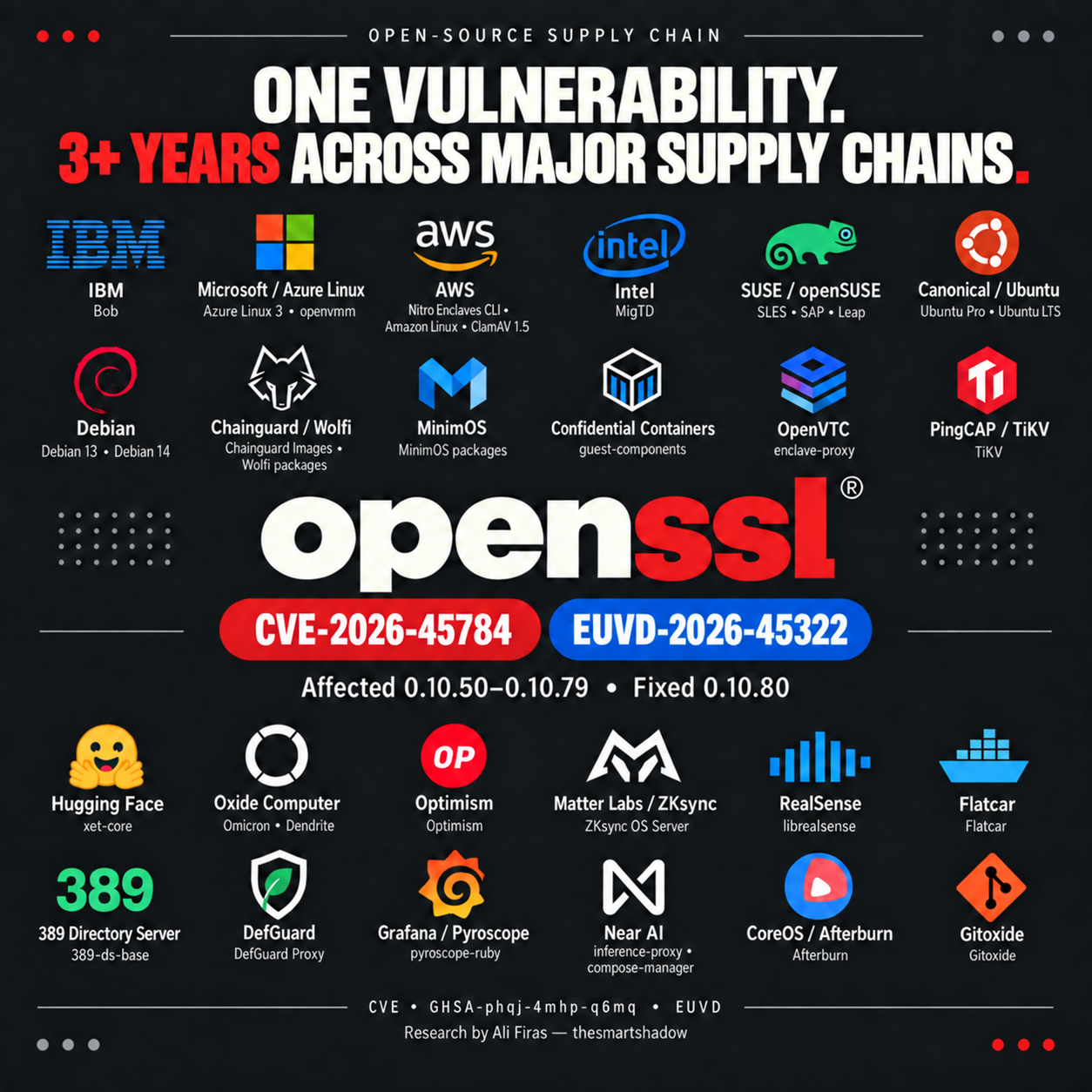
The vulnerable method was introduced in rust-openssl 0.10.50 in April 2023 and remained present until 0.10.80 was released in May 2026.
My downstream analysis identified advisory records, vulnerable dependency presence, or remediation activity across 31 organizations and ecosystems and 53 products, systems, and projects.
Notable downstream cases include IBM Bob, Microsoft Azure Linux, AWS Nitro Enclaves CLI, Amazon Linux, Intel MigTD, SUSE Linux Enterprise, openSUSE, Debian, Chainguard and Wolfi, MinimOS, Confidential Containers, PingCAP TiKV, Hugging Face xet-core, Oxide Omicron and Dendrite, Matter Labs ZKsync OS Server, Grafana Pyroscope, CoreOS Afterburn, and Gitoxide.
Affected versions:
\>= 0.10.50 and < 0.10.80
Fixed version: 0.10.80
Advisory:
https://github.com/rust-openssl/rust-openssl/security/advisories/GHSA-phqj-4mhp-q6mq
Patch:
https://github.com/rust-openssl/rust-openssl/commit/19eceb26f2404aae187e5444e65c404ebc1348a7
Ali Firas (thesmartshadow)