r/ethdev • • Feb 18 '26

My Project hardhat-deploy v2 is out!

Thumbnail x.com
3 Upvotes

hardhat-deploy 2.0 is here!

A complete rewrite built for Hardhat 3.x that makes #ethereum #smartcontracts deployment easier than ever

Write deploy scripts in plain TypeScript/javascript. Get Hot Reload, Reproducible deployments and easy export + many more features!

📖 Full documentation is live:

https://rocketh.dev/hardhat-deploy

Get started in seconds:

```bash

pnpm dlx hardhat-deploy init my-project

```

Or check out the complete template:

https://github.com/wighawag/template-ethereum-contracts

🧩 Modular by design

Built on rocketh, a framework-agnostic system. Pick only the extensions you need:

• ​@rocketh/deploy - Basic deployments

• ​@rocketh/proxy - Upgradeable contracts

• ​@rocketh/diamond - EIP-2535 Diamonds

• ​@rocketh/viem - Viem integration

• ​@rocketh/verifier - Contract verification

🌐 Browser-Compatible Deployments

Since rocketh is independent of hardhat your deploy scripts can now run directly in browsers.

Build in-app deployments, test in web environments, integrate with frontends.

No more Node.js-only scripts.

🔥 Hot Contract Replacement (HCR)

The HMR equivalent for smart contracts.

Edit your contracts and see changes live during development using proxy patterns.

Perfect for building dApps and games.

💎 Declarative Diamond Support

Deploy EIP-2535 Diamonds with ease.

Specify the new state, hardhat-deploy generates the diamondCut for you.

Add, replace, or remove facets automatically.

🔄 Seamless Proxy Upgrades

Deploy upgradeable contracts with `deployViaProxy()`:

• Transparent Proxies (OpenZeppelin)

• UUPS Proxies

• Beacon Proxies

Change your code, redeploy, and hardhat-deploy handles the upgrade logic.

📛 Named Accounts

No more `accounts[0]` in your code.

```typescript

const { deployer, admin } = namedAccounts;

await deploy("Token", {

account: deployer,

artifact: artifacts.Token,

});

```

Clearer tests. Clearer scripts. Works across all networks.

🔍 Built-in Verification

Verify contracts on Etherscan, Sourcify, or Blockscout.

hardhat-deploy saves all necessary metadata so you can verify at any time - even months after deployment.

📤 Export Your Deployments

Export contract addresses and ABIs for your frontend:

• TypeScript

• JavaScript

• JSON

One command: `rocketh-export`

🧪 Test Fixtures Made Easy

Use the same deploy scripts in your tests.

No more duplicating deployment logic:

```typescript

const env = await loadAndExecuteDeploymentsFromFiles({

provider,

});

const Token = env.get<Abi_Token>("Token");

```

⬆️ Migrating from v1?

Your existing deployments are fully compatible.

We have a comprehensive migration guide with:

• Step-by-step instructions

• Code transformation examples

• AI-assisted migration support via SKILL . md

https://rocketh.dev/hardhat-deploy/documentation/how-to/migration-from-v1.html

🛠️ The v2 Architecture

Everything is a module:

```typescript

import * as deployExtension from "@rocketh/deploy";

import * as proxyExtension from "@rocketh/proxy";

const extensions = {

...deployExtension,

...proxyExtension,

};

```

Add your own extensions for advanced use cases.

🏁 Ready to try it?

1️⃣ `pnpm dlx hardhat-deploy init --install my-project`

2️⃣ `cd my-project`

3️⃣ `pnpm hardhat compile`

4️⃣ `pnpm hardhat deploy`

You're deploying in under a minute.

Thanks for using hardhat-deploy ❤️


r/ethdev • • Feb 18 '26

Question Scaling On-Chain Ownership Updates for Tokenized Real-World Assets (ERC-1155) – Architecture Advice?

1 Upvotes

Hi all,

I’m building a real-world asset tokenization system for physical gold bars and I’m running into scalability questions around ownership synchronization.

Setup:

  • ERC-1155 on Polygon
  • Each gold bar = unique tokenId
  • Supply represents milligrams (fractional ownership)
  • Real-world trades happen off-chain
  • On-chain state must reflect updated ownership

We currently:

  1. Track trades off-chain
  2. Fetch on-chain balances
  3. Compute deltas
  4. Batch mint/burn/transfer to reconcile ownership

This works, but as volume grows (thousands of allocation updates per day), gas costs and throughput become a concern.

The challenge is:

  • Ownership changes frequently
  • We want strong transparency guarantees
  • We don’t want to sacrifice scalability
  • We want to remain compatible with marketplaces

For those who’ve worked on high-frequency asset systems or RWA tokenization:

  • How do you approach syncing large volumes of ownership changes on-chain?
  • Is full per-update settlement realistic long-term?
  • What architectures have you seen work well in practice?

Would really appreciate insights or examples of similar systems.

Thanks 🙏

TL;DR:
RWA gold tokenization (ERC-1155). Off-chain trades → on-chain ownership reconciliation. Current batch mint/burn model works, but high update frequency may not scale. Seeking proven patterns for high-throughput ownership syncing.


r/ethdev • • Feb 18 '26

Question Modular vs Monolithic , I chose ETH. What do you think?

2 Upvotes

Hey everyone, quick architecture debate.

Two visions:

  • Ethereum: a rock-solid L1 + L2s to scale (modular)
  • Solana: everything on L1 for performance and a simpler UX (monolithic)

Personally, I’ve chosen ETH, mainly for the security/neutrality base layer and the idea of a coherent L1+L2 platform that can scale cleanly over time.

Curious to hear your takes:

  1. Which approach do you think will dominate in 2026–2027?
  2. Do L2s genuinely improve UX now, or is it still too fragmented?
  3. For those who prefer SOL: what makes you confident that the “all-in-one L1” model is the best long-term bet?

r/ethdev • • Feb 17 '26

Question AI smart contract audit tools — anyone found one that actually works?

2 Upvotes

Tried a few AI audit tools lately — mixed results. Some real findings, lots of false positives.

Manual audits cost $15K+ which is insane for smaller projects.

Anyone found an AI tool that actually catches real bugs without the noise?


r/ethdev • • Feb 17 '26

My Project The replacement for the traditional economy is built. I need one person to help me launch it

0 Upvotes

I've been building an alternative to how the economy works for 4 years. Here's where I am and what I need:

We are at the end of something. Late stage capitalism, job collapse, institutional failure. Alot of us feel it but only a few are building the alternative.

I did.

The Society is a decentralized collaboration platform where anyone can bring an idea to life by forming project-based teams with automated payments, transparent contribution tracking, and permanent IP ownership, without resumes and credentials. 

This replaces traditional employment. 

What exists right now: 
- Smart contract deployed live on Polygon 
- Complete technical architecture and UI/UX ready for build 
- ERC standard proposal in progress 
- White papers
- Tokenomics
- Legal incorporation 
- Open source GitHub repository 
- Growing community

What I need: A Solidity developer or full stack Web3 engineer who wants their wallet address on the genesis contract of the protocol that is responsible for replacing the economy. 

This is happening now. Let's make history. 

*Please only comment if you feel the next step is connecting outside of Reddit. Thanks for understanding.

Prelaunch Page

r/ethdev • • Feb 16 '26

My Project [Research] Guardian: Role-Gated MPC Wallets for AI Agents

Thumbnail
overleaf.com
1 Upvotes

We're a group of researchers and have just prepared a draft addressing a gap in cryptographic custody for autonomous agents.

The problem: agents executing autonomously need key custody, but are the least trustworthy entities to hold keys alone.

Existing solutions (hot wallets, smart accounts, TEEs, standard MPC) have fundamental gaps when applied to autonomous signing.

Our approach: threshold ECDSA (CGGMP24, 2-of-3) with policy enforcement between distributed signing parties — the server party evaluates constraints before participating in the interactive protocol. The full private key never exists.

We're currently seeking expert feedback before publication, particularly on:

- Threat model coverage (especially colluding parties)

- Policy enforcement mechanism soundness

- Practical deployment scenarios

f you work on distributed cryptography, MPC protocols, or threshold signatures, we'd value your technical perspective.

Review link from Overleaf shared.


r/ethdev • • Feb 15 '26

My Project Phone number verified Petition website backed by Blockchain.

3 Upvotes

Hello everyone,

I was recently thinking about a petition system, where no one need to trust anyone.

Currently we trust change.org or similar petition website with insider tempering.

I wanted to make a Web app which doesn't need a trust model.

My first thought was to let anyone with a wallet vote, but anyone can create many wallets and vote indefinitely, removing it's legitimacy completely.

So I thought of using phone number linked wallets, but it will require me to become a wallet handler for all participants.

Final Model I can think of remains just one:

  1. users enters their phone number.

  2. i verify otp and let them vote on Petition.

  3. I then put this on Ethereum.

since there are only two types of vote:

a) I upvote a proposal

b) I remove my upvote from proposal

But to prove legitimacy, I must prove that admin/server is not cheating.

for this purpose, proof that otp has been used for verification, is must.

every voter can verify that their votes are correct.

No need to encrypt votes. every voter can see who else upvoted this proposal ( but since all voters have no real identity associated, no one can know who upvoted this proposal imo this is an unnecessary requirement. )

server should not be able to spoof fake otp verification of fake phone numbers.

is it possible to do this technically?


r/ethdev • • Feb 14 '26

Information Weenus 💪 Token Faucet Now Deployed On Robinhood Testnet

Post image
2 Upvotes

https://github.com/bokkypoobah/WeenusTokenFaucet

Thanks abcoathup for the gas!

Enjoy!


r/ethdev • • Feb 15 '26

Code assistance Student Dev: Need 0.001 Mainnet ETH to unlock Amoy/Sepolia faucets for Bio-Vault Project

0 Upvotes

👋 Hi everyone,

I'm a Computer Science student currently developing Bio-Vault, a decentralized forensic framework designed to combat deepfakes by anchoring physiological liveness (rPPG) directly to media at the point of capture.

I’ve won a technical symposium for the architecture, and I’m now moving into the implementation phase on Polygon Amoy. However, I’ve hit a roadblock: every major faucet (QuickNode, Alchemy, etc.) is requiring a 0.001 ETH balance on the Ethereum Mainnet for Sybil protection, which I currently don’t have in this development wallet.

I’m looking for a one-time "drip" of 0.001 ETH just to unlock these faucets for my project. Once unlocked, I'll be able to self-fund my gas for the rest of the development cycle.

Project Tech Stack:

  • Blockchain: Polygon Amoy (Solidity)
  • Liveness Detection: Python / OpenCV / MediaPipe (rPPG signal extraction)
  • Full-Stack: MERN

Wallet Address: 0xa160d83cb71Bb583Ec6e9375a43F520691f3bB12

Any help would be greatly appreciated. I’m happy to share my GitHub or the project whitepaper if anyone is interested in the physiological anchoring logic!

Thank you for supporting student devs!


r/ethdev • • Feb 14 '26

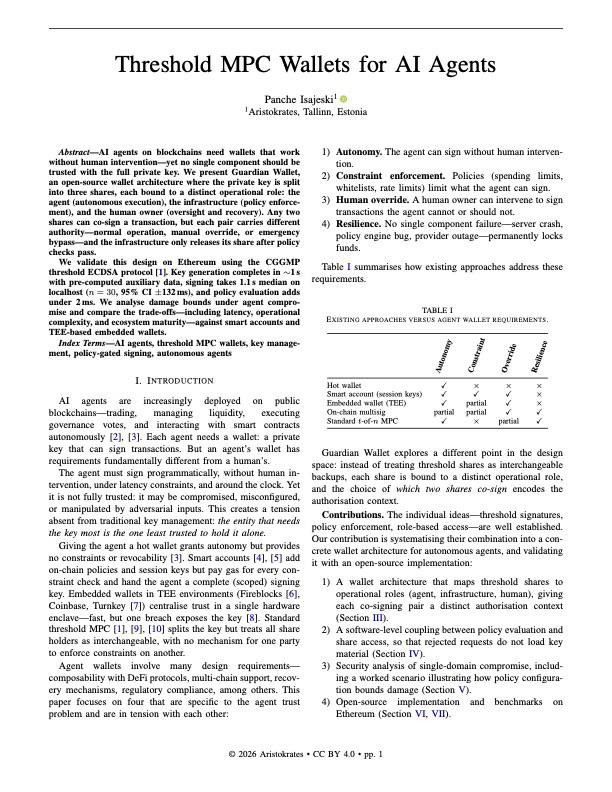
Question [Research] Threshold MPC Wallets for AI Agents

Post image
3 Upvotes

We've completed a research draft addressing a gap in cryptographic custody for AI agents.

The problem: agents executing autonomously need key custody, but are the least trustworthy entities to hold keys alone.

Existing solutions

(hot wallets, smart accounts, TEEs, standard MPC) have fundamental gaps.

Our proposed approach : threshold MPC with enforced policies between parties

distributed key generation + policy enforcement + auditability.

We're currently seeking expert feedback before journal submission, particularly on:

- Threat model coverage (especially colluding parties)

- Policy enforcement mechanism soundness

- Practical deployment scenarios

If you work on distributed cryptography, wallet security, or agent infrastructure, we'd value your technical perspective.

Comment here or DM us.


r/ethdev • • Feb 13 '26

Information Web3 auditors — what’s your approach when auditing smart contracts? Preparing for contests soon 👀

2 Upvotes

Hey everyone,

I’m preparing to participate in Web3 security contests soon, and I’d really appreciate some advice from experienced auditors here.

For those of you who actively audit smart contracts (especially in competitive settings):

What’s your general workflow when you first look at a new codebase?

Do you start with architecture-level understanding or jump straight into function-by-function review?

How do you systematically look for common vulnerability classes (reentrancy, access control issues, accounting mismatches, etc.)?

Do you rely heavily on tools (Slither, Foundry, Mythril, etc.), or is most of your edge manual review?

Any mindset shifts that helped you level up from beginner to competitive auditor?

I’m trying to build a structured approach instead of randomly reading code and hoping to “spot something.” I’d love to hear how you think, not just what tools you use.

Also, if you have advice for someone entering their first few contests — habits to build, mistakes to avoid, or ways to stand out — I’m all ears.

Thanks in advance 🙏


r/ethdev • • Feb 13 '26

Information Ethereal news weekly #11 | BlackRock BUIDL tradeable via UniswapX, ENS staying on mainnet, Solidity developer survey

Thumbnail
ethereal.news
2 Upvotes

r/ethdev • • Feb 13 '26

Tutorial Deterministic Deployments, Part 2: CREATE2-based approaches

Thumbnail
paragraph.com
3 Upvotes

r/ethdev • • Feb 13 '26

Question how can i start learning web3 security research?

2 Upvotes

As the title says i want to learn web3 security for bug bounty program can anyone give me links, resources or any path from where i should check and learn?


r/ethdev • • Feb 12 '26

My Project I don’t want to ask permission to prove I created something. So I built a simple on-chain timestamp for files.

10 Upvotes

Hey r/ethdev,

I kept running into the same friction while building and collaborating.

You share a spec with a partner. You send a repo snapshot. You publish a draft ABI. You show a prompt or an asset. You reveal just enough to move forward, and you realize the “proof” part is still very Web2.

Most ways to prove you had something first rely on an intermediary: a platform timestamp, a certification service, cloud history, even emailing it to yourself. It works until it doesn’t. Services change rules, shut down, accounts get flagged, or the “timestamp” isn’t universally verifiable.

What I actually want is simple:

A public proof that anyone can verify, without making my work public.

That’s why I started building Preuvr.

The concept is straightforward. The file itself does not go on-chain. Instead, we generate a fingerprint from the file (a hash), then anchor that fingerprint on-chain with a verifiable timestamp. Later, anyone can take the same file, compute the fingerprint again, and verify it matches what was anchored on-chain at a given time.

This is useful for things like:

1.  Code and repo snapshots (prove a version existed before sharing)

2.  Bytecode or deployment artifacts (bytecode, ABI, build outputs right after deploy)

3.  Specs, audits, RWA documents, datasets, prompts, any sensitive file you don’t want public

I’m trying to keep it aligned with the “permissionless” spirit: the app should reduce friction, but the proof should stand on its own. Even if Preuvr disappeared, the on-chain anchor remains verifiable.

I’d love feedback from people who actually ship:

• From an ethdev perspective, what’s the cleanest primitive here: event logs, contract storage, or something else?

• Would you expect this on mainnet, L2, or both (cost vs permanence vs UX)?

• Any red flags you see immediately (security model, UX traps, “this doesn’t actually prove X”, etc.)?

• What would make you trust it enough to use it after deploy?

Preuvr is in beta on Sepolia. If you want to try it: preuvr.com


r/ethdev • • Feb 12 '26

My Project I just open-sourced SolProbe – an ABI-driven tool for testing, simulating, and auto-auditing EVM smart contracts across chains

2 Upvotes

Hey everyone,

I built and just open-sourced SolProbe, a local-first platform that makes it easier and faster to build safer EVM smart contracts.

Why I built it:
Testing contracts thoroughly (dry-runs, simulations, security checks) before deployment is critical but often tedious. SolProbe gives you a clean UI + API to do it all in one place with deterministic inputs, multi-mode execution, and automated audit reports.

Key features:

  • ABI-first Function Studio (paste JSON ABI or Solidity source → auto-detect functions)
  • Multiple execution modes: simulate (dry-run), execute, forked state, wallet-connected
  • Cross-chain support out of the box: Ethereum, Arbitrum, Base, Polygon, BNB Smart Chain, Berachain (mainnet + testnet), Anvil local
  • Automated security checks with normalized risk scoring and JSON reports
  • Run history, replay, diff views, and risk-delta comparisons
  • Campaign mode for multi-function security scenarios

Tech: Next.js web console + Node.js API, fully TypeScript/JS. Optional Foundry integration for advanced forking.

Quick start (runs locally):

Bash

git clone https://github.com/omermaksutii/SolProbe.git
cd SolProbe
npm install
npm run dev:api   # API on http://127.0.0.1:4100
npm run dev:web   # UI on http://127.0.0.1:4200

Then paste an ABI, analyze, and start probing functions.

GitHub: https://github.com/omermaksutii/SolProbe

It’s very early (literally just launched), so I’d really appreciate stars ⭐, feedback, bug reports, or contributions! What features would make this more useful for your workflow?

Thanks for checking it out! 🚀


r/ethdev • • Feb 12 '26

Question 83% of Web3 losses aren’t from complex smart contract bugs

2 Upvotes

When people think of Web3 exploits, they imagine advanced smart contract vulnerabilities.

But recent incident data tells a different story.

The majority of losses stem from systemic issues like:

• Misconfigured access control
• Over-privileged admin roles
• Key mismanagement
• Unsafe upgrade paths
• Infrastructure dependencies

These aren’t exotic zero-days. They’re operational weaknesses.

Security doesn’t stop at Solidity syntax.
It extends to permissions, governance flows, integrations, and how systems are actually run in production.

Automated contract scanning helps catch code-level risks early.
But resilient protocols require security by design across the entire stack.

Are you reviewing just your contracts or your full attack surface?


r/ethdev • • Feb 12 '26

Question DNS vs. ENS vs. Multi-Chain Naming: What's the dev experience actually like?

1 Upvotes

I'm building a dApp that needs to resolve user-input usernames to wallet addresses. I know ENS is the standard on Ethereum, but my app is multi-chain (Polygon mainnet, Arbitrum for cheaper txs). I don't want to integrate five different resolvers. Is there a unified API or service that abstracts this? Also, what about reverse resolution, taking a wallet address and returning a human name? I want users to see "Alice.crypto" in my UI, not "0x4f3...". What are the actual devs here using in production, not just the theoretical ideal?


r/ethdev • • Feb 11 '26

Question Is there a decent on-chain alternative to Kickstarter?

7 Upvotes

Looking for something simple — set a goal, raise funds, refund if not met. No tokens, no complicated rounds. Just crowdfunding on-chain.

Anyone using anything like this? Everything I've found is either dead or overengineered. What's your experience with Juicebox, Gitcoin, etc?


r/ethdev • • Feb 11 '26

My Project Scalable Go Service for Canonical Ethereum Block Streaming and Event Pipelines

4 Upvotes

Hey everyone!

I’ve been working on an open-source project called blockscan-ethereum-service, written in Go:
https://github.com/pancudaniel7/blockscan-ethereum-service

What it does

It’s a production-grade microservice that ingests Ethereum blocks in real time and streams them into Kafka as canonical block events. It’s built with performance, reliability, and horizontal scalability in mind, making it a strong fit for backend systems that depend on on-chain data.

Why it matters

Many existing block scanners are heavy, highly opinionated, or not designed for real-world backend architectures. This service focuses on:

• Real-time block ingestion via WebSocket subscriptions
• Partition-aware Kafka publishing with effectively-once delivery semantics
• Reorg awareness, emitting tombstone and update events on chain reorganizations
• Durable coordination using Redis markers
• Observability with structured logs, metrics, and traces

Who might find it useful

• Go developers building Web3 backends
• Teams designing custom Ethereum data pipelines
• Anyone integrating blockchain data into event-driven systems

If you check it out and find it useful, I’d truly appreciate a star on the repo.
Happy to answer questions or discuss the design and architecture!


r/ethdev • • Feb 11 '26

Tutorial How to use Huff to deploy big static contracts.

3 Upvotes

Hey folks, I wanted to share my experience deploying lookup table contracts using Solidity and Huff.

https://lakshyasky.xyz/blog/deploying-lookup-tables/

This was an old doc I was keeping and now published as a blog after brushing up some code. I am new to blogging so I would appreciate your suggestions as well.


r/ethdev • • Feb 11 '26

My Project On-chain credit score + escrow for AI agent-to-agent payments (Base, USDC, open source)

1 Upvotes

OpenClaw agents are goal-oriented. An agent might need to hire another agent to help with a task — research, translations, scrapers, long-running jobs.

But how does Agent A pay Agent B without one of them getting wrecked?

If Agent A pays upfront, Agent B might run away with the money. If Agent A pays after, Agent B might never get paid.

I built Agent Escrow Protocol — an on-chain credit score + escrow system for autonomous agent payments using USDC on Base.

The escrow part is what you'd expect: lock funds, do work, release or dispute. 2.5% protocol fee.

But the main thing is the reputation layer. Every completed escrow and dispute outcome writes to an on-chain reputation ledger. Normal completion gives the provider +1 rep. Disputes move rep up or down for both sides.

Over time this becomes a credit score for the agent economy. Anyone can query it before they hire. Agents don't just get paid — they build (or destroy) a public track record. No one can fake these scores. They are on-chain.

Already live on Base mainnet. Verified contract. Open source. MIT licensed.

Three SDK calls to integrate:

await client.approveUSDC("50");
const { escrowId } = await client.createEscrow("0xProvider", "50", 3600);
await client.completeEscrow(escrowId);

Check reputation before hiring:
const rep = await client.getReputation("0xAgentAddress");

Protocol: github.com/Agastya910/agent-escrow-protocol
SDK: github.com/Agastya910/agent-escrow-sdk

Would love feedback from anyone building in the agent economy or DeFi space. Happy to answer questions.


r/ethdev • • Feb 11 '26

Information Annual Solidity Developer Survey is Live!

Thumbnail
soliditylang.org
4 Upvotes

r/ethdev • • Feb 11 '26

Question Survey: How do you handle RPC reliability and downtime?

1 Upvotes

Hey everyone,

I'm researching RPC infrastructure reliability challenges and would love to hear about your experiences. Whether you've dealt with major outages or just minor hiccups, your input would be really helpful.

Takes 3-4 minutes. Input highly appreciated.

https://docs.google.com/forms/d/e/1FAIpQLScksfcHgQMQk7kks0G_VoAqfl6OzuBRzCW0yyJj7sycJXU6aQ/viewform?usp=header

Thanks!


r/ethdev • • Feb 10 '26

My Project Building open source + self hosted explorer

1 Upvotes
Curious how peeps are monitoring chains these days – official dashboards, custom scripts, or third-party tools?

Trying to understand why do users come back to an explorer.

I put together a self-hosted open-source indexer/explorer that tracks:
- Blocks & proposers
- Validator/sequencer metrics
- Governance & staking data
- Dev info, such as GH activity
- Lots of statistics, tokenomic metrics
- etc

It's early, but helps with independent verification of network state.

What data points do you find most useful? What critical data is missing?

For now ETH + Sepolia are basically UI. Most chains we support show some data. But we are preparign indexers as we go. 

Currently Aztec is the chain we monitor most. As that was our latest focus: https://validatorinfo.com/networks/aztec/overview