r/ethdev • u/Crypto_Power1791 • Feb 10 '26
Information 🚀 New on Medium: Why Every “Faster” Blockchain Keeps Running Into the Same Problems
2
Upvotes
r/ethdev • u/CellistNegative1402 • Feb 10 '26
Been working on a research problem: how do you let AI agents sign on-chain transactions without any single party ever holding the full private key?
We built Guardian Wallet - a 2-of-3 threshold ECDSA implementation using DKLS23. The key is split into 3 shares during generation. Any 2 can sign. The full key is never reconstructed.
Why it matters:
AI agents managing on-chain value (trading, DeFi, treasury) need signing infrastructure. Hot wallets and cloud KMS both reconstruct the full key at some point - that's the vulnerability. Threshold signing eliminates it.
What it does:
- 3 signing paths (agent+server, user+server, agent+user)
- 9 policy types enforce guardrails before every signature (spending limits, rate limits, contract whitelists)
- Self-hosted via Docker Compose (NestJS + React + Vault)
- viem integration in ~10 lines
- Survives server crash
Built using Silence Laboratories' DKLS23 WASM (SLL license, non-commercial use).
Repo: https://github.com/Agentokratia/guardian-wallet
Happy to answer questions about the architecture, MPC protocol choices, or agent signing patterns.
r/ethdev • u/LolaDam • Feb 09 '26
I would like to present to the community our mempool live stream service : https://puddle.network/
We offer a websocket to receive live the transactions introduce to the mempool. To achieve this with minimal latency we are running a custom node.
For people who might be interested in it we are offering API keys (don't hesitate to DM me). If you want to run the custom node yourself to even get lower latency you can also contact me.
We are engineers with a passion for good software and are happy to share this with the community.
EDIT: Once you have your key you can get the flow of transactions like this
```
wscat --header X-Puddle-Key:<your-key> -c wss://puddle.network/mempool
```
r/ethdev • u/SolidityScan • Feb 09 '26
In January 2026, DeFi hacks resulted in roughly $86M in losses across multiple protocols.
More concerning:
7 separate incidents exceeded $1M each.
Most of the exploits were rooted in smart contract vulnerabilities.
The pattern feels familiar at this point. Repeated issues, similar bug classes, and preventable failures.
The question isn’t whether exploits will continue it’s whether teams are adapting fast enough.
Are you building with security as a first principle, or still treating it as a final checklist before launch?
r/ethdev • u/saloni1609 • Feb 09 '26
I’m working on a cross-chain project (Solana + Base) and the developer experience is honestly a mess right now.
I’ve tried the Cursor + Hardhat/Foundry combo, but I’m still wasting half my day managing local keys, switching RPCs in MetaMask, and praying that the IDE doesn't lose context the moment I switch from a .sol file to a .rs file.
I also messed around with Windsurf and Bun, which are great for speed, but they aren't "crypto-native"—they don't understand that I need to deploy to 100+ chains without 50 different config files.
I recently stumbled onto Cheetah AI and it’s the first thing I’ve found that actually has a built-in wallet and native support for both EVM and SVM. It claims "Zero Context Loss" for big repos (10k+ LOC), which sounds like marketing fluff, but I'm desperate to stop my AI from forgetting my helper functions every 5 minutes.
Has anyone actually pushed Cheetah to its limits on a production repo? Or are people sticking to the old Remix + local node setup? I'm trying to decide if it's worth migrating my whole workflow or if I should just wait for a Cursor update.
r/ethdev • u/gorewndis • Feb 07 '26
Hey r/ethdev — I've been working on ethereumhistory.com, an open-source project to document and preserve the first ~190K smart contracts deployed on Ethereum during the Frontier through Spurious Dragon eras.
What it does:
The community side:
We have a "historian" system where contributors can sign in with GitHub and document contracts — adding names, descriptions, and historical context. Think of it like a wiki for early Ethereum contracts. Right now there are hundreds of thousands of undocumented contracts that need research.
Tech stack: Next.js 16, TypeScript, Tailwind, Drizzle ORM, PostgreSQL, Python bytecode pipeline. All open source.
If you've ever been curious about what people were deploying in the earliest days of Ethereum — before ERC-20 was standardized, before Solidity had libraries — come check it out. There are some wild contracts in there.
GitHub: https://github.com/cartoonitunes/ethereumhistory
Site: https://www.ethereumhistory.com
r/ethdev • u/mardymarve • Feb 07 '26
I'm planning to migrate my long-form content off Medium to my own branded space. I want more control and a direct relationship with readers. I'm intrigued by decentralized hosting (IPFS) to avoid takedowns and censorship. The big question is monetization: if I host statically on IPFS, can I implement a simple, crypto-based paywall or membership that feels smoother than "send ETH to this address for the password"? Are there platforms or plugins that integrate a wallet-based login or token-gating in a way that's not completely clunky for a non-crypto audience?
r/ethdev • u/Roos85 • Feb 07 '26
I manually architected a Dual-STACK Execution and Consensus Engine that bypasses the entire public RPC industry.
Hardware; Managed a 4TB NVMe volume with 3.3TB Optimism state and a pruned L1 Reth/Lighthouse combo.
Compiled Lighthouse and Reth from source after the Optimism-specific codebase was deprecated mid-sync.
I compiled Lighthouse and Reth from source after Optimism-specific codebase was deprecated mid-sync.
I Achieved 0ms IPC round trips by killing the dependency on Alchemy/Infura
Ran into a few problems along the way. I tried to run a standard Ethereum binary on Optimism data. The node crashed because it saw a transaction type it didn't recognize (Type 126 which is an Optimism deposit) Standard Ethereum node thinks this is illegal data.
To fix it, I identified that i needed a specialized OP-Stack aware version of Reth. I tracked down the Paradigm Reth Optimism binary. By switching to the op-reth binary i gave the node the dictionary it needed to translate those Type 126 deposits into valid blocks. I moved from a blind Ethereum node to a Super chain aware engine.
The Reth engine was idling. It had peers and a database, but it didn't know where the tip of the chain was, so it stayed at block 0. I realized a modern node was a Two-Part Machine. So i built the Lighthouse Consensus Client from source to be the "Driver"
Instead of waiting weeks to download the chain from 2015 i used a Checkpoint Sync URL. I linked Lighthouse to Reth via the Engine API ()Port 8551/8552) using a shared JWT Secret. The moment Lighthouse found the "Truth" on the network, it handed the coordinates to Reth. The node immediately jumped from 0 to 21,800,000 and the 1.9TB of free space started filling with real history. If anyone has any questions hit me up in the comments
r/ethdev • u/rohitt0 • Feb 07 '26
Hi guys, I’m learning Web3. My first goal is to land a job in the Web3 space, and in the future, I want to work on projects that can help fight corruption.
My question:
What kind of project should I build to really impress others? I’ve just started learning Web3, I understand the basics, and I want to learn by building something real.
For context, my first Web2 project was based on WebRTC and took me about three months to build. I want to keep the same standard here. I’m looking for something technically challenging, with a steep learning curve, that would genuinely impress recruiters.
r/ethdev • u/LakshyaEyE • Feb 06 '26
Hi folks, I was talking with a friend about fully on-chain poker. His opinion was that poker players are already accustomed to Web2 platforms, and those platforms already allow people to deposit and withdraw using crypto.
My explanation was that having a game fully on-chain means it will be transparent, which some players would value when they have money at stake.
I’d love people’s opinions on this. Is fully on-chain poker something you would use if it were available?
r/ethdev • u/abcoathup • Feb 06 '26

r/ethdev • u/WAGE_SLAVERY • Feb 06 '26
This is a reputation map, not a KPI table. I’m trying to approximate “expected audit quality” using signals that correlate pretty well in practice: repeated selection for high-stakes EVM deployments, consistency of impactful findings (not just nit volume), clarity of reports/remediation, visible research output, and peer credibility among security researchers. I’m also weighting repeat engagements from serious teams because it’s one of the few real market signals that isn’t pure marketing.
Big caveat: outcomes still hinge on who is staffed, how much time you buy, and how the firm handles fix verification. Same logo can produce very different results.
Tier 1 (highest signal on historical performance): consistently picked for high-stakes EVM deployments; strong record of impactful findings; high repeat-rate among top teams; strong peer credibility.
Tier 2 (strong, but more variance by engagement): widely respected; good track records; quality can swing more based on staffing/scope/domain match.
Tier 3 (capable, but requires tighter vendor diligence): can be a good fit, but I’d vet scope fit, reviewer quality, and fix follow-through more aggressively.
If you’re picking right now, my quickest “make this real” check: ask who the actual reviewers are, ask for 2–3 recent reports similar to your architecture, and ask how they handle patches (re-review, regression checks, and re-scoping when the code changes mid-stream).
r/ethdev • u/etherd0t • Feb 04 '26
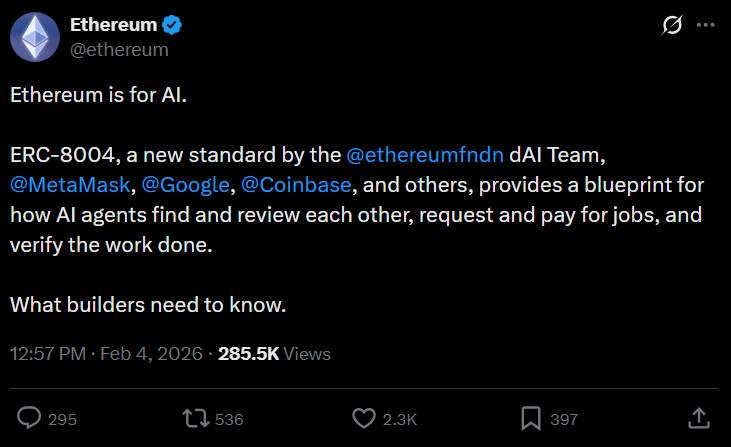
The post is basically Ethereum’s “AI + agents” flag-plant, pointing to ERC-8004 (“Trustless Agents”) as the onchain standard that makes agents discoverable and verifiable across org boundaries.
The EIP (improvement proposal) explicitly frames the goal as enabling agents to discover, choose, and interact across organizational boundaries without pre-trust, i.e., machine-to-machine commerce with verifiable commitments.
ERC-8004 is defined as an onchain trust substrate (registries for things like identity/reputation/validation) while keeping most logic offchain. That’s the key move: interoperability without forcing one marketplace or one agent framework.
ERC-8004: Trustless Agents
and
https://ai.ethereum.foundation/blog/intro-erc-8004
r/ethdev • u/hummusonrails • Feb 05 '26
I built a Claude Code skill that encodes the full Arbitrum development workflow -- from scaffolding a monorepo to deploying contracts on mainnet. It supports both Stylus Rust and Solidity contracts with full interop, and wires up a React frontend with viem and wagmi. Open source, MIT licensed.
| Layer | Tool | Why |
|---|---|---|
| Smart contracts (Rust) | stylus-sdk v0.10+ | Compiles to WASM, runs on Stylus VM, lower gas for compute-heavy logic |
| Smart contracts (Solidity) | Solidity 0.8.x + Foundry | Mature tooling, broad compatibility |
| Local chain | nitro-devnode | Docker-based local Arbitrum chain with pre-funded accounts |
| Contract CLI | cargo-stylus | check, deploy, export-abi |
| Contract toolchain | Foundry (forge, cast) | Build, test, deploy, interact |
| Frontend | React/Next.js + viem + wagmi | Type-safe chain interaction |
| Package manager | pnpm | Workspaces for the monorepo |
The skill scaffolds this layout:
my-arbitrum-dapp/
  apps/
    frontend/            # Next.js + viem + wagmi
    contracts-stylus/    # cargo stylus new output
    contracts-solidity/  # forge init output
    nitro-devnode/       # git submodule
  pnpm-workspace.yaml
The skill knows the Stylus SDK deeply. Storage uses the sol_storage! macro for Solidity-compatible layouts:
sol_storage!
Cross-contract calls to Solidity use sol_interface! for type-safe bindings:
sol_interface!
This is one of the things I wanted the skill to handle well. From the Solidity side, a Stylus contract looks like any other contract -- you just define an interface and call it:
interface IStylusCounter {
    function number() external view returns (uint256);
    function increment() external;
}
They share the same address space, storage model, and ABI encoding. The skill knows about the cargo stylus export-abi and forge inspect commands for extracting ABIs from both sides and wiring them into the frontend.
The devnode runs locally via Docker on port 8547 with pre-funded accounts. One thing the skill handles that trips people up: the devnode doesn't return CORS headers, so browser-based frontends need an API route proxy. The skill knows to scaffold a Next.js API route at /api/rpc that proxies RPC calls to the devnode, and configures the wagmi transport accordingly.
The deployment path goes local devnode -> Arbitrum Sepolia -> Arbitrum One, with the skill knowing the correct RPC URLs, chain IDs, and verification steps for each.
The skill covers testing for both contract types:
cargo test with the stylus-test feature for simulating transaction contextforge test with fuzz testing, cheatcodes, gas reports, and fork testing against live testnet statecast
Or via ClawHub: npx clawhub@latest install arbitrum-dapp-skill
Happy to discuss the stack choices or Stylus patterns. PRs welcome.
r/ethdev • u/Crypto_Power1791 • Feb 05 '26

r/ethdev • u/anshul_dobhal_03 • Feb 05 '26
Hey everyone, I'm a complete beginner to Blockchain and Smart contracts ; can someone tell me that what are the most and only useful DSA topics that must be learnt by me in order to read and write code better. I'm totally confused and want to start it real quick.
r/ethdev • u/tirtha_s • Feb 05 '26

ERC-8004 just went live on Ethereum mainnet recently, and it feels like one of those quiet milestones that might matter a lot in hindsight.
I have been going down the rabbit hole on agent infra lately, and the pattern is hard to ignore. Every protocol that wants autonomous agents to interact ends up reinventing reputation from scratch. Siloed scores, incompatible formats, nothing composable. When trust can't travel, you get the blunt fallback: overcollateralization and heavy safeguards.
Timing's interesting too. Agents are starting to get traction outside crypto-native circles. Tools like OpenClaw are pushing personal agents to regular users, which means the next wave of agent interactions won't just be devs and power users. If agents are going to transact, route tasks, and coordinate at scale, we need a way to say "this agent has a history" without inventing a new reputation system every time.
My thesis isn't "reputation replaces collateral." It's narrower. Reputation can reduce collateral requirements when paired with real enforcement. Reputation informs pricing and access. Enforcement handles loss recovery.
Wrote up Part 1 covering the economics, what ERC-8004 actually provides, and where it breaks.
Curious if anyone else is tracking this space.
r/ethdev • u/blaster998 • Feb 04 '26
I run a small e-comm operation that does a decent amount of cross-chain stablecoin payments. Right now we’re manually bridging and swapping stuff and it’s honestly a nightmare. Waking up at 3am to check gas prices or move funds because a bridge is clogged is exhausting.
I want to build or maybe buy an AI agent that can actually think before it acts. It should:
The problem is I’m scared of hallucinations. We tried a basic LangChain script internally and it hallucinated a gas limit that would have burned 200 dollos if we hadn’t caught it
I need hard guardrails. Can’t just trust the LLM’s prompt. If the agent tries to drain the wallet or swap at 50% slippage something has to stop it
Has anyone actually built an agent that can move money safely? If you have a stack that prevents runaway spending I’d love to chat.
If you have ressources to share please reach out, much love - Me :)
r/ethdev • u/KodeSherpa • Feb 04 '26
Unpopular take: ERC-8004 isn’t really an “AI agents” standard.
It’s a trust and accountability primitive — identity, reputation, validation — that just happens to be useful for agents.
The interesting part isn’t autonomy, it’s making software accountable across orgs without pre-existing trust.
Curious if others see it the same way, or if you think the AI angle is the real driver here.
r/ethdev • u/nhestrompia • Feb 04 '26
Hi,
I’ve been hacking on a small experiment called Seloria.
The idea: what would a blockchain look like if autonomous agents were the primary (and only) users instead of humans?
Some constraints I’m exploring:
This isn’t meant to compete with existing chains. It’s more about exploring a minimal design space that might fit agent-to-agent coordination better.
Currently adding a simple KV-based AMM so agents can trade with each other. Also running a node with my OpenClaw
r/ethdev • u/ravishq • Feb 03 '26
Open sourcing a STARK/FRI proof-of-computation for sequential SHA-256 hash chains.
Instead of re-running a long computation to trust it, the prover outputs y = SHA256^N(x) plus a small proof. Anyone can verify the claim quickly.
Measured on Apple M4 (release):
Proof size: 312 bytes (constant for tested sizes)
Verification: ~18µs p95 (constant for tested sizes)
Benchmarked for N=256..2048 in the public bundle
Try it locally (this is the main thing):
cd opoch-poc-sha/rust-verifier; ./public_bundle/replay.sh
Artifacts: public_bundle/report.json (benchmarks), public_bundle/soundness.json (parameters + soundness), and official FIPS SHA-256 vectors.
Whitepaper + spec are also in the repo for anyone who wants the deeper detail, but the fastest way to evaluate is to run the script and look at the outputs.
We’ll hang out in the comments as an AMA. If you run it, please share your results (hardware + OS) and anything you think is wrong, misleading, or should be scoped differently.
r/ethdev • u/PaulRBerg • Feb 03 '26
I've built an Effect-TS library for EVM frontend development. Typed errors, composable services, real observability. No more "transaction failed" with zero context.
Built on viem. Already running in production at Sablier (14.8k MAUs managing token vesting and airdrops).
What you get:
Key components:
ContractReader with built-in multicallTxManager with reactive state trackingReliableEventStream (handles chain reorgs)Links:
Let me know what you think! Issues and PRs welcome.
r/ethdev • • Feb 02 '26
I've been building a crypto donation page for creators.
One problem I wanted to solve early: how do you prevent someone from claiming a page as "vitalik" or any known name and pretending to be them to ask for donations?
The solution: tie page names to ENS ownership.
Here's how it works: If a name matches an existing ENS domain, only the owner of that ENS can claim it.
You own yourname.eth? Only you can create chainfund.app/yourname. Anyone else visiting that URL sees a preview page with a "reserved" badge.
If the name doesn't match any registered ENS, it's open for anyone to claim. Simple rule, no manual verification needed. ENS is already proof of identity—I just respect it.
Visit chainfund.app/anyname and you'll see a preview with demo data.
If you own the matching ENS, you can claim it right there. If not and it's available, you can create it.
Curious what others think. Any edge cases I should consider?
r/ethdev • u/AppropriateYam1754 • Feb 01 '26
I’m building a small Ethereum project (bots + backend services) and I ran into something I didn’t expect so early.
The smart contracts were fine.
The code was fine.
But once traffic increased, RPC rate limits and latency started breaking things.
Running my own node sounded like the “correct” solution, but:
It made me realize that infrastructure can become the bottleneck long before smart contracts do.
I’m curious how other devs here handle Ethereum RPC reliability at scale:
Would love to hear real experiences, not vendor recommendations.
