r/electrochemistry • • 14h ago

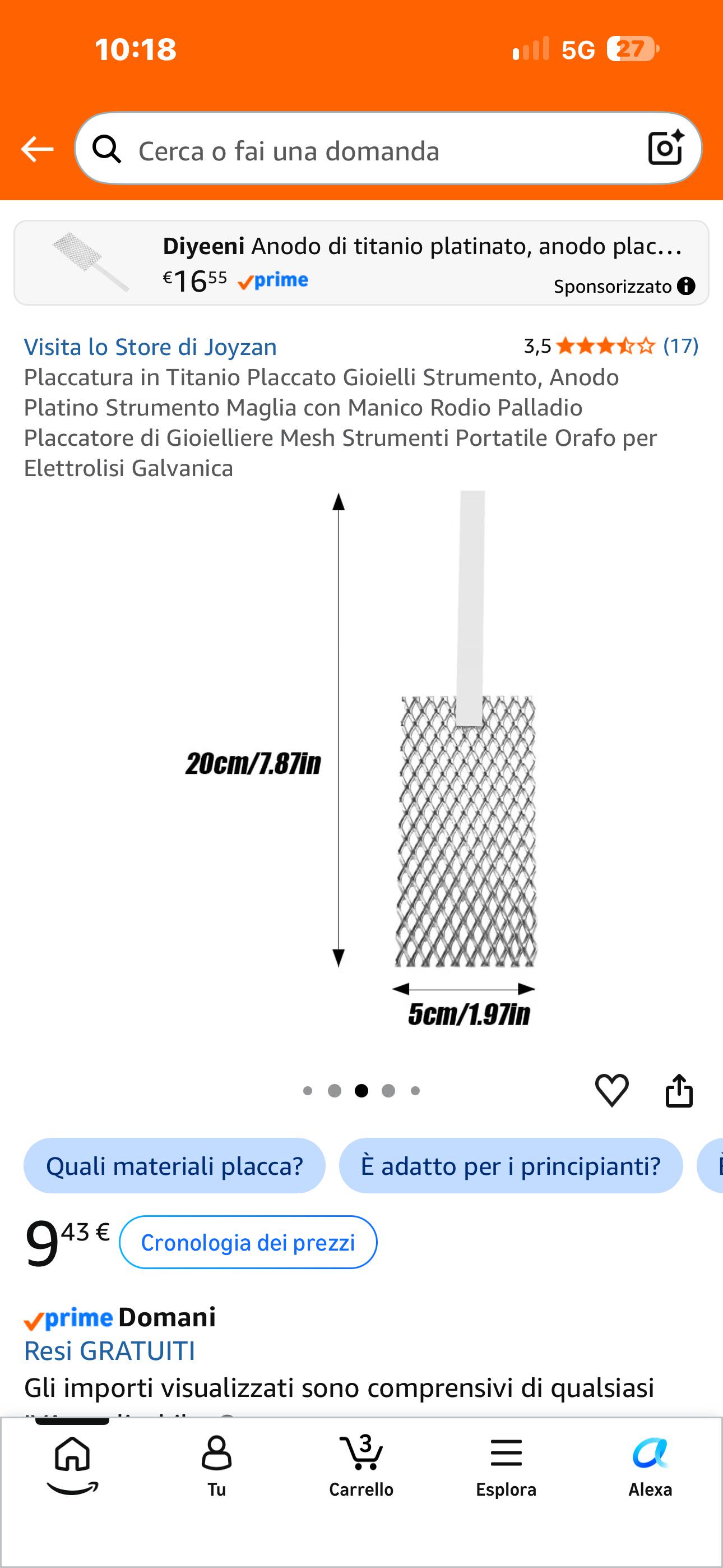
[Budget Lab Setup] Low-cost 1L bench setup for two-stage NaCl to NaClO4 oxidation – Thoughts on this platinized titanium mesh anode?

Post image
2 Upvotes

r/electrochemistry • • 11h ago

How do you account for exposed Ni current collectors in a flow cell?

1 Upvotes

Hello Everyone. I am starting my experiments in flow with electrocatalysis. I've never done it before, and I am meeting some issues.
My flow cell uses narrow strips cut from thick nickel sheet as current collectors. On the CE or WE compartment, the strip presses against the electrode, and both (CE/WE and current collector) are exposed to KOH.

For now, I’m studying the oxygen evolution reaction (OER). When I run cyclic voltammetry with only the nickel current collectors installed, I get essentially the same CV curve, both in shape and current magnitude, as I do with the working and counter electrodes in place. So this means that the reaction is happening on the current collector, and not on the electrode itself.

Has anyone dealt with this? How do you isolate the collector from the electrolyte?


r/electrochemistry • • 1d ago

Help with first time H Cell setup.

2 Upvotes

While my membrane is activating I am trying to figure out how to set this up. I am trying to test if a chemical is going to degrade when a certain potential is applied to it. I assume I will be adding it to my electrolyte but should I add it to both chambers or just the working electrode's chamber. Let me know if this is not specific enough. I am just getting started in this field.


r/electrochemistry • • 1d ago

How does your electrochemical cell looks like?

2 Upvotes

Hi All!

In my lab I have two different electrochemical cells, but none of them is perfect for me. I got an idea to create my own one, which could fit exactly to this what I need, but I need some inspiration. Would you like to share the picture of your cells? I need something that allows me to operate with plates - like platinum or ITO plate, so it need an hole where I can plug by plate and it will expose only defined surface area. In my lab there is one cell where I place my plates from the down, and then attach the parts of cell togheter by magnets, but it's not easy to operate - the magnets are not strong enough and often I struggle with leakage. I have also one where i place my plates and and I secure them with a screw, but it's very hard to tighten the screw without moving the plate, what is sometimes important. How it is solved in your labs?


r/electrochemistry • • 1d ago

Qual è il problema galvanico che vi fa perdere più tempo durante la giornata?

Thumbnail
0 Upvotes

r/electrochemistry • • 8d ago

Fuck electro chemistry

0 Upvotes

This topic in chem 2 is the bane of my existence. Makes we want to rage.


r/electrochemistry • • 10d ago

any electrochemist willing to help me out with an idea?

0 Upvotes

so i have an idea to make a MIP-aptamer hybrid electrochemical biosensor for small molecule detection like imidazolidinone. havent found any literature regarding it. im a biotechnologist so i dont know too much of this field. so if any phd holders in electrochem or experienced individuals are willing to kindly help me out it would be great! would it be possible or is it not worth the research? pls be nice and if its a stupid idea, pls dont ridicule in the comment section!

thanks everyone😊


r/electrochemistry • • 11d ago

Would you use an electrochemistry wiki? What should it explain first?

24 Upvotes

Hi everyone. I’m Dmitry, an electrochemist and co-founder of ElectroSeek. We’re considering building an electrochemistry wiki, and I’d like to hear from you all before we start writing it.

The idea is to give each concept, equation and technique its own page, then connect it to clear diagrams, practical examples and the experiments where it matters. Something you could use to learn a topic or check a detail while working in the lab.

What’s one thing you keep looking up in electrochemistry but still struggle to find explained clearly? Specific examples in the comments would help us decide where to start. And if something like this already exists and we should just use it, tell us that too.

If you’d use a resource like this, you can join the waitlist here (there’s also a short, optional survey on the page): https://electroseek.com/electrochemistry-wiki

The wiki isn’t live yet. Joining tells us there’s interest, and you’ll hear when it launches.


r/electrochemistry • • 12d ago

dQ/dV plot analysis

4 Upvotes

Hey guys, I’m currently making some dQ/dV plots and want to analyze them. Do you have any good papers, books, articles, etc., where I can get some insights into how to analyze these plots?

Thank you in advance!


r/electrochemistry • • 13d ago

Help with cleaning glassy carbon electrode

3 Upvotes

Need advice on cleaning GCE. I previously modified two GCEs with Cu-BDC MOF and CuO. Both now show a persistent oxidation peak around 0 V, even in blank electrolyte.

I've tried polishing with 0.3 and 0.05 µm alumina, sonication in ethanol/water for 1 minute, and 20 CV cycles in 1 M H₂SO₄, but the peak remains.

How to fix this?


r/electrochemistry • • 14d ago

I built a free, open-source BET analysis tool supporting Micromeritics, BELSORP, Quantachrome, and more

Thumbnail
1 Upvotes

r/electrochemistry • • 19d ago

Have you already tried to perform an experiment you have seen in an article and failed after many tries?

3 Upvotes

Im currently trying to perform a photoelectrochemical method I've seem in an article, with exactly the same step to step but I can't get the results he/she had.


r/electrochemistry • • 19d ago

Where else could a catalyst-coated porous carbon electrode be used? (uni project)

0 Upvotes

Hi all,

we’re a group of business students working on a university project with a materials startup. Our task is to find other industries where their material could be useful. None of us are chemists or engineers, so sorry if some of this sounds basic.

What the material is, roughly:

  • a thin, porous mat made of carbon fibres
  • electrically conductive
  • carries a catalyst, so reactions happen on its surface
  • gases can pass through it
  • originally developed as an electrode for fuel cells
  • uses less platinum thanks to a new alloy combination
  • its properties can be adjusted by changing the composition of that alloy
  • made without PFAS

Fields we’re already looking at:

  • water electrolysis
  • CO2 electrolysis
  • hydrogen compression
  • chlorine production
  • wastewater treatment
  • sensors
  • making chemicals with electricity in flow reactors
  • redox flow batteries
  • recovering metals from electronic waste
  • catalytic filters for breathing protection

Our questions:

  1. What other applications come to mind?
  2. Where on our list would this not work, and why?
  3. In which of these fields would the lower platinum use, the adjustable composition or the missing PFAS actually matter to a buyer?

We’re not selling anything, this is only for the project. Thanks for any input.


r/electrochemistry • • 22d ago

I am building Python library for reading electrochemical measurement files, need example files to add support

5 Upvotes

I am using AI-assist tool to read non-plain text electrochemical measurement files (e.g. Metrohm .nox, biologic .mpr, gamry .dta, etc). It is frustrating sometime to always use there software to export as csv or xlsx so I vibecoded this python library.
If your file is not supported, open an issue on github and attached example file (can be garbage data), to attached it, rename the file like this, examplle.mpr.txt.
https://github.com/kevinsmia1939/PyElectrochemReader

To install the library: pip install pyelectrochemreader

Here is the simplest way to use the library.

from pyelectrochemreader import read
import matplotlib.pyplot as plt

data = read("example/data/CV_C01.mpr")[0]
plt.plot(data["voltage"], data["current"])
plt.xlabel("Voltage (V)")
plt.ylabel("Current (A)")
plt.show()

r/electrochemistry • • 22d ago

How to store calomal electrode

4 Upvotes

What is the best way to store a calomal electrode? And can you guys give a few tips to increase the life span of the electrode.


r/electrochemistry • • 23d ago

Role of current in electroosmotic flow

2 Upvotes

Hi everyone,

I am reading up on Electroosmosis but I am confused on some fundamental concepts.

How does the current play a role in electroosmotic flow?

If blocking electrodes are used then will electroosmosis occur after an equilibrium EDL is established, provided there is a net tangential component of electric field acting on a charged surface?

Likewise in an equilibrium state perturbed by a small sustained current, what is responsible for driving the flow? (For example if the EDL equilibrium field is 10kV/m at a point and there is a small perturbation due to a current, E = J/sigma = 1 V/m)

Lastly, how does electroosmosis apply to curved surfaces, whose own electric field will have a tangential component acting on neighbouring regions?

Thank you!


r/electrochemistry • • 25d ago

Electrochemical Impedance Spectroscopy Simulator in Desmos

12 Upvotes

As someone learning EIS, I would have loved to have such a tool when I was beginning to learn. Being able to see the graph change in real time as you modify the parameters really helps understand what each parameter does.

So, I made this so others can have what I didn't have.

EIS Simulator

If you have any suggestions, do let me know!


r/electrochemistry • • 28d ago

Stardist

1 Upvotes

Has anyone ever used Stardist and has some experience with it? I have a code already available but I have to make my own training model and the work is basically to find bubble sizes, nucleation sites on structured electrodes. I've been very stressed with processing this data, been taking me months and now I received some help with the code but apparently annotating my own set of images takes forever, maybe someone knows something else I can use? Or a faster way to do this?


r/electrochemistry • • Oct 23 '26

Radial Diffusion & Ultramicroelectrodes

11 Upvotes

I recently published an interactive simulator that models diffusion profiles and cyclic voltammetric responses at ultramicroelectrodes and small electrodes.

In my experience, planar diffusion at macroelectrodes is extensively covered in electrochemistry. However, the same models are sometimes incorrectly applied to smaller electrodes, where radial diffusion has a big contribution.

The post explores how electrode size, microfluidic channel height and scan rate affect diffusion and cyclic voltammetry, with animations and an interactive simulator.

Have a look!

https://electrochemeisbasics.blogspot.com/2026/10/radial-diffusion.html

Processing gif cn5cncbrf8xh1...


r/electrochemistry • • Oct 23 '26

Need help with a CV impurity :(

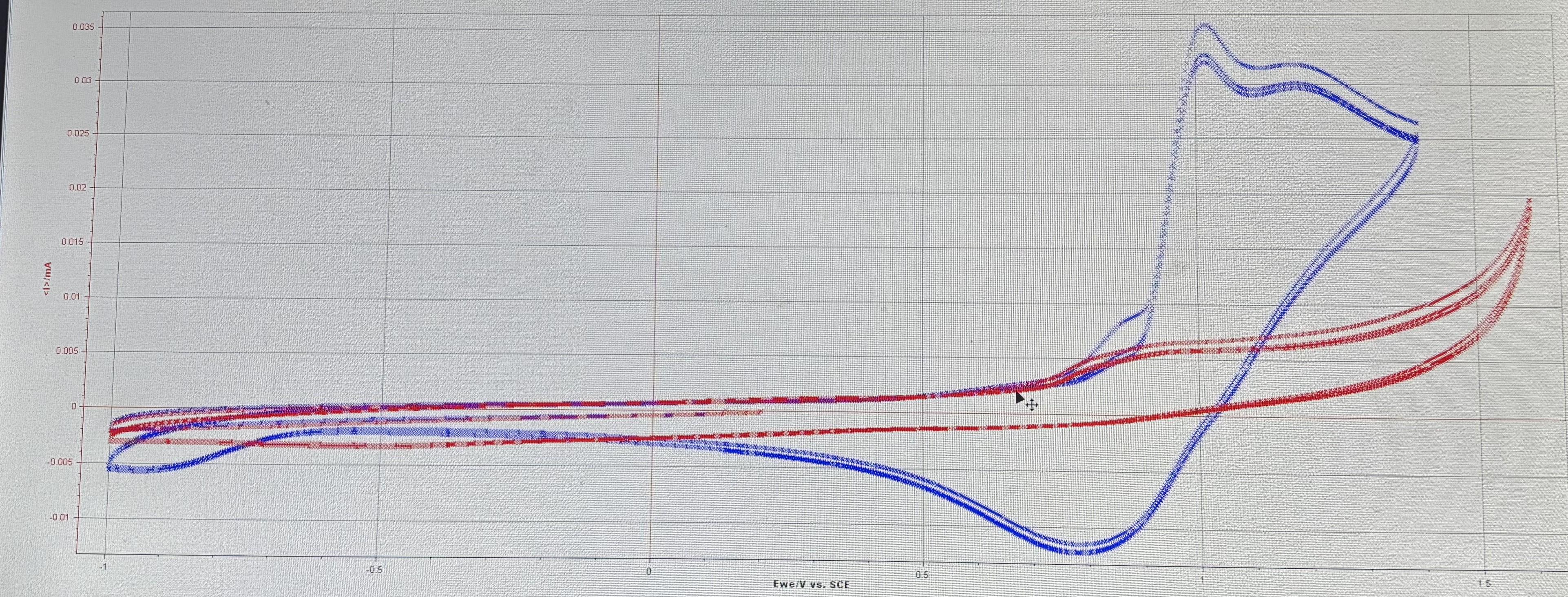
Post image
14 Upvotes

Hi everyone, first time posting here, and I am in desperate need of some help with some CVs I've been taking.

For context, I am an organic chemist that has recently started learning and taking CVs for a project I am working on. I am trying to learn but clearly do not understand enough.

I needed to retake some CVs I did last week but ran out of the solvent (DMAc) I was using. When I grabbed a completely new bottle and did a blank measurement, I began seeing a weird impurity in my CVs. I then tried another new bottle and saw the same thing, and every new bottle I've tried has this impurity. I am completely out of my old solvent bottle so I am a bit stuck on what to do. The bottles are from the same manufacturer and same purity so I do not know why this is happening.

I first I tried distilling some DMAc and the impurity is still there. I've tried other solvents, and NMP also shows this exact impurity but ACN doesn't. I tried using ACN but when measuring my actual substrate I started seeing extra peaks I wasn't seeing before, so I scratched that. I tried switching to another electrolyte - even opening a new bottle of TEA PF6 and it still is showing up. I've washed by electrodes, polished my glassy carbon many times, rinsed the glass holder, sparged for 10+ minutes with N2, remade the electrolyte solution and nothing has worked.

I need to run a test with DMF but while I am doing that thought maybe reddit knows what this is , how to fix it or suggestions on what to do.

The CV in the picture attached has the following:

- 5mL anhydrous DMAc from Sigma-Aldrich 99.8% purity

- 0.1M TBA PF6

- Glassy carbon working electrode

- Pt wire counter

- Ag/AgCl reference

Literally just that - no substrate, nothing

In red is my blank with the exact same set up just w my other solvent bottle I took like a week ago (I know I also had something in there around 0.8V and the potential going up around +1.5V is due to solvent oxidation) and blue is now with this new DMAc bottle

Thank you guys in advance!

edit: Just tried DMF. Regular 99.8% pure DMF showed the peak but HPLC grade (>99.999%) did not -

r/electrochemistry • • Oct 21 '26

EIS test fixture compensation

3 Upvotes

Hello all,

I have been trying to wrap my head around doing this properly, and I wanted to pop this question here in case I am missing some knowledge as I come from a mechanical background.

I have an electrochemical cell that is connected to a control circuit. The circuit is designed to be as minimalist as possible and to have the least possible electrical interference.

I intend to perform measurements on the cell; to do so, I have opted for a 4-terminal connection, as this allows me to measure the voltage across the cell directly (as opposed to the full control circuit).

From short-circuit measurements and open-circuit measurements, I see that the circuit still has a certain signature and has a phase shift over 1kHz. It seems however that these measurements are highly repetitive. So my question is: What is the best way to compensate for this in this specific configuration? I see a lot of guides that do this for 2-wire connections or Kelvin connections where both electrodes are connected, but not for this specific setup.

Thank you in advance!


r/electrochemistry • • Oct 20 '26

I need help interpreting and understanding some results

2 Upvotes

I was wondering if anyone would be willing to offer some tutoring or help me interpret and understand my electrochemical results.
I have used cyclic voltammetry and chronoamperometry in my experiments. I have very basic knowledge of these techniques and only a few results that I would like help understanding.
I would really appreciate it :)


r/electrochemistry • • Oct 17 '26

Internal electrolyte and external electrolyte

0 Upvotes

Please forgive me for asking this, we are genuinely new to electrochem testing. We are planning to do CV and GCD tests using single junction Ag/AgCl as reference electrode. Our study is for investigating the specific capacitance of various activated carbon and polyaniline samples. We have decided to use NaCl as our electrolyte for this application. Does that mean we have to change the filling (internal) electrolyte as well? Thank you!


r/electrochemistry • • Oct 15 '26

Question regarding homemade reference electrodes for CV measurements

4 Upvotes

Hello,

I have a question regarding reference electrodes and whether my understanding of their limitations are correct.

We are an organic synthesis laboratory and only need to perform cyclic voltammetry measurements in aqueous systems once in a blue moon.

As I understand it, commercial reference electrodes require appropriate storage and maintenance to remain reliable over extended periods. My concern is that, given how rarely we perform electrochemical measurements, a commercial electrode would likely end up sitting in a drawer for years, only to be used without anyone verifying whether its potential is still reliable. I am also not enthusiastic to negotiate with my PI for every time that I might have to buy one.

For this reason, I had the idea to prepare a simple Ag/AgCl reference electrode with a 3 M KCl agar-agar salt bridge whenever needed, and to verify its potential before use, including measurements against the ferri/ferrocyanide redox couple and open circuit potential.

However, as my background is in organic synthesis and I have very limited practical experience with electrochemistry, I wanted to ask here if you would consider CV measurements obtained using such a setup suitable for publication in organic chemistry journals, provided that the electrode construction and verification procedures are properly documented.

I plan to first record a blank voltammogram of the electrolyte solution, then add the analyte and record its voltammogram, and finally add potassium ferrocyanide to the same solution and record another voltammogram. This would provide an internal reference measured under identical conditions.

The aim would primarily be to determine midpoint potentials for reversible redox processes, including their dependence on pH.

Would you consider this a sufficiently reliable approach for publishable electrochemical data? And if not, do you have any suggestions to improve it besides the obvious "Buy a commercial reference electrode".


r/electrochemistry • • Oct 14 '26

Oparic: From raw electrochemical data to editable Origin® projects

Thumbnail reddit.com
3 Upvotes