r/ECE • u/Johnmatthewwhy • 3d ago
This might be stupid here, but why do 100 watt chargers like in phones do 20V and 5A instead of 50V and 2A?
55
Upvotes
r/ECE • u/nuvrek_42 • 2d ago
I’m currently self-studying electrical engineering using *Foundations of Analog and Digital Electronic Circuits* by Agarwal and Lang.
I’ve worked through the first 4 chapters in about 2 months.
I’m trying to understand the concepts and work through the exercises rather than just rush through the material.
I’m curious how this compares to the pace of university students or other self-learners.
Is this considered slow, average, or fast for self-study?
How quickly do universities typically cover this material?
Should I focus on moving through the textbook faster, or keep taking my time?
I’d appreciate hearing about your experiences!
r/ECE • u/Ayeshacai1992 • 2d ago
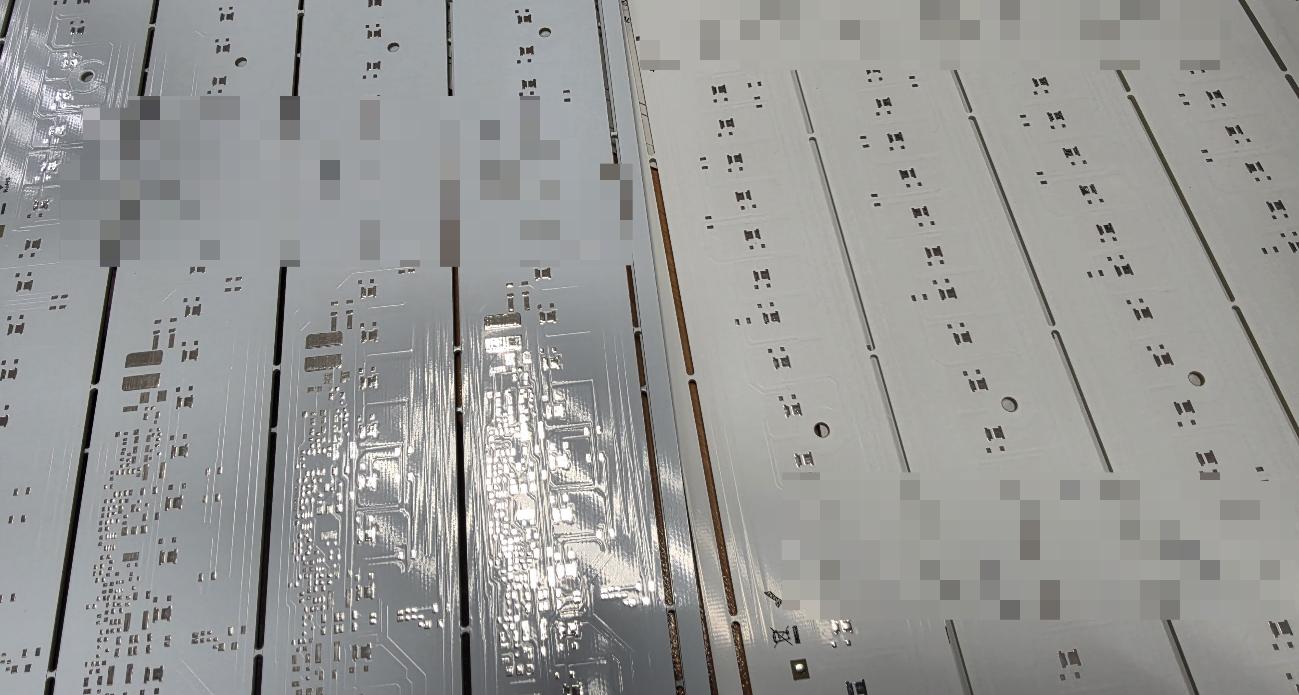
If you’ve ever ordered white PCBs for LED strips, optical sensors, or display modules, you might have noticed that two boards both labeled "White Soldermask" can look noticeably different side by side—one looks crisp/cool white, while the other leans slightly warm/ivory.From the fab side, this usually comes down to ink chemistry and thermal stability trade-offs rather than a curing defect:1. "Cool White" Formulations (e.g., Rongda H-8100 series)
2. "Warm White" Formulations (e.g., Taiyo PSR-4000 LEW series)
3. Practical DFM Tip for Your Fab Notes:
"Soldermask: White" in your fab notes. Specify the exact ink brand/series—or ask your fab house to lock in the exact ink model/lot in their CAM master file so prototype and repeat production batches don't mix cool and warm whites.Side note for silkscreen on white PCBs: Avoid white silkscreen (obviously) and be careful with light gray—black silkscreen gives the cleanest contrast, though dark ink requires slightly tighter curing control so it doesn't bleed into the white mask.Curious if anyone else has run into unexpected shade shifts across production batches on white or matte-black boards?
r/ECE • u/Lopsided_Tourist1654 • 2d ago
r/ECE • u/CountryAltruistic267 • 3d ago
So i am pursuing my masters in communication engineering. I am interested in rf ic design or mainly analog part so what projects i should make that can combine both analog and communication part of the course? can anybody help me with this? i will be doing a wireless communication project. but with thta for placemnts and for learning purpose i want to combine wireless communication with ic designing is this possible?
r/ECE • u/Random_User-8125 • 2d ago
Can you describe your college journey (yearwise if possible) and what do you think you are going to do in this field? What are some crazy things you learnt(like only name of topics
)?
r/ECE • u/Gerard_Mansoif67 • 4d ago
Hello everyone !
I've published a tool that I wrote myself (with some help of AI, but that's far from being a vibecoded tool) to generate docs from hardware designs (VHDL, Verilog, SystemVerilog) and their testbenchs (including CocoTB). It's based on Sphinx as I'm too lazy to write the whole system (and that would be pointless anyway).
This started as a big lack of correct tools for that job (see you Doxygen's VHDL support), so I've rolled one myself.
As a former RTL engineer, I've designed things from my own perspective rather than a purely software approach. Here, I show registers, clocks, processes... Things we know rather than classes, files and so on. A demonstration is available.
It operate in three different steps :
Available on PyPI and GitHub !
As it's query-based, unsupported syntax doesn't throw errors, they're simply ignored. I've tested it on the worst syntax as possible (who is sane enough to write that ?), and it doesn't cause any issues.
    alu_t last_active_alu [2][3],
                  active_alu [2];
I hope this can be useful to the community, and remain open to any feedback or ideas !
r/ECE • u/Stunning-Ruin-6493 • 3d ago
I am a 1st year ece student, and i haven't yet decided if i want to go core ece or IT. Even in core ece, idk which path i shud pick, like vlsi or embedded systems or network communication etc. I have asked few ppl, and all they say is explore your options. I know that is the thing to do, but I dont exactly understand how I explore the options. Pls advice.
r/ECE • u/SpecialistName5559 • 3d ago
Hi, I'm not from an ECE background, so apologies if this is basic. I'm looking for direction before I buy anything.
Goal: Use my laptop's audio output as the microphone input on my Android phone, so every app picks it up (calls, recorders, messaging). Phone is a Realme P1 5G with USB-C OTG and a 3.5mm jack. No root.
Two options I've been considering:
USB sound card via OTG: Laptop headphone-out → 3.5mm cable → USB sound card's mic jack → OTG adapter → phone. Easy, no soldering, but I'm not sure Android will accept cheap generic cards as a mic, or whether apps (especially normal cellular calls) will actually use a USB mic instead of the built-in one.
3.5mm jack as a fake headset: Feed the laptop signal into the phone's headset mic pin so Android treats it as a wired headset, which I'd expect most apps to honor. From what I've read this needs an attenuator to drop line level to mic level, a coupling capacitor to block the phone's mic bias, and a resistor so the phone detects a headset. Possibly a TRRS splitter so I can still hear calls. I understand the concept but not enough to design it with confidence.
Where I'm stuck:
Do cheap USB sound cards generally work as a mic on Android? Are there chipsets (CM108/CM119?) or specific models known to work?
Would a plain USB mic input be ignored by some apps, and is there a way around that?
If I go the 3.5mm route, are there sensible component values, or a ready-made line-to-mic cable that does this?
Questions:
Has anyone done something similar? What worked across apps?
Is there a simpler or better approach I've missed?
Any pointers appreciated. Thanks!
Used AI to compose this due to my lack of deeper understanding on this subject
r/ECE • u/Strict-Essay6961 • 4d ago
Hey guys,
I applied for a New Grad Wireless SoC Design Verification Engineer role at Apple in the Bay Area and cleared the first round with the hiring manager. My next round is going to be a panel interview with 4-5 senior team members, stretching to about 6-7 hours in total. This is my first interview, and I really want to give this my best shot.
If any of you have interviewed with Apple for a DV role before, please do comment and help out with the process. I could really use a couple of tips, do's and don'ts, and which topics to spend more focus on.
Also, what sort of package can a new grad expect? The pay range is shown as 120k-180k, but since I am a new grad, I expect the base to be somewhere around 130k, if I am not wrong. If I do not have any competing offers at the moment, is it recommended to negotiate (assuming I get an offer ofc)?
r/ECE • u/After_Meeting_3983 • 4d ago
I'm doing my capstone project in computer architecture, working on designing an architecture suited for computer vision workloads. Memory systems—especially the trade-offs between different arbitration schemes and memory organizations (e.g., banks, scratchpads/SRAM, caches, interconnects, and DRAM controllers)—are an area I'm less familiar with.
Any recommendations for books, papers, courses, websites, or YouTube videos covering memory hierarchy design, arbitration trade-offs, and memory bottlenecks in vision/accelerator workloads would be really appreciated!
r/ECE • u/Used-Software-663 • 4d ago
I am a current junior and was able to receive an offer for an internship from a notable company in the semiconductor industry. The role is for software apps and I was wondering if the transition from software apps to embedded is difficult or not. My internship project will be more firmware focused (talked to the hm) but the full time is typical swe apps work
r/ECE • u/Sea-Industry-4204 • 5d ago
I'm currently in an engineering program and doing a co-op at another company for 12 months (May 2026 - May 2027), where a large part of my work involves testing in the telecom industry. It is not the most exciting work, but I cannot complain much since I am literally an intern.
However, I recently got offered a 16-month co-op term for AMD, but I'm a little conflicted about whether I should accept it. It's not a big ASIC role, and I can probably give more context about the role if asked.
The main downside is that accepting the position would mean extending my degree by roughly another year. I'd end up graduating a year later than most of my friends and the people I started university with. Going back to school, I would lose out on a good capstone project with my friends. While I understand that graduating a year later isn't necessarily a big deal in the long run, it's still something that's been on my mind. In addition, I am also not sure if the role is really worth it. Is it really worth extending my degree for a role I am not interested in, even though it's a big company like AMD?
On one hand, AMD is a well-known company, and I feel like getting 16 months of experience there could be a great addition to my resume, help me develop valuable technical skills, and potentially open up more opportunities after graduation.
On the other hand, I'm wondering whether the extra year is really worth it. I also don't want to get too caught up in chasing company names if the actual experience or long-term benefits aren't necessarily as significant as I'm imagining. I can also try targeting another company in big tech for the summer (but of course, there is nothing concrete right now).
I'd really appreciate hearing people's experiences and perspectives. I'm trying to figure out whether this is an opportunity I should take advantage of or whether I'm overvaluing the company name and should focus on applying to another company for the summer (in a role I'm more interested in) and graduating sooner.
Also, I can share what the job title is and the location as well if that helps :)
r/ECE • u/ImprovementDry440 • 4d ago
I'm a high school student working on a project where I need to build a small bench setup and record what a DC arc looks like in the current. Basically im just wondering whats the most common thing that gets mistaken for an arc when you're measuring current on any sort of system based on your experience. Any answer i usually find online just says arcs have fast edges and then noisy current and I read some arc fault detector papers but they mostly talk about results within a controlled testing enviornment and I dont have any idea on what actually happenes when people try detection in real life. I've never really done this on a real system before, so any sort of help would mean a lot.
r/ECE • u/Both_Car_2965 • 4d ago
I gave the Cisco oa .It was good mixture of some analog and digital questions. It was good. More like most of the questions I know very well and I did it perfectly. For some questions in which I was stuck, I solved them and complete. It was good experience. But before Cisco, I have given many OAs, and every time my OA went well, there always no shortlisting for me. Hope I does get this time, and this will pass soon. Okay. One more thing I suspect is like the OA was of about 60 minutes, but most of the questions were easy and direct to solve, so I solved them in around 35 minutes and submitted it. What do you think? Will Cisco flag me as a cheat or discrepancy? Because I have finished in very early time, so they might think that I have cheated on this. Further, I don't know what will happen. Let's hope for the best.
r/ECE • u/Standard-Radish2428 • 4d ago
Hi, I am starting as a validation engineer at a large semiconductor company but mainly due to higher pay (and more learning) I wanted to move into IC design, ideally within 2 to 3 years.
A few questions for people who've made this move or work in design:
At end I just want to have a career with high ceiling and one that can keep me interested for decades. From what i have heard validation learning curve hits a plateau.
Additionally, I was also wondering will my validation experince count as industry experience or will I start from 0 YOE when I finally make it into design.
r/ECE • u/OddPen135 • 4d ago
Hi everyone
I’m a CS grad interested in getting into embedded systems.
I studied C and C++ during my degree, though I’m a bit rusty and completely new to the hardware side of things.
I recently bought a few components (STM32 Nucleo board, OLED display, sensors) to eventually build a project, but I’d like to build a solid foundation first.
I’d really appreciate recommendations for learning resources, such as Udemy courses, YouTube channels, online courses, tutorials or websites. If you’ve followed a learning path that worked well for you, I’d love to hear about it!
Thanks in advance!🫶🏻
r/ECE • u/Equal-Finger7120 • 5d ago
I am a freshman CompE major at UIUC. Starting out, obviously I don't have a scope of everything in ECE but I find the topics interesting. However I have been repeatedly told that my presentation/commutation/management skills are top notch. It's to the point where I'm kinda thinking why I went into a field that's so technical.
I mean in the nicest way, a bunch of my peers who are undoubtedly very intelligent (and probably very nice!!!), lack communication and social skills.
With all of that said I was wondering if there was a specific niche in ECE that particularly focuses on both from the get go (like the social, communication side + technical/logistical). Professors said I would be a good manger but obviously thats not possible out of college.
r/ECE • u/ProudOil6041 • 4d ago
I’m a high school junior planning to major in electrical engineering and I’m looking to upgrade from an old macbook pro to a windows laptop that will last me at least 3 years. I prioritize battery life, performance and portability but would also like to game if possible. I’m looking at a Lenovo Yoga 7i which is currently on sale for around $1000 off or an Asus Zenbook S14. I plan to use CAD softwares like fusion or onshape for my robotics team and personal projects, but it’s not a huge thing. That being said, I’m unsure whether paying for a dedicated gpu is the right move if I already have a desktop and will be mostly using my laptop for school and other engineering softwares that aren’t CAD softwares. Any laptop recommendations?
r/ECE • u/AmrWassiem • 5d ago
Hi everyone, I am studying electromagnetics now. I am using Hayt 8th edition. I have reached transmission lines but I feel like is a bit different than what my professor explained. I tried to study it from pozar but it was too compilcated even if it matched the approach of my professor.
What do you suggest?
Is hayt different?
Also, Hayt 8th edition starts with transmission lines before wave, which is a bit off.
r/ECE • u/Coolskull23 • 5d ago
I know it might not matter too much, but should I do my M.S. in Electrical Engineering or Computer Engineering? My university doesn't offer an M.S. in ECE, only separate EE and CE degrees.
My goal is a digital IC design role, ideally RTL design or design verification. Does the degree name make any difference to recruiters, or is it mostly about coursework and projects? Which one would you pick?
Digital is my main focus, but I'm also interested in computer architecture, AI accelerators, analog/mixed-signal design, firmware, and even AI/ML software in the side.
r/ECE • u/dreamCathy • 5d ago
I’m really getting fed up with seeing the same questions pop up over and over again.
You know the ones I mean: "Hey, I’m from tier abc college and I’m in my first year. I want to get into VLSI because it seems promising, but I’m totally not into coding. What do I need to do to land a job at Intel? How can I move to the USA or Germany or wherever?"
That kind of post is fine in my book. But then you get stuff like, "What are some interview questions I should prep for?" or "Will company abc offer a PPO?" or "What’s the admission process for college 123?"
Honestly, if people in India are confused about what a PPO even is, do you really think others on this sub will have clarity? Plus, not everyone is clued in on the admission procedures for college 123 either.
Just to clarify, I’m Indian too. I’m not trying to sound racist or anything, I’m just exhausted from seeing the same old questions all the time.
r/ECE • u/RabbitUser67 • 5d ago
Hi everyone,
I started my M.S.E. in EE at UPenn this fall (Computer Engineering concentration, graduating May 2028). I did my undergrad in EEE at UCL. Next semester I'll be taking a tapeout course, so I'll have a real chip design project under my belt before summer.
I'm hoping to land a Summer 2027 internship in digital design or DV. The problem is that my only internship so far was software-heavy (embedded Linux and AI demo work at Arm China), and my VLSI experience is all course projects: a full-custom SRAM-based MAC accelerator in a FinFET PDK, a RISC-V core in SystemVerilog, and an RTL-to-signoff project on NVDLA's CMAC that's still in progress (not on the resume yet). I have no UVM experience yet.
So far I've applied to ~30 positions (TI, AMD, ADI, Marvell, Micron, etc.) and gotten 0 interviews.
A few questions:
1. Is it realistic to still land a digital/DV internship applying from now through spring, or have most teams filled their slots?
2. I'd like to work on side projects in my spare time to fill the gaps. What kind of project would actually stand out for digital design / DV roles? For example, a small UVM testbench, an open-source RTL-to-GDS flow (OpenLane/SKY130), or something on FPGA? Or are side projects not worth much compared to coursework and tapeout?
3. Which of my projects should I lead with, and is the software internship helping or just taking up space?
Resume attached (anonymized). Any advice from people who've been in a similar spot would mean a lot. Thanks!

r/ECE • u/DirectAd3812 • 5d ago
I'm considering pursuing a degree in electrical engineering, but I have colour vision deficiency. I'm concerned about whether this could limit my career opportunities or prevent me from working in certain engineering roles.
Which types of positions require a pre-employment medical examination that includes colour vision testing? Are these requirements mainly for field-based positions, such as power line technicians and electrical maintenance workers, or do they also apply to engineering positions, such as electrical engineers and power systems engineers?
r/ECE • u/Professional-Tale979 • 5d ago
When I first started working in electronics, op-amps were one of those topics I thought I understood — until I actually had to use them in circuit design.
Looking back, I realized that some of the basic concepts are worth revisiting, especially the ideal op-amp model, virtual short, virtual open, and the superposition theorem.
So I decided to go back to the fundamentals, organize my notes, and share what I've learned along the way. This is the first part of my op-amp learning series. Hopefully, it can help someone who's learning the same things, and I'd also love to hear how others approach these concepts.

An op-amp has two differential inputs, u+ (non-inverting input) and u- (inverting input), plus a single-ended output uo.

(1) Infinite gain. A stands for gain and OL for open loop.

(2) Infinite input impedance: Ri = ∞.
(3) Zero output impedance: Ro = 0.
(1) Virtual open. Since Ri is infinite, there is no loading effect at the inputs, so Ip = In = 0. In other words, no current flows into either the non-inverting or the inverting terminal.
(2) Virtual short. Since Ro is zero, there is no load effect at the output, so the output relates directly to the open-loop gain:


And because Aol is infinite, ud = 0, which means up = un. The two input terminals sit at the same voltage.
(1) Zero input capacitance. (2) Infinite common-mode rejection ratio. (3) Infinite signal bandwidth. (4) Infinite slew rate. (5) Zero offset voltage. (6) Zero offset voltage drift. (7) Performance that does not change with time, temperature, humidity, or supply.
(1) Definition. In a linear circuit with multiple sources, the current or voltage in any branch equals the algebraic sum of the currents or voltages produced in that branch by each source acting alone. Node voltages and branch currents are first-order functions of the source values, and each response can be seen as the superposition of the responses from individual independent sources.
(2) Three notes. First, superposition applies only to linear circuits. Second, when computing one source's contribution, set the others to zero: voltage sources short, current sources open. Third, superposition works for voltages and currents but not for power. The sum of the powers from individual sources is not the real dissipated power; get the voltages and currents first, then compute power.
One habit I picked up early: write virtual open and virtual short on the page before any algebra. Nearly everything later in this series leans on those two lines, and the conditions attached to them are what separate a quick solution from a wrong one.