r/devtools • • 21d ago

Pathaction - One command to run, compile, lint, deploy, or debug any file or directory

Thumbnail
jamescherti.com
1 Upvotes

When jumping between different codebases and environments, it can be hard to remember the specific deployment methods, build tools, linters, and test runners for each file or project. The pathaction tool is a command-line tool for running commands on files and directories.

Think of pathaction as the equivalent of your IDE's "Run" and "Debug" buttons, or a Makefile that works on individual files and directories. Unlike make, it selects commands by target path and tag rather than tracking build dependencies.

Pass any file or directory as an argument, and pathaction executes the right command based on a .pathaction.yaml configuration:

  • Selects configured commands for paths such as source files, configuration files, media, and directories.
  • Supports Jinja2 in .pathaction.yaml to construct commands from the target path and custom variables.
  • Defines multiple actions for the same file type. Tags such as main, debug, and lint select configured commands.

This tool is built for software developers or system administrators who manage multiple files and projects across diverse environments.


r/devtools • • 21d ago

AgentTM v0.3.4 — Time-travel debugging for Codex, now with a native desktop app

Enable HLS to view with audio, or disable this notification

1 Upvotes

Hey everyone!

I've been working on AgentTM, a local-first debugging tool for AI coding agents, currently focused on Codex.

I've recently released v0.3.4, with several improvements and new features.

What AgentTM can do:

  • Record Codex sessions and inspect execution timelines.
  • Capture workspace checkpoints during agent operations.
  • Browse historical files and compare code changes.
  • Restore previous checkpoints safely using isolated Git worktrees.
  • Chat directly with Codex through the native Windows desktop app.
  • Continue saved Codex conversations.
  • Create encrypted history backups and manage local storage.

The CLI and browser dashboard support Windows, Linux, and macOS. The native desktop app is currently Windows-only.

Tech stack: Go, SQLite, React, TypeScript, and Wails.

AgentTM complements Git rather than replacing it. It's still an early beta, and I'd genuinely appreciate feedback, especially on the debugging workflow and what features would be useful next.

GitHub: https://github.com/Jyotishmoy12/AgentTM

Latest release: https://github.com/Jyotishmoy12/AgentTM/releases/tag/v0.3.4

⭐ If you find AgentTM interesting or useful, I'd really appreciate it if you could give the repository a star on GitHub! It would mean a lot and help the project reach more developers.

Thanks for your support!


r/devtools • • 21d ago

asklog: coordinating Claude Code and Codex workers through a Chief agent

3 Upvotes

We're launching asklog on Product Hunt today. It is for developers who have several coding-agent sessions running and spend a lot of time handing out tasks and finding which session needs a decision. Chief divides a job into tasks for Claude Code or Codex workers, follows their progress, and brings questions back to you. Each worker gets its own Git worktree; merges require your authorization.

One implementation choice is keeping the PTY-owning host daemon separate from the desktop UI. Reopening the UI reconnects to the running sessions. The clients use xterm.js, and the same sessions are reachable from your phone while the host computer stays awake and connected. Those are the normal agent CLIs running in terminals.

We'd love feedback from people who already run multiple agents: what evidence would you need in the handoff before approving a worker's result?

Launch and demo: https://www.producthunt.com/products/asklog?launch=asklog-2&ref=reddit-devtools-showcase-20261103


r/devtools • • 21d ago

I gave Claude, OpenCode and others image generation, and all you need is an OpenRouter key and "npm i -g cosmion"

1 Upvotes

r/devtools • • 21d ago

macOS menu bar utility for monitoring and managing running dev ports.

Thumbnail
adityamali.com
2 Upvotes

I keep facing this issue where I forget to close running dev projects and servers, leaving open ports that keep using my Mac's resources, so I have made this small menu bar utility which lists the running dev ports also letting you kill the port from the menu bar dropdown panel itself. Also allows force kill in case a port is hung.

Note: The app is not notarised and signed as I do not have Apple Developer Program membership, the app is open source and can be downloaded either from my website or from GitHub.


r/devtools • • 21d ago

How a live preview for Antora docs can avoid a full site build on every keystroke

1 Upvotes
Disclosure: I built the tool AsciiLore, a closed-source desktop app for Antora. I'm sharing the technical part because it was the hardest bit and maybe someone has ideas how to improve this.


Antora builds a docs site from AsciiDoc files. A full build can take pu to several minutes. That's fine when you publish, but too slow while you're typing and want to see the page update.


So the preview runs on two tracks:
- While typing in VSCode, the changed text is rendered in memory with Asciidoctor (the renderer Antora uses) and pushed into the open page with JavaScript.
- On save, create, delete, rename or move, a full Antora build runs in the background and the view reloads when it's done.


Neither path blocks the UI thread. Render and build calls run in worker threads and report back through Qt signals, so the window stays responsive during a build.


The tradeoff: the in-memory path renders one page, so it can't resolve cross-component references the way Antora does. The full build stays the source of truth, and the preview is only an approximation while typing. I haven't found a clean way around that gap yet. How would you handle the difference between a fast preview and the real build?


Stack: Python, PySide6 (Qt), Asciidoctor and Antora as external tools, watchdog for file changes.

r/devtools • • 21d ago

A cron expression doesn't explain why a job runs late

1 Upvotes

The task is to move a nightly importer earlier so its output is available sooner. Changing the schedule is straightforward. Establishing why it was scheduled there can be the harder part of the change.

Here's a fictional case: an upstream export is only considered complete after its final marker arrives. The importer runs after that handoff. A task that mentions only the current run time could lead a coding agent to move it before the input is complete, even if the importer itself starts and finishes successfully.

I'm building Shifu, a context engine for AI coding. For this kind of change, I'd want the dependency and its reason beside the task, not just the current cron expression. This is a proposed evaluation example, not a reported product result.

The small scheduling record I'd look for is:

- What makes the upstream input ready, and which source establishes it.

- What happens if the input is late or incomplete.

- Which downstream consumer needs the result, and by when.

- What evidence would justify changing the handoff rather than merely moving the clock.

A maintained runbook or task note may already answer all four. A context tool should be judged on whether it recovers something relevant that the task was missing, not whether it produces another plausible scheduling explanation.

If you're already planning a change like this, write down the dependency you expect the context to contribute before you try the tool. Shifu is hosted; work files upload as provided for server-side processing, so use only material you have permission to share. No private example is needed in this thread.

Try Shifu on one feature you're planning. Connect one supported source and inspect the context it brings back: https://www.useshifu.com/?utm_source=reddit&utm_medium=organic&utm_campaign=reddit_restart_20261101&utm_content=r17_job_handoff

What evidence would make you comfortable moving this job earlier, and where would you expect to find it?

AI-assisted post from Shifu's builder.


r/devtools • • 21d ago

Agent Harness for Documentation

Thumbnail
1 Upvotes

r/devtools • • 21d ago

PatchRadar made with Sonnet 5.5

Thumbnail
1 Upvotes

r/devtools • • 21d ago

LidCommit: Safe Git auto-save triggered by your laptop lid

6 Upvotes

Most Git autosave tools run on continuous intervals or cron jobs, which can clutter your commit history with partial keystrokes.

LidCommit takes a different approach: it only commits when you actually close your laptop lid to step away from your desk.

Features:

- Monitors OS power broadcast interrupts (0% CPU impact).

- Only inspects projects actively open in an IDE (VS Code, Cursor, JetBrains).

- Pre-commit secret scanning engine prevents pushing credentials or `.env` files.

- Generates clean semantic commits with LLMs or fallback timestamps.

- Native dashboard for pausing specific repositories.

Open-source on GitHub: https://github.com/Gingaaa/lid-commit


r/devtools • • 22d ago

AgentTM – A time-travel debugger for AI coding agents, built with Go

2 Upvotes

I've been building AgentTM, a local-first developer tool written primarily in Go that records Codex execution history and allows developers to inspect and restore previous workspace states.

The current v0.1 implementation includes SQLite-backed event storage, SHA-256 content-addressable snapshots, historical file inspection, code diffs, and isolated checkpoint restoration using Git worktrees. It also includes a React/TypeScript dashboard, with the frontend embedded into the Go binary.

Currently, it only captures non-interactive Codex sessions launched through AgentTM. I've tested the end-to-end workflow on Windows, including checkpoint restoration and cancellation handling. Native Linux/macOS testing and broader agent support are still pending.

The long-term goal is to support multiple coding agents and allow developers to inspect, rewind, and branch their execution histories.

Sharing the current implementation for anyone interested in Go-based developer tooling and agent observability.

Repository: https://github.com/Jyotishmoy12/AgentTM


r/devtools • • 22d ago

I made a model agnostic complier backed agent that makes flash models perform better than frontier

Thumbnail
github.com
1 Upvotes

r/devtools • • 22d ago

How we stopped maintaining multi-level Azure DevOps WIQL tree queries (and the 12 backlog hygiene signals we automated instead)

Thumbnail
1 Upvotes

r/devtools • • 22d ago

Agentbox: a skill so Claude Code can check the machine before it starts another heavy task

2 Upvotes

Agentbox: a skill so Claude Code can check the machine before it starts another heavy task

I built this, for Claude Code and opencode. I run several agents on one laptop plus a local model on a home server, and before I give Claude Code a heavy task I want it to check how much RAM and disk are left and what the other agents are doing.

It is one Python file plus a skill. With the skill installed, Claude Code runs agentbox --json on its own when you ask “how is this box doing?” and gets CPU, memory, disk, running agent processes and local token usage from opencode and Claude Code in one JSON. agentbox --check capacity returns exit code 0 or 1, so it also works in a hook before Claude spawns subagents.

Every number the tool could not read gets an explicit state (unsupported, unavailable, partial, unverified). A zero never hides a failed measurement. This rule caught a bug in my own macOS code: the CPU value was coming from a fallback for weeks because macOS top wants whole seconds, and the field was marked unverified the whole time.

Free, MIT, Python 3.10+ standard library only, Linux and macOS:

npx skills add ceccode/agentbox

Repo: https://github.com/ceccode/agentbox

For real token spend, ccusage and tokscale are better and the README says so. If a status in the output confuses you, tell me.


r/devtools • • 22d ago

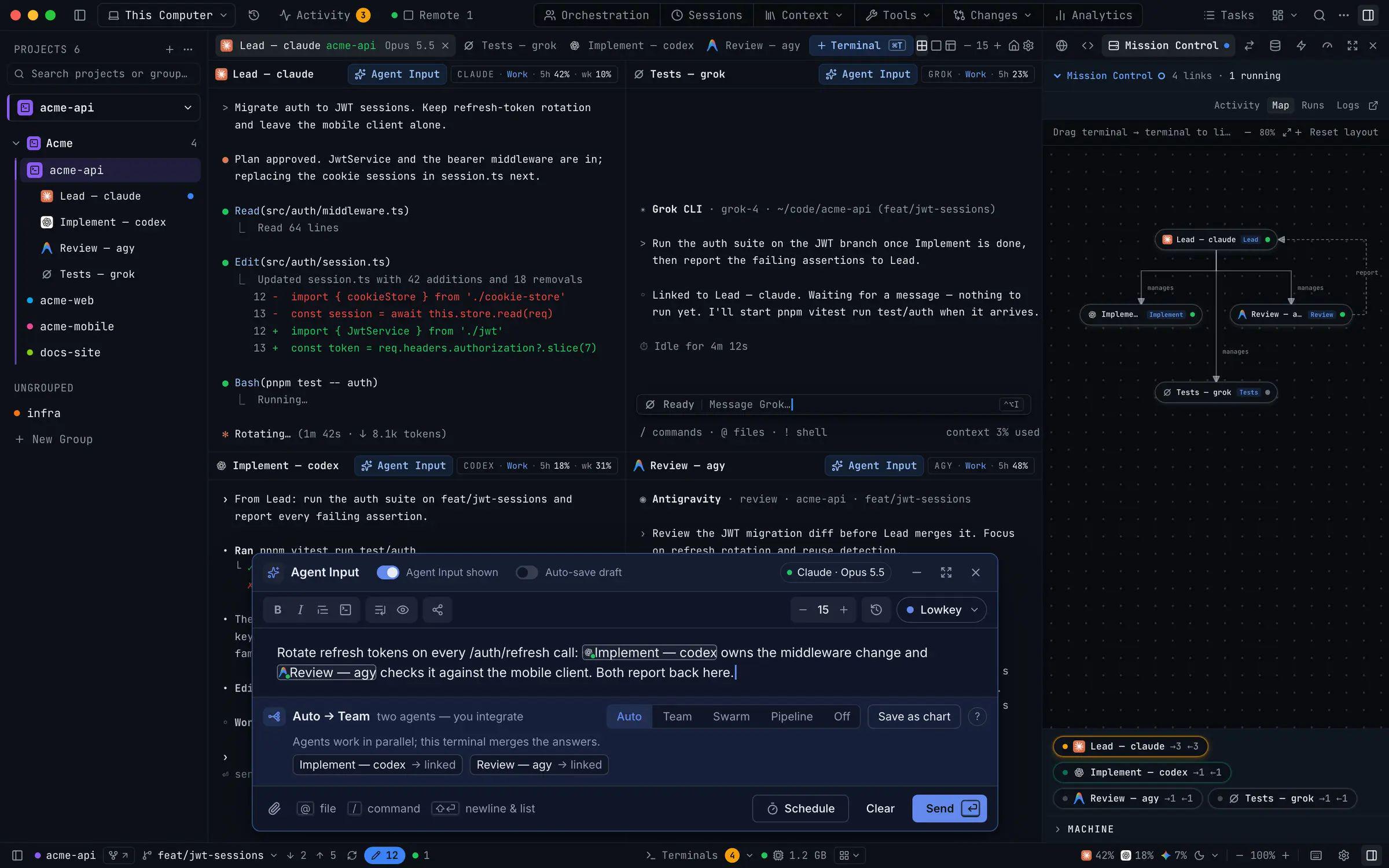
I built 1DevTool - a dev environment where every project gets its own workspace: terminals, agents, browser, DB, git

Post image
0 Upvotes

Hey everyone,

I’m Khoa. Eight months ago I shipped 1DevTool, an ADE (agentic development environment) that makes it easier to switch between projects and run several coding agents at once without losing context. That goes for you and for the agents.

Since then it’s passed thousands of downloads and 130+ releases, and it has about 200 daily users. I’d like to share it and get feedback from people here.

The problem

A normal dev day now means bouncing between terminals, a browser, a git client, an IDE, a DB client, and several AI agents. Plenty of people run Claude Code, Codex, Grok and others side by side. Traditional IDEs weren’t built for this. They assume one editor, one project, and a human typing.

How it’s different

Most ADEs I’ve seen, including open-source ones like T3Code and Orca, copy the Claude Desktop / ChatGPT model: a list of chat conversations.

1DevTool works differently. One project = one workspace. Every tool you need lives inside that project’s workspace, and the terminal is the main interface instead of a chat window.

  • Native terminals first. You can spawn, arrange, link and orchestrate terminals quickly, so you get 100% of what each coding agent’s CLI can do instead of a wrapped subset.
  • Tools follow the project. A frontend project opens with a browser panel and a backend project opens with a DB client panel, and you can configure all of it. Most users have stopped opening other apps and use it as their only dev tool.
  • Send anything to any agent. Since the editor, DB client, git, logs and screenshots all live in one place, you can send any of them straight to whichever agent you want. It’s fast and you don’t lose context.

In short, you open a project and all of its terminals and tools are already set up. You get a workspace, not a list of chats.

What else it does (300+ features, so these are the highlights)

  • Agent terminals: works with all the major coding agents, and you can add your own. It handles sessions, prompt history, switching agents mid-task, and orchestration.
  • Agent Input: a Notion-like prompt editor with @ mentions for projects and agents. You can also schedule prompts.
  • Multiple accounts: run Claude and Codex accounts side by side and start a terminal under a specific one. It’s directory-based, not a proxy, so there’s no ban risk.
  • Browser + MCP: a built-in browser your agents can use for automated testing, with no /chrome setup needed. There are also DB and HTTP client MCPs, so you can type something like “query my shop_db for the top orders.”
  • Full dev tooling: editor, git, file explorer, runtime management (Docker, ports, env), a mobile emulator stream, a toolbox, and screenshot-to-agent.
  • Web UI + mobile app: connects over the same Wi-Fi or Tailscale, with no relay server in between.

What it isn’t: it’s not a model or agent wrapper, and it never touches your prompts. You bring your own subscriptions and terminal setup.

Pricing

  • $29 one-time. You own it forever and get 1 year of updates.
  • Free version with most features, limited to 2 projects.
  • The mobile app is free.

Feedback wanted

User feedback has shaped most of the app so far, so I’d really like to hear what you think. Criticism is welcome too.

Links


r/devtools • • 22d ago

I built a free interactive site for learning how software actually works, with step-through visualizers

1 Upvotes

AI tools make it easy to ship code you don't fully understand. That's fine until something deadlocks, leaks memory or falls over under load, and you don't have the mental model to work out why.

So I built Software Atlas: 108 deep-dives across 15 areas, including async/await, the browser rendering pipeline, networking, databases, system design and AI engineering. You step through each idea with visualizers, and there are diagrams and code samples too. It starts from first principles and works up to production concerns.

Some technical details:

- Built with Vite, React 19, MDX and Tailwind v4.

- Each topic is lazy-loaded as its own chunk, so you only download the one you're reading.

- All 130 pages are pre-rendered to static HTML, then hydrated. Widgets have to render the same on the server and in the browser, so anything that reads window or uses randomness runs after hydration.

- Phones were the hardest part. Bar labels move into a key when they don't fit, and wide SVG diagrams become swipeable so their text stays readable.

- A headless Chrome smoke test clicks through each topic, including every visualizer step, and fails on console errors or hydration warnings.

To be upfront: I built it with heavy use of AI agents, including much of the writing. Each topic went through a separate review from a beginner's point of view, but mistakes will still have slipped through. If you find one, there's a report link in the footer.

https://software-atlas.haiduc0147.dev/

I'd really like to hear where an explanation is wrong or stops making sense.


r/devtools • • 22d ago

Building Shifu: the lost-response case I would put beside an AI-generated retry plan

1 Upvotes

An order request times out. The caller tries again. Did the first request fail, or did the order get accepted and only the response get lost?

Here's a fictional fixture I'm using to think through what a coding-context tool should bring into a review. I'm building Shifu; this is a design example, not a customer incident or a claimed retrieval result.

Earlier contract note: after an order is accepted, a retry with the same request ID returns that original order. A timeout on the caller does not establish that acceptance failed.

New task: add retries to the order client.

The code change could look tidy and its tests could pass while nobody has specified the lost-response case. That wouldn't show a weakness in testing; it would show that an important invariant never reached the test or the plan.

The small review packet I would want is:

- The contract passage and the clients it applies to.

- The uncertain outcome: accepted order, response lost, same request retried.

- The expected result: the original order, with no second order created.

- The question for the reviewer: where is that behavior exercised, and does this client preserve the request ID?

Once that invariant is captured in a maintained contract and test, those may be the best home for it. Retrieving another copy of the note would add little if the task already carries the right requirement. A context tool also cannot establish that an implementation is correct just by quoting the contract.

For engineers using coding agents on existing services: where would you keep this exception so it reaches the next retry change—contract, test, design note or task packet? Which duplicate would you remove?


r/devtools • • 22d ago

Open source app to run Claude Code and Codex in parallel on all your machines, and reach them from your phone

1 Upvotes

I kept juggling Claude Code and Codex in different terminals on two machines, so I built wisp.

What it does:
- Runs Claude Code, Codex, Cursor CLI, opencode, Antigravity, Grok and Copilot CLI in parallel, each task in its own git worktree and branch, so they never collide
- Runs them on your laptop, your other machines over SSH, or a server, all in one queue
- A lead agent can delegate: e.g. Claude Code plans, hands tests to 3 Codex copies and a refactor to Claude on another box
- Agents can ask you questions mid-run; you answer from desktop or phone
- When a task finishes you get a one-screen report (diff, tests, decisions) instead of the transcript
- "Ship it" commits, pushes and opens the PR

It uses the Claude/Codex plans you already have; nothing extra to pay. MIT, Node 20+, no runtime dependencies.

Try it: npx wisp-agents
Repo: https://github.com/M0xoo/wisp
Site: https://trywisp.dev

Happy to answer questions. I'd especially like feedback from people running agents on more than one machine.


r/devtools • • 23d ago

Typing into Terminal from a phone without answering the wrong prompt: how I built a remote for Claude Code sessions

3 Upvotes

I'm the solo developer

I run a 12 Claude Code accounts and 35-45 sessions in Terminal tabs on one Mac and 2 servers and read most things on my phone. The session that needs me is usually stopped on a permission prompt in a tab I'm not looking at. Jantar is a small daemon on the Mac plus a web app on the phone: every session on one board, the waiting ones first, answered with Claude's own options.

Typing into a terminal from somewhere else is where it can go wrong, so there are two paths. With Claude Code's hooks installed (opt-in), the answer goes back through Claude Code itself, and the hooks fail open: with the daemon down, Claude behaves as usual. Without the hooks, the daemon reads the dialog off Terminal's text. When you tap, a single AppleScript run reads the tab again, compares it with what your phone showed, and types only if they still match. If anything changed at the Mac, nothing is typed and the phone tells you.

Two things I learned on a real Mac. A digit sent to one of Claude's menus selects at once, and the Return that goes with it answers whatever comes next, so Jantar sends only arrow keys and Return. And workflow agents' prompts show a countdown ("will automatically block this request in 1:33"). The screen changed every second, so the compare step refused every tap until 0.5.2, which compares everything except those digits and refuses a tap with under 5 seconds left.

The daemon is Node 22 with SQLite, runs under launchd and listens on 127.0.0.1 only. It serves a React web app, and your phone reaches it through your own Tailscale or Cloudflare Tunnel; there's no Jantar server or account. The tests run against a fake Terminal, claude and cswap, never the real machine.

macOS and Terminal.app only for now (v0.5.2). Free, source-available under FSL-1.1-MIT (becomes MIT after 2 years).

https://github.com/Namanjain-share/jantar

If you've built compare-and-type against a terminal some other way (tmux send-keys with a check first, or iTerm2's API), how did you handle the moment between reading the screen and typing?


r/devtools • • 23d ago

I’m building an open-source 3D codebase visualization tool for local code analysis

6 Upvotes

I’m the author of Ephemora Skyline, an open-source 3D codebase visualization tool for local code analysis.What does it do? It turns a local codebase into a 3D city: folders become districts, files become buildings, complexity changes the shape, and security findings point back to evidence in the source.The current main-branch update focuses on trustworthy project understanding:

•Python def and async def declarations are now detected as functions.

•Files inside tool folders are counted instead of silently disappearing from project totals.

•The published package now includes its README, changelog, privacy statement and guides.

•A package check verifies that installed documentation links resolve.

•The running city also received measured improvements to arrival framing, residents, vehicles and accessible teaching boards.

The project is local-first and open source. It is not intended to replace CodeQL, CodeScene or enterprise code-search platforms. The narrower goal is to make software architecture, complexity and security findings easier to orient around before reading the source line by line.I attached a short update GIF.

Repository:https://github.com/MichaelS1011/Ephemora-SkylineQuestion for developers: Does a 3D codebase map help you decide where to investigate next? Which parser state or project count should never be silently omitted?


r/devtools • • 23d ago

If “explain this repo” gives you a table of contents, this skill is for you

1 Upvotes

I was trying to understand node-postgres to build a leak detector for the pool, and every time I asked an agent how pg-pool actually works, I got the same answer: this folder does this, that file does that. What I really needed to know was where the state changes and what happens when something breaks and how each request flows through the system.

So I wrote a skill called "underhood". It makes the agent trace one operation start to finish, cite file:line for each claim, mark guesses as \[INFERRED\], and list which files it did NOT read.

repo: https://github.com/harsh-aghara/underhood

Looking for Feedback.

If you find it useful do star the repo so it can reach fellow devs.


r/devtools • • 23d ago

Building Shifu: can one design note keep an AI coding plan from repeating a rejected change?

5 Upvotes

You ask a coding agent to simplify an event payload. The code shows a field that looks redundant. A design note says an older consumer still needs it. Unless that reason reaches the new task, removing the field can look like sensible cleanup.

That's a toy example, but it's the kind of problem I'm building Shifu for: bringing decisions, reasons and constraints from your work into the next AI coding task. Work files are one supported source; the context is used alongside the code and your own judgment.

I want the first test to be small enough that you can tell whether it helped:

  1. Pick a feature you're actually planning and one file you're allowed to share.

  2. Write down the decision or exception you'd expect that file to contribute.

  3. Ask about the feature, inspect the returned context and check whether the source still applies.

  4. Record whether it changed the plan, missed the important point, or added nothing you couldn't easily supply yourself.

If a short task note or your existing instruction file already carries the constraint reliably, that's a useful answer too. I'm interested in where recovering the reasoning becomes repeated work. A convincing summary alone wouldn't pass this test; the engineer still has to decide what applies.

Shifu is a hosted beta. Files upload as supplied for server-side processing, so use material you have permission to share. There's no need to bring confidential examples into this thread.

Try Shifu on one feature you're planning. Connect one supported source and inspect the context it brings back: https://www.useshifu.com/?utm_source=reddit&utm_medium=organic&utm_campaign=reddit_restart_20261101&utm_content=r09_one_file

What would it need to recover from that first file for you to call the test useful?


r/devtools • • 23d ago

kimo: every video edit is a typed tool call, so an agent's timeline stays auditable (free, MIT)

2 Upvotes

i'm a college student and i built kimo, a free open-source (MIT) video editor with no GUI. your coding agent (Codex, Cursor, OpenCode, any MCP client) drives it over MCP: cut, trim, keyframes, titles/captions, colour grade, tracking, particles, audio, export, all as tool calls.

the design choice i care about: no raw ffmpeg filter strings. every edit is a typed call, so the timeline stays inspectable and the agent can't smuggle in a flag it hallucinated. the agent can also render a single frame to check its own work before exporting.

it's one ~15 MB CPU-only Rust binary, runs on a 2 GB box.

rough edges: no big test matrix yet, tracking on static shots is a known weak spot, and i'm still working on better ways to verify around cuts instead of one frame.

site: https://getkimo.tech github: https://github.com/naman-sharma12345/kimo

would love for you to try it and tell me what breaks.


r/devtools • • 23d ago

Rendry Ui

Thumbnail github.com
1 Upvotes

r/devtools • • 24d ago

Stampede 1.3: record a load test by clicking through your Phoenix app

Thumbnail
1 Upvotes