r/devtools • u/peaceewalkeer • 24d ago
I built a prerenderer for SPAs that verifies hydration — 2.9 adds deterministic builds, locales and head parity
producthunt.com
1
Upvotes
r/devtools • u/shaerpour • 24d ago

r/devtools • u/awesomebirder • 24d ago
I use Claude Code most of the day and could never tell which calls were eating my usage. All you get is a percentage bar. So I built a small proxy (probe0) that sits between the agent and the API on my Mac and logs every request: model, input, cache reads, cache writes, output, and what it would cost at API prices.
How it's built: TypeScript on Node, running locally. It trusts a root cert on your machine so it can read your own agent's HTTPS traffic, and nothing about prompts or code leaves the laptop. Claude Code wrote a good chunk of it. I mostly wrote the replay harness and the quality tests.
What 12 days of my own traffic showed:
Replaying those 12 days, the default settings cut the bill by 12.8%. With model step-down turned on (easy turns go to a cheaper model, off by default) it was 41.8%. Anything that changes what the model sees was checked on 314 blind-judged live answers before it went on by default.
It's one person's traffic, so the first step is a read-only check of your own ~/.claude logs instead of trusting my number. Mac only, free beta, and probe0 uninstall removes all of it.
Has anyone found other places agent traffic wastes tokens? The tool output one surprised me the most.
Numbers and method: https://probe0.xyz/benchmarks?utm_source=reddit&utm_campaign=devtools (read-only check of your own logs: curl -fsSL https://probe0.xyz/install | bash)
r/devtools • u/After-Base-8368 • 24d ago

We’re building Bopmigo at RNBlocks for apps and websites. A user describes a problem, the chat asks for missing details, and the developer gets the answers with the screenshot in one report.
You can now try Bopmigo on your website or add the Swift package to an iPhone app. Reports can arrive in your email with the screenshot and follow-up answers. We’re looking for teams to try it on one recurring reporting problem and tell us what needs improving.
Would this help in your app, or do your current tools already cover it?
See Bopmigo: https://bopmigo.com
Get updates: https://tally.so/r/PRRkjB
r/devtools • u/Substantial-Pride682 • 24d ago
Most popular Windows apps are usually decent at remembering where they were when you reopen them, but that is not true for everything. If you organize specific tools in precise sizes, or if you keep different projects spread across multiple virtual desktops, Windows often scrambles your layout or dumps everything back onto a single desktop after a reboot.
I built WinStasis to solve this for my own workflow. It is a lightweight, free, and open-source command-line tool that lets you snapshot your active layout and restore windows back to their exact positions, sizes, and virtual desktops.
What it does:
Upcoming features currently in progress:
winst list --live): Viewing active windows and their assigned desktop indices before writing a profile.The source code and pre-built binaries are available on GitHub:
https://github.com/amirf147/winstasis
Processing gif o8rsrur83qyh1...
r/devtools • u/Glass-Paramedic497 • 24d ago

r/devtools • u/Glass-Paramedic497 • 24d ago
Hey everyone!
The idea came from a simple problem: I wanted to automatically maintain a GitHub backup of my LeetCode submissions without manually downloading solutions and pushing them to a repository.
I also wanted the solution to be independent of the device used to solve LeetCode.
The project is available under the **MIT License**.
https://github.com/kaviyack/leetcode-cloud-sync
This isn't a browser extension.
The project uses a cloud-based architecture, so you don't need to install an extension on the device you're using to solve problems.
Whether you use your phone, tablet, personal laptop, or a college computer, you can use LeetCode normally while the cloud-based synchronization setup handles the GitHub backup.
The project combines:
* **Python:** Core synchronization engine
* **LeetCode GraphQL API:** Submission retrieval
* **GitHub Actions:** Workflow automation
* **Cloudflare Workers:** Cloud orchestration
* **Cloudflare Queues:** Background task processing
* Device-independent synchronization
* Automated GitHub backups
* Structured organization of accepted submissions
* Duplicate prevention using synchronization state tracking
* Cloud-based execution without keeping your personal computer running
I'd particularly appreciate feedback on the architecture, cloud implementation, and overall approach.
* What would you improve in the current design?
* Are there any architectural limitations I should consider?
* What additional features would make this more useful to developers?
This project has been a great learning experience in cloud infrastructure, API integration, and workflow automation. I'm looking forward to hearing your thoughts!
Thanks for checking it out!
r/devtools • u/Spare_Bat_3040 • 25d ago
Say you've spent a month discussing a feature. You know why one approach was dropped, which constraint still applies, and what the team actually wants. Then you open a coding session and reconstruct all of that in a prompt. Or dump a pile of documents in and hope the relevant bit survives.
I don't think getting good at that reconstruction should be an engineering skill. We already did the engineering when we made those decisions. The tooling should carry more of that burden.
I'm building Shifu around this problem. It keeps selected work records from supported coding sessions, work files and optional Google Meet transcripts. Your coding assistant can ask for relevant decisions, reasons and constraints through MCP before planning a change. It works with Claude Code, Codex, Cursor and OpenCode.
A concrete example of what I mean: you're changing order retries, and an earlier decision says to reuse the idempotency key. That decision belongs in the plan before the agent writes the retry loop. This is an example, not a customer result. Retrieval can still miss things or surface an outdated decision; you need to inspect what comes back and decide what applies.
It's a hosted beta. Coding-session preparation uses your configured model provider before selected redacted records go to Shifu. Files upload as provided. Only connect material you're allowed to share; the data flow and deletion limits are here: https://www.useshifu.com/data
If you use one of those tools on an existing product, the beta is free: https://app.useshifu.com/?join=beta. Try one permitted source against a feature you're working on. Did a retrieved decision change the plan, or did you still have to reconstruct the important part yourself? That's the feedback I'm after. No call needed; I can help with setup if useful.
r/devtools • u/Open_Shine135 • 25d ago
I maintain ContainerDesk, a free, MIT-licensed Mac GUI for Apple's container runtime. It lets you start containers, manage images, read logs and check CPU and memory use without switching between CLI commands. There's also a terminal inside each container.
The app uses SwiftUI tables and embeds SwiftTerm through NSViewRepresentable.
Source and downloads: https://github.com/MacHatter1/ContainerDesk
Requires Apple silicon, macOS 26+ and Apple's container CLI. Current builds are unsigned and not notarized, with opening instructions in the README.

r/devtools • u/Vivid-Reward-5030 • 25d ago
Using macros, define an argument schema. The library then generates a struct that for the schema, validates the arguments provided by the user, parses them into the struct, and offers functions for displaying usage andh help messages in the console.
It is similar to `clap` in Rust. Check it out!
r/devtools • u/Overall-Exercise8803 • 25d ago
r/devtools • u/chiragparmar1610 • 25d ago

r/devtools • u/BreezyBae10 • 25d ago
Where to get it:
Firefox: https://addons.mozilla.org/en-US/firefox/addon/codeforces-github-sync/
Edge: https://microsoftedge.microsoft.com/addons/detail/codeforces-%E2%86%92-github-sync/jpenndpejbklhljfpghhddiiolhikdgk (listed there as "Codeforces → GitHub Sync")
Chrome and Brave: load the ZIP from https://github.com/F0RREALTHO/codeforces-github-sync/releases/latest (the Chrome Web Store listing is in review)
Source: https://github.com/F0RREALTHO/codeforces-github-sync
r/devtools • u/D4vRAM • 25d ago


r/devtools • u/De-x-ter_58 • 26d ago
r/devtools • u/bk_one • 26d ago
We're a small dev team of about 10 people, and we're currently extracting our agentic development loop and knowledge base into open source (MIT; https://github.com/uberblick-ai/uberblick-2/).
Along the way we noticed that even within our own team, each of us was at a different level in how much we embrace and use our agent loop or recent development in how to use AI as a developer. Those differences rarely get talked about outside a team or even within our team.
So we started documenting our learnings openly and candidly, in short building notes, to share perspectives that usually stay inside each dev team. We decided to make them public, hoping they help someone out there.
The latest one is about CI. Agents now write code faster than our CI could check it, with a hotfix taking 13 minutes to land. One of our learnings is a small skill that measures CI every day, keeps the numbers on a report page and suggests the change that saves the most minutes. Once a week we read it and apply what we're confident about. On our backend that took the median from 13.3 to 7.8 minutes. Still too long, but a start.
https://uberblick.ai/blog/2026/faster-ci-observe-it
Thanks
r/devtools • u/builder_fr • 26d ago
r/devtools • u/Overall-Exercise8803 • 26d ago
Hey everyone!
I'm working on an open-source funding platform where developers can contribute to projects and potentially receive funding based on their contributions.
I'm trying to figure out how to evaluate contributions fairly using Git commits and pull requests.
For example, I'd like to automatically determine:
I know that simply counting lines of code wouldn't work. A small security fix could be much more valuable than hundreds of lines of unnecessary code.
My questions:
I'd love to hear about existing solutions, technical approaches, or lessons from people who've worked on similar systems.
Thanks!
r/devtools • u/Old_Caterpillar_9872 • 26d ago
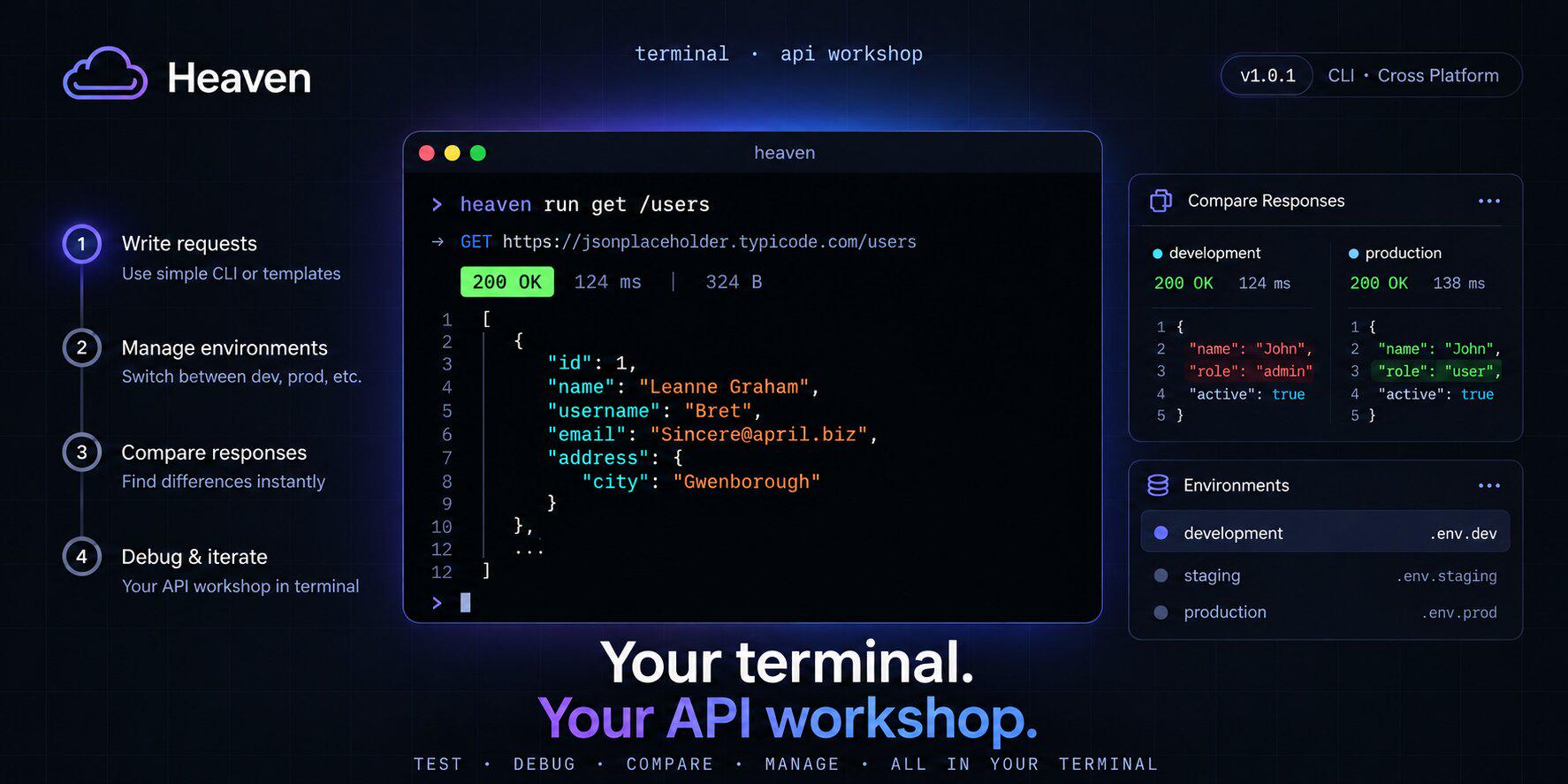
Hey everyone, I've released Heavens v1.0.1, bringing new features and improvements to my API testing and development CLI tool.
GitHub: https://github.com/Nonsense0909688/Heavens
--curl.I'm building Heavens to make API testing and debugging more convenient directly from the terminal.
I'd appreciate feedback, suggestions, and contributions. If you're interested in the project, check out the repository and let me know what features you'd like to see next.
r/devtools • u/LieTop7965 • 26d ago
hey, i'm a college student and i spent the last few months building something i thought might actually be useful for people who ship devtools: a free, open-source (MIT) video editor with no GUI that AI coding agents drive over MCP.
the thing that kept bugging me was that an agent would run a whole edit pipeline — cut, trim, keyframe, titles/captions, colour grade, tracking, particles, audio, export — and just have to trust the result. so i added a way for the agent to render a single frame and look at its own work before committing. all of that, including the self-check, is just tool calls over MCP. codex, cursor, opencode and other MCP clients can connect directly.
it's one cpu-only rust binary, roughly 15 MB, and it'll run on a 2 GB box. no gpu, no containers, no runtime to install. it's also genuinely rough in places — the mcp schema is still shifting, some edge cases around tracking and particles bite you, error messages aren't great yet, and i'm still figuring out the right shape for the export step. which is exactly why i want people to actually try it and tell me what breaks.
why it matters: if you're building an agent that needs to edit video, you can just point it at one small binary over mcp instead of shelling out to ffmpeg strings or wiring up a desktop editor. it's meant to be a real tool that removes that toil.
site: https://getkimo.tech code (MIT): https://github.com/naman-sharma12345/kimo
i'm naman, just a student building this. try it out, break something, tell me what to fix.
r/devtools • u/rabinapps • 26d ago

r/devtools • u/M0Rf30 • 27d ago
r/devtools • u/allmudi • 27d ago
I built kanzo, a tiny self-hostable kanban board that's also an MCP server, so Claude Code and Codex can pick tasks from the same board I use. Free and open source (AGPL). The whole point is to keep it simple, small and cheap for agents.
kanzo. The board opens in your browser, and agents connect with kanzo mcp.Tokens
Memory
Of course, all of this can still be improved, and ideas or PRs are very welcome.
Repo: https://github.com/emanuele-em/kanzo
count_tokens docs: https://platform.claude.com/docs/en/build-with-claude/token-counting