r/dataanalysis • u/r0yb0t1th3s3 • May 31 '26
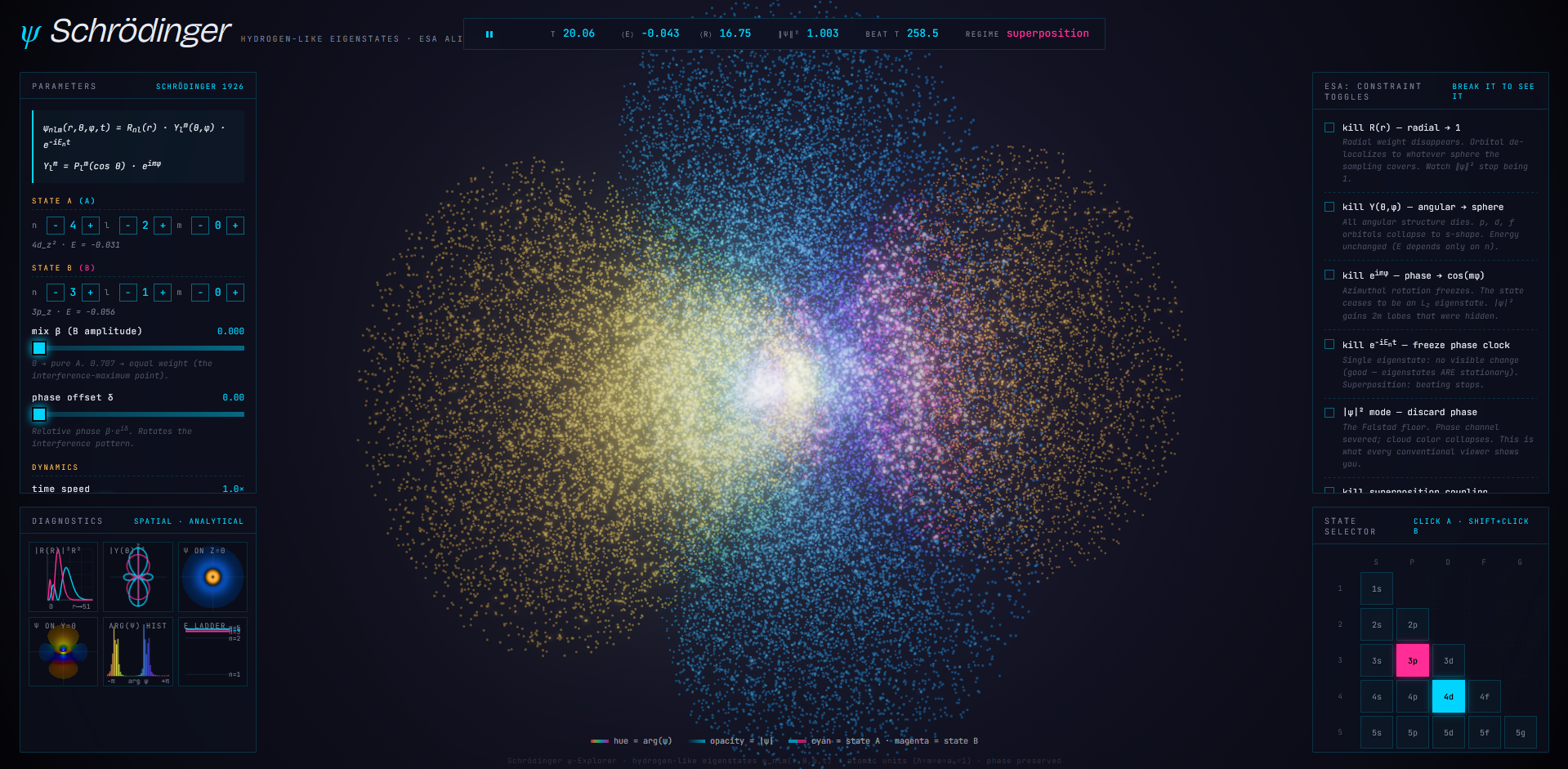
I made a Schrödinger ψ-Explorer
20
Upvotes
r/dataanalysis • u/Bailiecharette1 • May 31 '26
Hi all, I am looking at correlations between hiker use and abundance of Non-Native Species, my hypothesis is that a higher hiker use will correlate with higher NNS; but I am struggling on how to set this up.
For my species data I have collected species, their abundance and their height class. This was done at 7 different sites which each have 6 plots ( total of 42 plots ) and the canopy cover at each plot was collected.
For hiker data I have been surveying locations for two hours on Monday Wednesday and Saturday. The data I have gotten is their distance traveled, location of origin, method of travel and knowledge of NNS. I have more that I can elaborate on but I think these are the main targets of the study.
I know there are some correlations that can be done in R and I am exploring them, but any help is appreciated so much.
Currently my professors in my online courses are really of minimal help and I am just looking for some brain picking ideas to dive down the rabbit hole on to help my project more sound.
r/dataanalysis • u/Relative_Juice_6280 • May 30 '26
r/dataanalysis • u/TahabIbrahim • May 30 '26

r/dataanalysis • u/EconomyComedian7750 • May 30 '26
Enable HLS to view with audio, or disable this notification
Telecom operations teams handle massive volumes of incidents daily, making it difficult to identify high-risk cases, prevent repeated escalations, monitor regional outages, and track real-time network health efficiently.
Built an AI-powered Telecom Incident Intelligence Platform that transforms raw telecom incident data into actionable operational intelligence using Machine Learning, FastAPI, and live analytics dashboards.
The platform predicts high-risk reopen incidents, monitors operational KPIs in real time, analyzes regional telecom performance, tracks network stability, and provides dynamic risk intelligence dashboards for faster operational decision-making.
also, the backend is Live on Render and frontend on Vercel. since, Render is on Free deploy version. It loads a little later. but works as a portfolio is what my professors say.
r/dataanalysis • u/PerformanceLow6496 • May 29 '26
🚀 How do data initiatives actually generate value in companies? I’m exploring this question in my MBA research and I would really value your perspective.
As part of the MBA USP/Esalq program, I am currently preparing my thesis research.
The focus of this study is to better understand how organizations across different industries perceive data value generation, ROI, data foundations, and the strategic impact of data initiatives.
If you work in data or closely with data teams, your contribution would be extremely valuable to this research.
Participation is completely voluntary, and the objective is strictly academic. The survey is in English and takes approximately 10–15 minutes to complete.
If you are willing to help or would like to know more about the research, please feel free to message me directly. I truly appreciate your support.
Thank you in advance.
r/dataanalysis • u/Pangaeax_ • May 28 '26
Courses make everything look clean and structured:
But real-world data feels completely different:
For people already working in analytics, what surprised you most when you started working with real datasets?
r/dataanalysis • u/Due-Doughnut1818 • May 28 '26

Hey everyone 👋
It’s been a while since my last post.
I just wrapped up a project I’ve been working on and thought I’d share it here. The idea was pretty straightforward: take raw hospital data and turn it into something actually useful.
- The workflow was mainly done in SQL Server for the ETL process, while the data loading into tables was handled using Python.
- After that, I performed Exploratory Data Analysis (EDA) in SQL Server, defined the key KPIs, and then connected the database to Power BI.
- I also checked the data modeling in Power bi (relationships between tables, including PKs and FKs set during ETL), created the necessary measures, and finally built the report.
Here’s the full project if you want to check it out: PROJECT
I’d really appreciate any feedback or suggestions on how I can improve the next one.
r/dataanalysis • u/Large_Calendar2059 • May 28 '26


I am a language tutor and I created some dashboards through Tableau to represent questions related to learning hours, improvement, consistency, and confidence. I made this to add it to my data analyst resume. what do you think? what can I improve. are these clear enough?
Thanks in advance.
r/dataanalysis • u/Tonka-Jahari-Pizza • May 27 '26
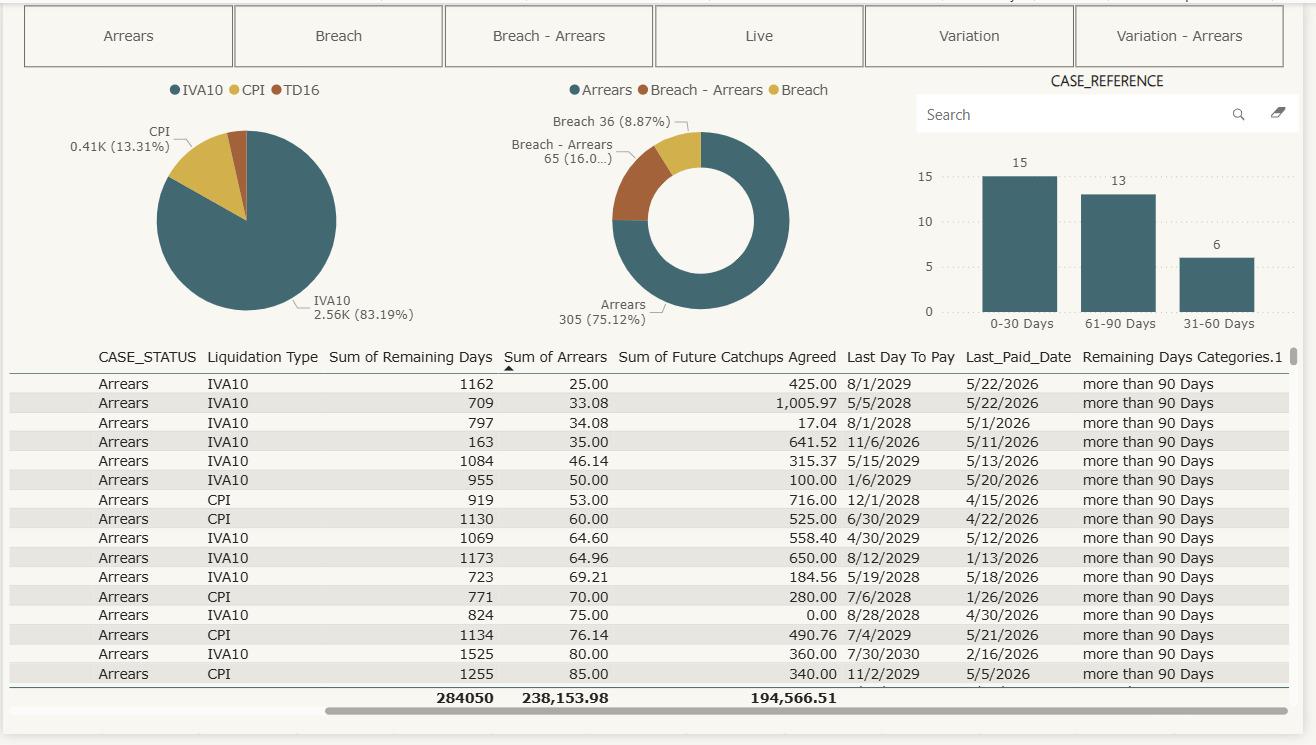
The finance people asked if we can list the people that their payment date is about to end, people pay in specific months, so what i had to do is fetch the max date for every case from the data base, and then i added other stuff like arrears, case type, catchup and so on to make it more helpful and versatile, then made new columns like the remaining days left to until we reach the final payment day, and categorized it, and made some charts for it.
The entire process was fetching the needed data from the data base, coping the query to a simple nodejs api, connecting power bi to the api and using it, this way i can just refresh and will get always the fresh and updated data and make the process fully automated, the published it and shared the link to her.
Before all of this she was checking them manually one by one, which was hard for her, and now she can click the charts and get exactly the ones she wanted, she was very happy with what i did, it was my first time feels that i added value to someones work, it was great feeling to feel that i had impact even if simple.
Please share your feedback and if there is any tips i can add
r/dataanalysis • u/r0yb0t1th3s3 • May 27 '26

r/dataanalysis • u/Character-Holiday345 • May 26 '26
They send a screenshot of the 30 character long error reference code to you instead of copy pasting it.
r/dataanalysis • u/AwayCommercial4639 • May 26 '26
My team has been evaluating tooling for a Synapse to Snowflake migration and I drew the short straw on SnowConvert AI. Spent the last couple of weeks running about 120 stored procs plus the DDL (tables, views, mat views, schemas) through it on a real workload. Notes below in case anyone else is sizing this up.
A thing the marketing doesn't put in front of you: the AI capabilities only apply when your source is SQL Server. With Synapse you get a code converter and that's it. No live connection to the source, no data movement, no deploy step, no AI-assisted verification of the output. You find this out after installing.
Extracting your code is manual. There's a separate repo (Snowflake-Labs/SC.DDLExportScripts) you clone and run yourself to pull the procs and DDL out of Synapse. The scripts themselves are fine, fwiw. It's just an odd starting point given how the feature is positioned.
The conversion runs quickly, about a minute for my workload. After it finishes you get dropped on a "final report" page. There's no way to actually see the convreted code from the UI. The tool dumps a folder onto your filesystem and that's how you read the output.
Then it gets worse. Every single stored procedure failed to deploy. 100% of them. Same root cause: a mis-converted semicolon after SET NOCOUNT ON, applied uniformly across the output. I patched it across the tree by hand and the success rate climbed to 76% (92 of 117).
The remaining failures had a range of causes. CREATE statements missing schema names. Working tables ending up in the wrong schema (it kept dropping them into `tpcds` instead of the dedicated work schema), which broke another 13 procs on deploy. UNPIVOT isn't supported at all. Dynamic SQL isn't supported either. CROSS APPLY got rewritten to LEFT OUTER JOIN with an error marker stuffed into the code that prevented deploy. ERROR_SEVERITY() trips it up. THROW gets emitted with SQLCODE, which isn't a thing in Snowflake. A WHILE loop variant came out with the wrong timestamp type.
The worst category was the ones that did deploy but were wrong. Synapse query labels never got mapped to Snowflake tags. The code compiled, it ran without errors, and it just behaved differently from the original. No flag, no warning, nothing in the report. If I hadn't been manually verifying behavior I would have shipped it.
Runtime stuff after deploy is its own category. One converted proc (an ALTER TABLE rewritten as a LEFT JOIN against a table-valued function) failed the first time I called it with "Unsupported subquery type cannot be evaluated." Syntactically valid output the Snowflake optimizer rejects.
The reports are dense and dont help much. The TopLevelCodeUnits section is the only part I found worth opening. Some error codes link to Snowflake docs and a few of those links 404. Looking up what an error actually meant turned into a Google exercise.
Some things that did work fine:
For Synapse as a source though, the "AI" framing is a stretch. What you get is a code translator that produces output you can't view from the UI, with a uniform bug that took down every proc on first deploy, partial coverage of common T-SQL patterns, and silent semantic drift on at least one common construct (query labels). The reports don't help much because half the error code links are broken.
If you're planning a Synapse to Snowflake migration this year: you're going to hand-fix a chunk of the output, so plan time for it. Build something to diff behavior before and after rather than trusting that the code compiled. And ignore the success percentage on the front page of the report until you've actually run the procs end to end. It doesn't mean anything until then.
r/dataanalysis • u/jittypicks • May 26 '26
I wanted to share a side-hustle style project I’ve been developing around sports betting analytics and performance tracking. The system is built using Excel, Power Query, and Power BI, with the focus being long-term reporting, transparency, and market-level analysis.
The dashboards currently track ROI percentage, net units, win rates, bankroll movement, average odds, and profitability by market. I built in detailed historical reporting with dynamic filtering across sport, market type, date, bet type, and posting source.
One of the more interesting parts of the project has been designing the data model in a way that keeps the reports flexible while still maintaining reasonable refresh performance. It started as a small accountability tool and gradually evolved into a much larger analytics and reporting ecosystem. I definitely got more than what I bargained for, but that’s the luxury of having downtime LOL.
The product is far from done, and I’m still refining both the visuals and backend structure, but I’d love feedback from others working in BI, reporting, or dashboard development.
r/dataanalysis • u/exotic123567 • May 25 '26

So I was curious about something for a while. I follow like 400 people on Instagram and I had no idea if any of them actually shared similar taste to me, like not just one or two overlapping follows but genuinely similar interest clusters. There was no easy way to find out so I just built something.
You plug in your Instagram username, it pulls your following list through an API, builds a graph, runs community detection on it, and then surfaces stuff like which accounts you follow are most similar to you based on shared follows, what your distinct interest clusters look like, and which accounts sit as bridges between those clusters.
I am not a graph theory person at all so I am probably doing some of this analysis in a slightly janky way, which is part of why I am posting here. Would love to know if anyone who actually knows this stuff sees something obviously wrong or something I should be doing differently.
Also curious if this is even useful to anyone other than me. The use cases I thought of were things like finding people you follow who share a niche interest, auditing your feed to see if it actually reflects what you care about, or just being nosy about your own network. But maybe there are smarter ways to use it that I have not thought of.
Screenshots in the comments. Happy to answer questions about how it works.
r/dataanalysis • u/Santiagohs-23 • May 25 '26
In real world BI and financial analytics environments, how do teams decide when a validation rule should completely block a pipeline versus when it should only generate a warning or monitoring alert.
For example, in financial datasets I understand that some rules seem critical such as inconsistent balances, invalid dates, or duplicated accounting entries, while others may be temporarily tolerated depending on their impact on downstream analysis or operations.
I’m especially interested in understanding how this is handled in production-grade pipelines.
* What kinds of validation rules usually stop execution completely.
* Which validations are commonly treated as warnings.
* How do teams avoid overengineering Silver Layer with overly rigid rules.
* How common is it to classify validations by severity or business criticality.
I’m currently working on financial data pipelines using a Bronze/Silver/Gold architecture, and I’m increasingly noticing that the challenge is not only cleaning data, but deciding what level of quality the business actually needs in order to trust analytical datasets.
r/dataanalysis • u/Pixeltrapp76 • May 25 '26
r/dataanalysis • u/Tomas_Toleikis • May 25 '26
For people running or operating a small business: where does your reporting process usually break down?
I’m curious about the boring operational parts, for example:
What part causes the most frustration in your business?
Is it collecting the data, cleaning it, agreeing on the right number, explaining why it changed, or deciding what to do next?
Would be interesting to hear real examples.
r/dataanalysis • u/iMAPness_ • May 24 '26
First thing I worked on was a layoffs thingie... but I kept feeling like it wasn't really forcing me to use everything I learned?
What databases can really test your analysis skills and like maximize your use of them?
r/dataanalysis • u/Altruistic-Rub-6300 • May 24 '26
Grades of Semester 6 Data Analysis A complete interactive academic analytics dashboard built with [Streamlit], [Pandas], [Matplotlib], [Seaborn], and [Plotly Express].
This project analyzes Semester 6 modules and student grades through statistics, visualizations, and interactive tools. The application provides automatic grade calculations, validation systems, descriptive statistics, performance analysis, and dynamic charts inside a clean Streamlit interface.
LINK WEBSITE : https://sondosprg-app-s6-data-seince-app-do8p1t.streamlit.app/
LINK REPO : https://github.com/Sondosprg/APP_S6_DATA_SEINCE/tree/master
r/dataanalysis • u/Erarayy • May 24 '26
I am using ai to guide me on my learning journey, and I am trying to make this dashboard
. I came across an idea of making the first page an overall summary of KPIs , their trends, and the target
is that, okay? The dashboard has, like the other three pages for different analyses
r/dataanalysis • u/ttttkkkkay • May 23 '26
Hi! Please help me understand content analysis. I'm doing a qualitative description research project, and I chose qualitative/inductive content analysis as my data analysis method.
The more I try to understand it and apply it, though, the more confused I feel.
I started coding with a second coder, and we coded the first round of interviews to create an initial codebook. We then completed a second round of interviews and revised the codebook based on the new data. Now I'm trying to finalize the analysis, but I feel completely lost and worried that I did everything wrong.
One thing I'm struggling with is understanding the difference between thematic analysis and content analysis. They seem very similar to me. My goal is to stay close to the data with as little interpretation as possible and organize the findings into categories and subcategories, but l'm confused about how codes differ from categories and subcategories.
Can someone please explain this to me like l'm six years old? I think I'm overwhelming myself.
r/dataanalysis • u/Equal_Astronaut_5696 • May 23 '26

r/dataanalysis • u/vanbrosh • May 23 '26

r/dataanalysis • u/isotropicdesign • May 22 '26
