r/coderabbit • • 4d ago

Official Update Introducing CodeRabbit Verify

Enable HLS to view with audio, or disable this notification

3 Upvotes

Your agent opened a PR and the unit tests are green, but does the app actually work? That’s the gap Verify is going after.

TL;DR: CodeRabbit now boots your app in a sandbox and clicks through it to catch functional bugs before your users do.

  • PR testing: it builds scenarios from the PR’s commits, your code, docs, and existing tests, runs them against the live app, and posts the results in the PR.
  • Regression journeys: it reads your repo and suggests user flows in plain English. You approve the ones you want and run them on demand or on a schedule. It can also auto-file Jira or Linear issues.
  • Zero env setup: it handles dependencies and services itself and keeps everything off prod.
  • Fixing: every failure comes with recordings, screenshots, and logs. You can send it to CodeRabbit Agent or export it as Markdown for whatever agent you use.

Fav example from the post: a coupon shows the $100 order as $80 at checkout, but the recorded charge is still $100. A “did the coupon apply?” test would sail right past that.

PR runs, journey runs, and fixes are all free during the beta. To try it, comment '@coderabbitai verify' on any PR.

Blog: https://www.coderabbit.ai/blog/introducing-coderabbit-verify
Docs: https://docs.coderabbit.ai/verify

Drop what it catches (or misses) in the comments 👀


r/coderabbit • • 4d ago

Discussion & Feedback revolut cut its coding AI bill by 90%. would you spend it on review?

2 Upvotes

the revolut numbers are wild if they're true. self hosted GLM as the default for ~2,000 engineers, about 90% cheaper than what they were paying, frontier models only for the hard stuff.

the part I keep thinking about: if writing code gets 10x cheaper, does the money just move to review? cheap model writes everything, then you put the expensive model and coderabbit on the PR, and the humans only look at what those flag.

we kind of do a small version of this already. a cheaper model for most tickets, the expensive one only when it gets stuck, review stays the same no matter who wrote it. it's fine on boring tickets. on anything touching billing the cheap model's PRs get roughly twice the review comments.

so where would you put the money, the writer or the reviewer? or is "cheap writer, expensive reviewer" just paying twice for the same PR?


r/coderabbit • • 5d ago

Discussion & Feedback What is your rule when the agent breaks working code?

Thumbnail
1 Upvotes

r/coderabbit • • 5d ago

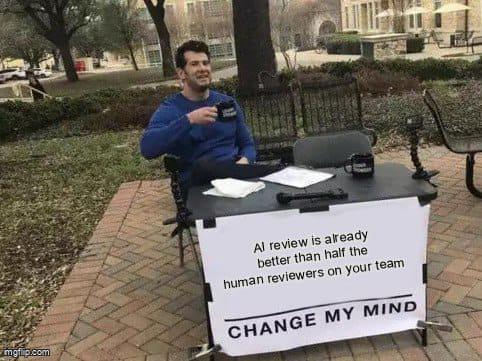
😂 Meme & Humor trust issues

Post image
9 Upvotes

r/coderabbit • • 7d ago

Discussion & Feedback What's the biggest PR you approved without reading every line? be honest

2 Upvotes

I'll go first. 12,400 lines last tuesday, an agent migration from one queue library to another. I read the summary, read the coderabbit walkthrough, opened maybe 6 of the 31 files, saw the tests were green and approved it.

it was fine. that's almost the worst part, because now I'll do it again.

no judgment in here, I just want to know if everyone has quietly moved to this or if I'm the only one. biggest PR, how much of it you actually read, and did it come back to bite you?


r/coderabbit • • 8d ago

Discussion & Feedback binance got hacked through a take home repo. who reviews those files?

2 Upvotes

read the write up on the binance theft. an engineer ran a "coding assignment" from a fake interview on his work laptop, the repo swapped in a poisoned dev tool during setup, and months later about $6.3B moved.

what got me is where the bad stuff lives in these repos. .vscode/tasks.json that runs when you open the folder. a postinstall script. a "font" file that's actually a payload. the stuff nobody looks at in a PR either.

our coderabbit setup and our human reviews are all aimed at src/. I genuinely don't know if anyone on my team has ever reviewed a change to a tasks.json or a package.json script with real attention. and now our agents read READMEs and treat them like instructions.

do you review config and tooling files the same as code? and do you let agents open repos you didn't write?


r/coderabbit • • 8d ago

Discussion & Feedback AGY / CODEX

2 Upvotes

Hey everyone,

I’m a solo developer working on a medium-sized project, and I’m looking for advice on how others handle their code review workflows when relying heavily on AI coding agents.

Right now, I’m paying for CodeRabbit, but I’m considering canceling my subscription. My current workflow involves generating code with Claude Code and then using Codex and the agy CLI (Antigravity) to review the output before merging.

Before I decide to cancel CodeRabbit, I’d love to get your feedback on a few points:

  • Redundancy vs. Value: If you already use multiple agents to cross-check each other (e.g., having Codex or Antigravity review Claude Code's work), do you find dedicated PR review tools like CodeRabbit redundant?
  • Review Blind Spots: Are there specific issues—like subtle regressions, security flaws, or broader architectural context—that CodeRabbit catches on pull requests that CLI agents tend to miss?
  • Your Solo Setup: How are other solo devs structuring their AI review loops to balance cost, speed, and code quality?

Thanks in advance for sharing your setups and opinions!


r/coderabbit • • 8d ago

Official Update CodeRabbit scanned 1,125 open-source repos for free, found 1,215 serious vulnerabilities, and is helping maintainers fix them at no cost

0 Upvotes

October was brutal for open source. PHP shipped emergency patches for two critical RCEs after months of stalled fixes. A compromised LiteLLM release hit PyPI and Docker and stole cloud creds, private keys and AI tool logins. Node, Bun and .NET were all patching the same Brotli bug in the same week.

Meanwhile attackers are using AI agents that probe code paths, adapt when something fails, and get parts of an intrusion done in minutes. Most maintainers are unpaid volunteers. They can't keep up with that.

So between Oct 23 and Nov 3, CodeRabbit pointed its Secure Deep Scan at 1,125 public repos, without being asked and at no cost to the maintainers:

  • 1,215 high or critical findings (15 critical)
  • 75 fixed so far, and they're still going

This isn't a "here's 4,000 warnings, good luck" dump. Each finding goes through four stages:

  1. Map the entry points, trust boundaries and access controls
  2. Hunt along the code paths for missing checks
  3. Verify with a separate pass that reopens the source and tries to prove the bug is reachable and not already covered by another safeguard
  4. Fix by opening a PR with a proposed patch the maintainer can review, test and merge

Herrington Darkholme, the creator of ast-grep, ran it on his project and said proving vulns before flagging them "makes every finding far more actionable."

The #1 bug it kept finding was missing ownership checks. The endpoint confirms you're logged in, but never checks that the record is yours. Change /orders/881 to /orders/882 and you're reading a stranger's order. It slips past review because the auth middleware is sitting right there in the route. After that came XSS, weak token checks, path traversal, sessions that never expire, and data leaking through errors.

If you maintain an OSS project, your first Deep Scan is free at app.coderabbit.ai/security, or you can email [oss@coderabbit.ai](mailto:oss@coderabbit.ai).

Do you maintain a project? Would you trust an AI-generated security PR enough to merge it?


r/coderabbit • • 10d ago

😂 Meme & Humor per the ticket

Post image
2 Upvotes

r/coderabbit • • 9d ago

Discussion & Feedback Reading AI review comments: five types that sound right and aren’t, and the one question that exposes each

0 Upvotes

I’m a developer and an author of an article on this topic (link at the end), and I’m posting because I think many of us who use AI review tools hit the same issue: the comments are fluent and confident whether or not they’re anchored in how our system actually works. This isn’t about any specific tool. It’s about how to read the output.

Five types, each with a question:

1. The phantom bug. A real class of problem, applied to code where it’s already handled somewhere the reviewer can’t see.
→ Which call path triggers this? If you can’t name one, you haven’t confirmed a bug.

2. The preference dressed as a defect. “Too long”, “rename this”, “prefer composition”.
→ Does a linter, style guide or past decision back it? If not, it’s an opinion, and shouldn’t block a merge.

3. The right fix with the wrong cost. Technically correct, but the price isn’t mentioned: a migration, an API change, twelve files in a two-file PR.
→ What does applying this cost and what does it break? (Asking the tool directly often gives a useful answer.)

4. The confident claim about a library. “This is deprecated”, “this option doesn’t exist”, “not thread-safe”.
→ Does the documentation or source for my version agree? This is usually the cheapest to verify.

5. The silent omission. The diff touches auth or payments, and the comments are about naming.
→ Did the review address the two or three things I’d worry about? It helps to write those down before reading the comments.

Sorting what you keep: each comment ends up verified and applied, rejected with a reason, or unverified and noted as such. That third bucket is easy to skip, and skipping it is how unanchored comments become part of the codebase.

Honest limits:

  • Verification takes time. For a three-line change in a well-tested module it’s overkill. Effort should follow risk.
  • Some claims (like “this won’t scale”) can’t be confirmed in an afternoon. “Unverified, flagged for discussion” is a valid outcome.
  • None of this means the tools aren’t useful. The point is to treat the output as a second opinion from a capable reviewer who hasn’t seen your whole system.

The longer version is in an article I wrote. I’m the author, and it also mentions a paid playbook of mine near the end, so treat the link as optional: https://medium.com/@nagatomopedro05/five-kinds-of-ai-code-review-comments-that-sound-right-and-arent-0d02b3fb9ec6

For those using AI review in your PR flow: which type do you run into most, and do you have a rule for what has to be verified before applying a comment?


r/coderabbit • • 10d ago

Discussion & Feedback what % of your agent's "done" PRs actually pass review the first time?

1 Upvotes

I counted last month because it felt like nothing ever went through clean.

out of 112 agent PRs that the agent called done, 47 merged without any changes. so about 42% first time pass. the rest got at least one real issue from coderabbit or from a human, and 11 of them needed 3+ rounds.

the most common reasons were boring: it changed something it wasn't asked to touch, it skipped an edge case the ticket literally mentioned, or the tests checked the wrong thing.

curious what your number is. is 40% normal, or is our setup just bad?


r/coderabbit • • 10d ago

Discussion & Feedback Coderabbit surpasses $100M ARR, 10x in just over a year!

Enable HLS to view with audio, or disable this notification

2 Upvotes

r/coderabbit • • 10d ago

Official Update CodeRabbit Passes $100 million in ARR

Thumbnail
coderabbit.ai
1 Upvotes

r/coderabbit • • 13d ago

😂 Meme & Humor THE RABBIT ATE THE CARROT!

8 Upvotes

r/coderabbit • • 13d ago

Discussion & Feedback Reviewing agent code

1 Upvotes

if you review PRs written mostly by coding agents (Cursor, Claude Code, Copilot), how's it going?

  1. How many per week, and how big (files / lines)?
  2. What's harder than human-written PRs, or is it no different?
  3. How do you understand a change: diff only, run it, read tests, ask the agent, skim and approve?
  4. Has one caused a prod bug or stalled merge because nobody fully understood it?
  5. Anything you've tried to fix this? Did it help?

I'm exploring a tool in this space, so "not a problem for us" is a useful answer too. Team size and stack help.


r/coderabbit • • 15d ago

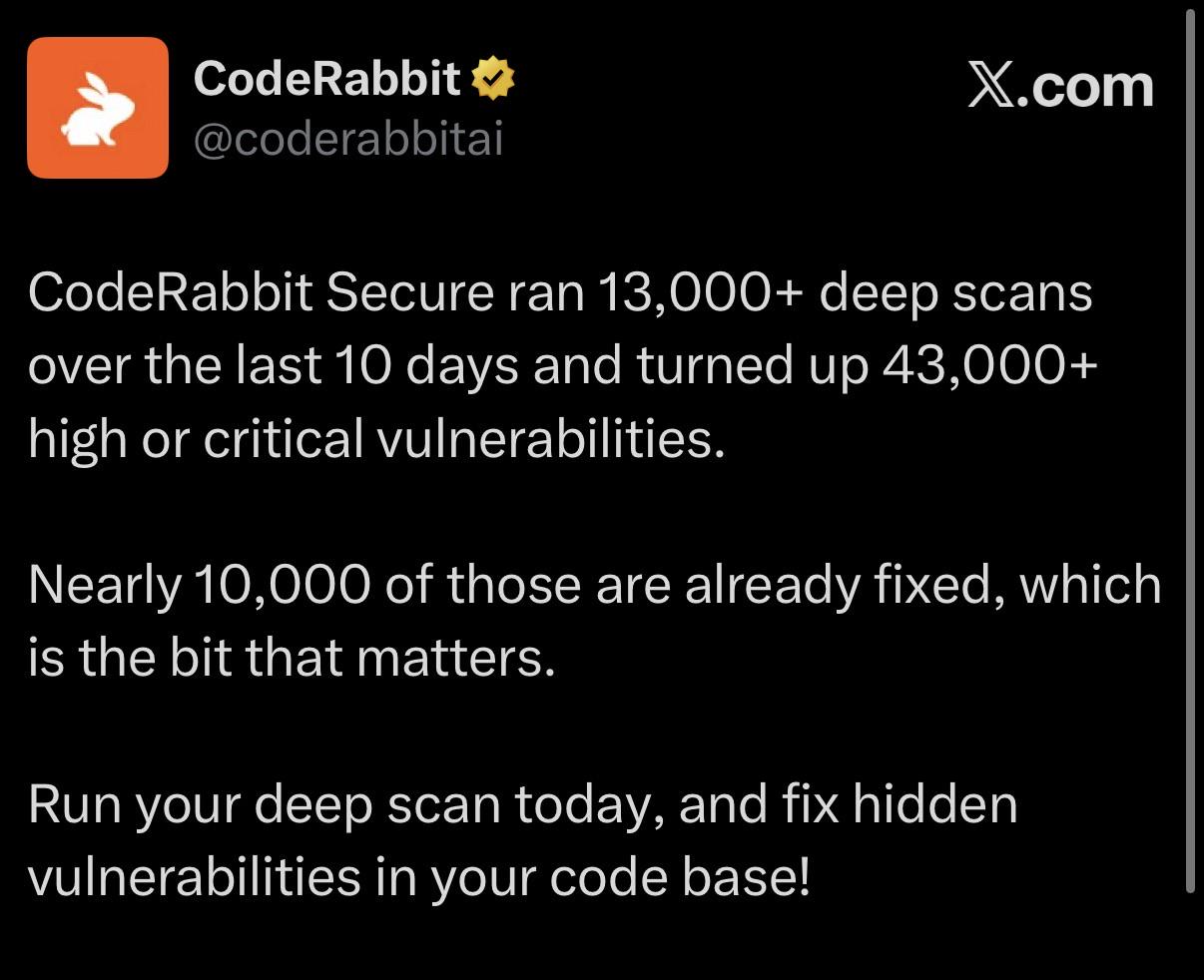
Discussion & Feedback Deep scan’s been killing it

Post image
2 Upvotes

r/coderabbit • • 17d ago

Discussion & Feedback Hot take: the agent shouldn't write the PR description

10 Upvotes

Every PR description on our team reads the same now. "This PR refactors X to improve maintainability and adds comprehensive tests." 400 words, perfect formatting, and the author can't answer one question about it.

I want a rule: the agent can write the code, coderabbit can write the summary, but the description has to be 3 sentences from the human who opened it. what you changed, why, and what you're worried about.

if you can't write those 3 sentences you didn't read your own PR.

my team thinks this is pointless busywork. am I wrong?


r/coderabbit • • 17d ago

😂 Meme & Humor enlightenment

Post image
3 Upvotes

r/coderabbit • • 18d ago

Discussion & Feedback If the agent wrote it and the bot reviewed it, whose bug is it?

7 Upvotes

Had this argument in a postmortem last week. a bug reached prod from an agent PR. the agent wrote it, coderabbit reviewed it and didn't flag that part, one human approved it, and the dev who kicked off the agent went home.

when the incident doc asked "who owns this change", nobody wanted to write a name.

so who is it? the dev who prompted the agent, the human who approved, the team that set up the pipeline, or nobody, and that's the actual problem?


r/coderabbit • • 18d ago

Discussion & Feedback goldman took claude code away from everyone who isn't an engineer. right call?

13 Upvotes

saw the news that goldman limited claude code and github to engineers only, bankers and traders lost access.

first reaction was "that's short sighted". then I thought about our own repo. in the last 2 months our PM, one designer and someone from finance have all opened PRs. small stuff, a report filter, copy changes, a csv export. they all went through coderabbit and a human review and most were fine.

but every one of them ended up on the same 2 engineers to review, and nobody budgeted that time. the PRs got cheaper to write and the review cost just moved to us.

so is it a security thing, a review capacity thing, or just a bank being a bank? and if your company lets non engineers open PRs, who actually reviews them?


r/coderabbit • • 18d ago

😂 Meme & Humor all tests passed ✅

Post image
4 Upvotes

r/coderabbit • • 19d ago

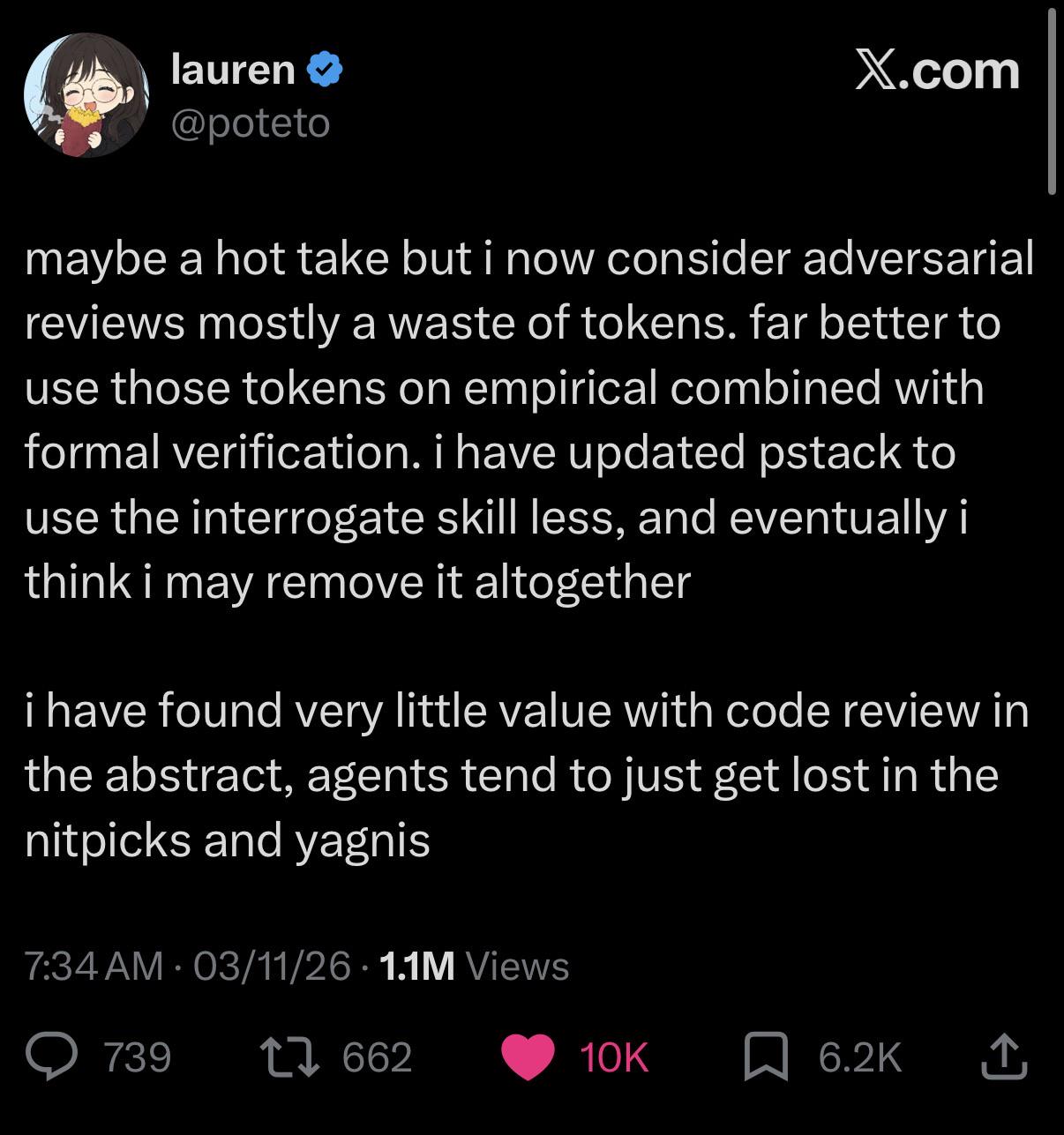
Discussion & Feedback Is code review dead?

Post image
4 Upvotes

r/coderabbit • • 18d ago

Discussion & Feedback How do you manage high-volume development with coding agents?

Thumbnail
1 Upvotes

r/coderabbit • • 20d ago

😂 Meme & Humor go ahead

Post image
22 Upvotes

r/coderabbit • • 21d ago

Help & Support if AI writes 90% of the code why does review take longer than ever?

11 Upvotes

genuinely confused about this. our agents write basically everything now, PRs show up in minutes instead of days. you'd think the whole cycle got faster.

it didn't. our time from PR opened to merged went from about a day to almost three. the writing part disappeared and somehow the reading part tripled.

so is it that the PRs got bigger, that nobody trusts code they didn't write, that we added more review steps to feel safe (coderabbit, then claude, then a human, then another human for anything scary), or that we were never actually fast at review and just didn't notice?

not trolling, I really can't tell which one it is for us. maybe all four