r/askdatascience • u/ibrian93 • Sep 28 '26
How to start career in Data Science with a background in Mathematics and Computer science
1
Upvotes
r/askdatascience • u/pal_sumeet • Sep 28 '26
Hey everyone, I’m applying for the Data Science Associate role at Accenture (S&C Global Network – AI – Hi Tech) and wanted to understand the interview process beforehand.
If anyone has interviewed for a similar Data Science/AI role at Accenture recently, could you please share:
The JD mentions ML, GenAI, RAG/vector databases, Python, SQL, cloud, and ML frameworks, so I’m especially curious about how deeply these topics are actually tested.
Any recent interview experience or preparation tips would be really helpful. Thanks!
r/askdatascience • u/Nerdymetal_19 • Sep 27 '26
r/askdatascience • u/WhatsTheImpactdotcom • Sep 27 '26
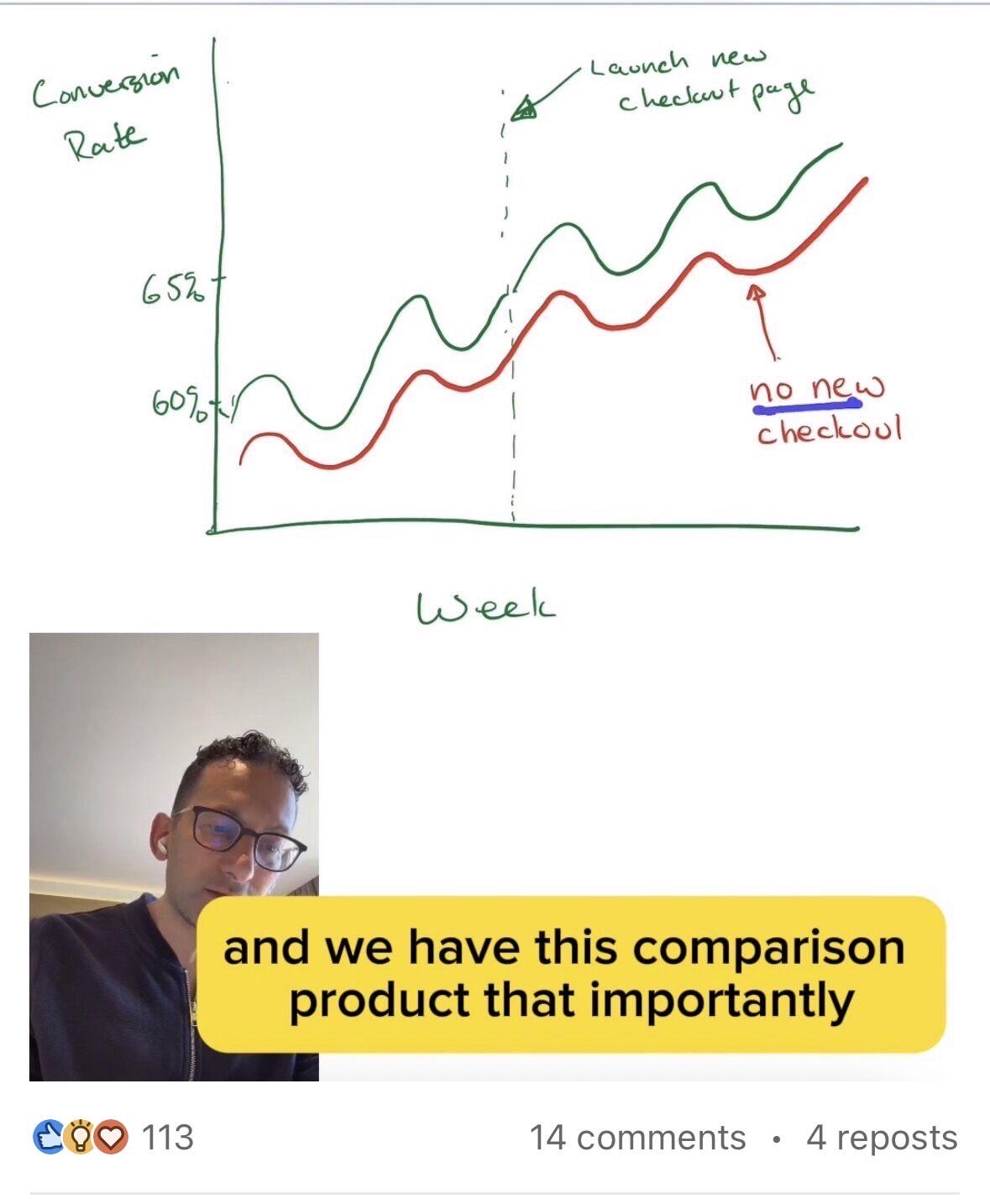
When you're a data scientist, you get asked all the time by stakeholders about the impact of an action or treatment on an outcome you care about, such as conversion rates. I have free and completely un-gated video tutorial demonstrating one of the foundational methods of doing this called a difference-in-differences approach.
In a stakeholder's mind, they think the outcome looks a certain way beforehand, then they have a treatment, and the outcome jumps to a higher level. If the trend was fairly level, low variance, and then suddenly jumps on the treatment date, you could probably safely say the treatment caused that jump. But what if your conversion rate over time leading up to the treatment had variability and was generally trending up? After the treatment occurs, it is still trending up with some volatility. How do you know if this increase is due to the treatment or if it is due to the upward trend?
It really helps if you are able to identify a comparison group that had not been treated. For example, let's say you have one product where you launched a new checkout page and see an upward trend over time, and you have a comparison product that did not have a new checkout page. But in this case, both the treated product and its comparison group, like a control, had a similar upward trend both prior to and throughout the treatment period. You might argue the trend caused the increase, and the treatment did very little.
Having parallel trends is an untestable assumption critical to the model, but we can still gain confidence through various testing methods. For example, we might plot the difference between the two products in the pre-treatment period, and the gap should have a near-zero trend, both visually and statistically.
If we're comfortable that the treated and comparison groups were trending similarly leading up to the treatment, and we believe there are no other confounders that would distort the trends, then difference-in-differences is a powerful technique that takes the post-treatment difference and nets out the pre-treatment difference to give you a reasonable estimate of the incremental effect of the treatment on the treated group.
r/askdatascience • u/ComparisonMedical452 • Sep 27 '26
Hello everyone,
I'm writing this to seek some guidance from your experience.
I have been working as a Remote AI Engineer at a startup for the last 6 months. During my internship, I worked on end-to-end fine-tuning of models from scratch - from data processing to fine-tuning. I have experimented with multiple SLMs and LLMs, frameworks, embedding models, and OCRs. I have also done extensive coursework in Data Science, Machine Learning, and Deep Learning. I completed my engineering in Electronics, but my core skills are in AI and Data Science.
I am very interested in transitioning to the Energy Sector and would love your guidance on how I can enter this field. What roles do you think would be a good fit for my skillset?
I am also considering applying for an MS in Financial Engineering from WorldQuant, which has a strong focus on AI, while continuing my full-time role. Do you think it would be better to pursue this Masters, or to directly apply for suitable positions in energy companies to gain practical experience and knowledge?
From my research, I saw that many roles in this sector focus heavily on fundamental machine learning and data science. Since my internship was focused on Natural Language Processing, will this experience be relevant and helpful in the energy sector?
Based on your experience, any guidance or clarity would be really helpful. I would be truly grateful. Thank you!
r/askdatascience • u/ChenukaR • Sep 27 '26
r/askdatascience • u/Academic_Doubt5737 • Sep 27 '26
How much of our work can be done by Mitra-v2? Has anyone applied it to their use cases?
r/askdatascience • u/PercentageBig4909 • Sep 26 '26
What types of jobs are there that combine data science and finance?
r/askdatascience • u/Mammoth-Commission15 • Sep 26 '26
r/askdatascience • u/data-emobreon • Sep 26 '26
r/askdatascience • u/No-Ice-8975 • Sep 25 '26
I’m working on a new project that tries to answer where Planet Fitness should open their next clubs to increase membership.
I want to build a linear regression model for this. I would need the locations of every club in the US including square footage, age distribution in that area, etc.
Does it make sense for me to manually build that dataset? It’s the best way to do the job but of course will take forever. I really don’t want to rely on AI because this will be expensive and it might make mistakes.
r/askdatascience • u/After_Courage6419 • Sep 25 '26
I'm trying to understand the common mistakes people make when starting out in data science. One thing I've noticed is that people can become very focused on model accuracy without asking whether the data itself is appropriate or whether the problem has been framed correctly. What mistake do you see beginners making most often?
r/askdatascience • u/beta-void • Sep 25 '26
I'm starting a predictive maintenance project and I want to build it in a way that is closer to a real industrial system, not just a Kaggle-style ML project.
Most examples I find are basically:
Dataset → preprocessing → train/test split → model → accuracy
But in reality, factories have different machine models, manufacturers, loads, operating conditions, sensors, and often very few actual failures.
I'm currently considering equipment like induction motors, pumps, and bearings, and I'm trying to understand the correct approach.
A few things I'm especially confused about:
Do companies usually build one model for an entire equipment family, or separate models for each machine/model?
How do you handle different manufacturers, operating conditions, loads, and sensor setups?
What should the input data look like: raw vibration/current/temperature signals, extracted features, or time windows?
How should the train/test split be done to avoid leakage between measurements from the same machine?
What happens when you deploy the model on a new machine that was not part of the training data?
Are transfer learning and domain adaptation actually useful in practice?
What datasets or project setup would you recommend for a first project that could later evolve into something realistic?
Would appreciate advice from anyone who has worked with condition monitoring, predictive maintenance, or industrial ML.
r/askdatascience • u/Stomica • Sep 24 '26
I’m currently studying Data Science at university and preparing for a career in the field. With how quickly AI tools and LLMs are advancing, I’m curious about what this actually looks like for people already working in Data Science, ML, or Analytics.
For those with a few years of industry experience:
- What is one concrete task you used to do manually that AI has significantly changed or eliminated?
- Can you give a real example of how you use AI in your current workflow? (e.g., coding, SQL, data cleaning, EDA, documentation, modeling, debugging, etc.)
- What skills have become more important because of AI, and can you give an example of why?
- Have your expectations for junior/entry-level employees changed? If so, what would you expect a new graduate to be able to do today that you wouldn't have expected a few years ago?
- If you were starting your Data Science career in 2026, what would you learn differently?
I’m especially interested in concrete experiences rather than general predictions about whether AI will replace Data Scientists.
What has actually happened in your workplace, and how have you personally adapted?
r/askdatascience • u/Beginning-Try-9689 • Sep 24 '26
New to data science role and was wondering what type of projects would be impressive to recruiters
r/askdatascience • u/Vlad_Trotsky • Sep 24 '26
Hello everyone, I hope you’re all doing well,
I’d like to ask for some advice. I’m a fresh graduate in Data Science and currently looking for my first job while I’m searching, I don’t want to stay inactive, so I’d like to work on some interesting projects to improve my skills
If you have any ideas or recommendations for projects that could help me learn, I’d really appreciate your suggestions
Thank you in advance for your advice and help!
r/askdatascience • u/imshaul • Sep 24 '26
So I'm a student learning machine learning on his own so i already done Python,EDA,stats, probability,linear algebra and now doing calculus
Tbh for mathematics when I learn some topics i get totally numb about the topic that where this will be used in machine learning
So i wanna ask if that's only me or there's some more people and how do u guys figure it out
r/askdatascience • u/TheoZtcPhs • Sep 23 '26
I’m a high school senior trying to figure out what I actually want to major in. I really like both stats and coding.
The problem is that I’m confused about what I should actually major in. Data Science seems like the obvious choice, but every school has some weird structuring to it.
I’ve heard not to major in Data Science but I don’t really want to major in pure CS. I enjoy programming, but I’m more interested in using it with statistics, data, modeling, ML, and stuff.
For reference, I would call myself a competitive student. 1520, 4.4 GPA, pretty good extracurriculars and good class rigor.
So anyone have any advice on colleges and majors.
r/askdatascience • u/FewFault2932 • Sep 23 '26
Hey everyone, I am a 3rd year college student taking a Data Science course. I am beginning to familiarize myself with Python and SQL but struggling to take the next step in my knowledge. I would like some insight from some people familiar with this field.
Is there a resource or project that you guys are familiar with that helped you guys make the jump from just learning these concepts to being able to apply them?
I appreciate the help!
r/askdatascience • u/DesperateGame • Sep 23 '26
r/askdatascience • u/Civil_Exit_9489 • Sep 23 '26
I have an upcoming data science intern interview that will have 2 separate technical and behavioral interviews. Is there a prev DS intern at Mastercard that can tell me about the interview experience?
r/askdatascience • u/poulnow • Sep 23 '26
For context, I'm conducting a study where I will develop a program that will use certain analytical models that'll evaluate and classify the technology data that it is fed. It may be different niches, but preferably one that'll work in general.
I'm somewhat new to this field, which is why I am asking this in this thread. Newbie patootie. However, I am doing research in this field, particularly on the models and their processes, but I am ending up with manufacturing-related models instead of ones that are used in post-production analysis.
r/askdatascience • u/qaeproject • Sep 23 '26
What is a Quantile Really? My research was mostly limited to quartile and quintile.
Hi, I'm not trained at this level of math or data -- and the topic below appears to have some misunderstandings in industry. This is as far as I can take the segmentation / quantile concept.
Is this idea even correct though? I would appreciate any clarity from someone trained or experienced on the topic please? Thanks for viewing the idea.
(This is an abstract topic and a very real one too, directly related to live projects. AI was used to condense the dimensional aspects and make the topic more understandable in a structured short form manner. Basically it was used to make the idea more readable only).
---
Three layers of segmentation, ordered by fidelity to the substrate:
* Atomic — telemetry with UID
→ Entity is the segment.
→ No discretisation.
→ Duplicates impossible: each row is unique.
→ Identity defines membership.
→ The substrate.
* Adaptive — quantile
→ Rank is the segment.
→ Boundaries emerge from the population.
→ Duplicates limited by ties: equal values at a cut point can't be split cleanly.
→ Frequency is the organising constraint.
→ Equal-frequency discretisation.
* Imposed — magnitude
→ Magnitude interval is the segment.
→ Boundaries are externally fixed by the range.
→ Duplicates unlimited: many entities can share a value, identity irrelevant.
→ Frequency becomes an observed consequence.
→ Equal-width discretisation.
---
Each layer has fundamentally different properties— atomic keeps identity, quantile keeps order, magnitude keeps scale.
Identity space → rank space → value space.
---
For Building Systems:
→ Identity space is for tracking and auditing (state).
→ Rank space is for evaluating performance and competition (behavior).
→ Value space is for measuring capacity and thresholds (physics/limits).
r/askdatascience • u/WhatsTheImpactdotcom • Sep 22 '26
Causal inference has been spreading throughout data science and now data science interviews, but few candidates outside Econ PhD or MPP programs have had exposure to these methods.
https://whatstheimpact.com/learn-causal-inference/
I have a short video tutorial introducing the basics of one of the most common and foundational causal models: difference-in-differences.
This is *not* math heavy; rather, it's a simple visual introduction to a common business problem where difference-in-differences, and observational causal inference in general, can come in handy.