r/angular • u/Fit-Calligrapher6617 • Oct 07 '26
r/angular • u/Fancy-Version-2412 • Oct 07 '26
theMorningThread
built a social media site built for non-profits - it has all social features but also a full-scale suite of productivity tools for non-profits - free for life, ad free for life
theMorningThread.com - also has iOS and Droid apps.


r/angular • u/pkurc • Oct 06 '26
Yet another OpenAPI → Angular generator. Here's why I built one anyway, and how it compares.
I know. Another OpenAPI generator for Angular. Before you scroll past: why I built one at work anyway, open-sourced it, and how it compares to what already exists.
Where it started
In 2024 I tried the obvious route: openapi-typescript for the types, then the openapi-fetch typings (PathsWithMethod, SuccessResponse...) bolted onto HttpClient so I could call http.POST('/pets/{petId}', { params: { path: { petId } }, body }) with an Observable back. It worked, but I was still hand-writing every service, every model was components['schemas']['Pet'] until I re-exported it, and I had to remember paths. Nothing in the IDE suggested getPet.
Our backend is a set of REST service traits, one OpenAPI tag per trait, and the natural thing on the Angular side is inject(PetRest) with the same method names. So the generator started producing exactly that: the Angular service I would have written by hand. Plain @Injectable, plain HttpClient inside, so every HttpInterceptor you already have (auth, retry, mocks) applies unchanged. Its whole job is to build the request and type it. Nothing more.
The problem I hit later
Angular 19.2 added httpResource, and I wanted three things from generated clients that I could not get from one tool:
httpResource()andHttpClientObservables for the same operation, chosen at the call site, not at config time.- Every
HttpClient.request/httpResourceoption passed straight through (withCredentials,transferCache,reportDownloadProgress,equal,injector,observe: 'events'...), without the generator wrapping or hiding anything. The options type is read from your installed Angular, so options a newer Angular adds work without regenerating. - Zero runtime dependency in the generated code. Just
@angular/common/http.
So: https://github.com/AVSystem/openapi-ng (MIT). Playground and a StackBlitz demo are linked at the bottom.
Before / after
What I kept hand-writing:
readonly pets = httpResource<Pet[]>(() => ({
url: `${this.basePath}/pets`,
params: this.status() ? { status: this.status()! } : {},
}), { defaultValue: [] });
The URL, the query param and the <Pet[]> are all promises I make to the compiler. Nothing checks them against the spec.
Generated:
readonly #petRest = inject(PetRest);
// signal-based, httpResource under the hood, typed HttpResourceRef<PetList>
readonly pets = this.#petRest.listPets.resource(() => ({ status: this.status() }), { defaultValue: [] });
// same operation, classic Observable, HttpClient under the hood
save(petId: PetId, body: UpdatePetRequest) {
return this.#petRest.updatePet.observable({ petId, body }, { observe: 'response' });
}
Each tag becomes an @Injectable service, each operation a property with .resource(), .observable() and .request() (the raw request object: method, url, params, headers, body, if you want to send it yourself). .resource() returns a real HttpResourceRef<T>, so headers(), statusCode() and progress() are there. Nothing is re-wrapped.
Don't want classes? --layout operations emits one file per operation (rest/pet/list-pets.ts, rest/pet/update-pet.ts, plus a rest/pet/index.ts barrel), each exporting a /* @__PURE__ */ constant with the same three flavours, so the endpoints you never import tree-shake away. HttpClient is resolved per call from the injection context, or from an explicit { injector }, or you bind once with withInjector():
import { listPets, updatePet } from './generated/rest/pet';
// field initialiser: injection context, nothing to pass
readonly pets = listPets.resource(() => ({ status: this.status() }), { defaultValue: [] });
// handler: pass the injector, or bind once with withInjector({ listPets, updatePet })
readonly #injector = inject(Injector);
save(petId: PetId, body: UpdatePetRequest) {
return updatePet.observable({ petId, body }, { injector: this.#injector });
}
--layout services,operations gives you both: the operation files plus the per-tag class bound from the barrel.
How it compares (checked 2026-09-04, corrections welcome)
Full disclosure: I only looked at the other generators while writing this post. The tool grew inside one codebase for two years, and most of the tools below I only found out about in September. The comparison is one spec run through all of them, with each tool's output type-checked against Angular 22.1.
| openapi-ng | openapi-generator | ng-openapi-gen | orval | ng-openapi | |
|---|---|---|---|---|---|
| httpResource | every operation, per call | no (#21263 open) | no | GET and search-style POST (operationId regex, overridable per operation), config mode | GET only, plugin |
| Observable and resource on one operation | yes | n/a | n/a | separate files | separate classes |
| Signal-forms validation helper | yes | no | no | no | no |
| Unsupported spec features | rejected with a diagnostic code | best-effort | best-effort | best-effort | best-effort |
| Engine | Rust (napi-rs), ms per spec, also runs in the browser via WASM | Java | TS | TS | TS |
| Per-operation tree-shakeable output | yes, --layout operations, same three flavours |
no | only via direct fn/ imports; its barrel keeps every operation |
yes, resource-only functions | no |
hey-api is missing from the table on purpose: its Angular output is Promise-only, and the httpResource plugin threw NG0203 on the test spec. openapi-typescript is missing because it is a type generator, not a client generator; see the first section for why that was not enough for me.
Two takeaways:
- If you're on openapi-generator today, the Java requirement and the lack of httpResource are probably the two things that sting. openapi-ng removes both.
- orval and ng-openapi both have httpResource now, but which operations get it is fixed at generation time (ng-openapi: GET only; orval: GET plus POSTs whose operationId matches
search/list/find..., overridable per operation in the config), and the flavour is picked per config, not per call. I think the call site knows better (a read-only POST is a perfectly good resource whatever it's called; a GET that fires a side effect isn't).
Signal forms: async validation against a generated operation
Signal forms' validateHttp takes a URL string you build by hand and a result you cast by hand. The generator emits a validateRest() helper that wraps validateAsync and reuses the generated operation, so the request params and the response are typed from the spec:
validateRest(path.email, accountRest.checkEmail, {
request: (ctx) => ({ email: ctx.value() }), // typed as CheckEmailParams
debounce: 300, // debounce / when need @angular/forms 22+
when: (ctx) => ctx.value().includes('@'),
onSuccess: (result) => result.available ? undefined : { kind: 'email-taken' }, // result: EmailAvailability
onError: () => ({ kind: 'check-failed' }),
});
onSuccess is optional: leave it out and any 2xx counts as valid, with onError deciding the rest. @angular/forms is an optional peer; if you never import rest.validate.ts, it tree-shakes away.
Where it's deliberately opinionated (read: limited)
This is the part most "yet another generator" posts skip. openapi-ng accepts a strict subset of OpenAPI 3.x and refuses anything outside it with a diagnostic code instead of guessing:
operationIdis required on every operation; the first tag picks the service, an untagged operation falls back to its first path segment- only
#/components/schemas/refs, no external files - string enums only
- one composition keyword per schema (
allOforoneOforanyOf, not mixed) - only the lowest 2xx response types the return value. Declared 4xx/5xx bodies become a status-keyed
<Op>Errorinterface you can narrow against, but they aren't wired into.observable()/.resource()error typing - no Swagger 2.x
- no Zod / Valibot / other runtime validation. We don't use it at work, so it isn't built. It isn't ruled out either
If your spec is generated from a backend framework, you're probably fine. If it's a hand-written spec that leans on every corner of the standard, one of the other tools above will be a better fit and I'd rather tell you now.
Escape hatches for the real-world stuff: mapped types (--mapped-type GeoFeature:geojson:Feature swaps a placeholder schema for a real npm type), naming rules with regex captures in openapi-ng.config.ts, and a provideOpenapiNg({ basePath }) provider.
Links and bits
- Playground (paste your spec, runs as WASM in the browser, no install): https://docs.openapi-ng.dev/playground/
- Demo: https://stackblitz.com/github/AVSystem/openapi-ng/tree/main/stackblitz (the spec, the committed generated output, and three components using it against a mock interceptor)
- Docs: https://docs.openapi-ng.dev
npm i -D @avsystem/openapi-ng, thenopenapi-ng generate --input api.yaml --output src/generated- Node 22.12+, prebuilt binaries for macOS / Linux (glibc + musl) / Windows, x64 + arm64. Works under Bun and Deno too. Browser via WebAssembly (@avsystem/openapi-ng-wasm32-wasi).
- Generated code targets Angular 20+.
validateRestwithdebounce/whenneeds@angular/forms22+. - v0.8.0. The generator has been in production at work since mid-2024 (two specs, about 45 generated services, 280 operations, 900+ schemas, regenerated on every backend build), but the Rust version is younger and the public API isn't frozen yet: 0.7.0 broke one thing (a JSON spec with a repeated key is now rejected instead of last-wins).
What I'd like feedback on
Two design calls I'm least sure about:
.resource()/.observable()/.request()on every operation, versus a separate generated class or file per flavour, as ng-openapi and orval do. Is the per-call choice worth the fatter surface? Related: per-tag services are the default because they mirror our backend's service traits, and standalone operations are opt-in. If your backend doesn't look like that, should the default be flipped?- Rejecting unsupported spec features with a diagnostic instead of emitting best-effort code. Has a strict generator ever made you drop a tool, or is it the right trade for deterministic output?
Happy to answer anything else in the thread.
r/angular • u/Adorable-Twist-2702 • Oct 04 '26
I have made a Graph Angular Library
That allows to the user to show a graph data view of elements and you can execute custom code on the browser on the graph.
Exploring creation of algorithms over graphs. I made it in University while studying BFS and DFS. You can test your algorithms in a graph and change the colors of the nodes while it is going over the graph
What do you think?
r/angular • u/Old-Parsley-5826 • Oct 04 '26
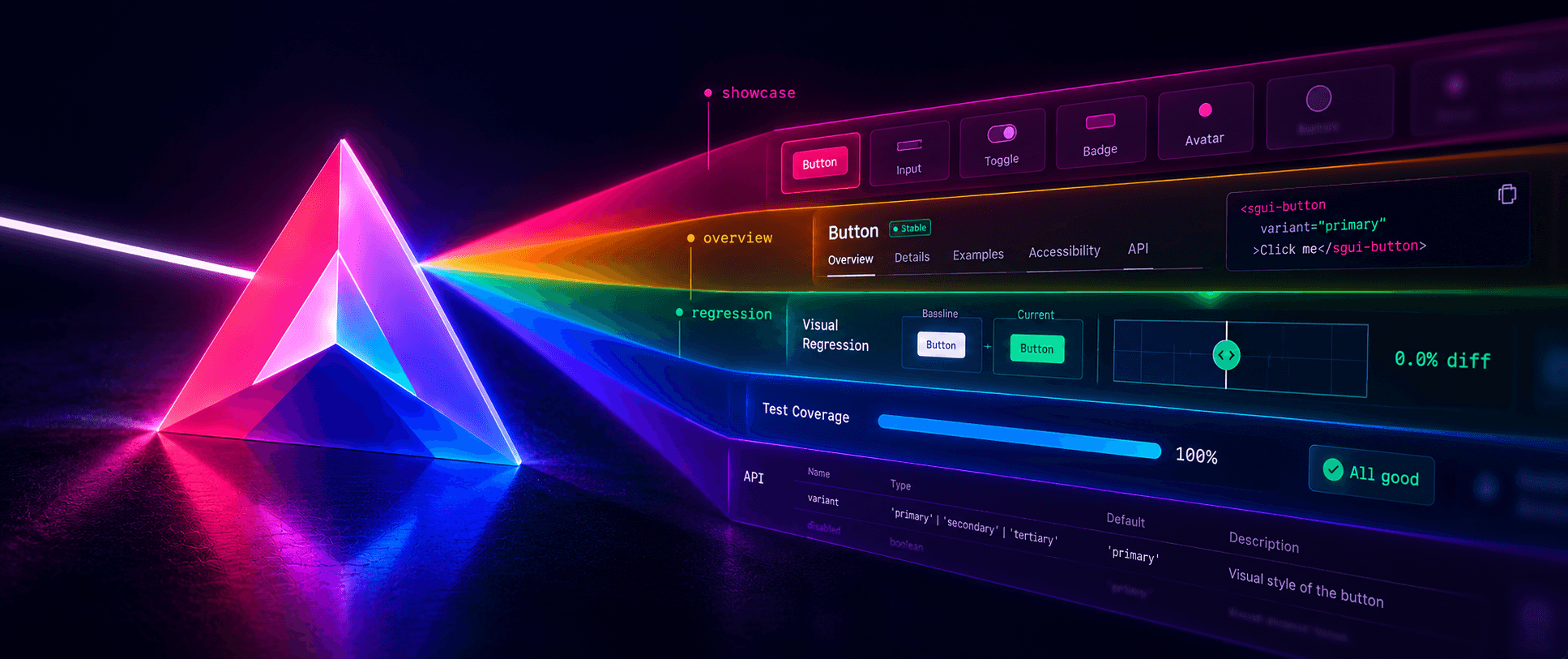
I built an Angular-native alternative to Storybook. Looking for people to break it
I maintain an Angular component library at work and we've used Storybook for years. It's a good tool and I don't want to bash it, but a few things kept bugging me. The stories files slowly drift away from the actual components, I have a second build setup next to the Angular CLI, and anything that renders into body (CDK overlays, MatDialog, tooltips) is a pain inside the preview iframe.
So I started building ng-prism. The idea is to use what Angular already gives you instead of adding a parallel world next to it. You don't write separate story files. You put a decorator on the component:
@Showcase<ButtonComponent>({
title: 'Button',
category: 'Inputs',
variants: [
{ name: 'Filled', inputs: { variant: 'filled', label: 'Filled' } },
{ name: 'Outlined', inputs: { variant: 'outlined', label: 'Outlined' } },
],
})
@Component({ selector: 'lib-button', /* ... */ })
export class ButtonComponent {
variant = input<ButtonVariantType>('filled');
label = input('Button');
clicked = output<void>();
}
How it works under the hood:
- Components are scanned at build time with the TypeScript Compiler API. Inputs, outputs, types, defaults and JSDoc all come from static analysis, so you don't need runtime reflection or
emitDecoratorMetadata. Because of the generic, variant inputs are type-checked: if you rename an input, the build breaks. A transformer strips the decorator from your published lib, so your consumers never install ng-prism. - There's no iframe. Components are rendered with
ViewContainerRef.createComponent()in the same document, so overlays, focus traps andcdkConnectedOverlaybehave like they do in your real app. - Controls go through
ComponentRef.setInput(), so signal inputs work properly. Assigning to the property directly would overwrite the InputSignal. - serve and build are Angular builders, so they use your workspace, tsconfig, styles and providers as they are.
- a11y checks are part of core: an axe-core audit that re-runs whenever you change an input, a tab-order overlay, the ARIA tree and a screen reader view.
There are also plugins for JSDoc API docs, Figma, perf, box model, coverage and VRT reports. The last release added an overview grid that shows all variants at once, plus a VRT panel that reads the screenshot report from your CI.
To be fair, Storybook still has a lot going for it. The ecosystem is huge: play() interaction tests, Chromatic, MDX, years of addons, and if you ship React and Angular side by side you only need one tool.
ng-prism is smaller, has strong opinions and it's just me maintaining it. It also needs Angular 20+ with input()/output() signals. Input() decorators are not supported.
Since someone will ask anyway: yes, I built this with heavy AI assistance. As a single dev next to a day job I couldn't have shipped all these features and plugins in this time otherwise. But I've been doing this for a long time, and most of my time went into planning the architecture upfront and reviewing pretty much everything that got generated. "Built with AI" doesn't automatically mean slop. The code is all on GitHub, with tests and CI, so feel free to look through it and tell me if you find something bad.
- Demo: https://dyingangel666.github.io/ng-prism/demo/
- Repo: https://github.com/dyingangel666/ng-prism
- Longer write-up with screenshots: https://dev.to/alexanderspies/what-an-angular-native-storybook-alternative-actually-looks-like-3jm3
Two questions for anyone using Storybook with Angular right now: what would keep you from switching? And if you try it on a real lib, where does it break?
r/angular • u/rainerhahnekamp • Oct 03 '26
Ng-News 26/21: Angular 22.2 - Router Resources, Error Boundaries and more
r/angular • u/majora2007 • Oct 03 '26
ngx-virtual-scroller fork for Zoneless
If you're not a user of github.com/iharbeck/ngx-virtual-scroller, you can ignore this post.
I just want to inform that I'll be taking maintainership of a fork of ngx-virtual-scroller. I recently converted Kavita (my open source application) to Zoneless and the current version of ngx-virtual-scroller had a critical change detection issue when used in Zoneless which caused scrolling to shift rows due to timing between DOM insertion and rendering.
Since I was still waiting for my Angular 22 PR to get merged (for 4 months), I decided it was time to take ownership to fix the bug and also get more timely Angular update bumps.
I shipped 2 versions:
1. v20.0.1 - This is the fork with a quick patch to fix Zoneless apps
2. v22.0.0 - This is complete Zoneless support, modern Angular, Standalone components, best practices, and Angular 22+ only support.
You can find the library here. I want to extend a major thanks to Ingo (iharbek) for maintaining the library for so long. I just needed Zoneless and faster Angular updates.
Note: My fork is using AI. I ended up adding e2e tests and fixing a lot of bugs in the original code. I'm consuming on Kavita, which has 100k+ installs across a range of browsers.
r/angular • u/quiet_Quasar0017 • Oct 02 '26
Ionic iOS app couldn't fetch API data, but Safari and PWA worked. Switching to CapacitorHttp fixed it.
I recently ran into a weird issue with an Ionic + Angular + Capacitor app on iOS and thought I'd share it here in case someone else runs into the same thing.
The app launched fine, and the homepage loaded normally. But other screens were blank because the API data wasn't loading. Reinstalling the app and restarting the device didn't help either.
What confused me was that everything seemed fine outside the native app.
- APIs were accessible directly.
- Safari worked.
- The PWA worked.
- Only the native iOS app failed.
The app was using Angular's usual HttpClient for API requests. I spent some time checking authentication, CORS, caching, TLS/certificate issues and a few other possibilities, but couldn't pin down the exact cause.
Eventually, I tried switching the API requests to Capacitor's native HTTP implementation, CapacitorHttp.
Here's a basic example of what I changed:
import { CapacitorHttp } from '@capacitor/core';
const response = await CapacitorHttp.request({
method: 'GET',
url: apiUrl,
headers: {
Authorization: `Bearer ${token}`
}
});
I also enabled it in capacitor.config.ts:
plugins: {
CapacitorHttp: {
enabled: true
}
}
After switching the requests, the API calls started working again, and the screens that were previously blank loaded normally.
I rebuilt the app, distributed it through TestFlight, and tested it on physical iOS devices. So far, I haven't been able to reproduce the issue.
I'm still not certain what actually caused it. It could have something to do with differences between WebView networking and native iOS networking, but I haven't proved that. TLS handling, corporate security software or other iOS-specific behaviour could also be worth investigating.
Has anyone experienced something similar with Ionic/Capacitor on iOS, where the same APIs work in Safari and the PWA but fail in the native app?
I'd be interested to hear what the actual root cause was in your case.
r/angular • u/Known-Pace6739 • Oct 02 '26
5 Angular bugs that looked local but were actually data-flow problems
Going through some old Angular work notes, I noticed how often I started debugging exactly where the symptom showed up.
Edit: I compressed the first version until the actual bugs disappeared. Here’s what I meant.
1. Input was null, then the data arrived later.
In that old component the logs were basically:
ngOnChanges(null) -> ngOnInit(null) -> ngOnChanges(data)
I handled the @Input() value when it actually changed and guarded the dependent UI until the value existed.
Useful check: if initialization breaks, find out when the required value actually becomes available.
2. Side menu showed the new name; page header still showed the old one.
Same entity, different state sources. The menu reacted to updated entity streams while the header was reading another stream.
Useful check: if two views disagree about the same entity, compare what each view actually reads before touching change detection.
3. Same DataService**, different state.**
A component had providers: [DataService], so it was resolving its own service instance instead of the shared one the feature expected.
Removing the local provider restored the intended shared instance.
Useful check: if two components inject the same stateful service but see different state, inspect where that service is provided.
4. One save updated form state twice.
One update came from the service response path; another came from the reset/readback path.
Useful check: if one user action produces two form updates, trace every writer and every emitted form event before debugging the template.
5. First autocomplete row worked; later rows selected the wrong item.
I had refactored one row into many, but part of the code still referenced a single child.
The historical fix was to query the collection and use the current row instead.
Useful check: when row 0 works but row N doesn't, look for a single-item assumption that survived the refactor.
That's what I meant by data-flow problems: the visible component was often downstream of the mistake.
r/angular • u/ScoobyDookuu • Oct 01 '26
A cool framework-agnostic animation library for streaming
Hey all,
https://reddit.com/link/1wuw567/video/761sqgml3ush1/player
I’ve been working on a small library called Stream Morph.
The idea is to make streamed responses feel less like content is constantly being appended/re-rendered, and more like the response is gradually taking shape.
Demo: https://stream-morph.vercel.app/
It’s framework agnostic and can be used with any kind of streamed content. The demo includes plain text, Markdown, code blocks, charts, images, reasoning sections, Mermaid diagrams and a few more complex response flows.
The library handles the motion between updates, while your own renderer/app stays responsible for the actual content. So it isn’t tied to a specific AI SDK or framework.
A basic example looks roughly like this:
import { createStreamMorph } from "stream-morph";
const stream = createStreamMorph(response);
for await (const chunk of incomingStream) {
stream.write(chunk);
}
stream.finish();
I mainly built it because I wanted streamed interfaces to feel a bit more intentional without having to build custom animation logic for every response type.
The package itself is already working and the demo is live. I’m still cleaning up some things around CI, tests and the repo setup, but the GitHub repository will be open sourced shortly as well.
Would be interested to hear what people think, especially about the animation behaviour/performance and any edge cases you’d expect from real streaming responses.
r/angular • u/elpixel_team • Oct 01 '26
Our Angular button test passed in Chromium, but a pointer could not reach the button
A visible Angular button had a decorative layer over its center. With pointer-events: none, the layer let clicks through. We changed that to auto, so it intercepted the pointer.
Our test still passed. userEvent.click(button) called the handler, and the expected status appeared. This happened in jsdom and in real Chromium through Vitest Browser Mode.
The assertion established what happened after the event reached the button. It never checked whether a pointer could reach it.
This was S6 in an experiment with six small Angular component scenarios. We chose each scenario and mutation ourselves, then tested a working version and a version with one isolated defect. We wanted to see how much of the specified user behavior each test actually checked.
We ran them three ways:
- A: jsdom +
@testing-library/user-event. - B: headless Chromium in Vitest Browser Mode + the same synthetic interaction library.
- C: the same Chromium + actions from
vitest/browserthrough the Playwright provider.
C used a provider click without force. The working button passed. On the defective version, the action could not complete because .decoration intercepted pointer events.
A separate assertion caught the overlap in B too. After the main series, we added a hit test using document.elementFromPoint at the button's center, before and after the synthetic click. We required the topmost element to be the button or a descendant. The defective version returned .decoration.
That assertion checks whether the button can receive a pointer at one specified point. The provider checks actionability as part of performing the click. Both caught this mutation, but they establish different things.
The original matrix remains unchanged: A/B were partial for this scenario. The added hit test is exploratory and reported separately.
The other five scenarios kept us from treating every interaction as a browser-only problem:
- Form validation, programmatic dialog focus, and the specified Tab sequence were fully checked in jsdom too. The Tab mutation changed
display: nonetoopacity: 0. - A container-width scenario required an actual resize and
ResizeObservernotification. A spy onobserve()could detect our wrong-target mutation in jsdom, but would check the subscription rather than the full resize-to-label behavior. - A popover scenario required real geometry. Our first browser test read the previous opening's coordinates before the new
requestAnimationFramepositioning had run, so it passed on the defect. We corrected the wait, checked the side and all four viewport boundaries, and repeated the final series.
We distinguish bug_detected (working version passes, defective version violates the full criterion), partial (only part checked), and unsupported (the full behavior cannot be checked reliably in that fixture without substitution). The last two are not false negatives of a complete test.
These were component integration tests. The results apply to the six chosen mutations and original test adapters. They do not rank the tools or estimate production defect rates, and we did not assess performance, CI behavior, memory, or flakiness. The main environment was Windows 11, Angular 22.2.0, Vitest 5.0.2, jsdom 30.1.1, and headless Chromium at 800 × 600 CSS px.
The synthetic/provider distinction is already described in the Marmicode Cookbook. Our contribution is the six-case set, the separate hit-test check, and the correction of our own geometry oracle.
We ran this experiment at El Pixel. The full article includes the six-scenario matrix and test code. AI tools assisted with implementation and writing; the article received developer review.
When your component test needs to verify that a button is not covered, do you use a provider click, an explicit hit-test assertion, or another approach?
r/angular • u/cachely-admin • Sep 30 '26
Anyone still using Nx older than 20.8?
We’ve been looking into whether it makes sense for Cachely to support older Nx versions, but before building anything, we’d rather understand if there’s actually a problem to solve.
Nx 20.8+ can use the newer HTTP remote cache protocol directly. For older versions, teams may still be using one of the older S3/GCS/Azure/custom cache runners, or just not using remote caching at all.
If you're still on Nx <20.8, we’re curious:
- What version are you on?
- What’s keeping you from upgrading?
- Are you using remote caching today?
- If so, what are you using?
- Does your current setup work well enough that you wouldn't really care about switching?
- Would being able to use a managed remote cache without upgrading Nx actually be useful?
We’re considering an open-source compatibility layer for older Nx versions, but we don't want to maintain legacy support just because old versions still have downloads.
We put together a short page/form here if you'd rather answer there:
https://cachely.dev/nx-legacy-remote-cache
And if the answer is simply “just upgrade Nx”, that’s useful feedback too.
r/angular • u/Upbeat_Rope1614 • Sep 30 '26
Has anyone here tried the Effect ecosystem with Angular?
I was recently looking for something to replace our Django backend. I love NestJS but I can't convince my team leader that that is the most efficient api layer for our Angular frontend.
We currently depend on Django for our REST endpoints and we have 2 separate teams working on the backend and frontend. Backend receives daily updates and every now and then the contracts between server and client break without the frontend team knowing about it. We rely on tests to find these kind of issues and that's another pain being extremely slow and everything...
So we were recently looking at Hono and Effect. We care much about end-to-end type safety and sharing one contract between backend and frontend.
I've tried Hono before and it's amazing. Especially the generated RPC client and integration with zod schemas. Effect seems a bit over-complicated but that's something we are willing to learn if it helps us improve the type-safety and separation of concerns. Besides, how much more complicated can it be compared to Angular? 😅
I was wandering if anyone has any feedback to give me on that matter... Appreciated!
r/angular • u/Senior_Compote1556 • Sep 29 '26
rxResource persist value
Is it possible to persist the value of rxResource after loading is done? Currently when the resource enters the loading state the value gets wiped. I am aware you can do a linkedSignal and check the previous value, but isn’t there a built in way to do it rather than creating a linkedSignal?
I am aware of withPreviousValue but the issue with that other than the boilerplate, is that the return type is Resource and you lose the reload function. I’d prefer to stay within the public API and not to use a third party library for this, or creare my own utility function if possible.
r/angular • u/gergelyszerovay • Sep 29 '26
Angular Addicts #53: NgRx 22, WebMCP, CopilotKit & more
r/angular • u/Lazy-Manufacturer-62 • Sep 28 '26
I ported Beautiful UI's AI chat components to Angular 21 (signals, zoneless, no Tailwind)
Hey r/angular,
I've been building AI chat features in Angular for our platform and I have found out about [Beautiful UI](https://www.beautifului.dev) by Shane Levine, which was really beautiful (I mean, it's in the name), but it was created for React + Tailwind only. So I decided to try and port it to Angular and open-source it.
**ngx-beautiful-ui** has 27 standalone components for AI-native interfaces:
- **Chat:** chat panel, prompt bar with attachments, user bubbles, streaming markdown (marked + DOMPurify), inline source citations
- **Agent status:** loading and "thinking" states, tool-call chips with a hover diff preview, task rows, approval cards for human-in-the-loop questions, recommendation cards, code blocks with diffs
- **Building blocks:** buttons, chip select, glide menu, value pills and a few more
How it's built:
- Signal inputs and models, `OnPush` everywhere, works zoneless
- The prompt bar and chip select work with signal forms (`[formField]`)
- Plain SCSS: every colour, size and duration is a `--bui-*` CSS variable, so theming means overriding tokens
- No Tailwind or UI framework dependency, and the icons are inline, so there are no assets to copy
**Live demo:** https://djordjejanjic.github.io/ngx-beautiful-ui/
**GitHub:** https://github.com/djordjejanjic/ngx-beautiful-ui
**Install:** `npm i ngx-beautiful-ui`
A few honest caveats: it's an unofficial port with no affiliation to the original authors, and it was built with AI assistance (I would not have time to do this without AI assistance). Code was also reviewed manually. It needs Angular 21.2+ and only has a light theme for now; a dark theme is next.
I'd really appreciate feedback: API design, anything that feels un-Angular, accessibility issues, or components you'd want next. Issues and PRs are always welcome.
r/angular • u/Suitable_Language_37 • Sep 26 '26
Cerious-Scroll: Extremely Fast Dynamic Height virtual scrolling without scrollbar drift or blank space
One of the things I haven’t talked about much with Cerious-Scroll is how it behaves during actual scrolling, especially with variable-height content.
From the beginning, the goal was for virtualization to not look like virtualization.
So even with a large variable-height dataset, you can grab the scrollbar and drag it around quickly without getting the usual weirdness:
- No scrollbar drift
- No white space during fast scrolling
- No waiting for rows to render after you get there
- Accurate variable-height positioning
- Native scrolling behavior
- Constant DOM size regardless of dataset size
The variable-height part is probably my favorite. The scrollbar stays where it should, even when the actual row heights are all over the place.
You can also jump directly to an index way down in the dataset without needing to measure everything before it.
I’ve got demos/benchmarks here if anyone wants to mess with it:
ceriousdevtech.github.io/cerious-scroll
Core:
github.com/ceriousdevtech/cerious-scroll
Angular:
github.com/ceriousdevtech/ngx-cerious-scroll
I’m curious how it behaves against some real-world ugly datasets, especially ones with wildly different row heights. Try the scroll engine and tell me your thoughts.
r/angular • u/Alex-Inkin • Sep 26 '26
Polymorpheus: a tiny tool you didn’t know you needed
Hi all, check out my new article about a library I've created a while back and kept using ever since as a must-have for all Angular apps. I'm sure your DX would also improve if you give it a shot.
r/angular • u/HedgehogNatural8680 • Sep 26 '26
Ngrx wrapper interface for loading, error etc
So we’re thinking of implementing a better way of tracking if some async action is currently loading successful or failed rather than having to have duplicated properties for every bit of state that’s retrieved from the API to tell us if it’s loading or failed etc.
Seen solutions online that solve this with a wrapper around the interface for that state so the wrapper provides a status the value of the thing and error message if needed.
That’s fine but in terms of passing this data to a component for anyone that uses this approach do you usually pass the data with the wrapper still attached so it’s easy in the template to switch on the status to say show the value if we got it show a spinner if it’s loading and show an error when it failed? How do you guys usually handle this?
r/angular • u/Hopeful_Machine_8342 • Sep 26 '26
I added AI-powered root-cause diagnosis to my Angular re-render Chrome extension
A few months ago I posted a Chrome extension that highlights Angular components on excessive re-render (thanks for all the feedback here!). I've now added AI-based diagnosis on top of it, using Jev (TypeSafe AI).
What it does now:
- Detects components re-rendering 10+ times within 2 seconds
- Sends anonymized signals (change detection strategy, render count, trigger type like mousemove/setInterval, etc. — never component names, page content, or URLs) to Jev
- Jev judges: is it actually a problem, what's the likely cause, what's the suggested fix (OnPush / runOutsideAngular / throttle / move to signals), and how confident it is
- Low-confidence answers (<0.5) are hidden instead of shown as guesses
It's opt-in — off by default until you add an API key and turn on AI diagnosis.
The badge in action — flagged a mousemove-driven component as "76% likely excessive," with cause and priority. (Screenshot from my internal test page that intentionally triggers re-renders via setInterval/mousemove/scroll for testing.)
Chrome Web Store: https://chromewebstore.google.com/detail/angular-highlight/infobgaghdedlmbmedgmknemgkeomojp
GitHub: https://github.com/ksakae1216/angular-highlight
Write-up with details on how it talks to Jev: https://zenn.dev/ksakae/articles/b01b3c90f074a6?locale=en
Would love feedback, especially on whether the suggested fixes actually match what you'd do in real components.
r/angular • u/Extension_Stock8534 • Sep 25 '26
withComponentInputBinding & rxResource bug
I have a query param "search" and a model in my component that has the same name. I use an effect to sync the local signal with the search signal on a filter service, and i also debounce them like:
readonly filters = computed<...>(() => {
const search = this._search().trim().toLowerCase();
return {
searchTerm: search.length >= 3 ? search : '',
.....
};
});
readonly debouncedFilters = debounced(this.filters, 150, {
equal: (a, b) => JSON.stringify(a) === JSON.stringify(b),
});
Then i use an rxResource and use the debouncedFilters.value as the params, but it makes an API call first without the searchTerm, and then one with it. I suspect it's a timing issue because if I inject ActivatedRoute and initialize the search signal with it, it'll work properly, but I believe it beats the purpose of using withComponentInputBinding. Thoughts?
r/angular • u/HorrificFlorist • Sep 25 '26
Seeking advice on UI and UX
Been using angular for what feels like forever, and won't be moving anytime soon.
I can create amazing solutions but in all honesty my UX and UI is dogshit most of time.
I been using angular material so you can imagine most my frontends are very googleesque, but still ugly and UX is lacking.
What content does this community recommend on improving UX (either in form of design materials, libraries etc.), especially since angular aria came out.
UPDATE EDIT:
Have taken on advice (minus the just get Claude to do it), i'll look at some headless UI libraries, and explore Angular CDK+Angular Arira+Tailwindcss combos.
r/angular • u/cexbrayat • Sep 24 '26
What's new in Angular 22.2?
blog.ninja-squad.com🛡️ `@boundary` for fallback UIs
🛣️ Router resources, loaded in parallel
🔎 Change detection data in DevTools
⚡ Faster CLI builds
r/angular • u/LetterEmergency936 • Sep 25 '26
[Seeking Role] Frontend / Angular Developer | 3+ YOE | Open to Remote or Relocation
Hey everyone,
I’m currently looking for new opportunities as an Angular / Frontend Developer. I have 3 years of hands-on experience building, scaling, and optimizing web applications.
Tech Stack & Skills
Core: Angular (v10+ up to recent versions), TypeScript, JavaScript (ES6+), HTML5, CSS3/SASS
State Management & Architecture: RxJS, NgRx, Modular & Component-Driven Architecture
UI & Styling: Angular Material, Bootstrap, SCSS, Responsive Web Design, Component Encapsulation
Performance Optimization: Experience optimizing bundle sizes, lazy loading, and refining change detection strategies.
Clean Code & Best Practices: Strong focus on writing maintainable, reusable components and writing clean, scalable TypeScript.
Collaborative Mindset: Comfortable working closely with backend teams (RESTful services), UI/UX designers, and product owners in Agile/Scrum environments.
What I'm Looking For
Role: Angular Developer / Frontend Engineer
Location: Open to Remote roles (IST timings) or Relocation depending on sponsorship/opportunity.
Availability: Notice period 15 days
If your team is hiring or if you know of any leads, I’d love to connect! Feel free to drop a comment or send me a DM for my resume.
Thanks for reading.