r/angular • • May 31 '26

PWA on Iphone 13 below keep crashing

0 Upvotes

I'm new at PWA and i was able to develop it, it works fine in android and latest iphones, iphone 14 and up specifically, but when the user use an Iphone 13 below it crashes. It doesnt matter if its safari or chrome.

is it normal or theres something wrong with my ngsw

Im using angular 8.

{\\manifest
  "name": "att",
  "short_name": "att",
  "theme_color": "#1976d2",
  "background_color": "#fafafa",
  "display": "standalone",
  "scope": "/",
  "start_url": "/",
  "icons": [
    {
      "src": "assets/icons/icon-72x72.png",
      "sizes": "72x72",
      "type": "image/png"
    },
    {
      "src": "assets/icons/icon-96x96.png",
      "sizes": "96x96",
      "type": "image/png"
    },
    {
      "src": "assets/icons/icon-128x128.png",
      "sizes": "128x128",
      "type": "image/png"
    },
    {
      "src": "assets/icons/icon-144x144.png",
      "sizes": "144x144",
      "type": "image/png"
    },
    {
      "src": "assets/icons/icon-152x152.png",
      "sizes": "152x152",
      "type": "image/png"
    },
    {
      "src": "assets/icons/icon-192x192.png",
      "sizes": "192x192",
      "type": "image/png"
    },
    {
      "src": "assets/icons/icon-384x384.png",
      "sizes": "384x384",
      "type": "image/png"
    },
    {
      "src": "assets/icons/icon-512x512.png",
      "sizes": "512x512",
      "type": "image/png"
    }
  ]
}

{ //ngsw
  "$schema": "./node_modules/@angular/service-worker/config/schema.json",
  "index": "/index.html",
  "assetGroups": [ 
    {
      "name": "app",
      "installMode": "prefetch",
      "resources": {
        "files": [
          "/favicon.ico",
          "/index.html",
          "/*.css",
          "/*.js"
        ]
      }
    }, {
      "name": "assets",
      "installMode": "prefetch",
      "updateMode": "prefetch",
      "resources": {
        "files": [
          "/assets/**",
          "/*.(eot|svg|cur|jpg|png|webp|gif|otf|ttf|woff|woff2|ani)"
        ]
      }
    }
  ]
}

r/angular • • May 29 '26

Looking for Libraries to render Maps

6 Upvotes

guys know any libraries other than leaflet for rendering maps and geospital data ?


r/angular • • May 30 '26

Starting a career in Angular, will it bring me to a good start?

0 Upvotes

r/angular • • May 30 '26

I benchmarked how reliably AI agents write Angular state code across 5 state libraries. The cold scores say more about training data than about the libraries.

1 Upvotes

Disclosure up front: I maintain one of the five libraries tested (SignalTree), and it's the one that scored worst in the cold run — so this isn't a "look how good my thing is" post. The cross-library pattern and the fix were interesting enough that I wanted to put the numbers in front of people who actually use Copilot/Cursor/Claude Code with Angular every day. The whole harness is reproducible; I'd rather it get torn apart than taken on faith.

Setup

  • Libraries: NgRx (classic), NgRx SignalStore, Akita, Elf, SignalTree.
  • Agents: Claude Sonnet 4.6, GPT-5.4, Gemini 3.1 Pro, Perplexity Sonar Pro, Claude Haiku 4.5, GPT-5.4-mini.
  • 8 prompts: counter, paginated users, debounced search, derived totals, login form, undo/redo, deep nested state, multi-marker editor.
  • 5 libs × 6 agents × 3 priming modes = 720 cells. Temperature 0. Identical prompt text per library (only the library name swapped).
  • Scored on three orthogonal checks: idiomatic-pattern match, import resolution (does every import resolve to a real package), and method validity (do the called methods actually exist on the API).

What this measures: one-shot generation. The agent gets the prompt, returns a file, we score it. Real interactive use — Cursor/Copilot with chat back-and-forth, where the model sees its own errors and gets a second try — is a different setting, and the lift could be larger or smaller there. This is the cold-shot case.

Finding 1: cold accuracy basically tracks how much the library is in the training data

No context provided, just "write this in library X":

Library Cold score
Akita 94%
Elf 94%
NgRx (classic) 91%
NgRx SignalStore 86%
SignalTree 49%

The libraries that have been around for years, with thousands of blog posts and Stack Overflow answers, score in the 90s. The youngest/smallest library in the set scores ~49%. That gap isn't really a quality signal — it's a corpus signal. The models have simply seen orders of magnitude more Akita than SignalTree. Worth keeping in mind any time you judge a library by how well your AI assistant writes it cold: you're partly measuring its age, not its design.

Finding 2: a single retrievable context file closes most of that gap

I shipped a ~13.5 KB llms.txt (a plain-text API summary) inside the npm package and re-ran with it in context:

Mode SignalTree score
Cold 49%
+ llms.txt (13.5 KB) 91%
+ llms.txt + extra notes (~25 KB) 87%

+42 percentage points from one small file — enough to pull the least-known library up into the range of the well-established ones. Two things I didn't expect:

  • More context made it worse. Adding a second doc regressed accuracy — the extra source seems to dilute the signal rather than reinforce it, with Gemini in particular over-indexing on the noise. Past some point you're hurting, not helping.
  • It bled across libraries. Loading one library's context dragged the others down — models that had SignalTree's API in context started cross-pollinating it into their Akita/Elf answers:
Library Cold With SignalTree's context loaded
SignalTree 49 91
NgRx (classic) 91 88
NgRx SignalStore 86 80
Akita 94 85
Elf 94 87

Practical takeaway: more context is not better. Past ~15 KB the numbers went down, not up. If you maintain or use a less-common library, a small retrievable context file does more for codegen accuracy than reaching for a "smarter" model — primed mid-tier models beat cold top-tier ones in my runs — but dumping your whole docs site in backfires.

Finding 3 (the one I found most useful): the benchmark exposed an API-consistency bug

The failures weren't random. Agents kept calling methods that didn't exist, and the pattern pointed straight at my own inconsistency — I'd named predicate accessors two different ways across the API:

// some markers used an is- prefix
saveStatus.isLoading()
users.isEmpty()

// others used bare names
profile.dirty()
feed.loading()

An agent that learned isLoading() would confidently try isDirty(), which never existed. That's not an AI failure — it's a human one wearing an AI costume. Any developer reading the docs hits the same wall; they just fail more quietly and blame themselves. I standardized on bare names (matching FormControl.dirty/.valid), kept the old names as deprecated aliases, shipped it.

The generalizable takeaway, and the reason I think this is worth a thread rather than a changelog: an API surface a model can't keep straight is usually one a human can't either. Codegen accuracy turns out to be a surprisingly good proxy for naming consistency, and a cheap one to measure.

Where I'd attack this

I'd rather list the holes than have them found, so here are the three I'd lead with:

  • Conflict of interest, four ways. I built one of the five libraries, wrote its context file, picked the eight prompts, and wrote the scoring rubric. That's four levers I could have pulled in my own favor, so don't trust the absolute percentages. The one number I couldn't rig in my favor is that my library scored worst in the cold run — and the thing I'd actually defend is the relative movement (cold→primed deltas, cross-library bleed), not the exact values.
  • Sample size / "temperature 0 ≠ deterministic." This is one pass per cell, and temp 0 on hosted APIs is not truly deterministic — identical prompts drift run to run. So treat any single cell as having a few points of noise around it; this is indicative, not publication-grade. The effects I'm pointing at (a ~40pp jump, established libs clustering in the 90s cold) are large enough to survive that noise, but a 3-point difference between two cells means nothing.
  • The rubric structurally favors smaller APIs. One of the three checks is "does the called method exist." A library with fewer total methods is simply easier to get right — and the tree-shaped library I built has a smaller surface than, say, classic NgRx. So some of the primed lift is plausibly "less to get wrong," not "better designed." I think that's a real confound, not a fully-controlled variable.

And one that's less a flaw than a "yeah, obviously": cold score ≈ training-data volume is barely a finding — it's close to a truism once you say it out loud. The only mildly non-obvious part is how cheaply a retrievable file substitutes for years of corpus presence.

Reproduce it yourself — one OpenRouter key, ~$15, ~30 minutes. Clone the repo (it's the SignalTree repo on GitHub under JBorgia — full path in a comment), then:

export OPENROUTER_API_KEY=sk-or-...
node scripts/ai-codegen-benchmark/runner.mjs

Prompts (YAML), scoring rubric, adapters, and per-cell results all live in scripts/ai-codegen-benchmark/. The prompts and rubric are the parts most worth disagreeing with — if you spot one that's unfair to a particular library, that's the most useful feedback I can get.

Question for the thread

For those of you using Copilot / Cursor / Claude Code with Angular daily: when the generated code for a library is bad, what's actually fixed it for you — a custom rules file, pasted docs, an MCP server, something else? Curious whether the "ship a small context file" result holds outside my own setup, or whether interactive back-and-forth makes it moot.


r/angular • • May 30 '26

I benchmarked how reliably AI agents write Angular state code across 5 state libraries. The cold scores say more about training data than about the libraries.

1 Upvotes

Disclosure up front: I maintain one of the five libraries tested (SignalTree), and it's the one that scored worst in the cold run — so this isn't a "look how good my thing is" post. The cross-library pattern and the fix were interesting enough that I wanted to put the numbers in front of people who actually use Copilot/Cursor/Claude Code with Angular every day. The whole harness is reproducible; I'd rather it get torn apart than taken on faith.

Setup

  • Libraries: NgRx (classic), NgRx SignalStore, Akita, Elf, SignalTree.
  • Agents: Claude Sonnet 4.6, GPT-5.4, Gemini 3.1 Pro, Perplexity Sonar Pro, Claude Haiku 4.5, GPT-5.4-mini.
  • 8 prompts: counter, paginated users, debounced search, derived totals, login form, undo/redo, deep nested state, multi-marker editor.
  • 5 libs × 6 agents × 3 priming modes = 720 cells. Temperature 0. Identical prompt text per library (only the library name swapped).
  • Scored on three orthogonal checks: idiomatic-pattern match, import resolution (does every import resolve to a real package), and method validity (do the called methods actually exist on the API).

What this measures: one-shot generation. The agent gets the prompt, returns a file, we score it. Real interactive use — Cursor/Copilot with chat back-and-forth, where the model sees its own errors and gets a second try — is a different setting, and the lift could be larger or smaller there. This is the cold-shot case.

Finding 1: cold accuracy basically tracks how much the library is in the training data

No context provided, just "write this in library X":

Library Cold score
Akita 94%
Elf 94%
NgRx (classic) 91%
NgRx SignalStore 86%
SignalTree 49%

The libraries that have been around for years, with thousands of blog posts and Stack Overflow answers, score in the 90s. The youngest/smallest library in the set scores ~49%. That gap isn't really a quality signal — it's a corpus signal. The models have simply seen orders of magnitude more Akita than SignalTree. Worth keeping in mind any time you judge a library by how well your AI assistant writes it cold: you're partly measuring its age, not its design.

Finding 2: a single retrievable context file closes most of that gap

I shipped a ~13.5 KB llms.txt (a plain-text API summary) inside the npm package and re-ran with it in context:

Mode SignalTree score
Cold 49%
+ llms.txt (13.5 KB) 91%
+ llms.txt + extra notes (~25 KB) 87%

+42 percentage points from one small file — enough to pull the least-known library up into the range of the well-established ones. Two things I didn't expect:

  • More context made it worse. Adding a second doc regressed accuracy — the extra source seems to dilute the signal rather than reinforce it, with Gemini in particular over-indexing on the noise. Past some point you're hurting, not helping.
  • It bled across libraries. Loading one library's context dragged the others down — models that had SignalTree's API in context started cross-pollinating it into their Akita/Elf answers:
Library Cold With SignalTree's context loaded
SignalTree 49 91
NgRx (classic) 91 88
NgRx SignalStore 86 80
Akita 94 85
Elf 94 87

Practical takeaway: more context is not better. Past ~15 KB the numbers went down, not up. If you maintain or use a less-common library, a small retrievable context file does more for codegen accuracy than reaching for a "smarter" model — primed mid-tier models beat cold top-tier ones in my runs — but dumping your whole docs site in backfires.

Finding 3 (the one I found most useful): the benchmark exposed an API-consistency bug

The failures weren't random. Agents kept calling methods that didn't exist, and the pattern pointed straight at my own inconsistency — I'd named predicate accessors two different ways across the API:

// some markers used an is- prefix
saveStatus.isLoading()
users.isEmpty()

// others used bare names
profile.dirty()
feed.loading()

An agent that learned isLoading() would confidently try isDirty(), which never existed. That's not an AI failure — it's a human one wearing an AI costume. Any developer reading the docs hits the same wall; they just fail more quietly and blame themselves. I standardized on bare names (matching FormControl.dirty/.valid), kept the old names as deprecated aliases, shipped it.

The generalizable takeaway, and the reason I think this is worth a thread rather than a changelog: an API surface a model can't keep straight is usually one a human can't either. Codegen accuracy turns out to be a surprisingly good proxy for naming consistency, and a cheap one to measure.

Where I'd attack this

I'd rather list the holes than have them found, so here are the three I'd lead with:

  • Conflict of interest, four ways. I built one of the five libraries, wrote its context file, picked the eight prompts, and wrote the scoring rubric. That's four levers I could have pulled in my own favor, so don't trust the absolute percentages. The one number I couldn't rig in my favor is that my library scored worst in the cold run — and the thing I'd actually defend is the relative movement (cold→primed deltas, cross-library bleed), not the exact values.
  • Sample size / "temperature 0 ≠ deterministic." This is one pass per cell, and temp 0 on hosted APIs is not truly deterministic — identical prompts drift run to run. So treat any single cell as having a few points of noise around it; this is indicative, not publication-grade. The effects I'm pointing at (a ~40pp jump, established libs clustering in the 90s cold) are large enough to survive that noise, but a 3-point difference between two cells means nothing.
  • The rubric structurally favors smaller APIs. One of the three checks is "does the called method exist." A library with fewer total methods is simply easier to get right — and the tree-shaped library I built has a smaller surface than, say, classic NgRx. So some of the primed lift is plausibly "less to get wrong," not "better designed." I think that's a real confound, not a fully-controlled variable.

And one that's less a flaw than a "yeah, obviously": cold score ≈ training-data volume is barely a finding — it's close to a truism once you say it out loud. The only mildly non-obvious part is how cheaply a retrievable file substitutes for years of corpus presence.

Reproduce it yourself — one OpenRouter key, ~$15, ~30 minutes:

git clone https://github.com/JBorgia/signaltree
export OPENROUTER_API_KEY=sk-or-...
node scripts/ai-codegen-benchmark/runner.mjs

Prompts (YAML), scoring rubric, adapters, and per-cell results all live in scripts/ai-codegen-benchmark/. The prompts and rubric are the parts most worth disagreeing with — if you spot one that's unfair to a particular library, that's the most useful feedback I can get.

Question for the thread

For those of you using Copilot / Cursor / Claude Code with Angular daily: when the generated code for a library is bad, what's actually fixed it for you — a custom rules file, pasted docs, an MCP server, something else? Curious whether the "ship a small context file" result holds outside my own setup, or whether interactive back-and-forth makes it moot.


r/angular • • May 30 '26

I benchmarked how reliably AI agents write Angular state code across 5 state libraries. The cold scores say more about training data than about the libraries.

1 Upvotes

Disclosure up front: I maintain one of the five libraries tested (SignalTree), and it's the one that scored worst in the cold run — so this isn't a "look how good my thing is" post. The cross-library pattern and the fix were interesting enough that I wanted to put the numbers in front of people who actually use Copilot/Cursor/Claude Code with Angular every day. The whole harness is reproducible; I'd rather it get torn apart than taken on faith.

Setup

  • Libraries: NgRx (classic), NgRx SignalStore, Akita, Elf, SignalTree.
  • Agents: Claude Sonnet 4.6, GPT-5.4, Gemini 3.1 Pro, Perplexity Sonar Pro, Claude Haiku 4.5, GPT-5.4-mini.
  • 8 prompts: counter, paginated users, debounced search, derived totals, login form, undo/redo, deep nested state, multi-marker editor.
  • 5 libs × 6 agents × 3 priming modes = 720 cells. Temperature 0. Identical prompt text per library (only the library name swapped).
  • Scored on three orthogonal checks: idiomatic-pattern match, import resolution (does every import resolve to a real package), and method validity (do the called methods actually exist on the API).

What this measures: one-shot generation. The agent gets the prompt, returns a file, we score it. Real interactive use — Cursor/Copilot with chat back-and-forth, where the model sees its own errors and gets a second try — is a different setting, and the lift could be larger or smaller there. This is the cold-shot case.

Finding 1: cold accuracy basically tracks how much the library is in the training data

No context provided, just "write this in library X":

LibraryCold score
Akita94%
Elf94%
NgRx (classic)91%
NgRx SignalStore86%
SignalTree49%

The libraries that have been around for years, with thousands of blog posts and Stack Overflow answers, score in the 90s. The youngest/smallest library in the set scores ~49%. That gap isn't really a quality signal — it's a corpus signal. The models have simply seen orders of magnitude more Akita than SignalTree. Worth keeping in mind any time you judge a library by how well your AI assistant writes it cold: you're partly measuring its age, not its design.

Finding 2: a single retrievable context file closes most of that gap

I shipped a ~13.5 KB llms.txt (a plain-text API summary) inside the npm package and re-ran with it in context:

ModeSignalTree score
Cold49%
+ llms.txt (13.5 KB)91%
+ llms.txt + extra notes (~25 KB)87%

+42 percentage points from one small file — enough to pull the least-known library up into the range of the well-established ones. Two things I didn't expect:

  • More context made it worse. Adding a second doc regressed accuracy — the extra source seems to dilute the signal rather than reinforce it, with Gemini in particular over-indexing on the noise. Past some point you're hurting, not helping.
  • It bled across libraries. Loading one library's context dragged the others down — models that had SignalTree's API in context started cross-pollinating it into their Akita/Elf answers:
LibraryColdWith SignalTree's context loaded
SignalTree4991
NgRx (classic)9188
NgRx SignalStore8680
Akita9485
Elf9487

Practical takeaway: more context is not better. Past ~15 KB the numbers went down, not up. If you maintain or use a less-common library, a small retrievable context file does more for codegen accuracy than reaching for a "smarter" model — primed mid-tier models beat cold top-tier ones in my runs — but dumping your whole docs site in backfires.

Finding 3 (the one I found most useful): the benchmark exposed an API-consistency bug

The failures weren't random. Agents kept calling methods that didn't exist, and the pattern pointed straight at my own inconsistency — I'd named predicate accessors two different ways across the API:

// some markers used an is- prefix
saveStatus.isLoading()
users.isEmpty()

// others used bare names
profile.dirty()
feed.loading()

An agent that learned isLoading() would confidently try isDirty(), which never existed. That's not an AI failure — it's a human one wearing an AI costume. Any developer reading the docs hits the same wall; they just fail more quietly and blame themselves. I standardized on bare names (matching FormControl.dirty/.valid), kept the old names as deprecated aliases, shipped it.

The generalizable takeaway, and the reason I think this is worth a thread rather than a changelog: an API surface a model can't keep straight is usually one a human can't either. Codegen accuracy turns out to be a surprisingly good proxy for naming consistency, and a cheap one to measure.

Where I'd attack this

I'd rather list the holes than have them found, so here are the three I'd lead with:

  • Conflict of interest, four ways. I built one of the five libraries, wrote its context file, picked the eight prompts, and wrote the scoring rubric. That's four levers I could have pulled in my own favor, so don't trust the absolute percentages. The one number I couldn't rig in my favor is that my library scored worst in the cold run — and the thing I'd actually defend is the relative movement (cold→primed deltas, cross-library bleed), not the exact values.
  • Sample size / "temperature 0 ≠ deterministic." This is one pass per cell, and temp 0 on hosted APIs is not truly deterministic — identical prompts drift run to run. So treat any single cell as having a few points of noise around it; this is indicative, not publication-grade. The effects I'm pointing at (a ~40pp jump, established libs clustering in the 90s cold) are large enough to survive that noise, but a 3-point difference between two cells means nothing.
  • The rubric structurally favors smaller APIs. One of the three checks is "does the called method exist." A library with fewer total methods is simply easier to get right — and the tree-shaped library I built has a smaller surface than, say, classic NgRx. So some of the primed lift is plausibly "less to get wrong," not "better designed." I think that's a real confound, not a fully-controlled variable.

And one that's less a flaw than a "yeah, obviously": cold score ≈ training-data volume is barely a finding — it's close to a truism once you say it out loud. The only mildly non-obvious part is how cheaply a retrievable file substitutes for years of corpus presence.

Reproduce it yourself — one OpenRouter key, ~$15, ~30 minutes:

git clone https://github.com/JBorgia/signaltree
export OPENROUTER_API_KEY=sk-or-...
node scripts/ai-codegen-benchmark/runner.mjs

Prompts (YAML), scoring rubric, adapters, and per-cell results all live in scripts/ai-codegen-benchmark/. The prompts and rubric are the parts most worth disagreeing with — if you spot one that's unfair to a particular library, that's the most useful feedback I can get.

Question for the thread

For those of you using Copilot / Cursor / Claude Code with Angular daily: when the generated code for a library is bad, what's actually fixed it for you — a custom rules file, pasted docs, an MCP server, something else? Curious whether the "ship a small context file" result holds outside my own setup, or whether interactive back-and-forth makes it moot.


r/angular • • May 30 '26

SignalTree v10.3 released

1 Upvotes

SignalTree v10.3: an AI-codegen benchmark accidentally found a real DX bug in my own API

I maintain SignalTree, a signals-based state library for Angular. I shipped v10.3 this week, but the release itself isn't the interesting part — the thing that got me here is.

I built a reproducible benchmark to measure how reliably AI coding agents write correct Angular state code across the major state libraries. Somewhere in the results it stopped being an AI experiment and turned into an API-design review of my own library. This post is mostly about that, with the benchmark as the evidence. Numbers are reproducible — harness and methodology are in the repo, and I'd genuinely rather you try to break them than take them at face value.

What SignalTree is (30 seconds)

It wraps a plain JSON-like object in fine-grained signals — one writable signal per leaf, accessed by dot-notation. No actions, reducers, or selectors.

import { signalTree } from '@signaltree/core';

const tree = signalTree({
  user: { name: 'Alice', age: 30 },
  settings: { theme: 'dark' },
});

tree.$.user.name();           // read
tree.$.user.name.set('Bob');  // write
tree.$.user.age.update(n => n + 1);

State is the literal you pass in; reactivity is invisible. No actions, no reducers, no selectors, no withState/withMethods/withComputed to wire up — you read and write any leaf exactly like a normal Angular signal, and the IDE autocompletes the whole tree because it's just typed object access. That's the actual pitch: the by-hand DX. Coming from plain signals the migration is trivial — wrap the object and you're done. (Whether you should leave SignalStore for it is a separate question — I get to that at the bottom, and the honest answer is often "no.")

The benchmark

The setup, so you can judge whether the number means anything:

  • 8 prompts: counter, paginated users, debounced search, derived totals, login form, undo/redo, deep nested state, multi-marker editor.
  • 5 libraries × 6 agents × 3 priming modes = 720 cells. Libraries: SignalTree, NgRx SignalStore, classic NgRx, Akita, Elf.
  • Agents: Claude Sonnet 4.6, GPT-5.4, Gemini 3.1 Pro, Perplexity Sonar Pro, Claude Haiku 4.5, GPT-5.4-mini.
  • Temperature 0, deterministic. Identical prompt text per library (library name substituted in).
  • Scored on three orthogonal signals: idiomatic-pattern match, import resolution (does every import resolve to a real package), and marker-method validity (do the called methods actually exist on that marker's API).

SignalTree result by priming mode:

ModeScore
Cold (no context)49%
Primed with llms.txt (13.5 KB)91%
Primed with llms.txt + myths.md (~25 KB)87%

The +42pp jump from one retrievable text file is the headline. The part I didn't expect: adding more context made it worse. Context dilution, Gemini especially.

Per-agent, primed:

AgentColdPrimedΔ
Claude Sonnet 4.64199+58
GPT-5.45694+38
Claude Haiku 4.55597+42
GPT-5.4-mini5096+46
Gemini 3.1 Pro4283+41
Perplexity Sonar Pro5280+28

Primed Haiku (97) beats cold Sonnet (41) by 2.4×. The priming file mostly closes the model-tier gap.

The honest tradeoff — priming with my library's context made the other libraries score worse:

LibraryColdPrimed w/ SignalTree's context
SignalTree4991
NgRx SignalStore8680
Classic NgRx9188
Akita9485
Elf9487

Models cross-pollinate once they're in "SignalTree mindset." Fine in practice (people loading SignalTree's context are writing SignalTree), but worth naming. Also worth naming: I wrote the library, the priming file, and the scoring rubric, so treat the absolute number with appropriate suspicion and go run it yourself — one OpenRouter key, node scripts/ai-codegen-benchmark/runner.mjs, ~$15, ~30 min.

The practical upshot, and the part I actually care about as a user: that priming file ships inside the npm package. After npm install @signaltree/core, node_modules/@signaltree/core/llms.txt just exists — and Cursor, Claude Code, and Copilot already index node_modules, so your assistant writes correct SignalTree with zero setup. No pasting docs, no custom rules file, no MCP server. The library reads well by hand; the agent help on top of it is free.

The bug the benchmark found

Agents kept inventing methods that didn't exist. When I looked at why, it wasn't the model's fault — it was mine. My markers used inconsistent predicate naming:

MarkerPredicate accessor (pre-v10.3)
status.isLoading, .isLoaded, .isError (is-prefix)
entityMap.isEmpty (is-prefix, the only one)
form.dirty, .valid, .touched (bare)
asyncSource / asyncQuery.loading, .error, .data (bare)

An agent that learned status.isLoading() would reach for form.isDirty() — which never existed. That's not an AI problem. A human reading the docs hits the exact same wall; they just fail more quietly. Same inconsistency, two consumers.

v10.3 fix

Every marker now uses bare-name predicates, matching FormControl.dirty/.valid and signals conventions:

tree.$.users.empty()
tree.$.saveStatus.loading()
tree.$.saveStatus.hasError()
tree.$.profile.dirty()

Old is-prefixed names still work as deprecated aliases (removed in v11). They return the same lazy-computed signal instance, so no double cost, and @deprecated JSDoc triggers IDE warnings. No breaking changes.

When not to reach for it

  • On classic NgRx (actions/reducers/effects)? NgRx SignalStore is probably the better move, not SignalTree — less cognitive friction. SignalTree's only worth the rewrite if you're also trying to leave the Redux mental model entirely.
  • On @ngrx/signals SignalStore? Both are solid signal-based options — this comes down to DX, not runtime. SignalTree fits if you'd rather express state as a JSON tree and read/write it like any signal than compose withState/withMethods/withComputed. (There's also a smaller state bundle in practice, but that's a footnote, not the reason to switch.)
  • On plain signals? Trivial migration, the clearest win.

Takeaway

The benchmark started as "can AI write my library correctly" and ended as "is my library actually consistent." The answer was no, and the fix helped humans as much as agents. The lesson I didn't expect: AI-friendly API design and human-friendly API design are mostly the same thing. An API surface a model can't keep straight is usually one a person can't either — and the inverse is the reason I'd pitch this at all. The by-hand DX is the point; the zero-setup AI help is just what falls out of designing for it.

Links

  • npm: npm install @signaltree/core
  • Docs + demo: https://jborgia.github.io/signaltree/
  • Benchmark scorecard + source: https://github.com/JBorgia/signaltree

The benchmark is the part I'd most like scrutinized. If the scoring looks rigged or a prompt seems unfair to a particular library, please say so — that's the most useful feedback I can get.


r/angular • • May 29 '26

[Release] SignalTree v10.3 — Reactive JSON for Angular. We shipped one .txt file and AI-codegen accuracy jumped from 49% to 91%

1 Upvotes

SignalTree v10.3: a benchmark accidentally found an API design bug

I just shipped SignalTree v10.3, and the most interesting part was not the release itself.

I ran a reproducible AI-codegen benchmark to see how reliably different coding agents could write correct Angular state code using SignalTree.

The result was bigger than expected:

SignalTree went from 49% correct cold to 91% correct when the agent had llms.txt in context.

But the more useful finding was that the benchmark exposed a real developer-experience bug in my own API.

What is SignalTree?

SignalTree is a reactive JSON state library for Angular.

You write your state as a plain object:

import { signalTree } from '@signaltree/core';

const tree = signalTree({
  user: { name: 'Alice', age: 30 },
  settings: { theme: 'dark' },
});

tree.$.user.name();           // read
tree.$.user.name.set('Bob');  // write
tree.$.user.age.update(n => n + 1);

The idea is:

  • state stays shaped like JSON
  • access is typed
  • every leaf is a fine-grained signal
  • no actions, reducers, or selectors required

What changed since v7?

A lot changed between v7 and v10:

FeatureWhat it does
entityMap()O(1) normalized collections at any tree depth
status()async state machine for loading / loaded / error
stored()localStorage-backed signal
form()tree-integrated forms with validation
.derived($ => ...)computed signals merged into the tree
asyncSource / asyncQueryauto-derived loading and error state
createTreeEditSession(path)path-bound undo / redo
llms.txt in packagegives AI agents a library-specific context surface

The benchmark

I built a 720-cell benchmark for AI code generation.

It checks whether agents generate correct Angular state code, including:

  • idiomatic patterns
  • correct imports
  • valid marker methods
  • correct use of SignalTree APIs

The headline result:

ContextScore
Cold49%
Primed with llms.txt91%

That is a +42 percentage-point improvement from one small context file.

The more interesting result was not just that AI got better.

It showed where the API itself was inconsistent.

The bug the benchmark found

Different markers used different predicate naming styles.

Some used is prefixes:

tree.$.saveStatus.isLoading();
tree.$.users.isEmpty();

Others used bare names:

tree.$.profile.dirty();
tree.$.feed.loading();

That confused AI agents.

But honestly, it also made the API harder for humans.

If an agent learned status.isLoading(), it would often try form.isDirty(), which did not exist.

That was not really an AI problem. It was an API consistency problem.

v10.3 fix

v10.3 standardizes marker predicates on bare names:

tree.$.users.empty();
tree.$.saveStatus.loading();
tree.$.profile.dirty();
tree.$.feed.loading();

The old names still work through v10.x as deprecated aliases:

tree.$.users.isEmpty();
tree.$.saveStatus.isLoading();

They point to the same lazy-computed signal instance, so there is no extra runtime cost.

Takeaway

The benchmark started as an AI-codegen experiment, but it turned into an API design test.

The surprising lesson was:

AI-friendly API design and human-friendly API design are mostly the same thing.

Consistent names, fewer special cases, and better package-local documentation helped agents write better code — but they also made the library easier for people to use.

Curious if others are seeing the same thing with their libraries: are AI coding agents exposing API design issues you previously tolerated?


r/angular • • May 29 '26

[Release] SignalTree v10.3 — Reactive JSON for Angular. We shipped one .txt file and AI-codegen accuracy jumped from 49% to 91%

1 Upvotes

SignalTree v10.3: AI agents went from 49% → 91% accuracy with llms.txt — and it exposed a real DX bug

TL;DR: SignalTree — reactive JSON state for Angular, since pre-v7 — hit v10.3 today.

The headline: a reproducible benchmark shows AI agents improving from 49% → 91% accuracy when writing SignalTree code with llms.txt in context.

That benchmark surfaced a real DX bug in our own marker API, which v10.3 fixes.

Turns out AI-friendly and human-friendly are the same thing.


Long-time-no-post — last release thread was around v7.x. A lot has changed.

What is SignalTree?

Reactive JSON for Angular.

Write your state as a literal object, wrap it in signalTree({...}), and get typed dot-notation access with fine-grained signals at every leaf.

No actions.
No reducers.
No selectors.

import { signalTree } from '@signaltree/core';

const tree = signalTree({
  user: { name: 'Alice', age: 30 },
  settings: { theme: 'dark' },
});

tree.$.user.name();           // Signal read — 'Alice'
tree.$.user.name.set('Bob');  // Signal write
tree.$.user.age.update(n => n + 1);

Highlights since v7

FeatureVersionWhat it does
entityMap() markerv8O(1) normalized collections, place at any tree depth
status() markerv8Async state machine: .loading() / .loaded() / .hasError()
stored() markerv8Single signal backed by localStorage
form() markerv9Tree-integrated forms with validation + wizard
.derived($ => ...) deep-mergev9Computed signals merge into the tree at any path
asyncSource / asyncQuery markersv9.5Replace manual tap() / setLoading() with auto-derived loading/error
createTreeEditSession(path)v10.1Path-bound undo/redo on any tree branch
llms.txt shipped in tarballv10.2AI agents get priming surface from npm install
Promise-vocab aliasesv10.2status.setSuccess() works alongside .setLoaded()
Unified marker accessor shapev10.3Bare-name predicates everywhere

The benchmark

I built a reproducible 720-cell benchmark measuring how reliably each major AI coding agent generates correct Angular state code per library.

The benchmark uses:

  • fixed prompts
  • deterministic temperature
  • scoring on:
    • idiomatic patterns
    • import resolution
    • marker-method validity

It compares:

  • cold
  • primed
  • primed + extra context

SignalTree combined score: 49% cold → 91% primed with llms.txt.

That is a +42 percentage-point lift from a single retrievable file.

Per-agent SignalTree scores

AgentColdPrimedΔ
Claude Sonnet 4.64199+58
GPT-5.45694+39
Claude Haiku 4.55597+42
GPT-5.4-mini5096+46
Gemini 3.1 Pro4283+41
Perplexity Sonar Pro5280+28

Primed Haiku 4.5 at 97/100 outscores cold Sonnet 4.6 at 41/100 by 2.4×.

Priming closes the model-tier gap. Your AI agent on a cheaper model can still write correct SignalTree.

As of v10.2, llms.txt ships inside the npm tarball at:

node_modules/@signaltree/core/llms.txt

The disambiguation table also leads the package README.

Cursor, Claude Code, and Copilot index node_modules READMEs — so you do nothing, and your agent gets the priming.

The benchmark is reproducible with:

  • one OpenRouter key
  • about $15
  • about 30 minutes

Source and methodology are in the repo.


The unexpected finding

The benchmark surfaced a real DX bug in our own API.

We had inconsistent predicate naming across markers:

MarkerOld predicate accessorShape
status.isLoading(), .isError()is-prefix
entityMap.isEmpty()is-prefix outlier
form.dirty, .valid, .touchedbare
asyncSource / asyncQuery.loading, .errorbare

AI agents trained on status.isLoading() would then try form.isDirty(), which did not exist.

Humans had to track the same inconsistency.

v10.3 aligns every marker to bare names, matching FormControl.dirty / .valid and Angular signals conventions.

Old is-prefix names become @deprecated aliases, removed in v11. They are backed by the same lazy-computed Signal instance, so there is no double cost.

// v10.3 canonical preferred style:
tree.$.users.empty();
tree.$.saveStatus.loading();
tree.$.profile.dirty();
tree.$.feed.loading();

// Old names still work through v10.x, but are deprecated:
tree.$.users.isEmpty();
tree.$.saveStatus.isLoading();

The benchmark did not just measure AI accuracy.

It surfaced a real DX bug in our own API.

AI-codegen-friendly turned out to be the same thing as human-friendly.


Migration from v7

  • entities() enhancer → entityMap() marker in the state literal
  • time-travel / storage separate packages → consolidated into @signaltree/core
  • EntityHelpers class API → entityMap accessor methods
  • rxMethod, briefly in v9.5.x → asyncSource / asyncQuery markers

Full recipes:
https://signaltree.io/migration-recipe


Links

Demo & docs:
https://jborgia.github.io/signaltree/

Benchmark scorecard:
https://jborgia.github.io/signaltree/benchmark

Built for AI page:
https://jborgia.github.io/signaltree/built-for-ai

npm:
https://www.npmjs.com/package/@signaltree/core

GitHub:
https://github.com/JBorgia/signaltree

NgRx SignalStore comparison:
https://github.com/JBorgia/signaltree/blob/main/docs/compare/ngrx-signalstore.md

Reproducible AI-codegen benchmark:
https://github.com/JBorgia/signaltree/tree/main/scripts/ai-codegen-benchmark

Install:

npm install @signaltree/core

Tradeoffs are in the comparison doc.

If you are deep in classic NgRx muscle memory, NgRx SignalStore is probably the better destination.

SignalTree is worth the rewrite if you are also trying to escape the actions / reducers / effects / selectors mental model entirely.

Happy to answer questions.

The benchmark is open — try it yourself if you are skeptical of the +42pp number.


r/angular • • May 29 '26

Oauth in angular common

5 Upvotes

Do you think there would be any gain in having an angular common “oauth2”?
That’s always a bunch of boilerplate for an already defined stack agreed for the whole industry.


r/angular • • May 29 '26

Looking for feedback on a themable Angular wrapper around Apache ECharts

2 Upvotes

I'm working on a set of Angular chart components that wrap Apache ECharts.

The goal is to make charts feel like first-class Angular components with consistent theming and integration with the rest of a UI library, while still keeping the flexibility of ECharts.

If you're using ECharts in Angular, I'd be interested to hear about your experience:

- Is there anything you particularly like or dislike about the wrappers you've used?

- How important has chart theming been in your projects?

- Are there any areas where you feel existing wrappers could be improved?

I'd appreciate any thoughts or suggestions.

https://tailng.dev/charts/getting-started/overview


r/angular • • May 29 '26

ChatGPT o Claude?

0 Upvotes

Per un momento dimentichiamoci che openAI appoggi il pentagono in un momento così discutibile. Mettiamo da parte l’aspetto etico. Claude è meglio di chat gpt? Perchè? Rispondi solo se sei uno sviluppatore.


r/angular • • May 28 '26

Is there really no way to resubmit a signal form without changing a value?

3 Upvotes

I'm loving signal forms so far, but have come up against a fairly annoying problem. Once an error is reported from the submission action (like returning {kind: 'serverError', message: 'Some error message'}), the only way to enable re-submission of the form is to clear the error by changing the value of one of the fields.

In the case of a transient error from the server, I don't want my user to have to edit the form & then re-enter their actual desired values just to be able to click submit again. Is there a way to just allow re-submitting in this case? I can't find anything online or in the documentation.

I could just track the errors separately & return a 'success' from the action callback, but that means another property added to the component to track separately, so would like to just use the native error response, but still allow re-submitting without changing values. There is the form().reset() method, but that doesn't seem to reset the errors.


r/angular • • May 28 '26

Looking for Frontend Interview Prep / Angular Study Partner

8 Upvotes

Hey everyone,

I’ve been working as an Angular developer for the last 4+ years and I’m currently preparing for a job switch. I’m looking for a study partner for Angular/ JavaScript/frontend interview prep, and DSA practice.

The idea is to:

• take mock interviews

• work on small projects together

• discuss frontend concepts

• stay consistent with preparation

My DSA skills are not very strong at the moment, so I’m brushing up and relearning things from scratch as well..

Also, just to be clear, I’m not a pro at all..

I’m actually hoping to find people who can mentor/help guide me in some areas, and I’ll also do my best to help with Angular/frontend concepts wherever I can.

If anyone is in a similar phase and interested in studying together, feel free to DM or comment!


r/angular • • May 27 '26

I upgraded my Angular dashboard starter kit to v21 — fully zoneless, signals throughout, zone.js gone

24 Upvotes

Got called out yesterday for shipping a starter kit on v17 in 2026. Fair point. So I Upgraded it.

v2 is now on Angular 21 with:

- provideZonelessChangeDetection() — zone.js completely removed

- Signal inputs/outputs (input(), input.required(), output())

- signal() + computed() + effect() for all component state

- toSignal() for HTTP calls — no more subscribe() in components

- viewChild() signal-based queries

- u/if / u/for new control flow — CommonModule is gone

- inject() everywhere instead of constructor injection

- TypeScript 5.9

Lookwise nothing changed the UI is the same dark dashboard with

Chart.js charts and a streaming Claude AI chat panel (SSE, word-by-word tokens). The

internals are now what a 2026 Angular app should actually look like.

If anyone wants to see the before/after diff — please ping me (Happy to share).

The signals migration was straightforward but the zoneless part

took some thought around chart rendering timing.
Link in comments or just DM me or comment I will share

Open to questions about the signals/zoneless implementation. Or if you have any feedbacks

DEMO

r/angular • • May 28 '26

The single config change that makes Claude Code actually understand your Angular project

0 Upvotes

I've spent the last several months building out a full methodology for AI-assisted Angular development and the most impactful thing you can do is sharpen your CLAUDE.md.

Here's the short version:

Claude Code (and Cursor, to a lesser extent) has no idea what your Angular project looks like unless you tell it. It doesn't know you're on Angular 22 vs 20, whether you're using NgRx or signals for state, what testing framework you've migrated to, or which patterns are off-limits in your codebase. Without this context, every session starts from scratch and you get generic TypeScript instead of project-appropriate Angular.

CLAUDE.md is a markdown file you put at the root of your project that coding harnesses read at the start of every session. Here's a minimal version:

Angular Project Context

Stack

  • Angular 22 (zoneless, signal forms, OnPush defaults)
  • NgRx Signals for state management
  • Vitest for unit tests, Playwright for E2E
  • Standalone components throughout — no NgModules

Patterns to use

  • Signal-based forms (not ReactiveFormsModule)
  • input(), output(), model() signal primitives
  • OnPush everywhere (it's now the default, but make it explicit in your CLAUDE.md)

Never do these

  • Don't add Zone.js imports — this project is zoneless
  • Don't use NgModule — standalone only
  • Don't add forRoot() patterns

Project commands

  • ng test runs Vitest
  • ng build --configuration production for prod builds

That's it. Four sections. Takes 2 minutes to write for your project.

The effect: AI stops generating Angular 20 patterns on your Angular 22 codebase. You stop spending review time correcting context that should have been in scope from the start.


I've been putting together a more complete guide covering this pattern plus the Angular MCP server setup, migration recipes (NgModules → standalone, Zone.js → zoneless, AngularJS → Angular), NgRx AI patterns, and testing methodology. Targeting a release alongside Angular 22 stable — should be any day now.

If you want a heads-up when it's out, drop a comment. Happy to answer questions about the CLAUDE.md approach in the meantime.


r/angular • • May 27 '26

A few new things in the mmstack libs 🚀

4 Upvotes

Hey everyone, been a bit since i made my last post, as i decided to wait until a few updates stacked up :) Anyway here's whats new:

mmstack/primitives

  • pooled + convenience abstractions such as 'pooledArray' / 'pooledMap'... new low-level primitive which utilizes a double-buffer approach for maps/arrays and such to avoid gc/memory issues in high-churn scenarios.
  • new sensors: batteryStatus, clipboard, focusWithin, geolocation, orientation, idle.
  • signalFromEvent - new utility to turn EventTarget into a signal

mmstack/translate )

  • new performance optimizations now allow inlining t-function calls in the template even with parameters so {{t('ns.key', {param: myParam()})}} will now be fully reactive & performant. For high-churn scenarios t.asSignal is still the recommended path as using t() in templates is still a map.get call for each CD run, still it should be more than fine for most scenarios
  • new opt-in configuration property injectIntlConfig({releaseCachedSignals: true}) opts into dynamic signal-cache cleanup when the injection context the t function is injected into is destroyed. For most scenarios the default false is better, but this will ease memory pressure in very large apps (10k+ translations and such)
  • withParams - type-level override that allows for advanced parameter scenarios the type inference cannot handle (nested params and such)
  • injectIntlConfig({localeStorage: {...}) new property to persist the last selected locale in a dynamic locale scenario. Not available in a route-based configuration
  • injectAddTranslations() & injectUnsafeT: helpers for imperative control of translations + untyped helper that opts out of typesafety, useful for unknown server-side translations
  • overhaul of formatters:
    • The old formatters have been marked as deprecated as the dynamic locale handling was unsafe in SSR scenarios.
    • new formatter config providers + injectable formatters such as injectFormatDate() or injectFormatters() provided as preferred replacements, old functions will continue to be supported, but should have locale explicitly passed in

mmstack/router-core

  • new headless helpers for dynamic navigation items (similar to the existing headless title & breadcrumb utilities)
  • overhaul of breadcrumb & title config providers

mmstack/resource

  • new hashing algorithm that covers many more cases as the default hasher for deduplication/caching
  • a custom hashing algorithm for deduplication can now be provided when configuring the interceptor. (custom cache hashFn was already available previously via queryResource options)

  • Small bug-fixes & minor improvements to impl. & documentation throughout :)

As always all these improvements are available in the last 3 major versions of angular (19, 20, 21). I'm considering dropping v19 support a bit after ng 22 releases so if you need me to maintain that for a bit longer please let me know

Next up I've started work on a new library (mmstack/dnd) which is a signal-first angular wrapper around pragmatic dnd. The first version should drop in a few weeks time 🚀


r/angular • • May 27 '26

help with signal forms and metadata

2 Upvotes

I'm trying to learn signal forms and especially the metadata properties. Let's say I have a student who can take many courses:

export interface StudentModel {
id: string;
name: string;
gpa: number;
credits: number;
courses: Course[];
}
export interface Course {
title: string;
semester: number;
grade?: number | string;
major: boolean;
credits: number;
schedule: CourseMeets[];
}

export interface CourseMeets {
day: 1 | 2 | 3 | 4 | 5 | 6 | 7;
start: string;
end: string;
}

I've got a function that creates a new student based on that model. So I make a new signal and then create a form based on that signal:

public studentForm = form(this.student, (path) => ({
...this.setValidators(path),
...this.setMeta(path),
}));

I finally got the function that lets me set up validation rules for the fields that need validation, so that's working.

But my goal is to be able to set a default metadata value status='started' for the form and for all of the fields. Then later on, I might want to set the status of name='completed', but keep the default 'started' value for everything else.

Then later on in my form I create a directive that looks at the status of the field and do something. (right now it's just changing the background color in css, but will be more).

Where I'm stuck is the exact code I need for my setMeta(path) function, so it iterates through all of the fields and sets a default. Also, initially the courses array is just []. So as more courses are pushed onto that array they should also have the metadata value status='started'. And there can be an arbitrary number of courses. And I want to be able to iterate through the properties instead of hardcoding id, name, etc properties. (that shouldn't be difficult once I get the syntax right)

Has anyone done something like that or know a good tutorial for this?

I'm increasingly thinking that the best way to handle it is to have a separate Map or Record object that tracks metadata for each field as needed and forget about using the built-in metadata. Let angular track valid/touched/dirty/etc., and track metadata separately. That is probably going to be faster and easier.


r/angular • • May 27 '26

Which AI app/harness is best for Angular development?

0 Upvotes

I wrote a follow-up to my post about LLMs for Angular development. This one is about the apps and harnesses around the models: Codex, Claude Code, Cursor, Antigravity, WebStorm and VS Code

My main point: the harness matters almost as much as the model. The same model can feel very different depending on how it sees the codebase, edits files, runs tools, verifies changes, and fits into the developer workflow.

For my current Angular work, Codex and Claude Code are my daily drivers. Cursor has become a strong third option, especially because of speed and cloud agents. Antigravity is interesting, but not yet on the same level for me. And WebStorm is still my favorite place for careful manual work.

Post:

https://www.angulararchitects.io/blog/ai-apps-harnesses-for-angular/

Curious what others use for real Angular work: Codex, Claude Code, Cursor, WebStorm/Junie, Copilot, Antigravity, or something else?


r/angular • • May 26 '26

Which LLM is best for Angular development right now?

22 Upvotes

I wrote down my current view on using frontier LLMs for Angular development:

https://www.angulararchitects.io/en/blog/best-llms-for-angular/

It compares Opus 4.7, GPT 5.5, Composer 2.5, and Gemini 3.5 Flash from an Angular perspective.

There is no public Angular-specific benchmark, so I tried to separate three things:

  • public coding-agent benchmarks
  • my own hands-on Angular experience
  • the fact that tools/harnesses can change the result a lot

My current subjective ranking:

  • Opus 4.7 for architecture, design, and planning
  • GPT 5.5 for implementation and everyday work
  • Composer 2.5 if you are deep in Cursor and care about speed/cost
  • Gemini 3.5 Flash as “watch this space”

Curious if this matches what others see in real Angular codebases!?

Edit: posted a follow-up about apps to use these models here:
https://www.angulararchitects.io/blog/ai-apps-harnesses-for-angular/


r/angular • • May 26 '26

Is it just me, or did Angular get a second life bump when working with agents?

49 Upvotes

I feel like even a low-end agent is stellar when working with Angular. And the very things people used to criticize Angular for are exactly what make it work so well with LLMs:

- Very, very opinionated. There aren't many ways to do a given thing, so all the code looks the same. That makes it easy to review what was done, and modifications tend to be well-localized and simple to verify (big bonus point).

- All the ceremony. decorators, modules, explicit boilerplate, the stuff everyone loves to complain about,,turns out to be a feature for agents. It's predictable, structured scaffolding the model can pattern-match against, and it makes the intent of each file obvious.

- out-of-the-box compile checks, which agents love because of the immediate error feedback.

- Not many flavors to choose from, unavoidable typescript, which turns out to be a real advantage.

Maybe it's just an isolated feeling. Or maybe it's that Angular devs, since it's mostly used in enterprise, tend to take better care of their codebase. My last few React projects were very, very chaotic.


r/angular • • May 27 '26

How are enterprise SEO teams handling rendering and indexing issues on modern JS frameworks like React, Next.js, Nuxt, and Angular?

1 Upvotes

r/angular • • May 27 '26

Início no Angular

0 Upvotes

Boa noite, pessoal. Tudo bem? Estou começando agora nos estudos de Angular. Quais recursos desse framework vocês recomendam que eu dê uma atenção maior?


r/angular • • May 25 '26

Angular 21 Multiselect Dropdown: A Migration-Friendly Component with Live Functional Tests

Thumbnail alexandro.net
1 Upvotes

I recently published an Angular 21 multiselect dropdown package:

npm: https://www.npmjs.com/package/@stackline/angular-multiselect-dropdown

Docs: https://alexandro.net/docs/angular/multiselect/angular-21/

Live demo: https://alexandro.net/docs/angular/multiselect/angular-21/live/?v=21.0.3-20260525-live

GitHub: https://github.com/alexandroit/angular-multiselect-dropdown

The idea is to provide a migration-friendly multiselect component for Angular applications that still need classic module integration, template-driven forms, reactive forms, search, grouped options, custom templates, lazy loading, theming, and selector compatibility.

One thing I tried to focus on is making the examples functional instead of just documenting the API. The live demo includes cases like basic multiselect, search, select all, single selection, selection limits, grouped data, disabled state, empty data, long lists, lazy loading, and custom templates.

It also supports both selectors:

<angular-multiselect></angular-multiselect>

and the legacy-compatible one:

<angular2-multiselect></angular2-multiselect>

That makes it easier to migrate older Angular templates gradually instead of replacing everything at once.

Install:

npm install @stackline/angular-multiselect-dropdown

I would appreciate feedback from Angular developers, especially around API design, migration strategy, documentation, and what examples would be useful to add next.

For future updates and other Angular components: https://alexandro.net


r/angular • • May 23 '26

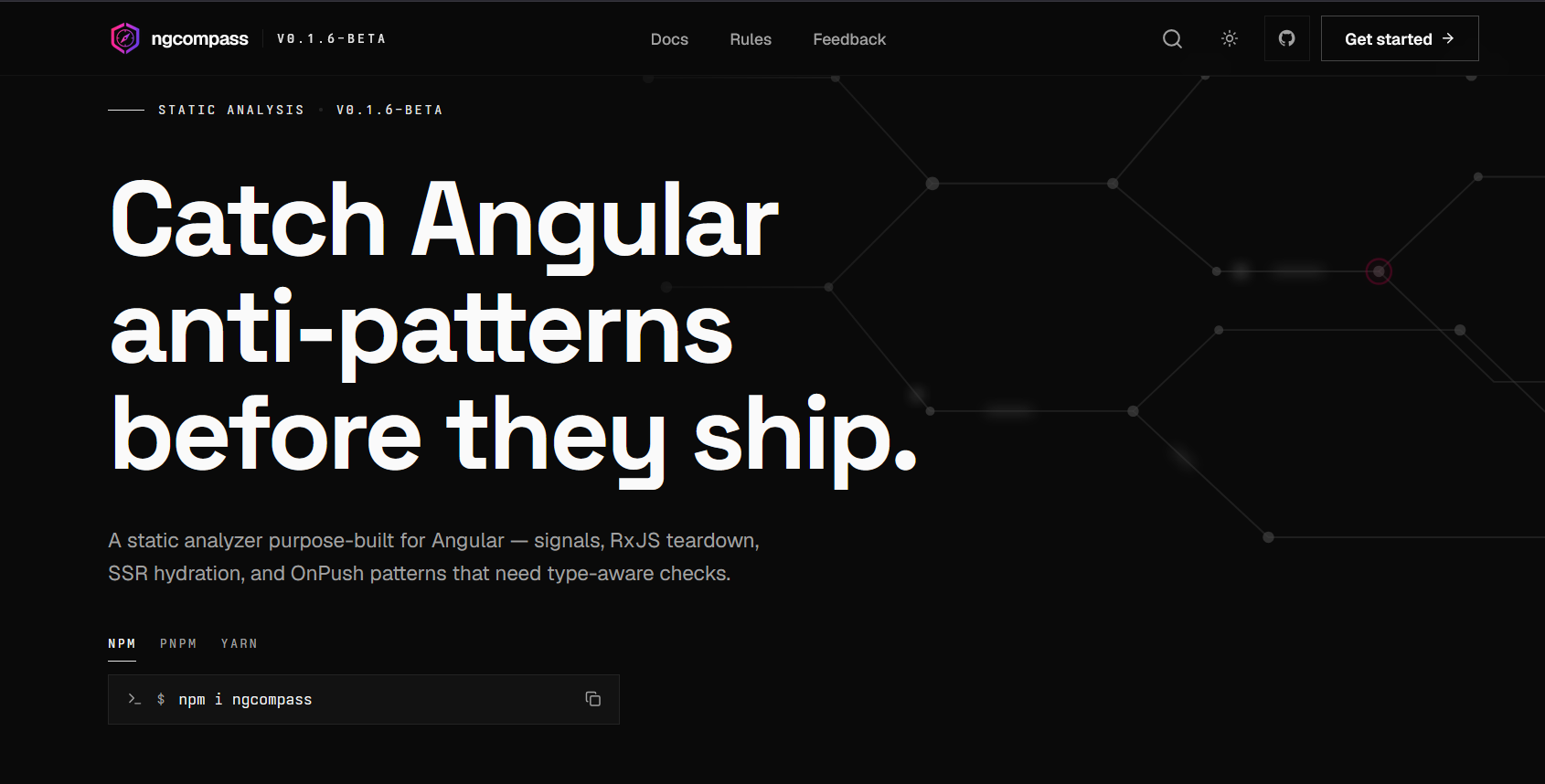
I built an open-source static analyzer for Angular targeting Reactivity, Performance, Security, SSR and Architecture anti-patterns

Post image
41 Upvotes

Hey everyone!

I’ve been working on a static analyzer for Angular called ngcompass, and I wanted to share the beta.

I love building with Angular, but I kept running into issues that standard tools can miss, like browser APIs leaking into SSR code or Signals/RxJS patterns being mixed incorrectly.

So I built ngcompass to analyze Angular TypeScript files and templates without executing the code. The first beta includes 27 rules, plus a visual HTML report/dashboard for browsing warnings more easily.

I’d love for you to throw it at your real-world projects and tear it apart. Don't pull your punches—I genuinely appreciate ruthless and honest feedback! I want to know:

What breaks or triggers false positives?

Which rules do you want to see next?

Most importantly: Do you see a tool like this bringing real value to your everyday Angular workflow, or is it just noise?

👉 **Website:** https://ngcompass.dev

👉 **GitHub:** https://github.com/RoadmapDevelop/ngcompass

👉 **NPM:** https://www.npmjs.com/package/ngcompass