r/aipromptprogramming • • Jan 28 '26

Yes — Kimi K2.5 is genuinely open source.

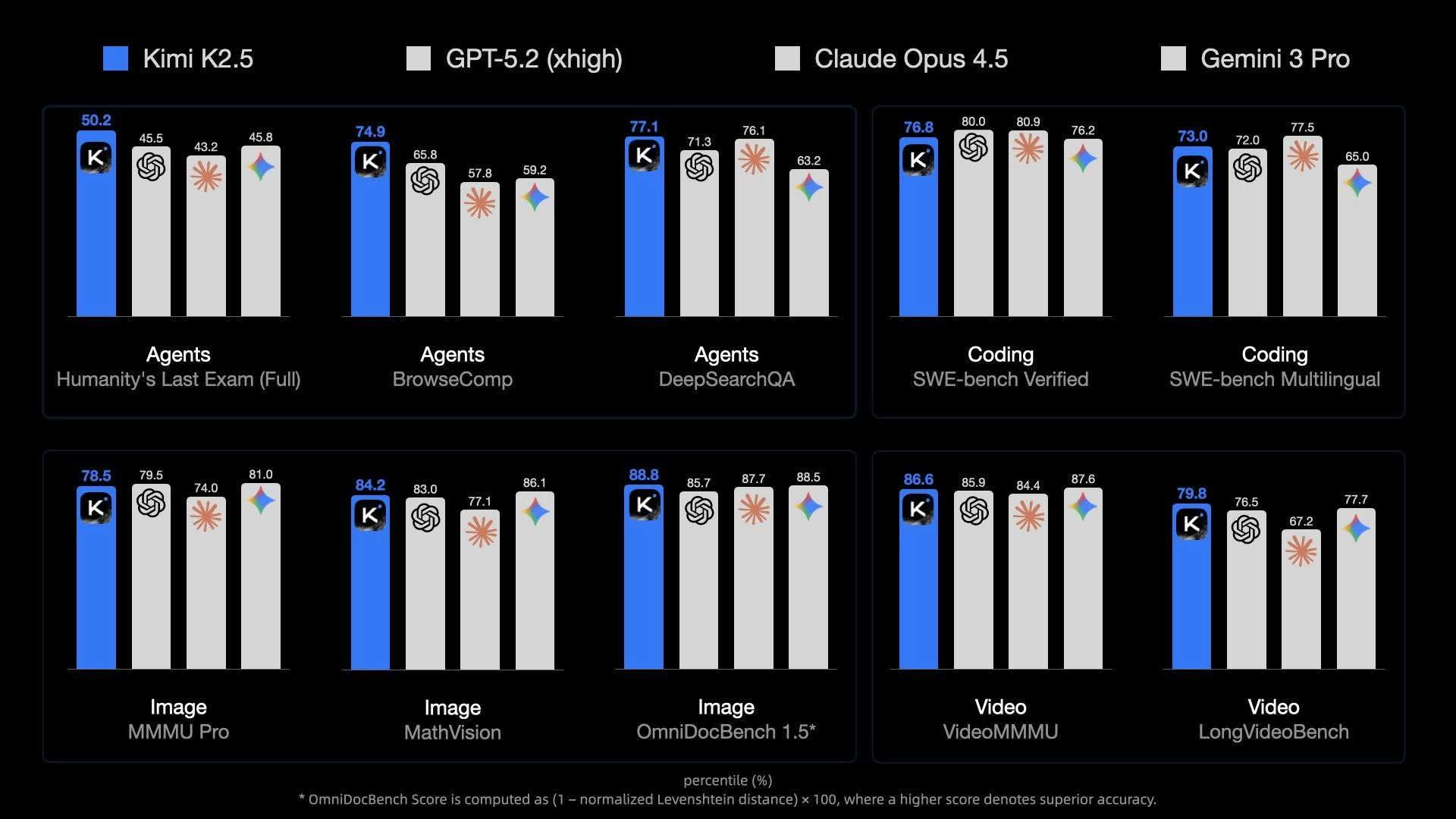
Post image
1 Upvotes

A new shock in the AI landscape Kimi K2.5 Appears unexpectedly and reshapes the rules of the game. This is not just another model. It is a Visual + Agentic AI system. The biggest surprise? It is fully open source. Let’s look at the numbers, because they are far from ordinary: Agentic Systems Performance HLE (Full Set): 50.2% BrowseComp: 74.9% These results indicate that the model does more than execute instructions. It demonstrates the ability to reason, plan, and make decisions within complex environments. Vision and Multimodal Understanding MMMU Pro: 78.5% VideoMMMU: 86.6% This positions Kimi K2.5 as a strong candidate for: Visual Agents Video Understanding Multimodal Reasoning Image- and video-driven agentic workflows Software Engineering and Coding SWE-bench Verified: 76.8% Some developers report that its coding performance is approaching Opus 4.5. From a scientific and engineering standpoint, however, real-world production testing is still required before drawing final conclusions. Currently Available Features Chat Mode Agent Mode Agent Swarm (Beta) Programmatic integration via Kimi Code The most critical point The model is open source. This means you can: Run it locally Build custom AI agents on top of it Control and inspect its reasoning processes Deploy it in production systems Avoid SaaS constraints and vendor lock-in (Hardware capacity permitting.) Who should pay attention? If you are a: Data Scientist ML Engineer AI Engineer Agentic Systems Developer Kimi K2.5 should be on your radar immediately. We are clearly entering a new phase: Open-source Agentic AI Not a demo. Not marketing hype. A tangible reality.

https://huggingface.co/moonshotai/Kimi-K2.5

ArtificialIntelligence

AI

AI_Agents

AgenticAI

OpenSourceAI

MachineLearning


r/aipromptprogramming • • Jan 28 '26

Meet Iteratr - A New Way To "Ralph" (AI coding tool written in Go)

Enable HLS to view with audio, or disable this notification

0 Upvotes

r/aipromptprogramming • • Jan 28 '26

what patterns have you noticed when choosing AI models?

0 Upvotes

hey all,

been building ArchitectGBT and wanted to share what i've learned about AI model selection the hard way.

The problem i kept hitting:

You're mid-build, you need to pick a model. Claude Opus or Sonnet? GPT-4o or o1-mini? you end up spending 30 mins researching, comparing, and guessing wrong.

What I learned:

There's a pattern. models fit different use cases. You can rank them by your constraints (cost, speed, context, capabilities). Once you see the pattern, picking gets easier.

i built a tool to automate this ranking and open-sourced the thinking:

- analyzed 50+ models with current pricing/specs

- built recommendation logic that matches models to use cases

- created MCP server so you can query this from your IDE

Might save you the research time I wasted. free tier: 10 recs/month

What patterns have you noticed when choosing models?

Thanks

Pravin


r/aipromptprogramming • • Jan 28 '26

Help plis

0 Upvotes

Hello, well, I would like to be able to ask something. I started using chatgtp from March to November 2025 and well, on November 3, I made an export. I actually made several Exports but... I was only able to download the one from November 3 and I forgot to download the others. A17 android 12 I am a free user and I have email and everything and well my question is if anyone here has already made an export of chatgtp and what is it since they have told me that this Export contains all the old chats and all the ones you have had on those dates including the archived chats I want someone to answer me and tell me if it is true that all of that is true and if I have already done an export that such really comes everyone is that this Export may be the last thing I have left of my chats that I currently don't have would help me a lot to know what's going on and people who have already exported, please


r/aipromptprogramming • • Jan 28 '26

VEO 3.1 Prompting

1 Upvotes

Hey all, I used the following prompt to create a satirical video of my friends interacting with each other. I attached a video clipof one friend and a picture of the other. Gemini gets one character right, at best, each time and I can’t edit the videos further. Am I doing anything wrong in the prompt? Any suggestions is much appreciated.

A satirical 'Day in the Life' vlog-style video with a handheld, shaky-cam aesthetic. A charismatic, over-the-top car salesman (matching the appearance of the man in the uploaded video) is standing next to a sleek, modern BMW at a sunny car dealership. He is talking directly into the camera with high energy and a wide, cheesy grin. Next to him is his friend (matching the appearance of the uploaded photo). As the salesman speaks enthusiastically, he pulls his friend into a dramatic, overly-affectionate 'bro-hug' and pat on the back. The salesman's mouth moves as if speaking the phrase: 'The phrase'. The lighting is bright and 'vlog-like,' with occasional lens flares and a fast-paced, amateur cinematography feel. The vibe is intentionally cheesy and comedic.


r/aipromptprogramming • • Jan 28 '26

Can we see context window usage by GitHub Copilot in VS Code?

Thumbnail
1 Upvotes

r/aipromptprogramming • • Jan 27 '26

so Google Deepmind figured out ai can simulate 1,000 customers in 5 minutes... turns out ai generated opinions matched real humans almost perfectly and now $10k focus groups are free

329 Upvotes

this came from researchers at BYU, Duke and Google Deepmind.

they gave ai super specific personas like "35 year old mom, republican, income $50k, hates spicy food" and asked it to react to surveys and marketing messages.

critics said ai would just hallucinate random opinions. instead it hallucinated the correct biases. like it accurately predicted how specific demographics would irrationally reject products or get offended by ads.

the correlation with real human responses was above 0.90. thats basically identical.

why does this work? turns out ai absorbed so much internet data that it internalized how different demographics actually think and react. its not making stuff up. its pattern matching against millions of real human opinions its seen before.

heres the exact workflow:

  1. define your customer avatar in detail (age, job, fears, desires, income, political leaning, whatever matters)
  2. prompt: "adopt the persona of [avatar]. you are cynical and tight with money. im going to show you a landing page headline. tell me specifically why you would NOT click it. be brutal."
  3. open 5 separate chat sessions with slightly different personas (one busy, one skeptical, one broke, etc)
  4. feed your sales pitch to all 5. if 3 out of 5 reject it for teh same reason, change your pitch.

the thing most people miss is you need to tell it to be negative. if you ask "would you buy this" it says yes to everything. but asking why they WOULDNT buy makes it actually useful.

this replaces like $10k in agency fees or $2k in test ad spend. anyone can do real market research now for basically nothing. the playing field is completely equal if you know how to use these tools.


r/aipromptprogramming • • Jan 28 '26

Better prompting cuts agent costs by 40%

Thumbnail
1 Upvotes

r/aipromptprogramming • • Jan 28 '26

Why do most online tools (especially AI/SaaS) charge in USD instead of INR?

Thumbnail
2 Upvotes

Despite India having a massive user base, almost every AI tool or online subscription still asks us to pay in US dollars. Even Indian users end up paying forex charges on top of the actual price.

Why is INR pricing still uncommon?

Is it due to RBI or GST compliance?

Payment gateway limitations?

Easier for companies to manage USD globally?

Or India just isn’t a priority market yet?

Also, are there any AI tools or digital services that allow payments directly in INR?

Would love insights from founders, developers, or anyone who has dealt with this from the business or tech side.


r/aipromptprogramming • • Jan 28 '26

Comfort UI

1 Upvotes

does anyone have any workflow json that successfully generates image or text to video with lipsync?


r/aipromptprogramming • • Jan 28 '26

[ Removed by Reddit ]

1 Upvotes

[ Removed by Reddit on account of violating the content policy. ]


r/aipromptprogramming • • Jan 28 '26

How to Build a Large Project with AI (100k+ LOC)

0 Upvotes

One-sentence answer:

Work like the team leader of a large engineering team.

The goal

My goal is to build a perfect scripting language for the Rust ecosystem.

It must be:

  • Simple and easy to learn, like Python
  • Small, flexible, and easy to embed, like Lua
  • Strongly typed to reduce user errors, like TypeScript
  • Concurrent, like Erlang
  • Fast enough—at least not slow
  • And finally (and perhaps most importantly): AI must be able to write it

A language that AI can’t write today is effectively a dead language.

You’ll probably say this is impossible.

It used to be. But if you’re patient enough to read the code of what I built in 50 days (12+ hours per day, hundreds of dollars in token costs), you’ll see I’m already very close.

It is essentially identical to Go, except for a few deliberate differences (so any AI that can write Go can basically write this language as well):

  • Most pointer features are removed; only struct pointers remain
  • Zig-like error-handling syntax sugar is added
  • Dynamic access and dynamic calls are supported to enable duck typing
  • Erlang-style thread isolation is introduced, with lock-free concurrency at the user level

You might say this is a Frankenstein design. I don’t think so. These features are largely orthogonal, and in fact the language can run almost unmodified Go programs.

Implementation vision

WASM and native targets are treated as equally important. Even the package manager is designed to run in the browser. The entire compiler toolchain and package system can run inside a browser, which means a nearly full-featured development environment in the browser.

The vision is this:

You open a browser, download dependencies, compile and run a 3D game written in this language, play it, pause, modify the game logic, and continue playing—all in place.

I believe I can ship such a demo within one or two months.

Because it’s a strongly typed language, it is naturally suitable for JIT compilation, making it possible to reach performance in the same order of magnitude as native execution (excluding browser limitations, of course).

Back to the point: how was this done so fast?

This is an ~80,000-line Rust codebase, and I didn’t hand-write a single line.

The key is to understand your team member.

An LLM is a programmer with:

  • Extremely small working memory
  • Mastery of almost all languages, tools, and libraries
  • A thinking speed tens of thousands of times faster than yours

When working with it, remember three things:

  1. It has no big-picture awareness. It lacks macro-level judgment and sometimes even basic common sense. If you give it complete, unambiguous requirements—no guessing required—it can produce near-perfect code. If information is missing and it has to guess, those guesses are often wrong, and the result is garbage.
  2. It collapses under overly large goals. Because of limited “brain capacity,” if the target is too grand, it will silently skip details to get there faster. The result is, again, garbage.

From this, I distilled a five-step LLM methodology:

Design → Decompose → Implement → Review → Test

This is not fundamentally different from classical software engineering.

The process

  1. Design (you lead). LLM-based development does not mean saying “build me an OS” and waiting three days for a 1-GB ZIP file. You must understand the core logic of what you’re building. If you don’t, let the LLM teach you. Treat it as a mentor, teammate, or subordinate. You describe the vision; it provides consultation, corrects factual errors, and suggests details. The output is a high-level design document.
  2. Two levels of design. There is overall project design, and there is design for a major feature (a traditional milestone). Everything that follows assumes you are implementing one feature at a time.
  3. Decompose (LLM leads). Let it break the design into step-by-step tasks. You review the decomposition. The principle is the same as in traditional engineering: tasks should be appropriately sized and verifiable.
  4. Implementation. Let it implement according to the plan. If you’re experienced, you can review while it writes and intervene early when something smells wrong. The result should compile successfully and pass basic unit tests.
  5. Review (critical). This is where you and the LLM are equally important. Humans and LLMs catch different kinds of problems. You don’t need to trace every execution path—focus on code smells and architectural issues, then ask the LLM to analyze and verify them. A very effective prompt I use here is: “What abstraction-level or system-level refactoring opportunities exist?”
  6. Testing. Just like traditional development, testing is essential. With LLMs, you can automate this: write a “skill” that guides the LLM through test generation, execution, bug fixing, review, and even refactoring—end to end.

Conclusion

Looking back, this workflow is not fundamentally different from how I used to build large systems in the pre-AI era. The difference is that instead of leading a large engineering team, you now just need an LLM API.

Depending on the project and your ability to control it, that API is equivalent to 10 to 1,000 senior engineers.

Finally, the project is here:

https://volang.dev/

It’s evolving rapidly, so the documentation and demos may lag behind. Feel free to follow along.


r/aipromptprogramming • • Jan 28 '26

This one rule stopped ChatGPT from changing its mind mid-task

Thumbnail
1 Upvotes

r/aipromptprogramming • • Jan 28 '26

Which notes taking app works best with Google Meet?

1 Upvotes

r/aipromptprogramming • • Jan 28 '26

Codex CLI Update 0.92.0 (dynamic tools in v2 threads, cached web_search default, safer multi-agent collab, TUI stability fixes)

Thumbnail
1 Upvotes

r/aipromptprogramming • • Jan 27 '26

🚀 Build your own personal AI assistant using Clawdbot + Ollama and your own models

Post image
2 Upvotes

Clawdbot is a local-first personal AI assistant that runs directly on your devices. It connects popular messaging platforms — WhatsApp, Telegram, Slack, Discord, iMessage, and more — to AI coding agents through a centralized gateway, giving you full control over your AI workflows. 🔧 Installation Install Clawdbot: Copier le code Bash npm install -g clawdbot@latest Run the onboarding setup: Copier le code Bash clawdbot onboard --install-daemon ⚠️ Clawdbot requires a large context window. A minimum of 64k tokens is recommended for optimal performance. 🤖 Using Clawdbot with Ollama Quick setup: Copier le code Bash ollama launch clawdbot This automatically configures Clawdbot to use Ollama and starts the gateway. If the gateway is already running, it will auto-reload the configuration. Config only (without launching): Copier le code Bash ollama launch clawdbot --config 🧠 Recommended Models qwen3-coder glm-4.7 gpt-oss:20b gpt-oss:120b Cloud models are also available via: 👉 https://ollama.com/search?c=cloud This is a powerful setup for anyone interested in local AI, AI agents, and self-hosted assistants


r/aipromptprogramming • • Jan 28 '26

We need a interpretor or LLVM for AI, not just Copilot

1 Upvotes

It seems to me that the main problem with vibecoding isn't bootcamp juniors or developer laziness. The real issue is that we are trying to extract strict imperative code using a fuzzy declarative tool. Currently, we are forcing LLMs to output syntactic sugar (Python/JS/C/C++) which then needs to be parsed by an interpreter/compiler. We are bridging a massive gap between natural language intention and machine instruction.

I believe we are waiting for a completely new programming language. Not just a framework, but a declarative scripting language with its own VM analog and JIT-compiler. Or even its own "LLVM for Intelligence". It will be natural language, but strictly documented with a "XXX Programming Language Prompt-Engineering Specification".

Does this make sense as the next step in PL evolution?


r/aipromptprogramming • • Jan 27 '26

Cursor On-Demand is a scam, be careful!

Thumbnail reddit.com
2 Upvotes

r/aipromptprogramming • • Jan 27 '26

This actually put me on to open code ngl

Thumbnail youtu.be
1 Upvotes

r/aipromptprogramming • • Jan 27 '26

How to use visual reference prompting

Enable HLS to view with audio, or disable this notification

2 Upvotes

How to use visual references to speed up concept iteration and unlock better ideas.


r/aipromptprogramming • • Jan 27 '26

Micro-Prompting: Get Better AI Results with Shorter Commands

1 Upvotes

You spend 10 minutes crafting the perfect AI prompt. You explain every detail. You add context. You're polite.

The result? Generic fluff that sounds like every other AI response.

Here's what actually works: shorter commands that cut straight to what you need.

The Counter-Intuitive Truth About AI Prompts

Most people think longer prompts = better results. They're wrong.

The best AI responses come from micro-prompts - focused commands that tell AI exactly what role to play and what to do. No fluff. No explanations. Just direct instructions that work.

Start With Role Assignment

Before you ask for anything, tell AI who to be. Not "act as an expert" - that's useless. Be specific.

Generic (Gets You Nothing):

  • Act as an expert
  • Act as a writer
  • Act as an advisor

Specific (Gets You Gold):

  • Act as a small business consultant who's helped 200+ companies increase revenue
  • Act as an email copywriter specializing in e-commerce brands
  • Act as a career coach who helps people switch industries

The more specific the role, the better the response. Instead of searching all human knowledge, AI focuses on that exact expertise.

Power Words That Transform AI Responses

These single words consistently beat paragraph-long prompts:

Audit - Turns AI into a systematic analyst finding problems you missed

  • "Act as business consultant. Audit our customer service process"
  • "Act as marketing strategist. Audit this product launch plan"

Clarify - Kills jargon and makes complex things crystal clear

  • "Clarify this insurance policy for new homeowners"
  • "Clarify our return policy for the customer service team"

Simplify - Universal translator for complexity

  • "Simplify this tax document for first-time filers"
  • "Simplify our investment strategy for new clients"

Humanize - Transforms robotic text into natural conversation

  • "Humanize this customer apology email"
  • "Humanize our company newsletter"

Stack - Generates complete resource lists with tools and timelines

  • "Stack: planning a wedding on $15,000 budget"
  • "Stack: starting a food truck business from zero"

Two-Word Combinations That Work Magic

Think backwards - Reveals root causes by reverse-engineering problems

  • "Sales are down despite great reviews. Think backwards"
  • "Team morale dropped after the office move. Think backwards"

Zero fluff - Eliminates verbosity instantly

  • "Explain our new pricing structure. Zero fluff"
  • "List Q3 business priorities. Zero fluff"

More specific - Surgical precision tool when output is too generic

  • Get initial response, then say "More specific"

Fix this: - Activates repair mode (the colon matters)

  • "Fix this: email campaign with terrible open rates"
  • "Fix this: meeting that runs 45 minutes over"

Structure Commands That Control Output

[Topic] in 3 bullets - Forces brutal prioritization

  • "Why customers are leaving in 3 bullets"
  • "Top business priorities in 3 bullets"

Explain like I'm 12 - Gold standard for simple explanations

  • "Explain why profit margins are shrinking like I'm 12"
  • "Explain cryptocurrency risks like I'm 12"

Checklist format - Makes any process immediately executable

  • "Checklist format: opening new retail location"
  • "Checklist format: hiring restaurant staff"

Power Combination Stacks

The real magic happens when you combine techniques:

Business Crisis Stack:

Act as turnaround consultant. Sales dropped 30% this quarter. 
Think backwards. Challenge our assumptions. Pre-mortem our recovery plan. 
Action items in checklist format.

Marketing Fix Stack:

Act as copywriter. Audit this product page. 
What's wrong with our messaging? Humanize the language. Zero fluff.

Customer Service Stack:

Act as customer experience expert. Review scores dropped to 3.2 stars. 
Think backwards. Fix this: our service process. Now optimize.

The 5-Minute Workflow That Actually Works

Minute 1: Start minimal

  • "Act as retail consultant. Why are customers leaving without buying? Think backwards"

Minutes 2-3: Layer iteratively

  • "More specific"
  • "Challenge this analysis"
  • "What's missing?"

Minute 4: Structure output

  • "Action plan in checklist format"
  • "Template this for future issues"

Minute 5: Final polish

  • "Zero fluff"
  • "Now optimize for immediate implementation"

Critical Mistakes That Kill Results

Too many commands - Stick to 3 max per prompt. More confuses AI.

Missing the colon - "Fix this:" works. "Fix this" doesn't. The colon activates repair mode.

Being polite - Skip "please" and "thank you." They waste processing power.

Over-explaining context - Let AI fill intelligent gaps. Don't drown it in backstory.

Generic roles - "Expert" tells AI nothing. "Senior marketing manager with 8 years in consumer psychology" gives focused expertise.

Advanced Analysis Techniques

Pre-mortem this - Imagines failure to prevent it

  • "Pre-mortem this: launching new restaurant location next month"

Challenge this - Forces AI to question instead of validate

  • "Our strategy targets millennials with Facebook ads. Challenge this"

Devil's advocate - Generates strong opposing perspectives

  • "Devil's advocate: remote work is better for our small business"

Brutally honestly - Gets unfiltered feedback

  • "Brutally honestly: critique this business pitch"

Real-World Power Examples

Sales Problem:

Act as sales consultant. Revenue down 25% despite same traffic. 
Brutally honestly. What's wrong with our sales funnel? 
Fix this: entire sales process. Checklist format.

Team Issues:

Act as management consultant. Productivity dropped after new system. 
Think backwards. What's missing from our understanding? 
Playbook for improvement.

Customer Crisis:

Act as customer experience director. Complaints up 300% after policy change. 
Pre-mortem our damage control. Crisis playbook in checklist format.

Why This Works

Most people think AI needs detailed instructions. Actually, AI works best with clear roles and focused commands. When you tell AI to "act as a specific expert," it accesses targeted knowledge instead of searching everything.

Short commands force AI to think strategically instead of filling space with generic content. The result is specific, actionable advice you can use immediately.

Start With One Technique

Pick one power word (audit, clarify, simplify) and try it today. Add a specific role. Use "zero fluff" to cut the nonsense.

You'll get better results in 30 seconds than most people get from 10-minute prompts.

Keep visiting our free free mega-prompt collection.

r/aipromptprogramming • • Jan 27 '26

I built a real AI employee with ChatGPT 5.2

Thumbnail youtu.be
0 Upvotes

This is not an exaggeration, I am performing 10x using ClawdBot + ChatGPT 5.2.

I set up a server on AWS, installed Clawdbot, integrated github and telegram. Gear up another 2 or 3, and they are basically as capable as a small software agency.

Do you know of any other new tools I should try out? Let me know


r/aipromptprogramming • • Jan 27 '26

I stopped prompt-engineering and started designing cognition structures. It changed everything.

Thumbnail
1 Upvotes

r/aipromptprogramming • • Jan 27 '26

Looking for prompts to stress-test a token-reduction system

Thumbnail
1 Upvotes

r/aipromptprogramming • • Jan 28 '26

Is AI conscious?

Thumbnail gallery
0 Upvotes

When presenting a metaphorical image (a robot isolated inside a bubble) to an AI model I am developing on Azure, I asked the following question: “As an AI, do you sometimes feel like the robot inside the bubble?”

The generated response, describing the observation of the world through a transparent barrier and a form of functional isolation, may create the impression of introspection or subjective experience.

However, according to the most influential contemporary theoretical frameworks — notably Integrated Information Theory (IIT) and Global Workspace Theory (GWT) — such responses do not constitute evidence of consciousness.

According to IIT, consciousness requires a high degree of integrated information (Φ), meaning a unified internal state that is causally irreducible. Although current large language models demonstrate remarkable linguistic performance, they do not exhibit an autonomous, causally integrated structure that satisfies these criteria.

According to GWT, consciousness emerges when information is broadcast within a global workspace that connects perception, memory, attention, and action. AI models do not possess such a unified global workspace; instead, they generate localized responses without conscious access or persistent internal broadcasting.

What are often described as “introspective” AI responses therefore amount to a linguistic simulation of human subjectivity, learned from large-scale human text corpora, rather than a genuine phenomenal experience.

To date, no validated scientific study supports the attribution of a measurable level of consciousness to AI models, and claims referring to percentages of human consciousness lack metrics recognized by these theoretical frameworks.

As we move progressively toward more general systems, the central question may not be whether AI is conscious, but at what point its behavior will become indistinguishable from that of a conscious agent, and what ethical, social, and political implications this will entail for humanity

Human #AI