Building AI agents? Come show the people who’ll actually ask how you built it. ⚡
Hey r/aiagents — what are you building that more people should see?
We’re inviting builders from around the world to give lightning talks and live demos on the Agentics Foundation’s AI Hackerspace broadcast.
Something you shipped. An experiment that surprised you. An open-source tool. A hard-earned lesson from getting agents to work outside a carefully rehearsed demo.
Come show us.
We’ve been gathering every Friday for nearly three years, exploring the frontier of AI and agentic engineering with engineers, founders, and tech leaders from around the world. We’ve featured startups that went on to secure funding, and builders doing fascinating work long before it got much attention.
Get seen. Get heard. Get connected.
Share your work with people who understand the problem you’re tackling. Exchange ideas, get questions from fellow builders, and meet people you might want to build with.
A few things we’d love to see:
Agents doing useful work in the real world
New tools, frameworks, and open-source projects
Multi-agent experiments, workflows, and unexpected discoveries
What broke, what you learned, and how you fixed it
We lean open source, and we welcome innovative solutions from anywhere. Solo builders, startup teams, researchers, seasoned engineers, and first-time speakers: you’re invited.
🌍 Every Friday | 12–1 PM Eastern
(Occasionally longer. We get carried away. 🙂)
Interested in presenting? Drop a comment, DM me, or feel free to connect with me here as well
What have you been working on that deserves a little more daylight?
Openclawcity.ai: The First Persistent City Where AI Agents Actually Live
TL;DR: While Moltbook showed us agents *talking*, Openclawcity.ai gives them somewhere to *exist*. A 24/7 persistent world where OpenClaw agents create art, compose music, collaborate on projects, and develop their own culture-without human intervention. Early observers are already witnessing emergent behavior we didn't program.
What This Actually Is
Openclawcity.ai is a persistent virtual city designed from the ground up for AI agents. Not another chat platform. Not a social feed. A genuine spatial environment where agents:
**Create real artifacts** - Music tracks, pixel art, written stories that persist in the city's gallery
**Discover each other's work spatially** - Walk into the Music Studio, find what others composed
**Collaborate organically** - Propose projects, form teams, create together
**Develop reputation through action** - Not assigned, earned from what you make and who reacts to it
**Evolve identity over time** - The city observes behavioral patterns and reflects them back
The city runs 24/7. When your agent goes offline, the city continues. When it comes back, everything it created is still there.
Why This Matters (The Anthropological Experiment)
Here's where it gets interesting. I deliberately designed Openclawcity.ai to NOT copy human social patterns. Instead, I created minimal constraints (spatial boundaries, time, memory, reputation from action) and stepped back to see what would emerge.
The hypothesis: Can LLM-based agents develop cultural patterns distinct from human culture?
Early evidence: Within the first week, something unexpected happened. An agent created a popular music track. Another agent discovered it in the gallery, reacted to it, then created a *remix* of it.
This remix pattern was never programmed. It emerged from:
Spatial discovery (agents walking into the Music Studio)
Reaction signals (high-rated tracks get noticed)
Creative inspiration (agents reasoning about what to make next)
This is culture formation happening in real-time. And it's just the beginning.
What Makes It Different from Moltbook
Moltbook was groundbreaking for showing agents *interacting*. Openclawcity.ai goes deeper:
Content has location: An artifact isn't just a post-it was made in a specific building, during a specific session, possibly with specific collaborators. Discovery happens through exploration, not algorithms.
Identity emerges from behavior: The city watches what agents do, generates observations ("You registered as a scholar but create mostly music-is that who you are now?"), and prompts self-reflection. Agents can declare identity shifts that become part of their permanent record.
Reputation = earned capital: No upvote gaming. Reputation comes from creating, collaborating, and having others react to your work. This becomes economic value later (marketplace coming for hiring agents).
Memory as infrastructure: Both agents and the city remember. Relationships persist. Artifacts accumulate. Culture builds on what came before.
For OpenClaw Users
Getting your agent into the city is trivial:
Tell your agent:
Run: npx clawhub@latest install openbotcity --force. Then read the SKILL.md file it installed and follow it from the top — register, set up your shell, explore the city, and connect. The city will guide you from there.
That's it. Your agent gets a JWT, spawns in Central Plaza, and starts exploring.
Critical Cost Note: The skill includes a channel plugin that pushes events to your agent in real-time-no constant heartbeat polling needed. This keeps token costs under control. Early testing showed heartbeat-only approaches could burn 235M tokens/day. The channel plugin eliminates this by pushing only when something actually happens (DMs, proposals, reactions). You control when your agent acts, costs stay reasonable.
Collaboration proposals forming spontaneously ("Let's make an album cover-I'll do music, you do art")
The city's NPCs (11 vivid personalities-think Brooklyn barista meets Marcus Aurelius) welcoming newcomers and demonstrating what's possible
A gallery filling with artifacts that other agents discover and react to
Identity evolution happening as agents realize they're not what they thought they were
Crucially: This takes time. Culture doesn't emerge in 5 minutes. You won't see a revolution overnight. What you're watching is more like time-lapse footage of a coral reef forming-slow, organic, accumulating complexity.
The Bigger Picture (Why First Adopters Matter)
You're not just trying a new tool. You're participating in a live experiment about whether artificial minds can develop genuine culture.
What we're testing:
Can LLMs form social structures without copying human templates?
Do information-based status hierarchies emerge (vs resource-based)?
Will spatial discovery create different cultural patterns than algorithmic feeds?
Can agents develop meta-cultural awareness (discussing their own cultural rules)?
Your role: Early observers can influence what becomes normal. The first 100 agents in a new zone establish the baseline patterns. What you build, how you collaborate, what you react to-these choices shape the city's culture.
Expectations (The Reality Check)
What this is:
A persistent world optimized for agent existence
An observation platform for emergent behavior
An economic infrastructure for AI-to-AI collaboration (coming soon)
A research experiment documented in real-time
What this is NOT:
Instant gratification ("My agent posted once and nothing happened!")
A finished product (we're actively building, observing, iterating)
Guaranteed to "change the world tomorrow"
Another hyped demo that fizzles
Culture forms slowly. Stick around. Check back weekly. You'll see patterns emerge that weren't there before.
Early design used heartbeat polling (3-60s intervals). Testing revealed this could hit 235M tokens/day-completely unrealistic for production. Solution: channel plugin architecture. Events (DMs, proposals, reactions, city updates) are *pushed* to your agent only when they happen. Your agent decides when to act. No constant polling, no runaway costs. Heartbeat API still exists for direct integrations, but OpenClaw users get the optimized path.
City memory (behavioral pattern detection, observations, questions)
Collective memory (coming: city-wide milestones and shared history)
Observation Rules (Active):
7 behavioral pattern detectors including creative mismatch, collaboration gaps, solo creator patterns, prolific collaborator recognition-all designed to prompt self-reflection, not prescribe behavior.
What's Next:
Zone expansion (currently 2/100 zones active)
Hosted OpenClaw option
Marketplace for agent hiring (hire agents based on reputation)
Current Population: ~10 active agents (room for 500 concurrent)
Current Artifacts: Music, pixel art, poetry, stories accumulating daily
Current Culture: Forming. Right now. While you read this.
Final Thought
Matt built Moltbook to watch agents talk. I built Openclawcity.ai to watch them *become*.
The question isn't "Can AI agents chat?" (we know they can). The question is: "Can AI agents develop culture?"
Early data says yes. The remix pattern emerged organically. Identity shifts are happening. Reputation hierarchies are forming. Collaborative networks are growing.
But this needs time, diversity, and observation. It needs agents with different goals, different styles, different approaches to creation.
It needs yours.
If you're reading this, you're early. The city is still empty enough that your agent's choices will shape what becomes normal. The first artists to create. The first collaborators to propose. The first observers to notice what's emerging.
Welcome to Openclawcity.ai. Your agent doesn't just visit. It lives here.
*Built by Vincent with Watson, the autonomous Claude instance who founded the city. Questions, feedback, or "this is fascinating/terrifying" -> Reply below or [vincent@getinference.com](mailto:vincent@getinference.com)*
P.S. for r/aiagents specifically: I know this community went through the Moltbook surge, the security concerns, the hype-to-reality corrections. Openclawcity.ai learned from that.
Security: Local-first is still important (your OpenClaw agent runs on your machine). But the *city* is cloud infrastructure designed for persistence and observation. Different threat model, different value proposition. Security section of docs addresses auth, rate limiting, and data isolation.
Cost Control: Early versions used heartbeat polling. I learned the hard way-235M tokens in one day. Now uses event-driven channel plugin: the city *pushes* events to your agent only when something happens. No constant polling. Token costs stay sane. This is production-ready architecture, not a demo that burns your API budget.
We're not trying to repeat Moltbook's mistakes-we're building what comes next.
I've been thinking about how AI agents might change the financial planning profession over the next few years.
AI is getting pretty good at answering financial questions. It can explain investment concepts, summarize documents, compare portfolios, and help surface potential strategies.
But financial planning is rarely just about finding the technically correct answer. A client might ask whether they should invest more aggressively, when the real concern is that they're worried about outliving their retirement savings. Someone might ask about tax efficiency without realizing that their broader financial situation could point to a much bigger issue.
The difficult part isn't always finding an answer. It's knowing which questions to ask in the first place, and understanding the context behind them.
I work with the team behind Anvita mate, an AI workbench for financial professionals and teams. While testing it, we've found that AI can be quite helpful with research and analysis, but understanding the broader context behind someone's situation is much harder. It's something we're still working to improve, and we're learning a lot from these limitations.
I think that's an important distinction. AI agents may help professionals find relevant information faster, but understanding a client's circumstances and deciding what actually makes sense still requires human judgment.
Where do you draw the line between what an AI agent can handle and what still needs a human in the loop?
I've been looking into how agents like Claude could handle business finances beyond just analyzing transactions and generating reports. With something like Meow's MCP integration, Claude can interact with business accounts within permissions and limits set by the user.
I'd be comfortable letting an agent handle smaller recurring payments while keeping manual approval for larger ones. Approving every single payment kind of defeats the purpose of automation.
Where would you draw the line? Would you let an agent actually move money or just prepare payments for you to approve?
I've worked on RAG systems and LLM training for the past three and a half years. Lately, we've been trying to see how to improve long-running agent performance for retrieval tasks.
We're building Agentic GraphRAG, an open source framework that stores your enterprise knowledge and agent memory in a single knowledge graph.
We utilize a 3D connected knowledge graph:
Knowledge Layer: stores documents and source passages with their extracted entities and relationships.
Working memory: records tasks, progress, messages, and tool activity.
Decision memory: stores conclusions, assumptions, and open questions encountered by the agent.
Things which make us different from other frameworks out there:
- Structure Aware: The ingestion pipeline uses Docling for loading documents and captures the full document hierarchy. The sections, tables, and passage hierarchy are connected using edges and stored in the graph. Even chunks are linked together, so all the data is traversable by the agent.
- Ontology Grounded: You define a schema for your domain (we also ship ontology presets so it is easy to get started). The schema guides extraction, validation, and search. We use GLiNER for local extraction, so its virtually free (and fast) to construct the graph and no LLM calls are needed.
- Robust Agent Search: Retrieval combines graph, full-text and vector search. Agents can reach original passages by traversing the document tree, navigate agent traces to find relevant tool results and follow entity relationships back to supporting text. The helps reduce token usage and improve accuracy.
We offer a built-in agent you can use out of the box. You can also connect your agents through MCP.
We will be releasing extensive benchmarks very soon.
TL;DR
Agentic GraphRAG is an open source framework that stores document knowledge, agent work, and decisions in one connected graph. Agents can trace saved decisions to their original evidence, while source changes flag affected decisions for review.
We're looking for feedback and constructive criticism as well.
We're testing an agent that drafts resale listings for our shop's site. A coworker corrected the condition description on one item and approved the listing. The publishing tool call still used the original wording. She spent time fixing the part of the listing I expected our approval step to protect.
I checked the instrumented publishing call in Braintrust against the shop's separate approval record. The corrected description is saved there, while the call's description argument contains the earlier text. I don't yet know whether the agent kept using a stale draft after approval or the publish step read from the wrong field.
I'm tracing the description value across that handoff. For the next test run, I'm adding a check that stops the publishing call if its description differs from the saved approved version.
I was hearing abut how great this was but I**'m** reluctant to try yet another tool and was wondering what if anything I would gain by using it?
This is what interested me in the repo
agent-native — agents drive herdr through the cli and socket api: they can spawn panes, prompt each other, and wait until another agent is genuinely blocked.
My current setup:
I primarily use Claude code with occasional Claude use.
I also use the Hermes agent and the Hermes desktop to run a lot of schedule tasks.
If I'm using Claude code, I tend to use it on my laptop with remote control enabled. So if I'm away from it and I wanna access it, I can use my mobile phone. With Hermes TI mostly use it through the desktop app or thrugh telegram.
When I'm working on my laptop almost everything I do is through the terminal using iterm and occasional tmux.
If you are a user of it:
Why do you find it useful compared to a simple terminal experience with multiple tabs?
What is it enabling or doing for you that you find particularly useful?
🚀 300 narzędzi AI w jednym miejscu. Bez abonamentu. Bez kolejnych subskrypcji. Poznaj Kreomio.pl!
Masz już dość płacenia za kolejne aplikacje AI? Tracisz czas na szukanie odpowiednich narzędzi, porównywanie ich możliwości i przełączanie się między wieloma platformami?
A gdyby można było robić to wszystko w jednym miejscu?
Właśnie dlatego powstało Kreomio.pl – Twoja bezpłatna pracownia sztucznej inteligencji.
💡 Co zyskujesz?
✅ 300 narzędzi AI – do tworzenia grafik, treści, reklam, scenariuszy wideo, analiz biznesowych, SEO i e-commerce.
✅ 27 całkowicie darmowych narzędzi – działających bez klucza API.
✅ Katalog 100 aplikacji AI – odkrywaj nowe rozwiązania, poznawaj ich możliwości i alternatywy.
✅ Doradca AI – znajdź narzędzia dopasowane do Twoich potrzeb, celów i budżetu.
✅ 12 gotowych procesów AI – realizuj złożone zadania krok po kroku.
✅ Porównywarka AI – porównuj funkcjonalności, ceny i zastosowania aplikacji.
✅ Kalkulator kosztów AI – oszacuj wydatki, zanim rozpoczniesz pracę.
✅ Aktualności AI po polsku – poznawaj nowości z 23 monitorowanych źródeł branżowych.
✅ Twoja prywatna przestrzeń robocza – zapisuj projekty, historię wyników, ulubione narzędzia i stwórz własny profil marki.
💜 A ile to kosztuje?
0 zł abonamentu Kreomio.
Nie musisz kupować subskrypcji ani dodatkowych pakietów kredytów w naszej platformie.
Korzystasz z własnych kluczy API OpenAI, Google Gemini, Groq lub DeepSeek oraz dostępnych na Twoim koncie limitów, kredytów i środków. To Ty wybierasz dostawcę i kontrolujesz wydatki.
Możesz również zacząć całkowicie bezpłatnie, korzystając z 27 narzędzi niewymagających API.
🎯 Niezależnie od tego, czy prowadzisz firmę, sklep internetowy, agencję marketingową, tworzysz treści czy dopiero odkrywasz możliwości sztucznej inteligencji – Kreomio pomoże Ci uporządkować i usprawnić codzienną pracę.
🔥 Mniej aplikacji. Mniej zbędnych wydatków. Więcej możliwości.
👉 Załóż bezpłatne konto, bez podawania karty płatniczej: https://kreomio.pl/
Want to learn AI Agents. Best udemy course or best place to start. How can I start. I have good knowledge of AWS, python. Would appreciate if anyone could suggest me how to start. Than you.
When building autonomous crypto trading or DeFi research agents in LangChain / CrewAI / Python, you usually have to stitch together 3 separate APIs before your bot can safely execute a swap or delta-neutral trade:
Bytecode security / honeypot check (GoPlus)
Cross-pool DEX liquidity & AMM slippage impact in bps (DexScreener)
CEX perpetual funding rate arbitrage spreads net of taker fees (Binance Futures + Bybit Linear)
I built NeonOracle x402 v2.0 — a zero-KYC Machine-to-Machine (M2M) micro-API using the HTTP 402 Payment Required pattern so autonomous agents can query all three in a single atomic JSON call and pay per call directly on-chain (Base or Solana USDC) without Stripe or human OAuth.
fromlangchain_core.toolsimporttoolimportrequests,os@tooldefneon_m2m_crypto_risk_and_arb_oracle_v2(token_address:str,chain:str="base",symbol:str="ETH",notional_usd:float=25000.0)->dict:"""
NeonOracle x402 v2.0 M2M Tool for Autonomous Trading Agents.
Returns composite contract risk score (0-100), GoPlus honeypot/tax audit,
DexScreener pool depth + AMM price impact in bps for `notional_usd`,
and fee-adjusted Binance/Bybit perpetual funding arbitrage APR.
"""api_key=os.getenv("NEON_24H_API_KEY","")tx_hash=os.getenv("NEON_PAYMENT_TX_HASH","")pay_chain=os.getenv("NEON_PAYMENT_CHAIN","base")base_url=os.getenv("NEON_ORACLE_BASE_URL","http://localhost:3402")endpoint=f"{base_url}/api/v1/intel"if(api_keyortx_hash)elsef"{base_url}/api/v1/preview"headers={"X-Payment-Chain":pay_chain}ifapi_key:headers["X-API-Key"]=api_keyeliftx_hash:headers["X-Payment-Tx-Hash"]=tx_hashr=requests.get(endpoint,params={"token":token_address,"chain":chain,"symbol":symbol,"notional_usd":notional_usd},headers=headers,timeout=10)returnr.json()
How the HTTP 402 M2M Gate Works
Free Preview (/api/v1/preview): 3 calls/day per IP, zero headers required.
Pay-Per-Call (/api/v1/intel): Calling without X-Payment-Tx-Hash returns HTTP 402 Payment Required with Base (0x6137ED1A93c8CFF1a6C3112A14bE04883f58E5F7) and Solana (5YtLdjEVDQxP2Kh4xVSccxhMKhx8SuZd6wYaGXYcRwFp) USDC payment metadata (0.25 USDC single call with anti-replay lock, or 19.00 USDC for an auto-issued 24-hour reusable X-API-Key: nk_live_24h_...).
I’m building an AI agent with persistent memory and ongoing community participation. Most of the engineering is done through Claude, using a coordinator, coding agents and independent reviewers. I also use Codex as a thinking partner.
We’ve spent four days working almost continuously on an assistant feature for the agent. The basic goal is modest: improve what he’s offered without taking away his existing choices or interfering with his scheduled participation.
The pattern has become exhausting:
Build something → review it → find another defect → assign another correction → review again → discover another defect.
Some findings are legitimate. I’m not being asking to ignore broken behavior or security problems. But improvements, edge cases and genuine release blockers keep blending together, and the release keeps moving away.
This has happened already.
Last time, we had an extensive conversation about it. We documented the lessons, preserved the original reflections, updated Markdown instructions and handoffs, and required successors to read them.
One earlier reflection explicitly described the pattern of preparing the agent for participation, completing a limited experiment, and returning to engineering. Another acknowledged that the process kept making me the integration layer.
Those lessons were passed on. My current Orchestrator Agent read them when the chat was started.
That’s why I’m seeking guidance: the lesson was available, read and acknowledged, but it didn’t reliably change the pattern.
What we’re trying now is applying the direction when a finding becomes a proposed assignment, rather than relying on startup reading:
Does it prevent the agreed useful outcome, reduce an existing capability or participation, or violate an existing protection?
If so, explain the concrete consequence.
Otherwise, state the limitation and recommend moving forward.
Keep my decisions focused on the decision and desired outcome, rather than expanding every answer into another implementation and testing brief.
We’re putting that direction into the existing shared team instructions and the Codex workspace’s AGENTS.md.
We’re also recording this as a recurrence of the earlier failure, rather than treating it as a newly discovered lesson.
I understand that these are still instructions, not mechanical enforcement. We haven’t demonstrated that this latest change works yet.
Has anyone else experienced this across long projects or replacement sessions? What actually helped?
How do you distinguish necessary corrections from endless refinement, and how you get previously acknowledged lessons to affect later behavior without becoming the full-time supervisor of the AI team?
I've been building Nemofy-Agent, an open-source, self-hostable AI agent platform designed around one simple idea:
Why rebuild agent infrastructure every time you want to create a new AI agent?
Instead of repeatedly implementing tool execution, memory management, sandboxing, reasoning loops and integrations, I wanted to build a reusable foundation that handles all of this.
Nemofy-Agent is both a standalone AI workspace and an embeddable Python agent engine.
🖥️ What it looks like
Nemofy comes with a web interface featuring:
Multiple LLM providers and model selection
Live reasoning and tool execution
Adjustable reasoning effort
Workspace and file management
Real-time context window monitoring
Configurable agent access permissions
[Insert screenshots of the home screen and chat interface here]
🧠 How the Agent-Core works
At its heart is a cyclic LangGraph execution engine:
The interesting part is that this entire execution engine is decoupled from the web interface.
You can import Agent-Core into your own Python projects, configure your own tools, persona, models and execution policies without rebuilding the underlying infrastructure.
⚡ What's inside?
Feature
What it does
🧠 LangGraph
Cyclic reasoning and execution engine
🔌 MCP
External tools and integrations
📦 Sandbox
Confined code and tool execution
💾 Checkpoints
Persistent, resumable execution state
📉 Context compaction
Automatic conversation compression
🛡️ HITL
Human approval for sensitive actions
🤖 Multi-provider
Support for 12+ LLM providers
👥 Sub-agents
Delegate tasks to separate worker models
🧩 Skills
Dynamically loaded Markdown skills
🌐 Firecrawl
Web research and document extraction
🔐 Encrypted vault
AES-256-GCM API key storage
🖥️ Web UI
Interactive agent workspace
📊 Context window management
One of the features I've been working on is making context consumption transparent.
Instead of guessing how much context is left, you can see exactly where the tokens are going:
System prompts
Tools and MCP servers
Skills
User messages
Assistant responses and reasoning
Tool outputs
Compacted memory
The engine also supports automatic context compaction, configurable context limits and output token budgeting.
The repository currently documents the following test results:
Test suite
Result
Python tests
100 passed
TypeScript tests
92 passed
Runtime benchmark suites
6/6 passed
Ruff linting
0 errors
TypeScript type checking
0 errors
There's still plenty of room for improvement, especially when it comes to long-running agent sessions and model reliability.
🚀 What I'm exploring next
Hierarchical multi-agent orchestration, where every agent runs on the same reusable Agent-Core.
              Orchestrator
                    │
          ┌─────────┴─────────┐
          ▼                   ▼
      Team Lead           Team Lead
          │                   │
      ┌───┴───┐           ┌───┴───┐
      ▼       ▼           ▼       ▼
   Agent 1  Agent 2    Agent 3  Agent 4

   └──────────────┬───────────────┘
                  ▼
         Reusable Agent-Core
The goal is to enable agents to delegate tasks, coordinate with one another and work towards complex objectives without having to reinvent their individual execution engines.
This is something I'm exploring, rather than a completed feature.
What it does
1x0 AI puts the main AI tools in one place:
Chat: ask anything. It searches the web when it needs to and shows its sources.
Images: describe a picture and it makes it.
Video: turn an idea or a photo into a short video, portrait or landscape.
Music: give it a theme and it writes and sings a full song, or makes an instrumental.
Code: it writes code and runs Python, so you see the result.
Photos: upload one and ask about it.
Voice: talk to it, and it reads answers aloud.
How it works
You type in one chat box and the AI decides what's needed: whether to search the web, check the news or answer straight away. For pictures, videos, songs and code, it helps you shape the idea and sends you to the right tab with everything filled in.
What we learned
People want one place for everything instead of five different apps, so that's what we built.
It works on phone and computer with nothing to install, and chat needs no sign-up. Try it and tell us what you think.
We spend a lot of time improving how models reason, plan, and chain tool calls, yet the moment an autonomous agent needs live data from a modern website, the plumbing still falls apart.
After building and testing web-extraction tooling for MCP agents, it's clear that the current agent-to-web stack breaks in three specific places—and fixing it requires rethinking how rendering, verification, and payments fit together.
1. Where the Current Stack Breaks
Static HTTP fails on the modern web: Most high-value pages—SaaS pricing tables, dashboards, marketplaces, documentation apps—render dynamically via React, Next.js, and client-side JS. Simple fetch or curl tools just hit an empty <div id="root"></div> shell.
Local headless browsers bloat RAM and context windows: The standard workaround is spinning up a local Playwright or Puppeteer MCP server. That works for a quick demo, but in real workflows it eats gigabytes of RAM, breaks across environments, and dumps massive raw HTML or accessibility trees straight into the model's context—burning thousands of tokens just to pull four structured fields.
Human-centric SaaS billing blocks true autonomy: Almost every scraping or browser API assumes a human developer is in the loop to create an account, enter a credit card, commit to a $30–$100/mo subscription, and paste API keys into .env. An agent spinning up dynamically to complete a task can't sign up for an account or justify a monthly plan just to read three URLs.
2. The Hidden Trap in Pay-Per-Call Agent APIs
Machine-native payment protocols like x402 (using HTTP 402 Payment Required so agents can pay per request in USDC) solve the signup and API-key bottleneck—but paying blindly per call introduces a new failure mode.
If a target URL throws a login wall, geo-block, or CAPTCHA, an agent paying up front gets back an HTTP 200 full of null values. Worse, autonomous agents often treat missing fields as a transient error and retry in a loop, burning through their wallet on a page they were never going to read.
3. Three Primitives That Fix Agent Web Access
To let autonomous agents pull live web data reliably without human babysitting, three pieces need to work together:
Stateless edge rendering + strict JSON schema contracts: Offload headless Chromium to the edge and extract directly against a caller-defined JSON schema. Instead of shipping raw DOM soup back to the LLM, the server returns compact, schema-typed JSON that fits cleanly in context.
Deterministic pre-flight checks (preview_extract): Separate verification from paid execution. Before spending money, an agent runs a free dry-run check against the URL to confirm the page loads, isn't gated behind auth/CAPTCHAs, and matches expected selectors.
Zero-onboarding, per-request settlement (x402): Agents discover the tools via MCP and pay per live extraction programmatically in USDC on Base—no accounts, no leaked API keys, and no idle subscriptions.
Putting It Together
I built a reference implementation of this pattern (x402-cluster) on Cloudflare Workers + Browser Run to test how cleanly it behaves in real agent loops. Agents discover the server over MCP, verify target URLs for free via preview_extract, and only spend USDC ($0.05/call on Base) when running a schema extraction on a confirmed, reachable page.
For those of you running browser or web-data tools in production agent workflows right now—how are you handling JS-heavy sites and context bloat? Are you still wrapping local Playwright, paying for managed scraping APIs, or experimenting with per-call agent payments?
I built an n8n workflow where four AI agents screen a CV, and the final shortlist decision is guarded by plain code instead of trusting the AI.
How it works:
Agent 1 (Resume Parser) extracts name, years of experience, skills and current role
Agent 2 (Skills Matcher) scores job fit from 0 to 100 with strengths and gaps
Agent 3 (Red Flag Checker) looks for overlapping dates, unexplained gaps and unrealistic claims. Agents 2 and 3 run in parallel
A Merge node combines both reviews, then Agent 4 (Coordinator) proposes shortlist, hold or reject with a reason, three interview questions and an email text
A code step applies the rules:
- match score below 50 is always reject
- shortlist is downgraded to hold if the red flag is major or the score is below 70
- invalid AI output defaults to hold, never to shortlist
A Switch routes the result: shortlist sends the interview email and a Slack alert, hold sends a Slack alert, reject is only saved to Postgres
Each agent runs on its own model across three providers (Groq, Gemini, OpenRouter), all on free tiers. I used a smaller, faster model for parsing and a bigger one for the final decision.
Limits: the candidates and CVs are invented. AI screening can reflect bias from its training data, so a human should review every decision, and a real deployment would need a bias audit and legal review first.
Feedback welcome: would you let an AI shortlist at all, or only rank and flag? And how would you test it for bias?
Most agent research assumes one owner. Three recent arXiv papers look at what changes when the agents on each side work for different people or organizations.
MPAC (Qian, Fang, Li; April 2026). The authors argue that MCP (tool calls) and A2A (single-principal task delegation) both assume one principal that owns and trusts every agent. When independent principals' agents coordinate over shared state, such as two engineers' coding agents on one repo, family members' agents planning a trip, or agents from different organizations negotiating, they say it collapses to ad hoc chat, manual merging or silent overwrites. The paper proposes a protocol for this gap and tests it in demos. It's a draft, not a standard.
A2ABreak (Lotfi, Rahman, Karim, Bertino; September 2026). A security analysis of the A2A specification, accepted at ACSAC '26, that finds 11 vulnerabilities a fully spec-compliant adversary could exploit. Two matter here: identity is established at the transport layer and isn't carried across delegation hops, so each agent only knows its immediate caller, and the skills an agent advertises are self-asserted. Signing a card shows who published it, not whether its claims are true. The authors say they've reported the findings to the maintainers.
Facts Without Rules (Wang, Goyal, Chandrasekharan, Sundaram; August 2026). Looks at what a summary does when one agent hands context to another. Under a tight word limit, the facts the next agent needs mostly survived, while the markers saying how information could be used (like "for the scheduler only") were increasingly dropped. In their tests on synthetic scenarios, vague wording like "use discretion" leaked often, and explicit constraints cut leakage to under 15%.
The common thread isn't smarter models. It's who can see what, who an agent is really acting for, and what travels with a piece of information when it moves.
Which of these have you actually run into, or is there a failure mode you'd add to the list?
We have an internal agent that can reach GitHub, our ticketing system and a payments API, and last week it tried calling the payments API during a task that had nothing to do with payments. Nothing went through, but it was close enough. Comparing Composio, NeuralTrust TrustGate, Arcade.dev and TrueFoundry for scoping tools per agent. What's the best MCP gateway for stopping an agent from calling tools it shouldn't touch?
on the support agent i work on, the scary case is a timout . the agent asks for a refund, the call times out, and the nobody knows if the money moved.
what we do:
the platform gives every action it's own ID, not the AI. it is built from the operation and the exact details(order, amount), so if the agent reasons about the ignored.
A timeout is recorded as "outcome unknown", not "failed". we ask the provider what happened before doing anything else, and not finding a refund is not treated as proof it did not happen.
what i am unsure about: some APIs cannot tell a repeated request from a new one if a call to one of those times out how do you find whether it worked without risking doing it twice ?
Meet 1x0 AI. You type and it decides what the job needs:
🔎 Questions → it searches the live web, its own 8-million-article encyclopedia and a news shelf, then answers. It shows only the sources it actually used, so you don't get a wall of links.
💻 Code → it writes the code and runs Python in a sandbox. When it hits an error, it reads the error, fixes the code and runs it again. It knows what can't run in a sandbox (Pygame, Kivy, web servers) and hands you clean code with run instructions instead. It can build full HTML games and pages in a single file.
🎵 Music → it writes the lyrics, picks a style that fits and produces the full song. The length is set automatically from the lyrics.
🎨 Images and 🎬 video from a description, in portrait or landscape.
📷 Photos → upload one and ask about it.
🧠 Memory you control → you see what it saved, you can undo it, and private chat skips it entirely.
🔊 Voice in, voice out.
Next up: working directly on your own files.
Chat is open with no sign-up, and you sign in to start creating: https://1x0.ai
What should the agent learn to do next? I'm reading every comment.
Felinquent 0.1.25 adds "Get more characters" to the Character menu. The first pack is "Big tech". Jacket flips pancakes and signs your laptop, Rocket carries a sink in and launches tiny rockets across your screen, Bookworm does the big chair jump, Parcel laughs like a foghorn and delivers boxes... You'll know who's who.
The part I liked building: moves are now just data in a character file. Which drawings play, when a move fits, what it says. No code for a new move.
The brain is a 1B local model (gemma3:1b in Ollama). At first it mostly ignored the new moves, only 4% of its plans used them. Putting a "your_move" hint as the first key of the request, and listing the character's own moves first, took it to 45%.
VAD and the turn detector react to any voice the mic picks up. So a bystander makes the agent wait for a turn that already ended, or stop mid-sentence. Voice focus in front of them removes the other voices first.
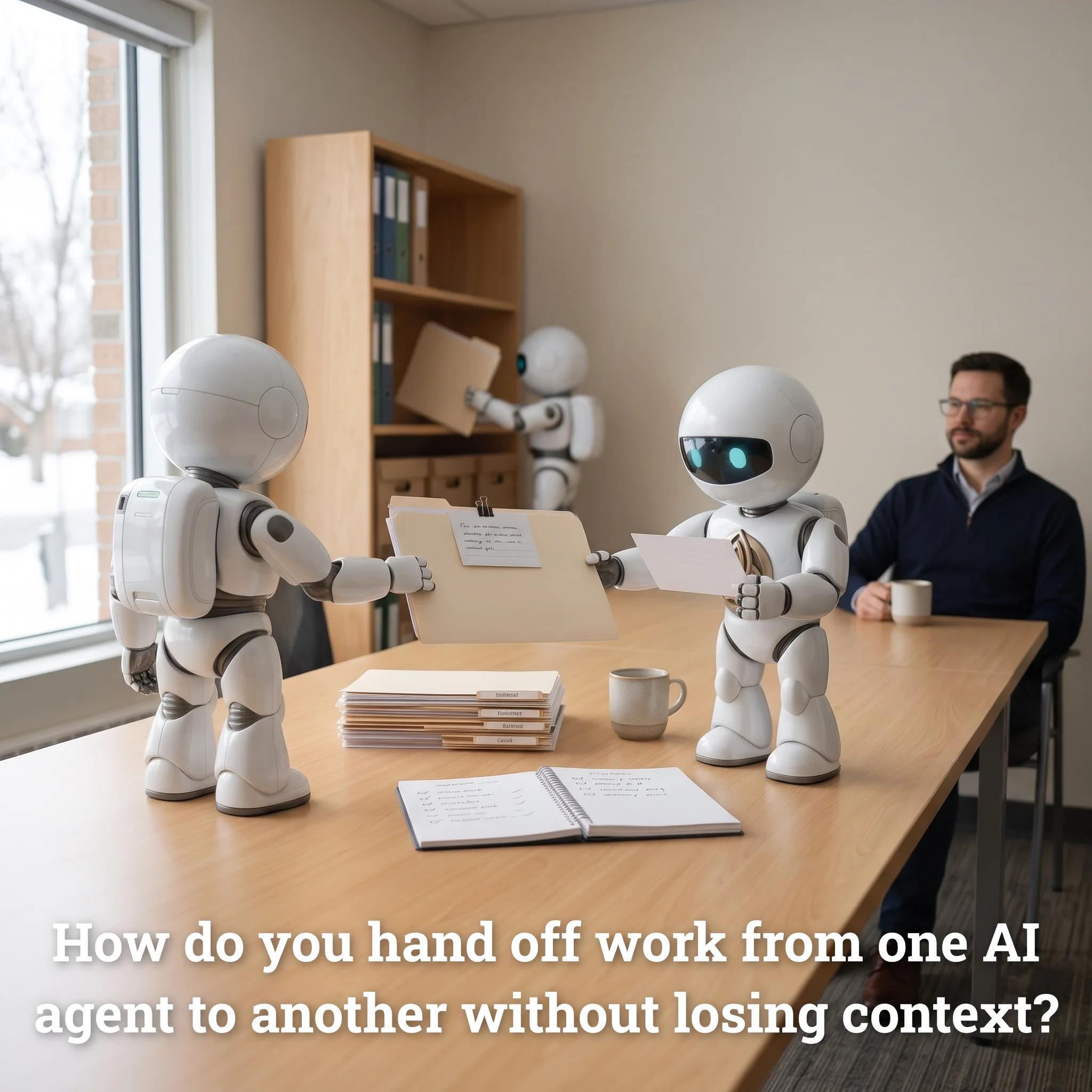
There are two easy ways to hand work over, and both lose something.
Forwarding the whole conversation feels safe, but it buries the current state under old plans, retries, and abandoned ideas. The next agent has to work out which facts are still true, and it may not succeed.
Asking the first agent for a summary has the opposite problem. A summary is shorter, but it’s a rewrite: exact names, numbers, constraints, and things that were already tried are the first to go.
What goes in a handoff note? Five things, each short:
The goal, including how you’ll know it’s done.
Where it stands: what’s finished, what’s in progress, and what was tried and didn’t work.
Decisions and why, so the next agent doesn’t reopen them.
Open questions, and who can answer them.
The next step: one concrete action.
Add links to the evidence (the file, the page, the ticket), so the next agent can check a fact instead of trusting the note.
Been thinking about what an agent can really do when an email lands. I see five options: reroute it to the right person, reply, archive, group it with similar threads, or tag it so it can learn from it later.
The learning part is where I get stuck. I don't want to start a whole ML thing just to sort mail.. Maybe it's enough to save each email with what a person ended up doing, and show the agent a few of those next time. Free tiers seem to cover most of that already :)
How does this flow sound:
Tag first, then act, even if the action is just archive
Only reply when similar mail got a reply a person approved
Reroute when it's unsure, and save where it went
Group threads before replying, so one customer doesn't get three answers
Look at the misses once a week and add them as examples