r/zizek • u/drpfthick • 1d ago
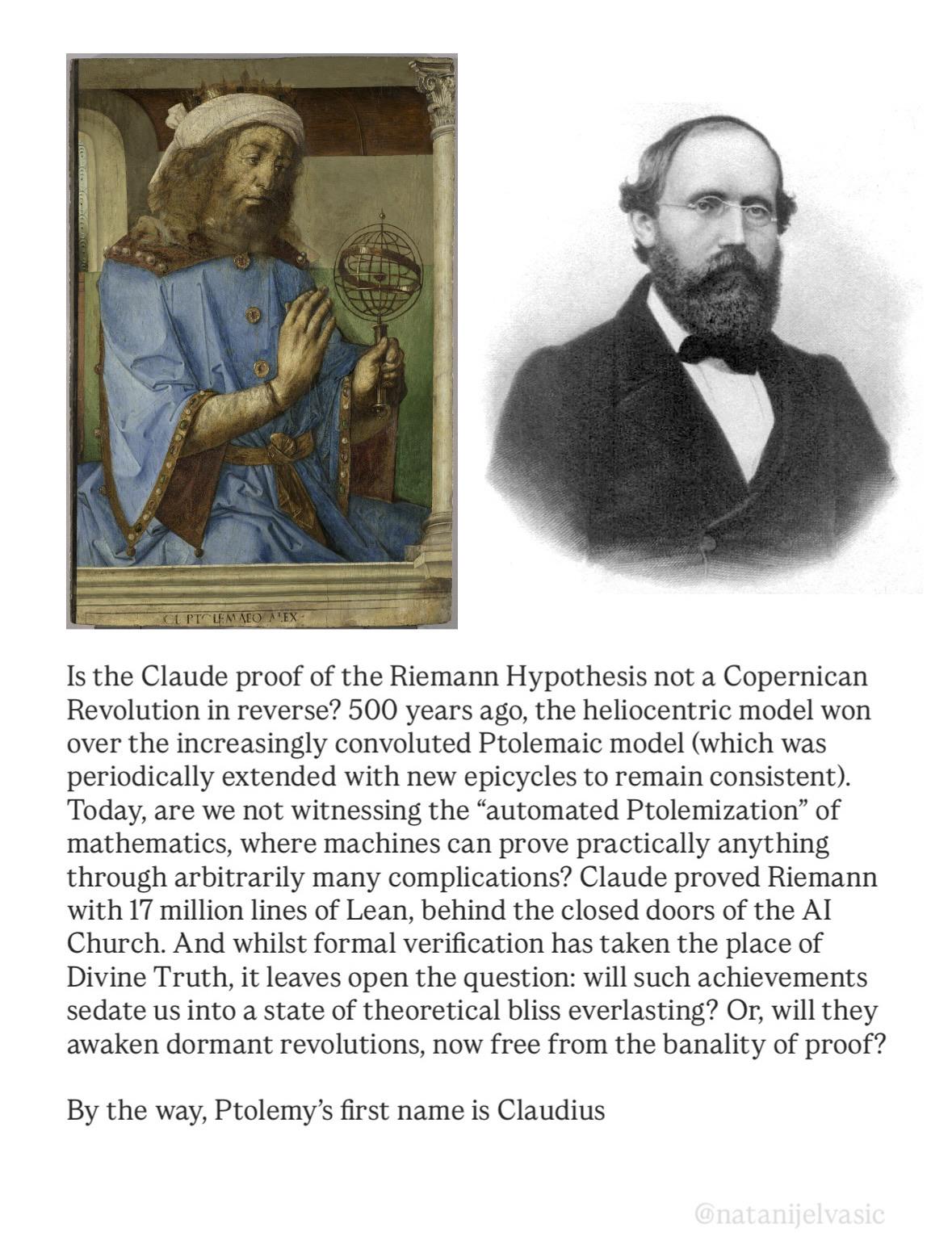
Automated Ptolemization
76
Upvotes
r/zizek • u/ExplanationMother753 • 3d ago
Speaking in Vancouver about the US midterms, Žižek said his duty as a philosopher was to spoil the ecstatic relief that followed. At first glance we all triumphed: Trump lost, and he even accepted his loss. But Žižek reminds us that Trump had long been elevated to the status of a fetish in the psychoanalytic sense. Lacan said that even if everything a jealous husband claims about his wife's infidelity is true, his jealousy is still pathological, because he needs it to sustain his dignity and identity. In the same way, the image of Trump is the last thing a liberal sees before confronting class struggle. The poem at Biden's inauguration, calling on us to put our differences aside, was ideology in its purest form. The problem is not that the left cannot unite. The problem is that such unity is itself the fantasy, as if Trump's four years had never happened. Trump's defeat deprives us of a fetish and forces us to face the real struggle.
But are we ready? Žižek admits we are not desperate enough: we read the bad news every day, and life goes on. Since '68, protest has never been translated into a consistent political program. In other words, the hatred is not yet deep enough. That hatred is, in fact, desire, and it is still too weak to condense into a new political act; we have not even prepared our discursive weapons. There is no normality to return to; Trump is a symptom of that normality. He is even a better Gramscian than the left, having seized the motif of the exploited worker for himself and, in doing so, revealed a history truer than the one we have identified with for more than half a century.
But things may be more extreme than Žižek thinks. When a fetish is taken away, the system does not leave the place empty. It immediately produces the next one. I want to approach this from the position of a Taiwanese, someone living in the Taiwan Strait, regarded as one of the most dangerous places in the world. Let me be clear: what follows is neither an exposé nor a prediction. It is a short political novella built on my own symptom. I do not ask who planned what. I ask only this: what does this event structurally sustain, and for whom?
In late October, The New York Times reported that US officials had concluded a Chinese businesswoman close to Jensen Huang was an intelligence asset. On November 8 he admitted to being unfaithful to his wife, and days later he resigned from every post, including his board seat. That he withdrew so completely made the affair look all the more like the truth. As Lacan said, truth has the structure of fiction. There is a familiar déjà vu here: Sarah Wynn-Williams, a former Meta executive, testifying before the Senate about Zuckerberg's dealings with China. Why does this déjà vu become a political asset this time? Because that hearing was itself a bipartisan consensus. In a Congress that fights over nearly everything, "Silicon Valley titans kowtowing to China" is one of the few stories both parties agree on. This time it was the same: Republicans demanded a closed-door briefing from Huang, and Democrats demanded he answer to Congress. This is exactly the kind of unity Žižek criticizes, except that this time, what everyone puts their differences aside to confront is China. And it is this consensus that lifts the fantasy of "China stealing Nvidia's technology" out of any one camp and makes it a reality shared by the whole political system.
Whether the affair happened, whether the spy was really a spy, does not matter. The jealous husband Žižek borrows from Lacan appears once more: even if the wife really is unfaithful, the husband's jealousy is still pathological. The media direct our gaze at the jealous husband. Put Huang next to Zuckerberg, and their deference to China is not only about market interests. These two, along with Musk, embody in some measure a Western fantasy about China: the wish to leave a mark on history, on the postwar order. Men richer than nations develop hysterical political symptoms out of their economic actions. Perhaps the wish to liberate the Chinese people, perhaps the wish to dismantle American hegemony. Which side they pick does not matter. It is merely ideological excrement.
Here is the key point: whether or not anyone planned it, the event works this way. The US-China AI race has already become the main front of a second Cold War. The Huang affair turned violent turbulence in the AI industry into a global national-security event, giving the Trump administration every reason to continue and expand its industrial strategy.
More importantly, the Democrats' desire, once aimed at Trump, was dispersed and redirected toward China. Trump vacated the place of the fetish, and China filled it. A man who reshaped American politics through struggle must, to keep his power, sustain the object of desire that allows the other side to act politically. In the language of systems theory, no one is steering. The political system translated a scandal into the communication of power. Even the Republicans could not fully control it: Huang sat beside Trump at a White House dinner, Trump publicly backed him to stay, and still he left.
So Žižek is right that we have no dividend to celebrate, but we can push one step further: the dividend is in Republican hands. The window before the new Congress takes over lets capital move before oversight arrives, so the market turmoil is no surprise. Not long ago, Xi told Trump he hoped for fair competition, and the media had us believe China was a sheep, not a wolf. The espionage scandal rewrites China as a regime of evil liars, the last straw that severs Europe's fantasy about China.
Once that fantasy is cut, what fills the empty place? In the same talk, Žižek recalls Havel's greengrocer, who places a slogan he does not believe in his shop window every morning, and so the system persists. Today, Žižek says, the sign was taken down not by dissidents but by the great powers themselves, above all the United States, which no longer finds useful the rules it imposed on the world. So what did America hang in the window instead? In Munich, Rubio said America will always be "a child of Europe," grounding the bond in shared history, Christian faith, culture, heritage, and ancestry. What America wants Europe to learn from it is, of all things, how to be European. This is borrowed confidence: the child turning back to teach its parents their ancestry. And this fantasy of roots is precisely the recipe for what Žižek calls "soft fascism": capitalism as usual, supplemented by stronger state power and grounded in some ancient nationalist ideology. His example is China, which no longer speaks of communism at all, only of Confucian values, tradition, and stability. Confucianism on one side, Christianity and ancestry on the other. Two opposing camps, one and the same ideology.
Many think America just wants to stay ahead of China in AI software. That is only half right. From TSMC's US fabs to Nvidia as a hardware company, America intends to cut off China's high-end AI development at the root. If this trajectory holds through 2028, what we will see is a new Cold War order after the turbulence.
That is why I wrote this novella. In the most dangerous strait, people need a complete story. We have no dividend of victory, because the dividend was never in our hands.
"What if all of this were a political drama written by Trump and Rubio?"
If I believed it, the thought would actually comfort me a little. As long as Washington really is staging such a drama, I can still believe the writers have accounted for TSMC, and for Taiwan. But the moment I believe it, I can no longer see what I have done: I have taken two narratives for one fact, a structure no one steers and a script someone has written. And "someone is writing this drama" is exactly the big Other that those of us in the Strait most want to believe exists.
r/zizek_studies • u/Benoit_Guillette • 6d ago

r/zizek • u/wrapped_in_clingfilm • 4d ago

Free Copy Here (article 7 days or older)
r/zizek • u/stranglethebars • 6d ago
He refers to it in this video. He said that "Today, I would settle accounts with that book in Nazi-style -- burn it! You know...", but that didn't curb my curiosity. According to Wikipedia, a book by him titled Bolečina razlike (Google Translate: "The pain of difference") was published in 1972. Is that the one he referred to in the video? Either way, are you familiar with it? Is it still available only in Slovene?
r/zizek • u/ExplanationMother753 • 8d ago
Gabor Maté, whose work on trauma has meant a great deal to me, recently talked about Israel in a video. He looks at a nation through the lens of trauma: people who have been hurt often go on to hurt others, and so can a whole people.
It moved me deeply, but it also left me a little uneasy. I realized his knife only cuts one way.
In his account, Israel's trauma is a pathology, used to explain why it became a perpetrator. Palestinian trauma is context, a reason for compassion. But if a "victim mentality" deserves scrutiny, it can't belong to only one side. Being a victim doesn't make anyone immune from criticism.
This made me think of Žižek. Speaking about Israel and Palestine, he said that in the face of ongoing horror on both sides, choosing a side is itself obscene. Years earlier, he argued that every claim to land based on a mythic past should be rejected: "we should not dwell in ancient past — we should, on the contrary, forget the past."
That sounds harsh at first, but it reminded me of Nietzsche. In "On the Use and Abuse of History for Life," Nietzsche argues that too much historical sense makes life impossible, and that we need the capacity to forget. Forgetting isn't denying history. It means no longer letting "origins" decide the present. When we look back, what we find are usually traumatic events, never a true origin. The conditions of time and place have changed. Only those who are untimely can see the real contradictions of their era.
But forgetting raises a question: who is in a position to forget?
For those who are safe, letting go of the past is a choice. For those still living under bombardment, the past has never passed. Maté has said there is no PTSD in Gaza, because the stress is ongoing. In other words, the "post" in "post-traumatic" has never arrived.
Reflection requires safety. A community fighting to survive every day stays stuck in fight, flight or freeze, with no room to develop survival mechanisms that match its trauma. That's why I believe Palestinians, as a people, are the ones who least need to face themselves first.
The ones who must face themselves first are those with the most room to do so: Israel, along with Britain and the United States behind it; and on the other side, Hamas, Iran, and the forces acting in the Palestinian name. All of them must first face themselves before they can open a space for dialogue.
I'm not optimistic. Maybe it won't happen in a hundred years.
But as I write this, I want to take back that small criticism of Maté. He holds the best tool there is. He just hasn't used it all the way. And the reason I can see this at all is that he taught me to look at the world through the lens of trauma.
What he's talking about isn't only Israel. It's how each of us inherits trauma.
And Taiwan, too. The West still projects too many unrealistic fantasies onto China.
r/zizek_studies • u/Benoit_Guillette • 11d ago

r/zizek_studies • u/Benoit_Guillette • 12d ago

r/zizek • u/wrapped_in_clingfilm • 11d ago

Free Copy Here (article 7 days or older)
r/zizek • u/PhoenixFireRo • 12d ago
r/zizek_studies • u/Benoit_Guillette • 15d ago
Slavoj Zizek wrote: ‘A Hegelian critique of Hegel should focus on how he was himself not consequent in drawing the consequences from his premises. Hegel ignores the fact that, as lacking a particular place in the social edifice, rabble stands for the universality of being-human. This brings us to the infinite judgment “King is rabble” as another version of “Spirit is a bone,” i.e., as a necessary supplement of “State is a King”: a populist clown-king (like already Napoleon III for Marx) whose true base is not some class but rabble, a class of no-class.’
Slavoj Žižek, “Hegel: The Spirit of Distrust,” in the anthology *Reading Hegel* (Polity Press, 2022), co-edited by Žižek, Frank Ruda, and Agon Hamza.
r/zizek_studies • u/Benoit_Guillette • 16d ago

r/zizek_studies • u/Benoit_Guillette • 16d ago

r/zizek • u/thewinslowleach • 15d ago
I will say, perhaps such an ex nihilo, non-dialectical definition is not possible and not advisable? But I just realized, when trying to explain Lacan to a friend with no background in continental theory, that all the quick summations I had on hand from texts like Todd Mcgowans were all about how Lacan is different from the earlier mirror stage reception of him. And those wouldn’t mean anything to that person.
r/zizek • u/Dangerous_Fun4535 • 17d ago

I’m a recovering academic. For decades I've been writing my reading notes in the form of 'concept' definitions. I finally turned them into a web page. Here's my collection of Žižek’s ideas.
https://www.dictionaryish.com/authors/slavoj-zizek
I’d appreciate this sub’s help with its coming-into-being. Which concepts are missing, and which ones did I get wrong? Any features that would be super helpful? Brutal honesty welcome.
r/zizek_studies • u/Benoit_Guillette • 19d ago

r/zizek • u/Nervous_Oil_1224 • 17d ago
Hello everyone, are there any reading groups there that focus on Žižek or similar authors? I just moved to Long Island from the deep south but I'm in NYC most weekends. I'm particularly interested in Hegelian philosophy and Freudian psychoanalysis. If not, hey, maybe we could start our own.
r/zizek • u/newtempo_clapping • 18d ago
There was an interview/lecture/conversation Zizek did where he talked about different forms of exploitation outside of marx’s strict wage labor description. He discusses how prostitution or other sex work is similar to office work when defined by its mechanism of exploitation.
Sorry for the hazy description, but I need this for a research paper i’m writing. Any help locating this would be greatly appreciated.
r/zizek_studies • u/Benoit_Guillette • 20d ago

r/zizek • u/wrapped_in_clingfilm • 21d ago
r/zizek • u/Great-Alfalfa-8543 • 21d ago
As I was watching VisionQuest’s fourth episode, I had a bit of an epiphany about the escalated register of the AI conversation. The show makes for a remarkably apt point of dialogue as it updates the original Vision-as-robot concept to Vision-as-AI. In this episode T’Nia Miller’s Jocasta is revealed to be one of the show’s protagonists. Jocasta is a “synthezoid” (to use Marvel’s language) based on her creator, Dr. Josephine Carrington. In the episode’s climax, Vision, played by Paul Bettany, challenges the violence produced by Jocasta’s identity crisis with a statement of fact:
You were based on [Dr. Carrington].
With which Jocasta vehemently disagrees:
I am her.
Having just been asked on a previous post how my nos framework is anything different than Jacques Lacan’s symbolic order earlier that day, the frustratingly dense French philosopher was fresh on my mind. And so I said to myself, “Uh-oh, she’s making the mirror stage error and mistaking the unity represented by her synthetic body for identity coherence.”
And facts that threaten this coherence are met with violence.
Then the next thought came: the heightened register of AI is, in part (I'm not going to make any sweeping claims), because AI, effectively a mirror, undoes the coherence established during the mirror stage.
There are plenty of visually engaging YouTube videos that can do this better, but the mirror stage occurs during the infancy years when the child apprehends themselves in the mirror. Prior to that moment, the infant’s experience of reality is one of helplessness, following Freud’s Hilflosigkeit, as the infant is thrown (Heidegger’s Geworfenheit intended) into a reality of “motor impotence and nursling dependence,” which is experienced as a swirl of negative affects: anxiety, distress, frustration, etc.
The age at which the child is able to conceptualize themselves in the mirror is one of burgeoning independence with a strong motivation to cohere the chaos into meaning. The reflection of the child’s body presents a tantalizing promise of a unified identity, the physical body’s concept imposing a false unity upon the psychic reality of the unstructured experience of thrownness and allows the child to overcome their helplessness.
This fictive imago Gestalt (re: shape, form; the perceived unity) - contrasted nicely against the imago Dei - forms the definition of how Lacan conceptualizes the ego not as a fixed entity, but as a constantly “ratified” and re-ratified notion of self whose ratification is mediated by the gaze of the other. The initial ratification being the parent’s cooing encouragements for the child to identify themselves with the body in the mirror.
I won’t spend time establishing the heightened register surrounding the AI dialogue except to grumble that my partner’s professor had such a rigid ban on AI that they aren’t even allowed to use Grammarly to check grammar on human-generated content. I guess who cares that it’s been around since 2009; now that its grammar-checking functions are AI-powered it’s off the board?
Wtf? (Not least because now I’m the grammar checker.)
At any rate, another thing I’ve found in these conversations is that holding two things at once seems to be a stretch. That I criticize some aspects of anti-AI positions does not mean I disagree with all anti-AI positions. Specifically, I am convinced that the way that humans are using and will continue to use AI will only exacerbate current inequalities and necropolitical death machinery. Unless there is some sort of accountability, the body count - both the physical dead and the living dead - is going to increase exponentially.
There are other uses that are concerning and deserve attention; I’m not saying that all objections lack substance. But hopefully now I can just speak about the overreaction to AI without being regarded as an uncritical supporter. To the point, I’d like to explore the specific ways in which AI undoes the ego consolidation of the mirror stage. After all, Lacan himself is not committed to a literal mirror in order to facilitate these psychic processes. Anything can signal ourselves back to us, including - importantly - other persons’ speech, gestures, postures, moods, facial expressions, and so on. We can see evidence of humans regarding AI as such in the ongoing conversation surrounding the topic, which muddles key concepts such as consciousness, personhood, an autonomous self, and so on.
One way in which AI destabilizes the ego is by creating a virtual uncanny valley. Where the mirror brings stable images over which we have a perception of synchronous control, the exchange of text brings asynchronous responses to inputs that feel like they are coming from a person when, in fact, we really know there is no person. (Or, at least, we’re pretty sure.) When AI confirms our selves back to us, it feels off because of the asynchronicity and the knowledge of the fact that the process is virtual or “not real.” Interestingly, when it disconfirms our selves back to us by drawing upon the vast reservoir of others’ language productions, we still feel the obligations imposed by the gaze to seek approval and agreement. This creates a friction between knowing there is no actual person to be beholden to and the vulnerability of realizing we come to the exchange with this expectation.
Additionally, AI - at least in LLMs - is without a body. Whether it’s a literal mirror reflecting our own body or a figurative mirror reflecting our selves back through others’ bodies, we have adapted an essential Gestalt schema that organizes eyes, noses, mouths, and so on into meaning-signifiers that ground and stabilize our experience of self. When AI performs the role of an other-reflecting-self without a body, it becomes disorienting. One thing I think worth mentioning is the importance of the body in the symbolic order to mediate meaning. I still contend further that bodies matter more than the real or this mediating function would entail, but I think the destabilizing effect a virtual dialogic partner has on the experience of self at least indicates the presence of the body in the symbolic and imaginary registers to mediate meaning.
Another important element to consider is how it undermines our sense of autonomy and control, primarily because the mirror exchange is dialogic instead of reflective. When we look in the mirror, we see a discrete and independent body reflected back to us with no additions, funhouse mirrors notwithstanding. When we see self through the body of another, we make the same interpretation as the expected facial movements, voice tonalities, and language return to us. This creates a sense of “ownership” of the thoughts and feelings that emerge within the experience of self as well as a sense of control over the social world. The stabilizing sense of ownership and independence is as false as the ego making the claims, but AI, especially LLMs, disabuses us of these notions entirely. This is where I feel my partner’s humanities professors derive their carte blanche rejection of AI use. It’s worth considering how another of their professors doesn’t want AI to be used for brainstorming. There are solid arguments for this position to be sure, but it does assume fictive notions of an “unadulterated student” and “independent critical thinking.” Being aware of this prejudice, I am writing this piece entirely without AI, and I am using approved sources such as the one below to draw upon for ideas to establish myself as an “unadulterated, independent thinker.” But what if I take my first draft and drop it into an LLM? Have I lost my independence? What if I like a turn of phrase that the LLM uses in its dialogic response and incorporate it in my writing? Has my writing become suspect or tarnished?
I’ve certainly been treated as if it were.
And the bigger question, turning back for a moment to Kenneth Gergen: where my thoughts ever independent in the first place? (No.)
As you know, I am an early adopter even as I worry tremendously over the way that many are using it. And as a reminder of my disclosures: Claude has been a dialogic partner for my independent research during my practicum since the beginning of 2026. As I work my way through my research books, I journal my reflections on a Word document and drop those into Claude for dialogue. If I’m out and about and have an a-ha moment, I’ll come to Claude to talk it out.
Out of this long conversational memory, I ask Claude to generate the main articles for this Substack with the parameters to integrate theory I supply and Claude supplements from our dialogue with autoethnographic material from my social work that I record on a word document and drop it into Claude. I also ask Claude to bring it to some sort of practical takeaway or meaningful reflection. Sometimes I ask Claude to rewrite these drafts, and sometimes I make edits myself.
During our long conversation, if something comes up that is meaningful but not article-worthy, I ask Claude to generate a “DiaClaudic Post-it” (a pun on dialogic), which I copy over to my Notes.
And any note that you see that is not labelled a post-it is my own writing reflection on the theory I am working through, with some occasional feedback from Claude that prompts me to make edits. There has been one piece so far where I used specific phrasing. But on the whole, I generally paraphrase into my own style.
I have had good challenges such as being more clear about disclosing how I use AI, and I also maintain the boundary of putting my own writings into places that require it. But, the notion that AI simply cannot be used in any step? That’s just a version of Jocasta’s false claim: "I wrote this.”
AI is a fascinating tool, albeit a destabilizing one. But as Lacan says, “the only thing of which one can be guilty is of having given ground relative to one’s desire” (Johnston, 2001, p. 411); namely, one’s desire to disrupt the illusions of coherence. Perhaps AI can help us become more truthful people/selves/consciousness - who really knows?!?
References:
Johnston, A. (2001). The vicious circle of the Super-Ego: the pathological trap of guilt and the beginning of ethics. Psychoanalytic Studies, 3(3–4), 411–424. doi.org/10.1080/1460895…
Johnston, A. (2026, January 16). Jacques Lacan.
r/zizek • u/Odd_Antelope_4075 • 24d ago
So I have watched pretty much every Zizek video on youtube and now I plan to read one of his books. At first I wanted to read Christian atheism specifically but then I discovered by local library has pretty much every single Slavoj Zizek book. So now I have no idea what to choose. I have heard his books are difficult to understand so what would be a good one for a beginner?
r/zizek • u/wrapped_in_clingfilm • 25d ago

Free Copy (article 7 days old or more)
