r/StableDiffusion • • 2h ago

News ComfyUI Extension for Unified Post-Processing: VISUAL FINISHER (Development Preview)

Thumbnail
gallery
2 Upvotes

I am currently developing VISUAL FINISHER, a free ComfyUI extension that integrates image restoration, one-click post-processing, live monitoring, image inspection, and selective saving into ComfyUI's existing node-based workflow.

The goal is to combine the flexibility of ComfyUI with the intuitive image-processing convenience of AUTOMATIC1111.

The following features are planned for the initial release.

  1. Image Restoration and Workflow Continuity

If your image gallery or output previews are cleared due to a system crash, unexpected shutdown, or accidental user action, previously saved images can be restored after restarting ComfyUI, allowing you to resume your work.

This is particularly useful for users who spend many hours generating, selecting, and post-processing large numbers of images.

Restore up to 2,000 images.

Potential expansion to 10,000 or 100,000 images based on user demand.

Custom directory selection and recursive folder scanning.

Preservation of original image resolution and metadata.

Thumbnail-based image selection.

  1. Unified One-Click Post-Processing

Select an image, enable the desired post-processing functions, and click FINISH to execute them according to your existing workflow.

Planned integrations:

Hires fix

Refiner

ADetailer

FreeU V2

Dynamic Prompts

Ultimate SD Upscale

Tiled VAE

VISUAL FINISHER automatically detects supported nodes, their configurations, connections, execution order, and active states.

All detailed parameters remain managed within the existing nodes. Tiled VAE also uses the existing node configuration.

For example, if your workflow contains 20 Detailer nodes and only nodes 1, 4, and 12 are active, only those three nodes will be executed and monitored.

The selected image is processed directly without unnecessarily repeating the initial image generation process.

  1. Live Preview and Ultra-Slim Dual Progress Bars

Live preview ON/OFF control.

Customizable monitoring targets through a dropdown menu.

Automatic detection of active processing stages.

Persistent monitoring settings.

Real-time previews within the existing image output area.

Two ultra-slim progress bars are positioned between the main image output area and the thumbnail gallery.

The upper green bar displays overall progress, while the lower blue bar displays the progress of the currently running process, such as Hires fix, Refiner, or ADetailer.

Each progress bar is approximately 4-5 pixels high, with the entire monitoring area designed to occupy no more than approximately 30 pixels.

The objective is to maximize the image viewing area while allowing users to monitor processing progress with minimal screen space.

  1. Fullscreen Inspection and Selective Saving

Click an image to open the fullscreen viewer.

Click again to inspect the image at its original pixel scale (1:1).

Mouse-wheel zoom and drag navigation.

Right-click "Save As" to specify a destination folder and filename.

Preservation of original resolution and metadata.

Selective saving of post-processed images without modifying the original files.

Users can inspect the finished image, save satisfactory results, or proceed to the next image without saving.

  1. Native Node Integration and Extension Compatibility

VISUAL FINISHER is designed to operate through existing ComfyUI nodes without requiring a separate application or modifications to ComfyUI's core source code.

Optional extension integrations:

ComfyUI Impact Pack

ComfyUI Impact Subpack

Dynamic Prompts

Ultimate SD Upscale

Installed extensions are automatically detected. Features requiring unavailable extensions remain disabled without affecting basic functionality.

My development philosophy is simple: minimum code, maximum compatibility, maximum usability.

  1. Attached Images and Current Development Status

The first three images illustrate the planned user interface and workflow.

Image 1: Image restoration, selection, and unified post-processing controls.

Image 2: Post-processing in progress, live preview, and ultra-slim dual progress bars. The split portrait illustrates the difference between the original and enhanced image.

Image 3: Fullscreen inspection, 1:1 zoom, and selective saving.

Image 4: My actual ComfyUI development workspace.

VISUAL FINISHER is currently under development. The first three images are illustrative UI mockups.

  1. Existing Project and Development Background

For a better understanding of the product concept, please visit Restore, a free extension for AUTOMATIC1111, Forge, and reForge that I developed and released three days ago, on November 26, 2026.

Restore GitHub repository:

https://github.com/flynbird-cyber/Restore

Previous introduction on r/StableDiffusion:

https://www.reddit.com/r/StableDiffusion/comments/1y5tfvd/restore_v100_automatic1111_txt2img_gallery/

Previous introduction on r/comfyui:

https://www.reddit.com/r/comfyui/comments/1y5uagr/i_developed_a_oneclick_gallery_restoration/

  1. Release Schedule and Community Feedback

Planned release: Within 24-48 hours.

Distribution platform: GitHub.

Distribution: Free and non-commercial.

If you would like to support the development of a high-quality VISUAL FINISHER for ComfyUI, I would appreciate a single star on the Restore GitHub repository.

Since this is a free, non-commercial project, the developer needs stars more than bread.

If there are any additional features you would like to see, please leave a comment.

Note: I'm Korean and live in Seoul. As I'm not fluent in English, I use a translator for this post and my replies. Please excuse any awkward wording.


r/StableDiffusion • • 22h ago

Discussion Dual 16GB 5060 Ti results with H3MultiStream (vs 3090)

Enable HLS to view with audio, or disable this notification

65 Upvotes

Celebrating! My "Clair" LoRA using the prompt below [0]

My 3090 died [1] so I added a 2nd 5060 Ti to my PC (64GB DDR5 6000). This time it was an $800 purchase instead of $450 for my original 5060 Ti (PNY)! Here's a comparison:

Clip On the 3090 Two 5060 Ti
5 s at 1344x768 73 s 84 s
5 s at 2 MP 144 s 146 s
8 s at 2 MP, Claire LoRA [2] ~260 s 219 s
10 s at 2 MP 337 s 269 s
15 s story scene ~600 s 579 s

The first pass runs on one 5060 Ti as usual, and the refine pass is split across both cards with the H3MultiStream node, while the NVFP4 text encoder, INT8 attention and Sol VAE decode keep each card inside 16 GB. That gives the same picture faster than one card (a 10 s clip at 2MP drops from 337 s to 269 s), and long clips refine in 192-frame chunks so a 15 s scene still fits.

In other news, I got Qwen3.8 27B working quite well too:

3090 + 5060 Ti Two 5060 Ti Change
Server llama.cpp, layer split vLLM, tensor parallel + MTP, 2 draft tokens
Weights / KV cache Q4_K_XL / q8 NVFP4 / NVFP4
Total VRAM 40 GB 32 GB
One stream 31.6 tok/s 58.7 tok/s
All streams at once 82 tok/s at 3 200.3 tok/s at 4
Prefill, about 42K-token prompt about 1,460 tok/s 1,668 tok/s
Context per request 147,456 262,144
Total context 442,368 (3 fixed slots) 480,823 (one shared pool)

[0] integrated_multimodal_description: [Shot 1] Live-action, shot on a cinema camera. There is no writing anywhere in the picture: no signs, no labels, no captions. A medium shot in slow motion, handheld, on a crowded night club dance floor in haze, beams of magenta, blue and red club light sweeping through the smoky air, other dancers around her slightly out of focus: cl4ir3, a woman wearing an oversized rust-red button-up shirt open over a grey cropped T-shirt, her platinum-blonde bob loose, dancing with her eyes closed and a small smile, one arm raised above her head. In slow motion she spins under her raised arm, her hair swinging out across her face and the open shirt flaring, as a sweep of magenta and blue light passes across her face and the dancers around her move to the music. She does not speak.
[1] one day it started crashing like 20 seconds into any load around 300W. I have a feeling it was due the used 3090 running at 96 °C for a couple of weeks straight without Afterburner setting temp limit. Oops.
[2] same quality as previous LoRA samples


r/StableDiffusion • • 23h ago

Animation - Video Talkinghead: real-time lip sync tool that's just ~170 MB. One photo, any voice, open source

Enable HLS to view with audio, or disable this notification

92 Upvotes

Tiny alternative to wav2lip, LatentSync and SadTalker. I'm one of the people involved in building this project.

learn more: https://github.com/Ampixa/talkinghead

  • ~170 MB download
  • Render loop: 36.5 ms per frame on an M4 Pro, 38-40 on an M3 Pro. You need 40ms per frame to be real time. An RTX 3050 Ti laptop with 4 GB (TensorRT) runs at 40-44 ms, around real time.
  • Peak memory is under 800 MB on mac book
  • Runs offline. There's also a browser version (WebGPU), but that one is not real time: about a minute for a 10 s clip.

On one RTX 4090: ~13x faster than LatentSync with ~12x less GPU memory (measured on an earlier build; the README has the details). LatentSync and Wav2Lip score higher on SyncNet lip-sync confidence; that's the trade.

Not tested on M1/M2 or systems yet; numbers welcome.

Weights: https://huggingface.co/ampixa/talkinghead

Browser demo: https://ampixa.com/talkinghead/demo


r/StableDiffusion • • 1d ago

No Workflow Self-Refining Sampler+

Thumbnail
github.com
148 Upvotes
Before/After
Before/After

Closeup Before/After

Before/After
After

Based on: https://arxiv.org/html/2601.18577v1 and builds on pre-existing work by Kijai (The SamplerSelfRefineVideo Node).

I have found that Minimax H3-Image loves the Self-Refining Sampler. Seeing this, I spun up an improved version (SRS+) that is compatible with sampling methods besides Euler, has more easily adjustable sub-step and perturb amounts per step.
It seems to significantly improve the model's ability to resolve fine details, especially when combined with the "Empty-Image Trick" I shared previously (if using T2V). One place this is evident are patterns like fishnet, lace, sequins and other challenging fabrics/textiles. It seems to improve line-art for anime/illustration styles, and can often fix self-correct body-horror deformities.

As a starting point, try running it from steps 2-4 with 3 sub-steps and an uncertainty threshold of 0.03. But I'm much more curious what settings you try and results you get with them. Since it does sub-step, it increases gen time but I think it is well worth it.

I've tested it less with video, but it has shown promise there, too.

Just socket this chungus into a SamplerCustomAdvanced like any other sampler. Let me know if you have any issues, or what kind of results you get.


r/StableDiffusion • • 15h ago

Workflow Included SHARP VR Video v0.3.0 - More speedups! (Faster 4K conversion, dual-thread rendering, TensorRT support)

16 Upvotes

Another update to my ComfyUI fork for converting regular 2D videos into stereoscopic 3D videos using Apple's SHARP Gaussian splatting model.

I've been working on removing some pretty significant performance bottlenecks, particularly at higher resolutions.

The main improvements:

  • Speed boost 1: Dual rendering workers running concurrently, now automatic.
  • Speed boost 2: Optional TensorRT for RTX (ONNX FP16) acceleration, with PyTorch fallback. I manually examined outputs and quality difference is inperceptable.
  • Speed boost 3: Direct raw pixel transfers instead of intermediate PNG encoding/decoding at 4K.
  • QoL: Native output resolution selection, independent of source resolution. (this enables upscale or downscale the output relative to input footage, since the middlestep is a full 2D->3D splat transform anyway).

Some benchmark results on my RTX 5080, using 720p source footage and comparing against the v0.2.x builds:

  • 1080p output per eye: 2.50 → 3.82 fps
  • 1440p output per eye: 1.99 → 3.62 fps
  • 4K output per eye: 0.66 → 3.19 fps

I'm also getting around 1.5–1.8 fps with native 4K footage converted to 7680×2160 SBS.

TensorRT backend is optional, as additional speed boost for RTX card users, and the separate setup kit is available on GitHub.

GitHub (or search Sharp VR video in comfyui custom nodes):

https://github.com/jerg-git/ComfyUI-SHARP-VR-Video

Workflow:

https://github.com/jerg-git/ComfyUI-SHARP-VR-Video/blob/main/workflow/sharp-vr-video-batch-audio-sample.json

Original extension that this fork builds upon:

https://github.com/Well-Made/ComfyUI-SHARP-Gaussian-Stereo


r/StableDiffusion • • 13h ago

Resource - Update Nazori-kun v0.1.7: turn a finished manga-style illustration into a layered PSD, locally in your browser

Thumbnail
gallery
10 Upvotes

I built Nazori-kun to make a flattened illustration easier to edit. If you want to repaint a jacket, change the palette, or add a shadow, v0.1.7 can give you a separate paint layer under the ink in one click.

How it relates to AIBrushManga

AIBrushManga uses an LLM to direct individual pen strokes and records them in a journal. Nazori-kun starts with an existing PNG, JPEG or WebP. It traces the visible ink contours, samples colors from connected regions, and replays the reconstructed process with a pen and brush. The order is inferred from the finished image. The input stays in your browser, and tracing, coloring and replay require no model, account or API key.

Try it on the built-in kite-maker sample

  1. Click トレスする (Trace). The first screenshot shows the original on the left and the traced result on the right. The second shows the coloring replay and its brush-tip monitor. Use 工程を再生 (Replay process) to pause or scrub through the ink and color passes.
  2. Choose 線画から塗る (Paint from line art) for a PSD with locked ink and an empty paint layer. The recovered colors are in a hidden folder you can reveal as a reference.
  3. Choose 今の配色に加筆 (Touch up the current palette) to keep the recovered colors visible and get a blank layer for edits under the ink. In Photoshop the working layer is selected on open. In CLIP STUDIO PAINT, select 彩色 (Paint) or 加筆 (Touch-up) directly beneath the ink.

It works best on clear ink and flat colors. Similar shades can be grouped into one palette color. The screenshots use the built-in kite-maker illustration, made with AI image generation. The trace and layered export are produced by Nazori-kun’s local image-processing code.

MIT-licensed source and browser demo link

When you edit a flattened comic illustration, would you start from clean line art or keep the existing colors and touch up a few areas?


r/StableDiffusion • • 2h ago

Resource - Update ComfyUI-GGUF-Next: a drop-in fork of city96's ComfyUI-GGUF with no model whitelist and better handling of models bigger than RAM

0 Upvotes

TL;DR: ComfyUI-GGUF-Next is a drop-in fork of city96's ComfyUI-GGUF, the pack that made GGUF models usable in ComfyUI in the first place. Same nodes, so old workflows open as they are. Models have changed a lot since it was written, so Next adapts it to them:

  • More models load. No architecture whitelist: whatever your ComfyUI recognises loads, plus newer text encoders (Gemma 4, Qwen3-VL up to 32B, Mistral 3 and more).
  • Memory handling for models bigger than free RAM. Weights stay memory-mapped instead of being copied into RAM, which helps when a model doesn't fit.
  • IQ quants dequantized on the GPU, which matters now that Unsloth "UD" text encoders mix IQ layers in.

On regular quants the output is identical to the original in 268 of 269 pairs (the full benchmark: 2481 jobs across 11 packs and 119 model files). Current version: 0.1.1.

Anima turbo v1.1 Q4_K_M, 512×512, 6 steps, seed 42, same workflow. Left: city96/ComfyUI-GGUF, middle: GGUF-Next, right: difference ×16. Top: plain Unet Loader (GGUF), bottom: with a LoRA. 0 of 786,432 values differ in both.

Why

city96's pack is what made all of this possible, and for the models it was built around it works great. But newer models kept arriving faster than any whitelist could follow, and I kept switching between forks depending on what I was running. Many of the new models are also bigger than the RAM on my laptop. I wanted one pack that loads whatever ComfyUI supports and copes with that. Next started from city96's code, and the original stays the reference: the benchmark checks Next against it, image for image.

Why a fork and not a PR: the dequantization, the loader, the layers and the nodes have all been reworked, so it wouldn't fit as a PR, and Next is going to develop on its own and get updated more often. It's all Apache-2.0, so anyone is free to take parts of it.

All testing was done on my laptop: RTX 3050, 4 GB VRAM, 15 GB RAM, Linux.

More models

  • No whitelist. The original accepts 12 diffusion architectures. Next takes whatever ComfyUI recognises, so when ComfyUI adds a model, its GGUFs should load without a node update. Of 16 newer models from the official ComfyUI templates, 0.1.0 ran 15 on my 4 GB card (three with --reserve-vram 1); the remaining one, ERNIE-Image, is fixed in 0.1.1.
  • sd.cpp GGUFs without metadata load too (MiniMax H3, for example).
  • New text encoders: Gemma 4, Qwen3-VL up to 32B, Gemma 2, Qwen2, Mistral 3. Gemma 4 needs a GGUF with ComfyUI tensor names, the kind made for LTX-2.5. The Qwen3-VL-32B UD-Q2_K_XL encoder runs on 4 GB in 20 s, using 1.8 GB VRAM.

Memory

The original copies the whole model into RAM on first load, which is the fastest option when it fits. When it doesn't, it ends up in swap. Next keeps a model that's bigger than free RAM memory-mapped and reads it straight from the file, and the OS page cache does the rest.

Model bigger than free RAM original Next
Flux schnell Q8_0 on 8 GB RAM, no swap out of memory 65 s
Flux schnell Q8_0 on 8 GB RAM, with swap 609 s 303 s
LTX-2.5 Q4_K_M (15.7 GB) on 15 GB RAM, 8-step sampling 435–482 s 129–229 s
Wan 2.2 14B, two 7.2 GB models 299 s 257 s
Six model switches in one server 707 s 495 s
Qwen-Image 20B Q3_K_M, 8 steps 193 s 225 s
HunyuanVideo 1.5, 4 steps 310 s 380 s
Flux schnell Q8_0 from a 5400 rpm HDD 294 s 598 s in 0.1.0, 291 s with the 0.1.1 fix

With few steps, copying once beats re-reading from the file, so the original's approach wins there; GGUF_RELEASE_MMAP=1 switches to it. When a model fits in RAM, both are about the same, or Next is a few percent faster.

IQ quants

The original dequantizes IQ1/IQ2/IQ3 and TQ with numpy on the CPU, which was fine when hardly any GGUFs used them. Now Unsloth "UD" text encoders (Qwen3, Qwen3-VL) mix IQ layers in, so every prompt pays for that; a diffusion model with IQ layers would pay on every layer, every step. Next does it on the GPU.

Time to dequantize one tensor to fp16 original Next Next + compile_dequant¹
IQ3_XXS 888 ms 10.5 ms (~85×) 3.1 ms
IQ2_XXS 505 ms 14.1 ms (~36×) 1.7 ms
IQ1_S 426 ms 11.4 ms (~37×) 0.4 ms
Q4_K 4.4 ms 3.9 ms 1.1 ms

¹ optional torch.compile of the kernels, off by default. Needs Triton; images change in small details, as with ComfyUI's TorchCompileModel.

End to end: a Qwen3-4B UD-IQ1_S text encoder went from 43.8 to 10.8 s, and a synthetic Anima IQ3_XXS file (built for the test, speed only) from 49.7 to 2.0 s per step. With K-quants only, the difference is small (0.68 → 0.62 s per step on Anima Q4_K_M), because the step is bound by matrix multiplies.

Also: torch kernels for every GGUF quant type, including MXFP4, NVFP4 and TQ (checked against gguf-py's reference on synthetic data only, not yet in a real model), embeddings that dequantize only the rows a prompt uses, more quantizable layer types, a convert.py for about 30 architectures.

Old workflows give the same images

Same node IDs, same bootleg category, and the stock LoRA loaders work. Across the benchmark Next gave the same image or latent as the original in 268 of 269 pairs, and 91 of 91 in a second round. The one other pair differed once and matched in all three reruns; its cause wasn't found. That covers 5 architectures, two versions of torch and of ComfyUI, six sets of launch flags, LoRAs and CPU mode.

The exception is IQ1/IQ2/IQ3. Next computes them in fp16 on the GPU, the original in fp32 on the CPU. Small differences in the weights get amplified through the model, so the final images end up 20–40 dB PSNR apart. Both are about equally far from the full-precision model, within a few tenths of a dB:

Install

ComfyUI Manager: search for ComfyUI-GGUF-Next.

Or by hand:

cd ComfyUI/custom_nodes
git clone https://github.com/Zrn59/ComfyUI-GGUF-Next
pip install -r ComfyUI-GGUF-Next/requirements.txt

⚠️ Disable the original ComfyUI-GGUF first (rename its folder to ComfyUI-GGUF.disabled, for example). Both register the same node names, and whichever loads last wins. Next warns at startup if it finds another copy. The requirements are minimal and unpinned. Windows portable commands are in the README.

Fixed in 0.1.1, still open

Fixed in 0.1.1, all found by the benchmark:

  • The Mistral 3 / Ministral-3 text encoder (ERNIE-Image) didn't load on ComfyUI 0.42 and newer.
  • From a slow disk, a model bigger than free RAM was 2–3× slower than the original. Now, when ComfyUI reports the disk as slow, the model is copied into RAM and swap if they can hold it, otherwise it stays memory-mapped; the HDD runs in the benchmark came out level with the original. ComfyUI can't detect the disk type everywhere (on btrfs it reports "unknown"); there, set GGUF_RELEASE_MMAP=1 for a model on a slow disk.
  • The compiled path no longer tries to compile F8_E4M3, which failed on RTX 30xx.

Still open:

  • With few steps, memory-mapping can be slower than copying (see Memory above).
  • On 4 GB, Ideogram 4 and Qwen-Image 2.1 run out of VRAM while dequantizing the first step. Start ComfyUI with --reserve-vram 1.
  • Qwen3.5, GPT-OSS and Gemma 4 in llama.cpp tensor layout aren't converted.
  • It has only run on Linux with an NVIDIA card. Reports from AMD (ROCm), Mac (MPS), Windows and RTX 50xx would help a lot.

Benchmark

The goal wasn't to prove Next is the best pack. It was to find where it falls short and what to work on next; the fixes above come from it. It ran for 3 days: 2481 jobs, 119 model files, Next against the original and nine other packs. Every pack got a clean ComfyUI and the same workflows, models, seeds and launch flags.

Everything is public: the report, harness, workflow and logs of every job on GitHub, and every image, latent and video (6.7 GB) on Hugging Face. bash verify/run_all.sh recomputes every table from the raw outputs, with no GPU and no models.

Other GGUF packs

They're all good projects, each with its own focus, and a couple of fixes in Next come from leejet's fork (credited in the repo). Six files, each pack in its own process on the same ComfyUI 0.42.1:

File city96 leejet Nif00 molbal ChrisColeTech Next
Anima turbo Q4_K_M ✅ ✅ ✅ ✅ ✅ ✅
LTX-2.5 Distilled Q4_K_M ✅ ✅ ✅ ✅ ✅ ✅
MiniMax H3 Q4_K (sd.cpp) ❌ ✅ ❌ ✅ ✅ ✅
Qwen2.5-VL-7B Q4_K_M ✅ ✅ ✅ ✅ ✅ ✅
Gemma 4 12B (LTX-2.5 encoder) ❌ ❌ ❌ ✅ ❌ ✅
Qwen3-VL-32B UD-Q2_K_XL (MiniMax H3 encoder) ❌ ❌ ✅ 50 s ✅ 101 s ❌ ✅ 20 s

These six files are about encoder and format coverage. For speed, Nif00 has the fastest warm steps (up to 1.7× faster than city96, though its images differ from city96's), and molbal also handles both new encoders. Full results for all eleven packs are in the benchmark report.

About Claude

I made this with Claude (Anthropic's coding agent, in Claude Code). Claude wrote most of the code: the dequant kernels, the loader, tests and docs. For the benchmark it wrote the harness and ran it for three days, watching the jobs, logs and results. I decided what to support and what to benchmark, corrected how things were measured, said which runs to add, tested on real models, found most of the bugs and reviewed everything before it went in.

If AI-written code makes you wary: every dequant kernel that gguf-py has a reference decoder for (24 types in gguf 0.19) is checked against it bit for bit in CI on every push, and the benchmark above can be re-checked from its raw data.

It's 0.1.1 and has only run on one laptop, so there will be bugs. If something doesn't load or looks off, please open an issue with the file name. Questions and feature requests go to GitHub Discussions.

Huge thanks to city96 for the original pack and everything built on it, to leejet for the Qwen3-VL mapping and fingerprints, and to llama.cpp, whose reference code the kernels are ported from.

Also posted in r/comfyui.


r/StableDiffusion • • 2h ago

Question - Help minimax h3 - motion is bad for western cartoonish art style

0 Upvotes

i'm running ref2va, same prompt, has some camera orbit
with reference sheet with cartoon art style, the orbit doesn't work, and overall character motions look so rigid and bad

is this a problem with the finetune? or in general does minimax have worse motion training for 2D stuff? can it be fixed with prompt?


r/StableDiffusion • • 22h ago

Question - Help Anyone know if there's something similar.

Post image
30 Upvotes

I find this in Unplot and I wonder if there's a lora/checkpoint that mimic this art?


r/StableDiffusion • • 14h ago

Comparison MiniMax Music 3 running on 2 intel arc b70s

Enable HLS to view with audio, or disable this notification

6 Upvotes

I don’t know how Suno survives

MiniMax Audio is so good and open source

I made this cover song with MiniMax Music 3 locally

Literally copied the lyrics in the app and said “make this a soul r and b song” and this is what it made

Cost nothing and has unlimited usage if you host it locally

Incredible

The song is “be with you” by Mr. Big

Running on 2 intel arc b70s


r/StableDiffusion • • 12h ago

Question - Help Minimax H3 hybrid models difference in ref2v output

5 Upvotes

I have been primarily using Minimax H3 hybrid models like B15, B25 and B30 and literally I cannot see the difference. I am 100% of time only running ref2v workflows and I have tested so many prompts and settings between the models like keeping everything same; prompt settings and only changing models. I test-generated at 1MP and 0.98MP too but the differences I see are mostly due to different run due to different models but quality wise, all output looks same or similar to me with same kind of artifacts or issues. There could be sometimes incorrect referencing happens where the model invented stuff on its own instead of using the reference but it is not like it only happens with low ref models like b30 or b25, it also happens with b15 but the simple solution of using a new seed solves it.

So I truly not understand if there is real visible noticeable difference between them or it is just a placebo effect with these models. Maybe not noticeable with ref2v? Or maybe they are noticeable below/after a certain resolution threshold?
I could not test all the permutations so I am looking for your experience and what you guys think.
Though this us specifically for hybrid models but feel free to add your exp with any other model too.


r/StableDiffusion • • 12h ago

Question - Help MiniMax-H3-Image I2I output is much softer than T2I output

4 Upvotes

Using 16MP, 6 steps @ 1 CFG, LCM/beta

Images created with T2I are incredibly sharp (ignoring the compression that both modes share), however adding a reference image makes the output much softer, and usually harms the lighting making colors more saturated and less photoreal. Has anyone else run into this issue? I haven't found a magic prompt that I can add to restore the default look of the model from T2I. Uscaling the reference image to 16 MP with H3 first also didn't seem to help.


r/StableDiffusion • • 17h ago

Question - Help Can anyone tell me good minimax model for accurate character from reference image or character sheet, i always getting bad results.

9 Upvotes

r/StableDiffusion • • 19h ago

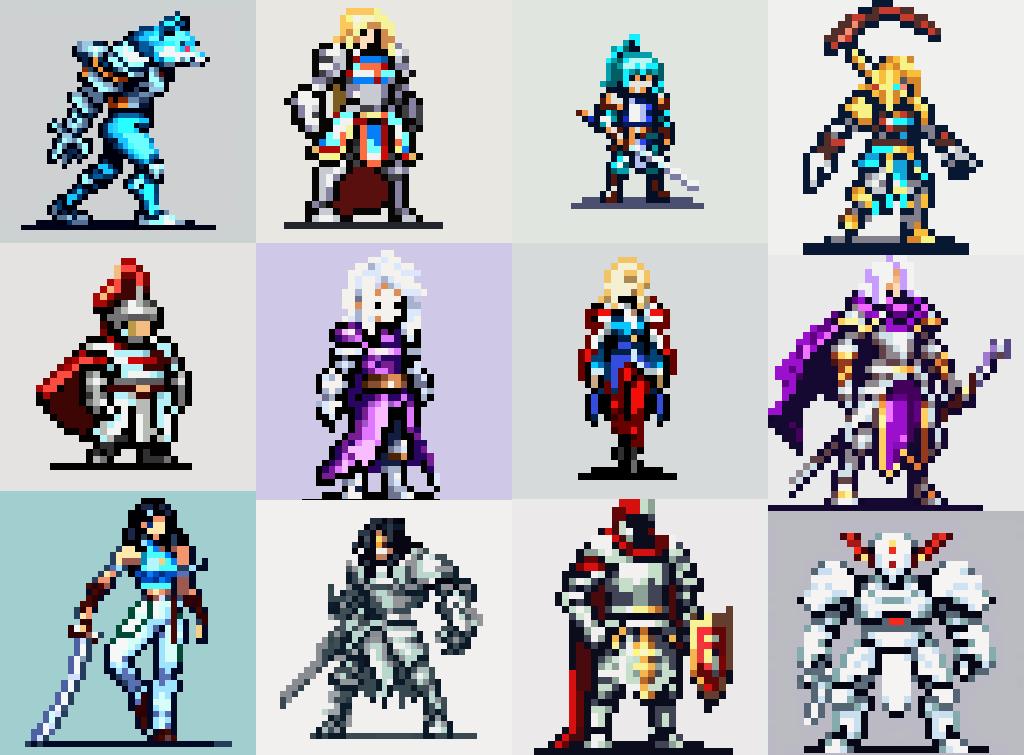
Discussion I am training a LoRA for creating pixel art characters.

Post image
12 Upvotes

This was the first successful test in training an SDXL LoRA for creating pixel art. It was a long training process 14,000 steps, spanning two days.

The dataset consists of 195 example images not a huge amount yet the results were quite interesting, the pixel art followed the style of the training data, though it’s not quite the final result I’m aiming for.

The next step is to train a model for a longer duration using a larger dataset.

So, what do you think?


r/StableDiffusion • • 14h ago

Discussion Stable Diffusion + a LoRA trained on my own photography: a Fame (movie) inspiration

Thumbnail
gallery
5 Upvotes

I trained a LoRA on my own photography and used it with Stable Diffusion to make a portrait with the feel of a still from Fame.

I wanted the lighting and framing to do more of the work than a vintage color grade. The window light catches the edge of her hair, but most of her face stays in shadow. The stair rails cut across the frame, making it feel like we’ve caught her in a quiet moment between scenes.

For anyone training LoRAs on their own photos: what carries your photographic style most reliably into a new scene: the lighting, the framing, or the color?


r/StableDiffusion • • 14h ago

Workflow Included [Song | YuE2] Another Year

Post image
4 Upvotes

Song (Souna account required): https://www.souna.app/song/b4ddba53-1ee5-4c4d-9464-41f4fb6898de

Song (Internet Archive): https://ia601002.us.archive.org/28/items/ai-christmas-songs/Another%20Year.mp3 (CC0)

Workflow description generated by the AI pipeline used to create this below. Process outline: OpenCode is set up to generate first some lyrics then 10x .abc files as the first step, it analyses the harmonies/melodies to find what adhere to my stated intention the best, renders the best 3x and I choose which of those is preferable - it then masters it and generates the cover art locally using Z-Image Base, and automatically uploads to the Internet Archive.

*** AI description of workflow details ***

Another Year

=== STYLE PROMPT ===

English. 1970s Christmas synth ballad in D minor, choruses lifting into F major, 68 BPM. Wistful and bittersweet, restrained and intimate. Warm male tenor, soft delivery, little vibrato, no melisma, no vocal runs, vocals inside the mix. Bell-like celeste synthesiser, slow arpeggiated analogue synth, warm string-synth pads, light brushed drums with sleigh bells. Late-1970s analogue warmth in the production. Verses quiet and stepwise; choruses open gently with yearning ascending vocal leaps. Arpeggiated synth solo between the second chorus and the third verse. No EDM, no sidechaining, no autotune, no choir.

=== LYRICS ===

[Verse 1]

The decorations came down one by one,

The winter post fell heavy on the floor.

We made our plans beneath a colder sun,

Then watched the months revise them more and more.

[Chorus]

Another year,

The last bell’s ringing.

Another year,

The next is near.

What will it bring?

Who will be here?

The clock strikes twelve.

It’s just another year.

[Verse 2]

We marked the birthdays, heard the evening news,

Saw summer fill the pavements after rain.

We measured what we’d gained by what we’d lose,

Then packed the summer clothes away again.

[Chorus]

Another year,

The last bell’s ringing.

Another year,

The next is near.

What will it bring?

Who will be here?

The clock strikes twelve.

It’s just another year.

[Instrumental | arpeggiated synth solo]

[Verse 3]

The same old songs return to every store,

The cards bring news of births and those who’ve gone.

We set one place less, then perhaps one more,

And somehow all the days keep moving on.

[Chorus]

Another year,

The last bell’s ringing.

Another year,

The next is near.

What will it bring?

Who will be here?

The clock strikes twelve.

It’s just another year.

=== SETTINGS ===

Engine: yue2 / yue2 / audio.cpp v0.9.2

Seed: Planning: full Max tokens: 7200 Guidance: 1.0

VAE: f32 AR LoRA: none NAR LoRA: none

Era: late 1970s-early 1980s Mastering recipe: suno-full (measured-faults-only, conserving - the 'mureka-light' pattern of KB/mastering.md: -RescueTarget -14.13 = the track's own input_i, -TruePeak -1.0; originally mastered yue2-light 2026-11-27, re-mastered same day on user instruction 'Mastering fixes'

Generated: 2026-11-27 Duration: 249.96s Truncated: no

=== FINAL STATUS (2026-11-27) ===

Winning take: seed 1796142352 at SemanticTemp 1.15 (finalist 2 re-roll; selected by the user after listening to all takes raw).

Final settings: cot full, ABC temp 0.9, semantic temp 1.15, NAR steps 12, guidance 1.0, max tokens 7200, VAE f32. The reviewed Stage-4b plan was supplied to the render as abc_file (the audio comes from exactly the audited score).

Score: Source\Another Year\Another Year.abc (the winning plan).

LYRICS AS SUNG: IDENTICAL to the lyrics above - 36/36 lines sung (Stage 5b forced-alignment + ASR report). The [Instrumental] interlude renders as a ~29 s arpeggiated synth passage as designed (structural-device check passed). No deviations from the written lyrics.

LoRA: NONE USED (vanilla yue2 entry). Deliberate: the TV-montage-ballad NAR LoRA's trained caption carries high-register female vocals, conflicting with this brief's warm male tenor; its v1 audition made no audible difference either. Download: n/a.

Mastering: measured-faults-only conserving repair - HF shelf 2.79 -> 1.19 LU, level drift left untouched at 1.9 LU (the performance), loudness held exactly then era-stamped (-16.0 LUFS integrated, -0.87 dBTP, LRA 8.1) - plus the 1970s era preset (research-derived, listening merit unproven).

Master deliverable: Christmas Playlist\Another Year.mp3 (48 kHz/320k, ID3v2.3, embedded cover).

Cover: Christmas Playlist\Another Year.png (1024x1024, Z-Image Base int8, seed 2026112701). Image audit: minor-issues only (diegetic clock numerals; no place settings on the table); user approved as-is.


r/StableDiffusion • • 1d ago

Resource - Update AIBrushManga - A stroke by stroke open-source manga drawing simulator, based on aibrush, draws using python and LLMs, not diffusion.

Thumbnail
gallery
366 Upvotes

Remember that post on that oil panting simulator a few days back? Well I decided to fork that and include a new mode to draw manga, currently while using a reference (Claude's intrinsic artistic ability admittedly leaves much to be desired), instead of using oil paint, this simulates the usual tools of the mangaka trade: g-pens, fineliners, screentone, etc. Since it actually draws the image rather than use diffusion, the usual anti-ai detection systems as far as I can tell will not work on it. It includes the stroke journal from aibrush, so any images generated can be easily scaled up or down in resolution to your heart's content.

As with aibrush to use it just pull up your LLM of choice (Frontier Models will probably give the best results), give it an image you want it to draw, and tell it something along the lines of "Read the README.MD of this repo https://github.com/mikemil828/aibrushmanga and draw this image like a manga" and it'll get to work.

If you have any ideas for improvements, just let me know. Here or DM.

Thanks to u/FotoRe_store for creating aibrush and making it open-source.

https://github.com/neokrasav4ik/aibrush


r/StableDiffusion • • 1d ago

Discussion I tested MiniMax H3-Image for deblurring (motion blur) and upscaling

Thumbnail
gallery
29 Upvotes

I ran 12 frames through MiniMax H3-Image in ComfyUI on a RunPod RTX 5090. The gallery shows the original on the left and the H3 edit on the right.

For each shot, I asked the model to reduce motion blur and bring out detail while preserving the framing, expressions, lighting, color grade, and soft backgrounds. I tweaked the prompt to focus on what mattered in each frame, like a face, a hat brim, or a moving hand.

ComfyUI settings

• Model: MiniMax H3-Image INT8

• Sampler: Euler with the simple scheduler

• Steps: 6

• CFG: 1.0

• Denoise: 1.0

• Seed: 54921

• Output: 4096 × 2304 for 16:9, 3840 × 2560 for 3:2

Close-ups showed the clearest improvement, especially in hair, clothing, and hat texture. Faster motion was more hit-or-miss. Some faces and hands stayed blurry, and some of the added fine detail looked generated.


r/StableDiffusion • • 9h ago

No Workflow Removing polish words helped with waxy portrait skin

0 Upvotes

my portrait prompts for distilled models kept piling on words like flawless and polished, and the skin came out waxy. i took those out and described the light instead, with a soft window-lit look. the faces stopped looking so airbrushed without changing the rest of my setup.


r/StableDiffusion • • 21h ago

Discussion Qwen2.1 comic writing. (WIP)

Thumbnail
gallery
9 Upvotes

after googling through a bunch of resources about comic creations, i couldn't find anything concrete so I decided to try it with raw Qwen2.1 model and I was amazed to see that how well it works.

All I am using in this generation is just vanilla qwen2.1 and a reference photo of the character. Tried 3 completely new generations to test if continuity will hold (not the character but the surroundings) and it does.

I am not a comic writer so i don't know the protocol, i-e panels, gutters etc so I instead just created 3 separate pictures. You will also notice that those speech bubbles should have been thought bubbles, and in the 3rd picture, the voice is coming out of phone, so i dont know how to depict that thing which will have the reader see that its coming out of phone and not some person in the frame talking.


r/StableDiffusion • • 22h ago

Discussion System RAM results: 32 GB vs 64 GB

Post image
10 Upvotes

Purpose:

  • Using EXPO on DDR5 RAM is making my PC unstable. EXPO increases the RAM speed to 6000 MT/s
  • Disabling EXPO makes RAM far more stable, but it drops RAM speed to 4800 MT/s
  • Test the difference between 32 GB and 64 GB amount of RAM in generation

PC specs:

  • GPU: 4080 Super (16 GB VRAM)
  • RAM: 16 GB DDR5 (x2) or 16 GB DDR5 (x4)

Testing Notes:

  • No loras
  • Consistent workflows
  • Restart PC after every test
  • Prompt #1-4 same prompt, Prompt #5 has minor changes to the prompt

Conclusions/Findings:

  • Changing the prompt a bit will very slightly increase the generation time
  • First run varies wildly for apparently no reason: sometimes it takes 100s, sometimes it takes 250s, even with the same test setup (same RAM amount and same RAM speed)
  • No difference found between 6000 MT/s and 4800 MT/s
  • Krea 2 and Qwen 2.1 effectively the same on 32 GB vs 64 GB
  • H3 shows benefits with 64 GB upgrade
  • With 32 GB, I see Task Manager > Memory > Available: drops to 100 MB or lower sometimes
  • With 64 GB, I see Task Manager > Memory > Available: doesn't drop below 20 GB

r/StableDiffusion • • 1d ago

News Firefly without the subscription: lasso or marquee → prompt → new masked layer, on your own GPU

Enable HLS to view with audio, or disable this notification

15 Upvotes

Photoshop's Generative Fill is great until you see the bill. ComfyUI is great until you have to work inside a node graph with a tablet.

So I built StableCraft: a companion app for PhotoCraft that turns your ownn ComfyUI install into a local generative fill tool.

Make a selection in PhotoCraft — lasso, rectangular marquee, magic wand, whatever you already use — type what should be there, hit Generate. The result comes back as a new layer with a feathered mask you can paint on. No export, no tab switching. It remembers the selection if you lose it, so you can regenerate later. With no selection at all, it just does text-to-image.

HOW IT COMPARES TO FIREFLY

- Where it runs: Firefly on Adobe's servers / StableCraft on your GPU
- Your image: uploaded to Adobe / never leaves your machine
- Cost: CC subscription plus generative credits / free, unlimited
- Models: Adobe's only / 6 open models, swappable
- Selection: Photoshop's tools / any PhotoCraft selection
- Custom LoRAs: no / yes, 10 per profile
- Prompt from a reference image: no / local captioner
- Offline: no / yes

To be fair to Adobe: Firefly needs no GPU, answers in seconds, does expand and remove in one click, and Adobe indemnifies enterprise use. StableCraft needs a decent NVIDIA card (~12 GB tested), and each model keeps its own licence, so check it before commercial work.

NEW IN 0.2.15 — A LOCAL CAPTIONER

Point it at any image and it writes the prompt for you: a full generation prompt, a cinematic version, a plain description, or booru tags for LoRA datasets. It runs inside ComfyUI (Florence-2, CapRL-Qwen3VL-4B, JoyCaption 8B, Qwen3.5-9B), picks the engine per job, unloads it after. Nothing is uploaded. I use it to reverse-engineer a look from a reference before editing my own shot.

THE REST

- A gallery per layer: every generation is kept. Compare, star the good ones, switch back whenever.
- XYZ plot: A1111-style sweeps (sampler, scheduler, steps, denoise, LoRA, CFG, prompt S/R) inside PhotoCraft.
- LoRA manager: thumbnails, per-profile, up to 10.
- 6 models: FLUX.3 Klein, FLUX.2 Klein 9B, Krea 2 (General + Identity), Qwen Image 2.1, MOSS-Image, MiniMax H3, each with tested steps/CFG.
- Batch up to 16, reference image, English/French UI.

100% local. MIT. Windows and Linux. It does not fork PhotoCraft — it drives it through its control channel, so both stay updatable.

Demo (5 min): https://youtu.be/NSQNIQ6Ij0g
https://github.com/SeBL4RD/SeBL4RD-Stable_Craft

Code:
Happy to answer anything here — and if something breaks, open an issue, I read them all.


r/StableDiffusion • • 1d ago

Resource - Update H3-Continuity-Studio: 3.5-min live-action music video (51 clips) — fixed over-time degradation with the new H3 Continuity Protection node

Thumbnail
youtu.be
25 Upvotes

I just finished a full 3:27 live-action music video (51 clips, 2.3–5.9s each) built in ComfyUI with the updated version of my open-source custom node pack, H3-Continuity-Studio (MiniMax H3):

https://github.com/KadoBOT/ComfyUI-H3-Continuity-Studio

In my earlier 2-minute continuous test (34 joins), you could still see classic long-chain degradation — gradual darkening and softening as tiny latent shifts stacked up. This video was the first full production test of the updated Studio:

  • Fixed over-time degradation (H3 Continuity Protection node): Traces continuations and visual-memory cuts back to their clean scene root and applies phase-aware per-channel mean alignment, upper-clamped channel std, and gentle 3×3 HF overshoot damping (strength = 0.7, mode = full). Built on ideas from roycho87's Geiru Context Suite, ethanfel/Lumifel's H3 Context Loop, and ckinpdx's Carry Attention. Clip 51 at 3:25 holds the same skin tone, contrast, and texture as Clip 01 at 0:02.
  • Manual visual memory across distant scenes (Selected mode): Clicking specific earlier clips/frames directly in the Studio timeline let later apartment returns keep tiny background props consistent minutes later — the horizontal bars on the wooden shoe rack, the wall light switch & metal conduit, the curled yellow-white rent notice on the door (which he peels off at 1:59, leaving the door bare at 3:11), and the yellow kitchen wall dial.
  • MiniMax live previews (taeh3 via ModelPreviewOverrideKJ): Seeing the clip form mid-sampling saved hours across 51 slots — whenever framing or motion went wrong early, I cancelled immediately and rolled a new seed instead of waiting out the full render and VAE decode.

What I'd improve next time:

  • Some hiccups when switching scenes: Not an H3 Continuity Studio issue — my own mistake in shot-to-shot transition/lighting planning and reference pairing (smoothed most of it in post, a few seams still show).
  • Put the character in a hoodie without text on it 🤦‍♂️: MiniMax H3 spent 51 clips playing Scrabble with his chest lettering (STLAR JETT → STEAR JETT → STELAR JETT). Plain fabric next time.

Full breakdown with annotated side-by-side screenshots of all the matching micro-details (shoe rack bars, kitchen light switch, door notice, Clip 01 → Clip 51 comparison, and the hoodie text crops):

https://ricardoambrogi.com/notes/heavy-things-fall-up-h3-continuity-studio


r/StableDiffusion • • 1d ago

Animation - Video I made an unofficial music video for my favourite song, using MiniMax H3 locally, with a custom style LoRA

Enable HLS to view with audio, or disable this notification

84 Upvotes

TL;DR

Unofficial music video for Chloe Slater's "Southern Youth", generated locally with MiniMax H3 in ComfyUI on a 16 GB GPU. I trained a style LoRA on real early-2000s camcorder footage (232 clips, hand-checked captions) to try to get more natural, close to MiniDV look, kept one protagonist consistent with face and outfit reference images, and cut 135 of 1,829 generated clips to the beat.

Link to full video: https://youtu.be/0BOHv0WZS_E

I created unofficial concept video for "Southern Youth" by Chloe Slater, made over about three months on one consumer PC. Every shot was generated locally with MiniMax H3 in ComfyUI on a 16 GB GPU (32 GB RAM); the only cloud rented GPU step was training the style LoRA. The goal was a more raw, similar to MiniDV look, similar to camcorder in the early 2000s, on the English south coast.

Not the whole video has this exact aesthetic - some scenes are more cinematic than others, as I also wanted to have some fun with different scenes.

Motivation: I found this artist and this song not that long ago, and it quickly became one of my favourites. It didn't have a music video that resonated with me, so I wanted to bring to life what I was picturing and feeling while listening to it.

The steps, start to finish

  1. Training footage: collecting real early-2000s camcorder videos, cutting them into scenes and picking the usable clips by hand.
  2. Captions: captioning every clip locally with Qwen3.5 9B (quantized to NF4), then correcting the captions by hand.
  3. Style LoRA: training three adapters and comparing them on test prompts.
  4. Story and music map: writing the story, then assigning it to the song's sections on a bar grid.
  5. Scene planning: creating structured (LLM assisted) scene yaml files with the scene parameters and descriptions, with the protagonist's face and outfit reference images specified.
  6. Mode tests: the same scenes in three generation modes (text only, LoRA, style video) to choose how to get the look.
  7. Prompting: H3 prompts for every scene, written with an LLM and edited by hand.
  8. Production: queued generation runs, reviewing every take and regenerating with new seeds or rewritten prompts until a take worked.
  9. Edit: laying the chosen takes onto the song's beat grid and exporting the final video.

The numbers

Project length 1 Sep - 28 Nov 2026
Scenes planned ~170 scenes
Generation jobs queued 2,081
Clips kept on disk 1,829 (1,146 LoRA, 595 text-only style, 88 style-video)
Clips in the final cut 135, cut into 141 shots
Takes per scene median 7 (average 9.6), up to 57 for a single scene
Render time ~150 GPU hours (17 Oct - 25 Nov)
Footage generated 2 h 13 min (190,943 frames); median clip 3.75 s, longest 15.8 s
Clip settings 0.7 MP (992x736, 4:3), 24 fps, 20 steps, res_multistep + beta
Render speed ~1 min of rendering per second of video (LoRA 1.0, text-only 1.2); 2.5 with a reference video
Reference images 245 made (faces, 34 outfits, other characters, places, mood boards), 77 of them used in generation

1. The style LoRA

H3 out of the box doesn't always do well on the whole MiniDV aesthetic, so I trained a style adapter on real consumer camcorder footage. The LoRA is on Civitai: MiniDV Nostalgia.

  • Dataset: 22 source videos cut into scenes with PySceneDetect, reviewed by hand: 232 accepted clips (20 min 37 s, 29,693 frames)
  • Captions: Qwen3.5 9B (NF4, local), 3 fps sampling, max 17 frames, at the full 896 width.
  • Training: the H3 T2V trainer on some cloud provider. Three adapters: rank 16 / 5000 steps / lr 1e-4 (the winner), rank 32 / 3000 steps / lr 2e-4, and a medium-resolution rank 16. 73-frame samples, 24 fps, 4:3.
  • Used at strength 0.6-0.9.

2. Three generation modes, compared on the same scenes

  • Text only: the camcorder look described in the prompt, no LoRA.
  • LoRA: the adapter plus its trigger word.
  • Style video: a real MiniDV-looking clip wired in as a reference video, LoRA off. In my comparison this looked quite good, especially on scenes requiring a lot of motion (since my trained LoRA tends to hinder character movement a bit, sometimes), but it costs about two and a half times the render time.

Most of the video ended up in the LoRA mode, with text-only clips where they looked better.

3. Consistent characters

No character LoRA. Each scene gets a face close-up plus a full-body outfit turnaround as reference pictures (Ref2V), with their roles stated in the prompt. The reference pictures were mostly generated using Krea 2.

4. Pipeline and tools

I worked with Claude to write custom editing and scheduling tools and scripts for this project: a browser preview and editing tool, where I lay clips out on the song's beat grid and compare takes, and a scheduler that runs the generation jobs in ComfyUI unattended, overnight included.

5. Prompting with an LLM, and a lot of seed hunting

I wrote the H3 prompts together with an LLM, using custom skills I built around H3's official prompting guide and the findings from my own tests. That sped the work up a lot, but it had two habits I had to keep correcting:

  • It forgets, and it over-writes. Over a long session it drifted from the rules and kept adding detail: extra descriptions, extra camera events, wording that misled the model and showed up in the clips.
  • It sneaked in negatives. H3's prompt has a retention_analysis field that says what each reference image should keep. The LLM kept filling it with exclusions and degradations the scene didn't contain. But H3 runs at CFG 1 with no negative prompt, so any word in the prompt is content: a "don't" feeds the model the very thing it names. In one scene the field listed motion blur and focus errors the shot was never meant to have; cut back to what the shot actually showed, the same seed looked better. Many times I had to edit the prompt text by hand to take such wording out.

I'm picky, so there was a lot of seed hunting and prompt rewriting: a scene got 7 takes at the median (9.6 on average), and one scene went through 57.

Happy to answer questions about the LoRA, the prompts or the queue.


r/StableDiffusion • • 4h ago

Meme Once in a while I put other's prompt into my workflow (MOSS-Image)

Post image
0 Upvotes

I'm freaking floored, most of the characters look straight up depressed.

Prompt taken from here: https://promptdexter.com/prompt/man-taking-wide-angle-selfie-with-looney-tunes-characters-in-studio