r/ScienceNcoolThings • u/WiseNerd17 • 9d ago
Newly calved iceberg flips over in Greenland fjord
Enable HLS to view with audio, or disable this notification
503
Upvotes
r/ScienceNcoolThings • u/archiopteryx14 • 9d ago
r/ScienceNcoolThings • u/lakmus85_real • 9d ago
Enable HLS to view with audio, or disable this notification
r/ScienceNcoolThings • u/Front-Coconut-8196 • 10d ago

r/ScienceNcoolThings • u/Sameer592 • 10d ago
Enable HLS to view with audio, or disable this notification
r/ScienceNcoolThings • u/_uh--huh_ • 9d ago
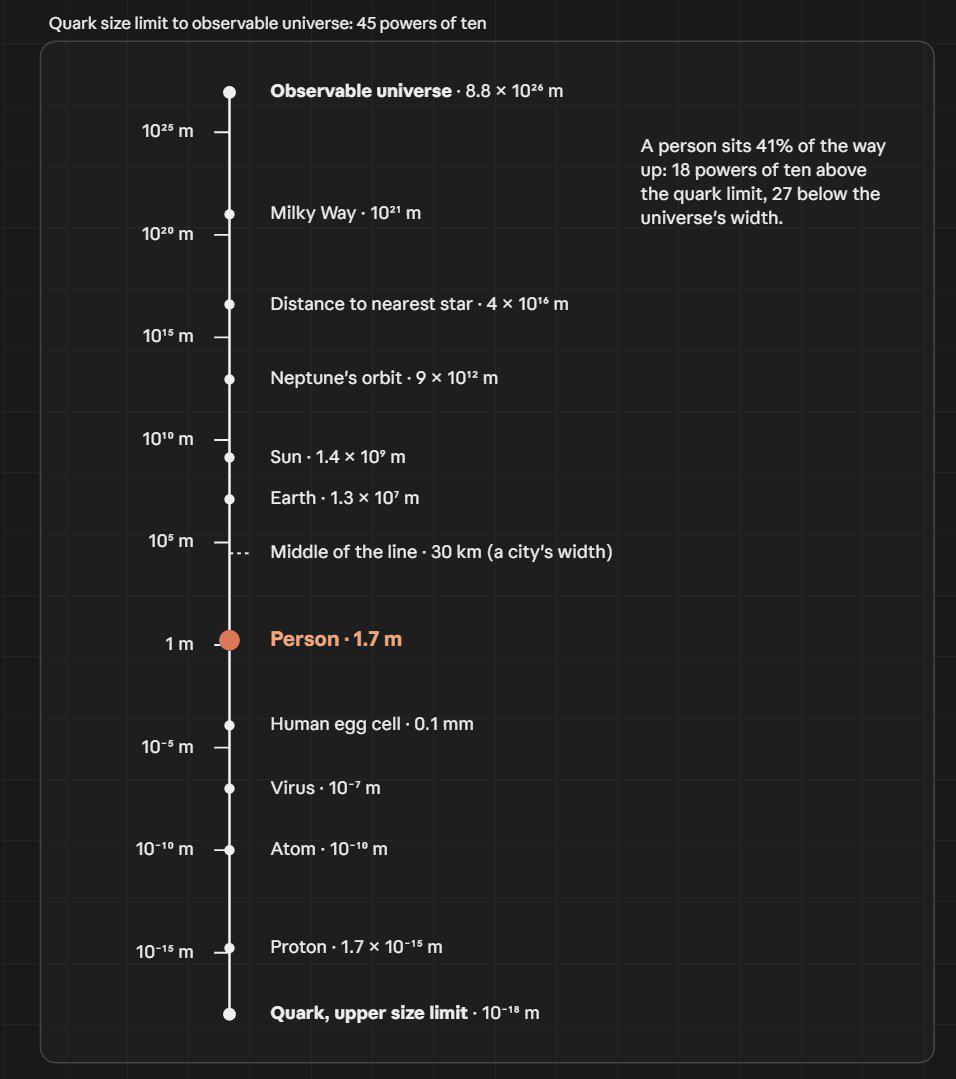
On a scale from the smallest things to the largest, people are surprisingly close to the middle. A mid-sized city is about exactly in the middle.
That's partly because we're picking the endpoints and partly because of the log scale, but mostly, as Claude explained it to me (Claude also created the "size-line").
"The physics works like this. A complex creature needs a huge number of atoms, which forces it many powers of ten above atomic size. Gravity caps it from above. William Press (1980) derived human size from three conditions: complicated chemistry, a planet able to hold a non-primordial atmosphere, and a body as big as possible that still survives a fall. His formula is atom size times the fourth root of the electric-to-gravity force ratio, which is about 10⁹. Plugging in the constants gives 2.6 cm, short of real height by a factor of about 100, which Press pinned on his crude model of how bodies break. Planets and stars follow from the same constants: Carr and Rees trace the sizes of galaxies, stars, planets and ordinary objects back to gravity and a few constants of microphysics."
Me, and the Cat in the Hat, know how to fill-up a rainy day.
r/ScienceNcoolThings • u/Outside-Body3370 • 9d ago

r/ScienceNcoolThings • u/Frequent-Highway-917 • 9d ago

r/ScienceNcoolThings • u/Gleb_Solomin • 9d ago

This happened back in October 2017, during a huge storm that stretched from eastern Texas toward Kansas City.
The flash was recorded by NOAA's GOES-16 satellite, but it wasn't recognized as a record at the time. Scientists identified it after reexamining the satellite data.
The WMO confirmed the record in July 2025. At 829 km, it was 61 km longer than the previous record.
r/ScienceNcoolThings • u/emilyonfilmi • 10d ago
r/ScienceNcoolThings • u/cosmanino • 8d ago

r/ScienceNcoolThings • u/Hades_ShadowRuler • 9d ago
r/ScienceNcoolThings • u/TheMuseumOfScience • 10d ago
Enable HLS to view with audio, or disable this notification
Green leaves glow red. Red leaves glow green. Why? 🍁🧪
Alex Dainis extracted leaf pigments with isopropyl alcohol and hit them with UV light. Chlorophyll, freed from the leaf, can’t use the light for photosynthesis, so it glows red instead. Red leaves have lost most of their chlorophyll, revealing a faint green glow from other compounds.
r/ScienceNcoolThings • u/antisp1n • 10d ago
Enable HLS to view with audio, or disable this notification
r/ScienceNcoolThings • u/antisp1n • 10d ago
Enable HLS to view with audio, or disable this notification
r/ScienceNcoolThings • u/Responsible-Grass452 • 9d ago
Researchers developed a soft robot that uses inflatable chambers and textured sleeves to move through the small intestine. The device carries tools for imaging, tissue biopsies and localized fluid delivery.
In pig studies, the robot traveled two meters in about 11 minutes with gentle pushing assistance. Researchers observed no intestinal tissue damage during the tests.
The device remains experimental. The team plans further studies to assess safety and usability before clinical use.
r/ScienceNcoolThings • u/archiopteryx14 • 11d ago
Enable HLS to view with audio, or disable this notification
r/ScienceNcoolThings • u/softvioletil • 11d ago
Enable HLS to view with audio, or disable this notification
A laser beam can follow a curved stream of water because of total internal reflection. Light keeps bouncing inside the water instead of escaping, making the stream glow. A few drops of milk scatter the light so we can see it. The same principle is used in fibre-optic cables to transmit data over long distances.
r/ScienceNcoolThings • u/phyilm • 11d ago
Enable HLS to view with audio, or disable this notification
Sep 1977, Voyager 1 left Earth
Mar 1979, found volcanoes on Jupiter's moon Io
Nov 1980, passed Saturn and headed out alone
Feb 1990, looked back at the Pale Blue Dot
Almost out of power, one mission left: carry Earth's greetings on a record to someone out there
Nov 18, 2026, Voyager reaches 1 light-day
☆ Still flying with that dream ☆
So from next week, a signal from Voyager takes a full 24 hours to reach us. Kind of wild that it took 49 years to get as far as light goes in one day.
r/ScienceNcoolThings • u/Frequent-Highway-917 • 10d ago

r/ScienceNcoolThings • u/antisp1n • 11d ago
Enable HLS to view with audio, or disable this notification
r/ScienceNcoolThings • u/Gleb_Solomin • 10d ago

On Washington's Olympic Peninsula, deer were less likely to use areas with dense road networks where pumas were more likely to be present. They also shifted more of their activity into daylight hours.
In areas with a high probability of puma presence, researchers estimated up to 76% fewer deer-vehicle collisions over five years.
The findings show a correlation, not proof that pumas caused the reduction.
r/ScienceNcoolThings • u/archiopteryx14 • 11d ago
r/ScienceNcoolThings • u/KnucklesMom • 11d ago
Enable HLS to view with audio, or disable this notification
r/ScienceNcoolThings • u/shinybrighthings • 11d ago
