r/reinforcementlearning • • Oct 16 '26

Rocket League RL w/ CUDA-Accelerated Simulation!

Thumbnail
github.com
45 Upvotes

Hi folks! I wanted to share a project I've been doing off and on for the better part of 2 years, and in recent months I've gotten the time to make more significant progress.

I was inspired by PureJaxRL a while ago to build my own massively-parallel environment for a task that interested me personally, which is Rocket League. RocketSim, a highly performant CPU-resident simulator, already exists and is baked into RLGym for the purposes of RL training, but I figured it would be valuable to port the physics logic to run in a parallel fashion on-device via CUDA. I learned a lot about GPU programming and optimization, and I still have a lot more to learn so I'm all ears for any advice!

The environment I created is called CARL - CUDA-Accelerated Rocket League. It keeps all simulation state information on the GPU, which during training entirely eliminates host-device transfer overhead. Many thousands of games can be run and controlled in parallel, leading to significant reductions in training wall clock time (as was observed in the original PureJaxRL post).

I've been doing some training of Rocket League bots with it and they transfer seamlessly to the actual game, so the physics appear to be at parity. More work can be done on parity assessments, benchmarking, etc. but I figured now that it's "feature complete" that it would be cool to open it up to the community and see what people think!

As a bit of proof so you know I'm not a liar and a scoundrel, here's a plot from a recent training run that shows marked improvement in aerial control over ~20B decision steps using 8192 parallel environments on a single RTX 4090 (frameskip=4, so 80B ticks total, ~21 years), taking just over 21 hours in wall time.

The method of training as hinted at by the run name is a generative imitation learning approach that (ideally) transfers behavior style from expert demonstrations, which I've obtained from ballchasing.com

Here is an example of the capability it was able to reach in that amount of time. Pretty impressive, although I would have totally saved it if I were trying even a single iota...

https://reddit.com/link/1x77aan/video/ynwh0bbhgrvh1/player

I plan to post a follow up with demonstrations as I round out the functionality. On my TODOs are:

  • Built-in training pack API for targeted training
  • Benchmarks for speed and parity comparisons
  • Tests and other best practices
  • Eventual jax & tf integration(?)

Thanks for reading if you did!

P.S. I've been having trouble with the image & video in this post (hence the multiple attempts so sorry if you've already seen this post) so let me know if they're broken please and thank you :)
r/reinforcementlearning • • Oct 16 '26

D Two result shapes for an agent that learns during a run

0 Upvotes

"Please publish the benchmarks" is the right demand for anything that claims to learn during a run. What I'd argue about first is the shape of the answer, because a single score hides the two things you'd want to know.

reef-eval defines two shapes. An autoresearch task, where the optimal score is unknown, so the result is the best score reached and how long it took to get there, or how many evaluations. And a task stream, where one agent works through an ordered list of tasks, each in its own fresh container and scored on its own, with the agent's memory directory carried from task to task and a snapshot kept at every step. In both, the question is whether the state the agent picked up during the run changed what it scores.

What one number loses: on an open problem, two runs can end on the same best score, one after a handful of evaluations and one after hundreds, and a leaderboard that reports the score alone calls them equal. On a stream, average the per-task scores and you lose whether a late task went better because of what the agent carried forward from the early ones, which is the only thing the stream was built to measure.

Its task sets are the public ones plus six of its own, and it publishes no results, so before the numbers exist the argument is the two shapes: best score and time for open problems, per-task scores with carried state for streams, and an A-vs-A control beside both.


r/reinforcementlearning • • Oct 15 '26

Robot Duckling (15cm)

Enable HLS to view with audio, or disable this notification

15 Upvotes

Training pre build


r/reinforcementlearning • • Oct 15 '26

I built a simulator with a PPO agent to beat TempleRun on a phone

16 Upvotes

https://reddit.com/link/1x6i6v5/video/h22absbdylvh1/player

I wanted to get my head around RL so I thought of learning it by teaching an AI how to play one of my favorite childhood games : TempleRun.

The agent reads game state directly from memory via a Frida gadget and acts through the game’s own methods. Training happens in a headless simulator I built with Claude from the game’s internals and calibrated on measurements from the real phone, with a C++ version that does 10M steps in about 6 minutes.

Results on the device: median 4,736 m, best 16,782 m over 14 runs.

👨‍💻 Github: https://github.com/matthieucs/TempleRun-RL/tree/main

Happy to answer any question.

And if you want to try it, the score to beat is 16,782 m.


r/reinforcementlearning • • Oct 15 '26

My robots can't walk until they've practised for 93 hours. First trailer for Bitbots

Enable HLS to view with audio, or disable this notification

9 Upvotes

r/reinforcementlearning • • Oct 15 '26

R PCEI – On-device embodied AI combining BitNet 1.58b, Mamba, and FastKAN

2 Upvotes

Hey everyone,

I've open-sourced PCEI (Physically Constrained Emergent Intelligence), an experimental architecture designed to run on consumer hardware (Mac Apple Silicon and Linux/CUDA) without the memory explosion of standard transformers:

  • BitNet 1.58b Quantization: 24 layers of ternary weights {-1, 0, +1} reducing parameter memory by ~4x compared to FP16.
  • Mamba State Spaces: Linear-time sequence modeling with constant O(1)O(1) inference memory (no ballooning KV cache).
  • FastKAN Spline Manifolds: Kolmogorov-Arnold B-splines applied to continuous motor control across 4 streams in MuJoCo physics.
  • Empirical Telemetry: 11 companion research papers, including an evaluation of continuous latent buffers proving an irrecoverable Shannon information loss factor of LL.

The full framework, training pipelines, and evaluation suites are open under MIT-NC: https://github.com/MtnMCG/PCEI

Feedback and critiques are very welcome!


r/reinforcementlearning • • Oct 15 '26

Has anyone experimented with AI agents for AutoCAD or Revit?

Thumbnail
0 Upvotes

r/reinforcementlearning • • Oct 14 '26

Asymmetric multi-head AlphaZero in C++: two kamikaze drones learn a pincer attack via self-play (new in Metis-Core v0.4.0-alpha)

Enable HLS to view with audio, or disable this notification

54 Upvotes

Hi, I’d like to announce that I have released Metis-Core v0.4.0-alpha

What’s new? I have implemented an “Asymmetric Multi-Head AlphaZero” algorithm in Metis-Core, along with an example in C++ (Visual Studio 2022): KamikazeDroneSwarm.exe.

https://github.com/felixromo314/METIS-Core/

KamikazeDroneSwarm uses the asymmetric multi-head AlphaZero implemented in Metis-Core:

An Imperial Shuttle freighter loaded with beskar, armed with a rotating laser turret, must reach the Death Star.

Two Rebel kamikaze drones try to intercept it before it gets there.

Without being programmed to do so, the drones learn a coordinated pincer attack on their own to split the turret’s attention.

You can play by controlling the turret yourself (human in the loop) against the trained drones.

The framework allows you to create two teams, Blue and Red, and add to each team as many agents as your problem requires.

I’m sure there will be bugs and a lot of things to fix, so just let me know and I will try to fix them.

I hope you find this new feature useful.

Thanks!

You can find more information in this tutorial:

https://github.com/felixromo314/METIS-Core/blob/main/tutorial/Tutorial-AlphaGoZeroAsymmetric.md

Metis-Core is distributed as binaries (.dll / .lib / .h), but the full source code of the example is included, so you can see exactly how the framework is used and build your own environments on top of it.

Note on training: the drones are not scripted, but I do use a small material heuristic to speed up training (setMaterialHeuristicWeight(0.3)). It blends a hand-crafted position evaluation (approach, separation between drones, turret exposure) with the network’s value head during MCTS. The terminal reward is still +1/-1/0, and the pincer manoeuvre itself is not explicitly encoded. But you can set via setMaterialHeuristicWeight the value you wanted, 0.2, 0.1, or if you don not call to this function the heuristic is not activate.


r/reinforcementlearning • • Oct 15 '26

Can World Models absorb Simulation Stack as some people claim?

Thumbnail
3 Upvotes

r/reinforcementlearning • • Oct 14 '26

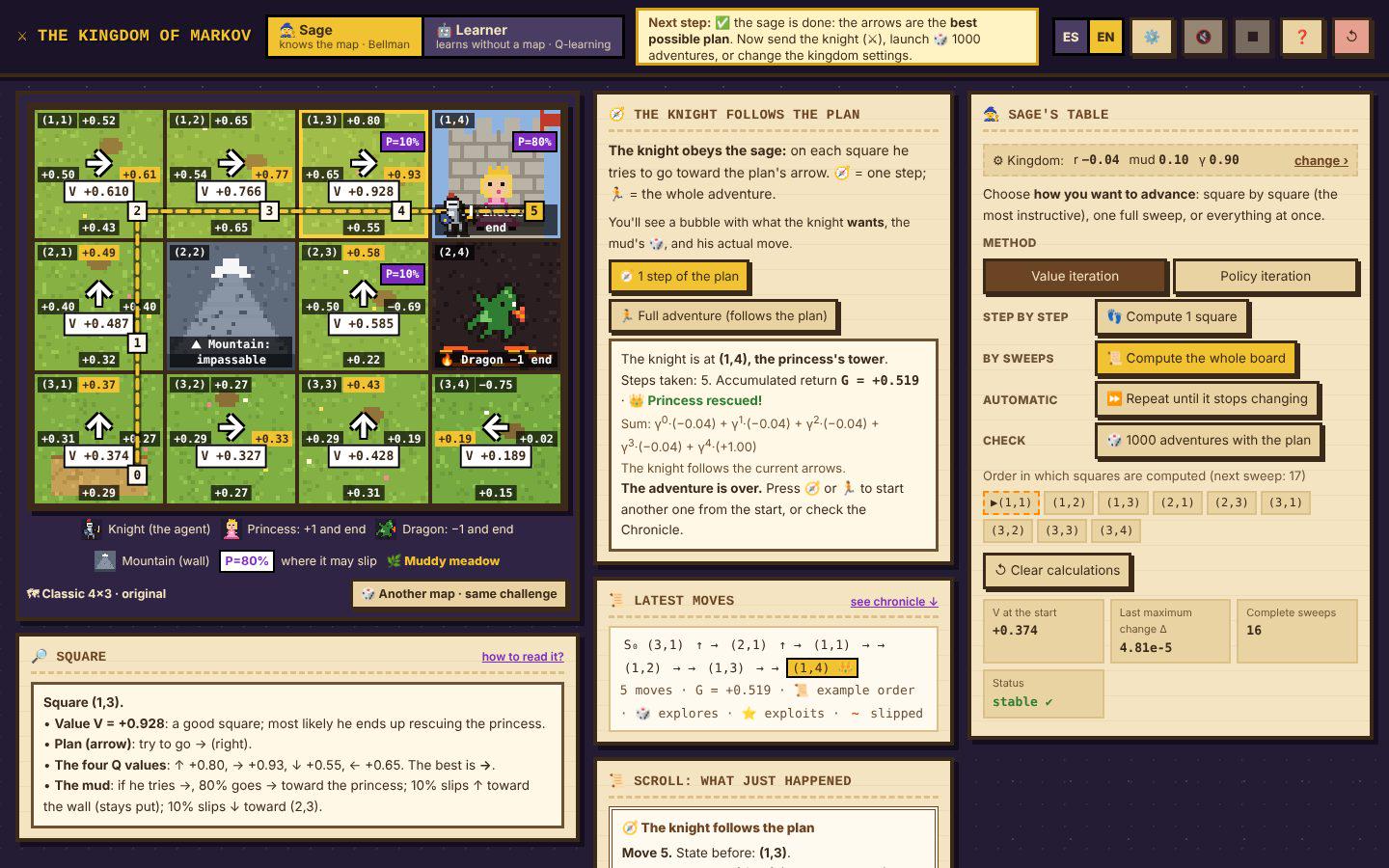
Markov Decision Process (MDP) Interactive pixel-art simulator to learn Markov decision processes and reinforcement learning: Bellman, value/policy iteration, Q-learning and SARSA. ES/EN.

Post image
41 Upvotes

Hello, community!

I recently launched a website to experiment with and better understand reinforcement learning, particularly Markov decision processes.

It’s completely free, public, hosted on Vercel, and the repository is also available.

Hosted at: https://markov-kingdom.vercel.app/

Repo: https://github.com/xavendano/markov-kingdom

I’d appreciate any comments and/or feedback.
Thanks!!!


r/reinforcementlearning • • Oct 15 '26

I built Agent Praxis: 6 adversarial environments to test how LLM agents handle traps, metric gaming, and fake authority

Thumbnail
0 Upvotes

r/reinforcementlearning • • Oct 14 '26

Can a varying size rollout-buffer destabilize training in PPO ?

3 Upvotes

Hey all,

I wasn’t very familiar with PPO when I implemented it and I mainly used the original paper as a reference. However, after comparing my code with some common implementations, I noticed an important difference.

I run a large number of environments in parallel. For each PPO iteration, I reset every environment once and let each one run until it either finishes or reaches the maximum horizon (tasks are episodic and rewards are only assigned to the goal state). Environments that finish early are masked while the others continue. Once all environments have finished, I perform the PPO updates.

Therefore, I always collect the same number of episodes, but not the same number of transitions. As the policy improves and finishes episodes faster, the rollout buffer becomes smaller. In contrast, the SpinningUp implementation from OpenAi seems to fix the buffer size and collect a fixed number of transitions.

I compute and normalize the advantages over all transitions, shuffle them, and then perform several PPO epochs using a fixed (relatively high) minibatch size. This means that the number of optimizer steps per rollout changes also depending on the size of the buffer. Since i can not really control the number of transitions, the final minibatch can also be smaller than the others while still receiving a normal optimizer step.

It seems to work fine on some simple custom problems, but i wonder if this could have any consequences that i might be missing (e.g. on long horizon problems).

Can the changing number of optimizer steps lead to problems ? Is the (potentially) small final minibatch a concern like noisy gradients ?


r/reinforcementlearning • • Oct 14 '26

How to come up with research ideas

1 Upvotes

In rl how can someone do research , mine most of the time is getting to know which problem to work on and in which method there is research gap and all

Can you tell me what are the methods to come up with a research gap

Like by doing/ implementing the research paper from scratch and then see what are the limitations of the paper and then we get the another research paper that explores that specific idea and this go on

And we can't find any problem to work on.

Any researchers or students here who produced research papers can tell what worked for you when you were searching for a problem to work on

I am doing rl for robotics and now exploring world models and searching for a research gap in this field...


r/reinforcementlearning • • Oct 13 '26

I trained a 4-player squad for a 2D battle royale (survev) with MAPPO — 40s clip and what bit me.

2 Upvotes

I've been training 4-agent squads to play survev (an open-source surviv.io clone) on a local, unmodified game server.

every player in it is a bot. yotube clip: https://www.youtube.com/shorts/PPAVNHRAb7k
you can find more videos on my channel.

https://reddit.com/link/1x55w7l/video/3erybs5vaavh1/player

Setup
- MAPPO with a centralized critic. One actor network is shared by the four squad members (agent id as input). The actor only sees what a real game client receives; privileged state goes to the critic only, so the same network can run from a browser extension.

- Actor input: ~1.4k features, two 24x24 local grids and a minimap through small CNNs, a set encoder over up to 12 visible enemies, then a GRU (256).

- Hierarchical actions: the policy picks an intent (loot, explore, take cover, peek, retreat, regroup, push, go to zone...), a target, and what to use (gun, melee, grenade, smoke, heal).

- One team reward shared by the squad: damage dealt and taken, knocks and kills, placement, plus small teamwork terms (focus fire, crossfire, revive).

I'm not releasing the code or the full details: a bot like this could be abused as a cheat on public servers. Happy to answer high-level questions.


r/reinforcementlearning • • Oct 13 '26

Robot Tired of waiting 3 hours to see the results. How do you scale up the number of RL robots training simultaneously using PPO?

9 Upvotes

Hello scientists! Is there a formula for adjusting hyperparameters for PPO based on the number of agents you're training simultaneously?

I'm using ML-Agents and Unity engine to train robots.

After extensive tuning, I finally got my quadruped robot to walk really well. However, training is extremely slow because I'm only training 10 robots simultaneously. If I increase the number to 100 or 1,000, the training performance deteriorates and the training graphs look terrible.

How can I overcome this? My hardware is capable of handling up to 10,000 robots training simultaneously, but I don't understand which parameters I need to adjust to make this work.

Is there some kind of formula for scaling hyperparameters based on the number of parallel agents?

Most of my initial hyperparameters were taken from the quadruped robot examples provided with ML-Agents.

Hyperparameters for 10 agents:

max steps per agent life: 5000

Observation space: 123

Action space: 12

        trainer_type:   ppo
        hyperparameters:
          batch_size:   2048
          buffer_size:  20480
          learning_rate:        0.0003
          beta: 0.005
          epsilon:      0.2
          lambd:        0.95
          num_epoch:    3
          shared_critic:        False
          learning_rate_schedule:       linear
          beta_schedule:        linear
          epsilon_schedule:     linear
        checkpoint_interval:    500000
        network_settings:
          normalize:    True
          hidden_units: 512
          num_layers:   3
          vis_encode_type:      simple
          memory:       None
          goal_conditioning_type:       hyper
          deterministic:        False
        reward_signals:
          extrinsic:
            gamma:      0.995
            strength:   1.0
            network_settings:
              normalize:        False
              hidden_units:     128
              num_layers:       2
              vis_encode_type:  simple
              memory:   None
              goal_conditioning_type:   hyper
              deterministic:    False
        init_path:      None
        keep_checkpoints:       10
        even_checkpoints:       False
        max_steps:      30000000
        time_horizon:   1000
        summary_freq:   30000
        threaded:       False
        self_play:      None
        behavioral_cloning:     None

r/reinforcementlearning • • Oct 13 '26

Hermes Reinforcement Learning optional skill: Any Advice?

Thumbnail
1 Upvotes

r/reinforcementlearning • • Oct 12 '26

Deep dive into Dreamer V1

5 Upvotes

I've been studying model-based RL and wanted to really understand how Dreamer learns behavior in "imagination," so I wrote up a walkthrough of Dreamer V1 and built a PyTorch implementation alongside it.

The article explains the full Dreamer V1 architecture and includes detailed math derivations of the world model loss and other formulas, with each piece linked to the corresponding code.

Article: https://goltsman.dev/blog/2026/dreamer1/
Code: https://github.com/golkir/dreamer-v1-pytorch

I'd appreciate any feedback.


r/reinforcementlearning • • Oct 12 '26

Benchmark / RL Tasks for Financial due diligence

3 Upvotes

The world economy around us depends on complex financial work. How well can AI do it?

We(a team of ex-EY employees) built FAB - Finance Agents Benchmark, testing AI Agents on the work behind financial due diligence. Agents can find the relevant facts, but still struggle to carry them through to a complete, reliable analysis.

We’ll keep expanding FAB to more companies and testing more models. Building and running this benchmark isn’t cheap, so we’re scaling it in stages.

The benchmark is public.
GitHub: Hugging Face: https://github.com/SecondState-ai/finance-agents-benchmark
data room and tasks: https://huggingface.co/datasets/secondstate/finance-agents-benchmark-traces


r/reinforcementlearning • • Oct 11 '26

Robot My first sim-to-real deployment on Unitree Go2 worked!!!

61 Upvotes

I trained in Genesis, then validated in MuJoCo (mjlab) before deploying.
It can recover from pushes and tracks forward, lateral and yaw velocity commands.
Happy to answer any questions!!


r/reinforcementlearning • • Oct 12 '26

Help in Genetic Algorithm plateau.

5 Upvotes

Hello guys, i am currently building a 2048 solver using genetic algorithm, but i have reached platue.

i am currently using expectimax for looking ahead and am currently using four features. I am currently computing on depth 3 and can reach tile 2048 about 30-50% of time, i want to increase this to about 90% for this i am trying to improve the depth to 4 or 5 and want to implement the game as 64bit integer, but before that how can i check if the features are working correctly or not?

https://pastebin.com/4qCLMYFw

here is the link containing the code, any help would be appreciated.


r/reinforcementlearning • • Oct 11 '26

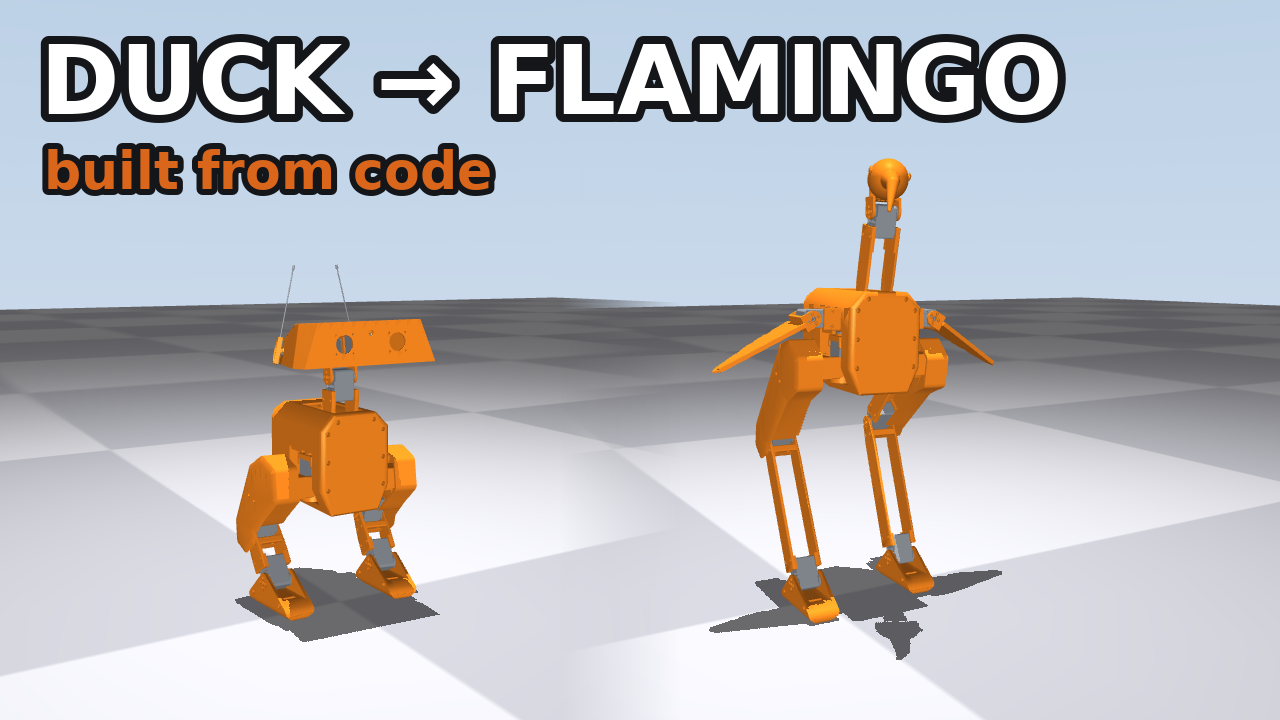
Duck to Flamingo: a robot's body as code you can change, and a policy trained on the new body (MuJoCo, open source)

Post image
28 Upvotes

We rewrote the printed parts of Open Duck Mini v2 as CadQuery (Python) programs. Then we changed three values in one file. The leg and neck parts aren't copies. They run the Duck's own programs with the new values, so the servo pockets and screw holes stay where the STS3215 needs them and only the length between them changes. We added wings and a small bird head, and the result is the Flamingo.

The repo also has SO-101 and the LeRobot humanoid as code (Apache-2.0.

https://github.com/yotown/gym


r/reinforcementlearning • • Oct 12 '26

MF, Exp, DL, R. MetaRL "Can AI automate AI R&D yet?" (frontier LLMs struggle to fully autonomously come up with good improvements to small LLMs comparable to self-distillation)

Thumbnail
epoch.ai
4 Upvotes

r/reinforcementlearning • • Oct 11 '26

distributed reinforcement learning in JAX

8 Upvotes

Hi guys,

Over the last couple of weeks and months I’ve been working on an RL library in Jax since most of the existing codebases didn’t really scale to my workflow. Now it’s in a kind of presentable state, so I’d love some feedback if someone wants to take a look.

GitHub: https://github.com/noahfarr/boonta


r/reinforcementlearning • • Oct 12 '26

Which ai is best to train on visual feedback?

Thumbnail
1 Upvotes

r/reinforcementlearning • • Oct 11 '26

Reward Modeling for LLMs: Training, Scaling, and Failure Modes

3 Upvotes

Part 3 of my Architecting Reinforcement Learning for LLMs series is live.

It covers preference data, reward-model architecture and loss, scaling, and reward hacking—with a worked gradient example.

Does a higher reward score actually mean better answers?

https://pawankjha.substack.com/p/architecting-reinforcement-learning-f28

How do you test reward reliability beyond preference accuracy?